
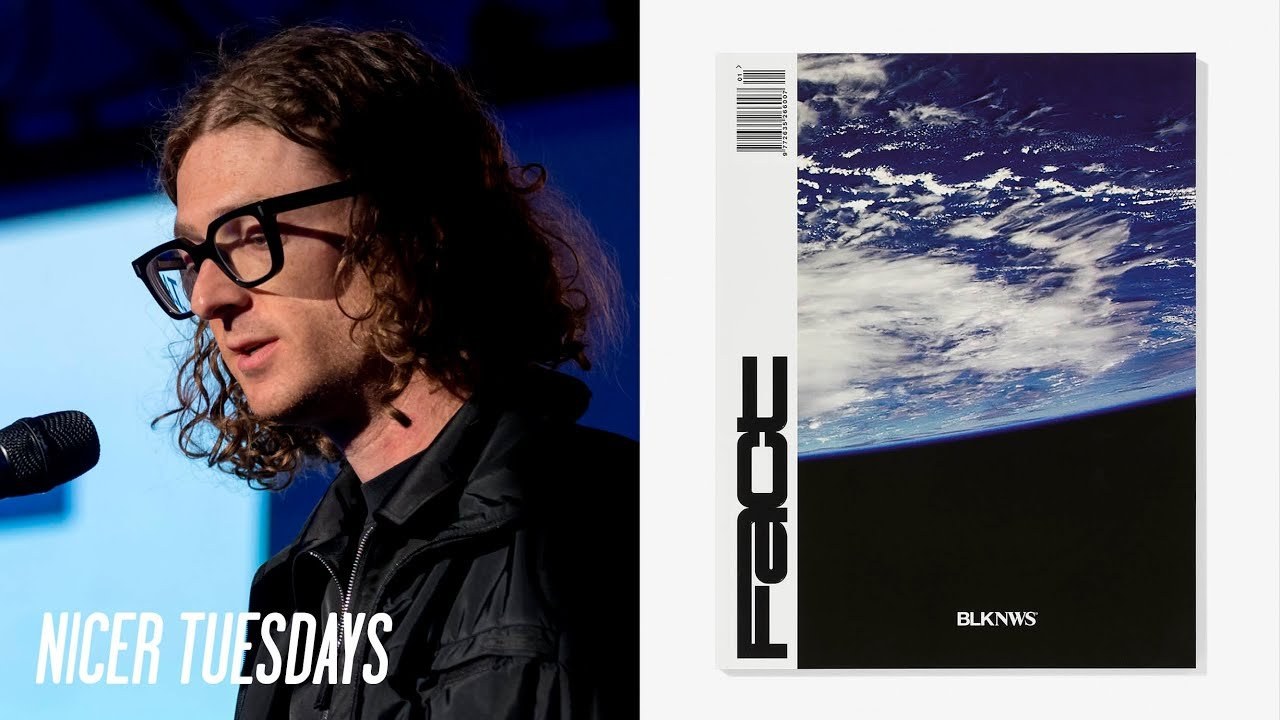
Zak Kyes is the founding designer of Zak Group, a London-based design office known for uniting various fields such as design, education, and music under a cohesive visual language. He is recognized for revitalizing the visual identity of Fact Magazine and creating new opportunities for underrepresented students in design.
Zak Group
What happens when you embrace an elastic visual language
“We got rid of hard and fast style guides to embrace an elastic visual language.”
Transcriptmay contain minor errors or formatting inconsistencies
Hello everyone thanks for the introduction matt a question that I often wonder is what is that group there have been many references and models that have kind of influenced us in terms of how we established ourselves as a studio and that kind of first reference I discovered as a teenager growing up in southern california growing up to swiss and american parents we had family friends that had also emigrated to california and one of those families was an older couple that had a house that was very kind of unlike ours it was a kind of glass and wooden box and they mainly had really great books and one day when I was at their house they introduced me to the work of a friend of theirs that settled in that town around the same time called herbert and as a teenager the name herbert beyer didn't mean anything to me.
But I later discovered that he trained at the bauhaus and later became the director of printing and advertising and his work was really fascinating to me because it managed it manages to kind of meld graphic design architecture and art in ways that I kind of hadn't seen before and and didn't know was possible the expansiveness of that practice was kind of influential to how we kind of set up zach group so tonight I'll try to give a few kind of quick answers to the question of what is that group first of all that group is an office we call ourselves an office because anything can happen in an office and we're not a graphic design studio or an agency or a consultancy but rather an office where work is done and value is created so the office is a physical space where we work with people that we see as guiding the trajectory of contemporary culture but it's also a place where a group of people can come together to to work. And we really believe that kind of good design is the result of a group of people working together and that can be even greater than the individuals that compose it what that means physically is that you know the office is a space with shelves a desk a good coffee machine but it's also a network space for collaboration zach group is also an idea as an office were the sum of all of our ideas and recently we were invited to design a poster for the welt format graphic design festival in switzerland and for that poster we wrote a 10-point manifesto that articulates some of the kind of underlying methodologies behind our work we invited the artist jim joe to collaborate with us on this poster jim joe his work deals with language and writing and graffiti and we gave you know this invitation to jim joe who had given a lecture himself called explanations mean nothing which was a kind of manifesto so we felt that we were on the same wavelength as him one of the points of our manifesto is called game the system and that refers to working within constraints to force unexpected outcomes and this was then adjusted by jim joe to read game the symbol so jim used tip x to kind of erase some of our letters and create new rules by adding drawn letters and and generate new meanings and so this relief to me also kind of sums up the work of a graphic designer which is to work with other people's words and images and to create new meaning zach group is also a platform as a design office we see ourselves as a platform that exists to create opportunities where they might not exist and this can really take many different forms and we see it as kind of our responsibility to initiate them one of the things that we recognize is that our industry needs to expand opportunities for communities that are currently underrepresented in our industry and in partnership with central st martins we launched a scholarship called the future forward scholarship to improve access to design education future forward provides full maintenance and support for a ba graphic design communication student for the three-year period of their degree and we're super excited to have awarded the first recipient this year.
And we hope to continue the scholarship next year. So if anyone here runs a studio you support our agenda please get in touch that group is also a t-shirt where also the things that we make and where as we were entering the first lockdown last year we noticed that cultural projects which are always the kind of the first to be cut in terms of budgets were starting to be cancelled and we created a campaign called culture is not cancelled that was a way for us to urge commissioners to not cancel culture and the work that everyone in this room does is is extremely urgent and important and that work is essentially to create culture and culture is what kind of gives meaning to to our world so you know.
This is if culture is what defines us it's really something that we must take care not to let get cancelled so kind of two years later.
I think this message is still extremely relevant we recently released an edition of t-shirts for cultures not cancelled that support pioneering cultural institution.
So the first run was done with chisenhail gallery which is just down the road from where we are tonight so purchases of this t-shirt support I think one of london's most interesting and important emerging contemporary art centers zach group is also an art school earlier this year nts radio reached out to us to invite us to create a guest episode that we called zach group art school and as a studio we work with writers that make architecture architects that make art and artists that make music.
So we were interested in the idea to create a radio show of artists that make music.
So we included a few different artists that we have worked with and that we know personally such as anna imhot this is her record faust ♪
and the later record sex was also an opportunity for us to include artists that we had never met but would have loved to one of those issues ♪
and then for the vocal introduction of the radio show we invited a collaborator of ours hanzo rick obrist to do the intro hi everyone welcome you're listening to art school by zac group on nts radio we're on nts radio hello everyone you're on nps radio and you're listening to art school by sacro zach group is a fact our interest in the intersection of art and music that was the subject of zac group art school led us to design the relaunched fact magazine there were a few references that formed our kind of point of departure one of those was eat which is experiments in art and technology which was a kind of 19 late 1960s kind of non-profit that married engineering and art and that kind of what was was our starting point to try to marry these disparate fields the brief for fact was how do you present sound and moving image in print which are formats that they're not necessarily suitable to and our approach was to think of the magazine as an exhibition in print and we were inspired by many earlier experiments and in creating the magazine we started with the identity first and we wanted with the identity to kind of marry the futuristic origins of music technology with a new wave of of audio and visual art practices so on one hand like early music technology and on the other hand we were interested in kind of earlier analog approaches that kind of ♪
predated or anticipated the digital so we were interested in the work of aldo novorese at the nebiolo foundation who famously created euro style based on microgama in the early 1960s and this was a type face that was very much analog but was inspired by new forms such as like the cathode ray tube from which it borrows its geometry so it has this this kind of jet age and television-like quality to it.
And so the logo that we eventually created has these extended letter forms and kind of contrasting counter spaces that are all fused together in a single graphic element in working on the design of the magazine itself we tried to create a very elastic visual language which responded to the different kind of inputs from artists that would be in the magazine so we kind of got rid of like hard and fast style guides and rules but had a few kind of simple ingredients that we would allow to kind of co-exist and create kind of clashes on the page these collisions resulted in kind of typographic compositions and then also in a number of features we tried to kind of directly address the idea of moving image and you can see that in spread such as holly blakely's who is a choreographer and here we tried to use the magazine's kind of built-in logic which is sequential it unfolds over time to create a kind of temporal dimension to the contribution. So that can be these kind of densely layered image layouts or in the case of cecilia bengalia a kind of layered approach to the images in other sections we kind of gave complete carte blanche to the two artists such as khalil joseph who included his project black news and was given kind of complete autonomy to create a so-called page work and the term page work is is a term borrowed from the curator hamza walker to describe artworks that are made for reproduction in books and magazines so these are just a few other features this is roman gavras and sirkin's film generation ♪
and issue 2 also coincides with an exhibition. That's currently on view for the next few weeks I believe at 180 this round called lux so this first issue contains five different covers object blue gabriel moses lux anais and curl and it's out now thank you so much [Applause]
[Applause]
[Applause]
Latest Talks
-
Murugiah
Why you should reject the formula and make art about things you love
Watch -
Amber Weaver
How does contemporary type design translate into the wider world?
Watch -
Delali Ayivi
How does photography give us the right to imagine our futures?
Watch -
Will Anderson and Ainslie Henderson
Bringing stop motion sorcery to BBC’s Small Prophets
Watch -
Ollie Babajide Tikare
The importance of not flattening the complexity of observation
Watch -
Marina Willer
Design thrives when you find poetry in the simple things
Watch