
Marina Willer
Design thrives when you find poetry in the simple things
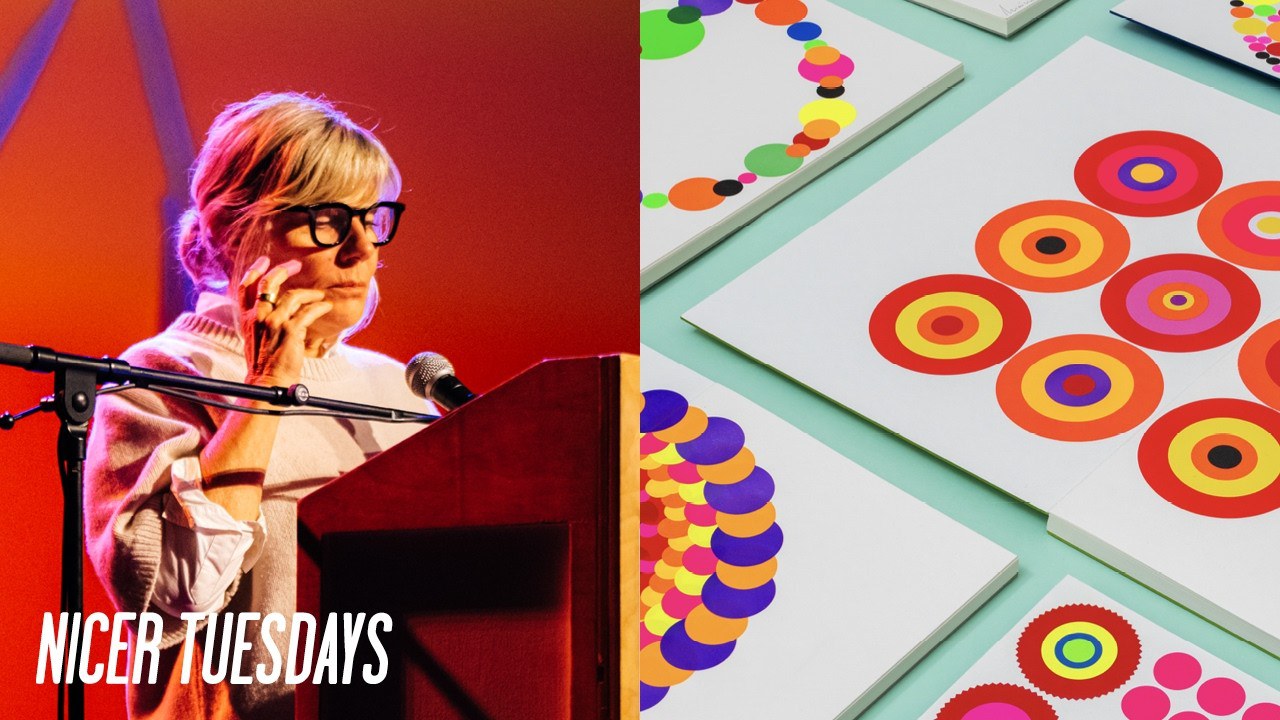
“What is difficult is to create work that is really genuine, whether it's with or without technology.”
Hello everyone. Uh thank you so much. It's nice that for inviting me. This is wonderful. Also, thanks everyone for being here. Um I'm really impressed uh with the three talks that I've seen tonight and um I hope I don't disappoint after that. Uh it was um it was all really honest and beautiful and sincere. Uh also very articulate. I didn't write my talk. I'm just going to speak from the heart, so I hope it's okay.
I think the title is because we're going through these very peculiar times as mentioned a minute ago uh where we all, you know, besides all the wars and the horrible things that are happening, also the the fear of AI has been overwhelming for many people, many people losing jobs, and um in general this going down, I think. Uh I think we, you know, I feel AI is becoming more and more powerful what we do and we embrace it, but we also are very keen not to succumb uh to AI. We feel AI is a tool uh and as designers, I I am a mixture of designer and graphic artist and also make films occasionally.
I am really more and more keen that we use many different ways of working and that we use AI as a tool and uh I do feel that with AI in our field of design, uh there's a a very quick temptation to do work that looks like other work. It's very easy to brief AI to do work that looks like someone else's or like another brand.
What is difficult is to create work that is really genuine, whether it's with or without technology. And we try more and more to diversify the ways that we work to use quite unusual methods, so that helps, hopefully, to make things that are still authentic. Um I'll show a very just some uh um uh uh some snippets of some of our work.
Everything that I show here is work of my team. Nothing that I do is alone. Uh some of my team are here and I adore them and we are very collaborative. Also, a very dear friend who used to be in our team and is big part of this these some of these projects. He's here, so I'm very happy to to to share this while they're here with me.
So, talking a little bit about these methods, um I think like I said I'm really keen to diversify the methods of work, so that every project looks different to the other. And I do feel that we collect methods as well that sometimes don't work in one project and then we explore those further and they become something different in another project. Uh this is my team, although some of them are couple of them are not around anymore and there's changes, but we need a new picture, so just wanted to to acknowledge because I I think they are everything that we do, like I said,
is is is us together. Um and um since I started uh at college, I've always and I'm much older than everyone else who spoke here before, but I've always been trying to find uh more experimental ways of of doing work. Uh so, I'll show a couple of very quick things that I did at time of college, so this is like 30 years ago to show my age.
Um >> [music] [music] [music] [screaming] [singing and music] [music] [music] >> So, this the way it worked at the time, I was making those in my own initiative and then I managed to sell them to Sorry. To MTV and and VH1. So, there's one more There was a whole series which was about finding music and things. This was done many years before American Beauty, if anyone saw that bag flying, just so you know, we didn't kind of we didn't follow.
>> [music] [music] [music] [music] [music] [music] [music] >> Uh just to show I think what I was talking about that I am I'm very keen and and with the team to find different methods and so, Red Trees at the top is a feature film which I made um with a bunch of wonderful people and um it's on Curzon. It used to be on Netflix. So, um there are different things that I do through work. I'm also obsessed with stickers and you see a little bit more.
Uh we did a film um we did a brand um for Grow to Know which is a charity that supports the community of Grenfell. So, we used uh leaves and flowers from the area of the disaster and we did through cyanotype by printing uh so, you're directly using the elements from the area to create the the identity. We also uh did a lot of rubber rub rub downs of manhole covers and created the series of prints that you saw in the little sizzle, which is now part of the V&A collection. So, many, many different ways of And it's also makes the work much more fun. Uh so, I'll show a quick and then I stop showing any sort
of videos, but I did a master class and we just chopped uh a small part of it uh which talks about these different methods. Uh and I'll I'll just play a little bit of it. And this is again when we were doing a title sequence for Roald Dahl, we made through shadows and filming objects um and creating things in ways that you create a lot of accidents, you film through light and uh Roald Dahl is famous for also having a dark side, as you probably know, and even they admitted that. So, in the brief, there was something about using light and dark.
Um so, I'll play a a little bit of the master class. This looks a bit mad. >> [music] >> There's a lot of explorations that we do without [music] much of a purpose and then later they come to be really relevant. It's if your mind had a library of ideas and images and things. >> [music] >> My role as a designer is to create the image [music] for a brand and that can be any aspect of it, but it's normally the logo and the identity.
So, Sometimes I find it really magical to create it mechanically without any control. So, if you put the pen and move very gently, you can face really challenging projects and still sleep at night because you know that if you go through a method of really distilling and understanding the problem and bringing the creativity and methods of working and working together, you will find a solution and it will it will be strong.
Many things keep me inspired. Having children has inspired me a lot. Also, looking at very trivial things and everyday objects. You almost find poetry in very simple things. The more curious you are, the more you look around the world, the more unique your work will be. What I really advise young designers to do >> [music] >> is to keep curiosity, keep looking for ideas in unusual places [music] and not just try to be like anybody else. We all have a story and a history [music] and from that story we can bring our own identities into [music] the work that we create and make it unique.
Yes, so I I really think that creativity is a way of life and during COVID I found myself, as we all did, you know, struggling with what do you do with your mind and your time and all of your free time that you're not working and I started to do a lot more of my own creative exercises from painting to building to doing a lot with my children. We were doing constructions of you know, cities with the things from the kitchen and they I was kind of encouraging them to do music and drawing whilst and that influenced me a lot and I started to do a lot more doodling or I go to the park, collect branches and paint and
so I think a whole other side of me came out of that I really enjoy now and it's become a obsessive, you know, you want to be doing things all the time if even when you're on holidays, in the evening and the desk looks like this. This was a little, you know, the boys were writing books with typewriters and all of these, by the way, when they grow up, a lot of it is lost and they don't do that anymore, but doodling has always been a big part of me as a meditation and a way of staying present. I also think you find ideas if you're present and if you're looking around and you're noticing things and if
you're just busy looking at the phone and social media, it kills the appetite to find ideas. So, all of that in a way informs my work when I'm doing brands like with the team like Naturalis Museum or any of the bigger projects, they get influenced by that and especially doodling led to using more and more stickers and these things I've done and a lot with my value was here on the front row. We were doing these as many inventions we could do just with a coat hanger. So, using very mundane things to create to create ideas and looking for things and colors in the real world and photographing, you know,
where one house ends and another one begins and especially when you travel as other wonderful people here said tonight, I think you collect all of these things and you form your palette. I also use document how my boys would I've got twins and how do they would wake up. So, I've got hundreds of pictures of them in the morning and how lovely it is when you can't control the hair. It's the same with anything in life. The less you control, the more beautiful things get and then pebbles and all of that [clears throat] and all of these ended up as projects and and for example, this is when I was asked to
do a series of menus for the Royal Designer of the Industry, which I was made a few years ago. It's a very fancy ceremony and we with the team we made each one by hand with stickers. So, it became a project and many things like the branches became a project for pride and we made a whole forest in a Ali Capellino shop. So, the things become something if you always have the practice of creativity and with the stickers particularly, I started to do more and more on the streets and then that obsession, it really is an obsession, um, became an idea to do a partnership with Piff, which is these beautiful
sketchbooks and to do something that would sell and the money could go to Choose Love, which is a wonderful charity that supports children especially in Gaza. So, we made I made 50 of those and then a few 20 more covers and they're each individual and they became an exhibition at the Design Museum and my team designed all of the marketing and the exhibition itself and how it it's set in the museum and they these are some of the the artworks that I made. So, now they've all gone to a good home hopefully and and the the money can support the cause.
So, it's also a nice way to use your time and these things become other things and I think if you keep the practice of making stuff, it becomes almost an addiction and it's lovely and it's entertaining, but it also inspire my work as a designer and I really encourage people finding whatever their passion is and I think tonight there were so many beautiful examples before my talk and in a way I feel that you know, the limitation of of lockdown made us work harder with our minds to do things and also to me that's a parallel.
I've got really insanely busy mind. I'm running in five tracks or 10 at the same time. My team knows this and I can't stop it and it can go quite crazy. So, doing things that you know, turn your madness into a good habit and using it I think we all have our weaknesses and our you know, uniqueness and and you can turn that into your secret power to create new ideas and to find your own voice.
So, I think it's always good to and there's so many stories and I don't have any time to to go on about this, but I think using our most vulnerable side to create new ideas is one of the the strengths and also is a way to channel stuff that otherwise you just be going a bit crazy. So, I always believe in that and and I think in many many times when we feel a bit low and we're not feeling creative are the times that you find your most powerful ideas.
Thank you very much.
Latest Talks
-
Murugiah
Why you should reject the formula and make art about things you love
Watch -
Amber Weaver
How does contemporary type design translate into the wider world?
Watch -
Delali Ayivi
How does photography give us the right to imagine our futures?
Watch -
Will Anderson and Ainslie Henderson
Bringing stop motion sorcery to BBC’s Small Prophets
Watch -
Ollie Babajide Tikare
The importance of not flattening the complexity of observation
Watch -
Lizzy Stewart
The hundreds of drawings and writing-on-a-whim that goes into comic novels
Watch