
Murugiah
Why you should reject the formula and make art about things you love
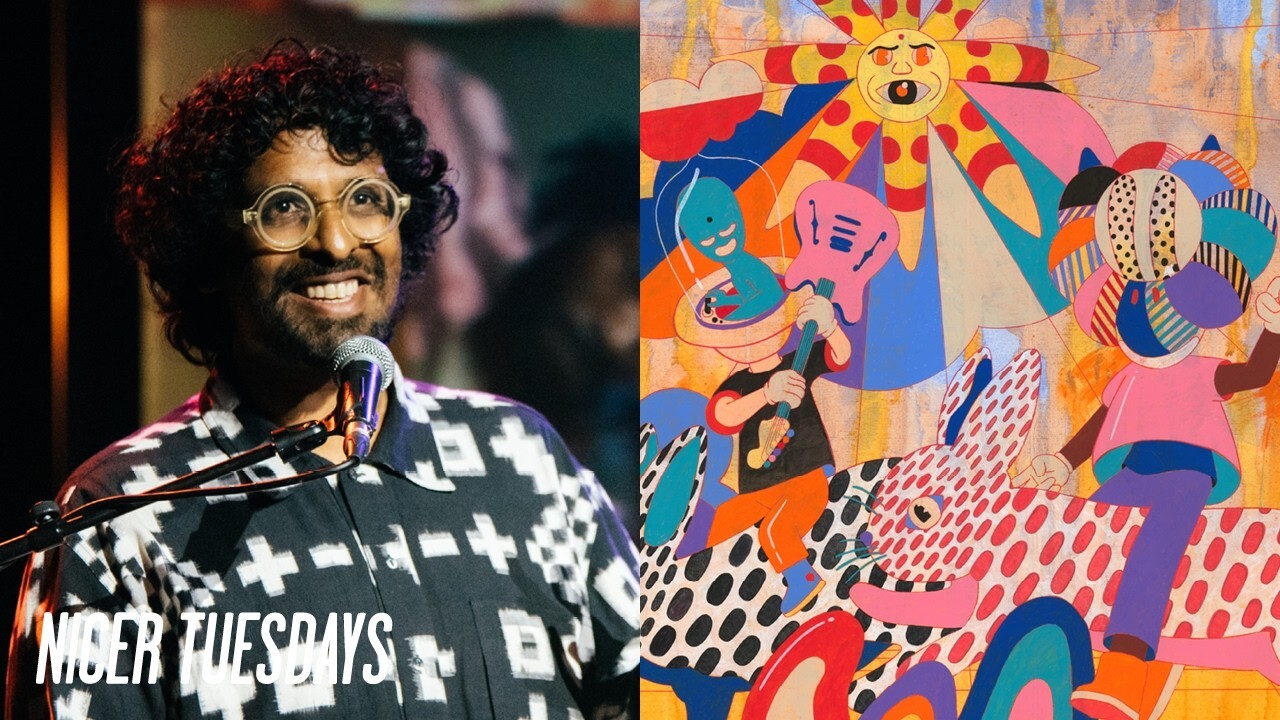
“I asked my parents if I could be an artist and they said no. They were like, 'Why don't you do something?' They just wanted me to do well, and all they knew was medicine, engineering, law.”
[applause] Hi everybody. How's it going? Doing good. Did anyone go to that Dev Patel lookalike competition on the weekend? I mean, come on. I didn't go, but I think I could have won it. Lesson one, you miss 100% of the chances you don't take. Okay, I'm just going to play my shiel [music] [music] [music] [music] [music] [music] [music] Okay. So, I could show you all the finished lovely projects in great detail someday, but it is not this day.
Today we need to get to the reason, the why I do what I do, or as the Meravenian from the Matrix would say, cause and effect. In short, parent issues. They didn't try and kill me. They were just South Asian, which means they just love me very much, but they just go a weird way about showing it. You know, a healthy dose of feeling alone.
discovering that books, records, and films matter and discovering art and ultimately never being satisfied due to an unhealthy need for approval and attention. So, thank you. In more detail, obligatory baby photo fashion fashionista. I'm just uh my brother and me. me looking very depressed that I parents dressed us up the same.
The creative mischief that my brother and I could have gotten up to. My goodness, he ended up becoming a doctor but also my biggest supporter. Uh me as a child, very mischievous, playful, and my first year on this planet, I'm going way back, guys. Uh, [laughter] my first year on this planet happened to coincide with some of the best things in popular culture. So, a good vintage. Uh, I am.
My childhood was filled with all of this stuff. Uh, Trapoor, Pokemon, Disney classics, the X-Men cartoons, video games of old. And my teenage years were filled with this stuff. really showing my age here, but I gravit I was forged in the fires of American pop punk, guys. Like the emotions that I feel.
I got a bit older and I realized I was gravitating towards other characters in pop culture that were senses that were like really in touch with their feelings. And there's contemporary versions of those characters today. Obviously, we all just have to be like Paddington. During my uh late school years kind of 16 17 I kind of gravitated towards art and design and my art teacher was like you're really good at this like you should do this for a career. So I I asked my parents um if I could be an artist and they said no.
They were like, "Why don't you do something?" You know, they're immigrant parents. They didn't really, they just wanted me to do well, and all they knew was medicine, engineering, law. They said, "Why don't you do something that's kind of science-based, that's like, you know, still arty, but has a nine-to-five job." So, we settled on architecture.
And I trained as an architect in a style of architecture that was interested in sensitive architecture. There's that word sensitive again. But um seven years later with some uh partying in between, I became an architect. And I thought I would feel like this, but in reality, I felt like this. I actually lost all of my hair from stress.
Giant tennis ball- sized holes of hair gone. I've got it all back now. So thankfully and um I really just felt broken. I was like I I don't think I should be doing this job. So I discovered art again. And I had saved enough money from my uh last year of working to take a full year off and just try to be an illustrator, a creative of some kind. And I was taking on projects of my own choosing. things like I decided to make Quentyn Tarantino's screenplay covers in the style of Penguin Classics or I would do drawings in a kind of where's Wally style or pointalism. I would even do brochures for my friend's jazz cafe. I would take anything on just
to get some kind of experience. Um that didn't last very long. [laughter] I needed some realworld experience in an office illustrating, designing, being a kind of graphic designer and illustrator. So, uh, I went to Scribbler Cards for a year where I got to learn about illustrating for customers, designing things very specific that had an audience. And I was doing cards, packaging design, uh, web graphics for the websites. And I did that for a year.
And then I decided to go to Leyon restaurants as an in-house graphic designer where I learned about typography and menu design and packaging design. And at the end of those two years, I realized something very important. But I never want to work for anybody ever again. While this was going on in the evenings and weekends, I was perfecting my illustration style. And I was getting to a point where this style was becoming quite um cohesive, but it still didn't really feel like it was authentic to me.
It felt like anybody could do this work. And this all culminated with um a project called Where's the Dude? For a film fan like myself, a dream project where I got to illustrate scenes from my favorite movies and hide the dude from the big Labowski in them. But this was a style that I was that wasn't authentically mine. So I actually struggled through this project. I so many details it broke me. It was just, you know, detail drawing after detail drawing. And by the end of that style, I was completely broke and I was like, I don't think I should do this job because this doesn't this should be a dream project for anybody. But I didn't feel
comfortable doing it. I didn't feel happy doing it. And then I went to see a pair of movies. I was invited by a friend of mine to a double bill of Alejandro Hodoroski's movies, The Holy Mountain and Eltopo. If you don't know anything about these films, they are movies about uh spiritual journeys through kind of psychedelic worlds um both in the mind and the soul.
So this is then what my work started look like and I was doing kind of Stranger Things, Spiderverse, like Nike things like these are all personal projects again picking things that I was into and illustrating them in a style. It didn't feel authentic again because I was just picking work that I thought looked cool. I wasn't picking work that felt that came from my heart, from my soul.
And then the pandemic hit. So, I didn't really know what to do. I was honestly at this point I was like in tears in my studio. Like I was like, "This is not going well. I care so much about this job, about being a creative person. I need to I want to do this right." And um I spoke to an illustrator friend of mine. I said, "What am I good at? What am I bad at?" He said, "You're really good at putting a lot of color on a page. You're really good at uh putting a lot of detail on a page." I said, "Loads of people can do that." And he said, "You're brown." He's a brown guy, too, so he's allowed to say it. He said, "Make work about being brown and put all of that other stuff in there, too. The busy compositions, the bright colors." So I went back to my childhood.
I went through some of the aesthetical influences I picked up along the way and I kind of merged them with my heritage which is uh my parents are from Sri Lanka. Even though I was born and raised in the UK, I have this calling from another country. And I just smashed them all together. I came up with a bit of a formula even though there is no formula for art.
This is all [ __ ] So just this is just my [ __ ] Okay, pick a thing you love. Like for my instance, I wanted to make another thing about a thing that I love, the Silver Surfer and Galactis. But instead of just making a drawing about the Silver Surfer and Galactis, times it by your Sri Lankan heritage and divide it by a thing you an aesthetical influence you picked up along the way and see what comes out of that. And that's where you get this piece of work. There's still a kind of giant head.
There's still a surfer character, but it's Asian. I did this during the pandemic every week. I made a new piece of work in this process every single week. I wanted to get as much work as that I could done in this time. This is a piece called Masquerade and it's about what if a fight were to break out at a masquerade party? What would that look like? I was just coming up with random briefs through this kind of loose formula over and over again. This uh piece here is that um alchemist character in in the surfer drawing but from above casting an incantation me at an exhibition and that turned into a career. But this
work that I'm showing you on this slide, it is the result of two years of the pandemic, but several years of getting things wrong, of trying things out, of of pushing, of keeping developing and just like really wanting to get to a place of authenticity. It started out with editorial work. Then it got got to gig posters, brand collabs, public art sculptures.
It was I finally felt comfortable. I finally did it. Okay. Case studies. Mr. Jones watches is a recent collaboration. They make these beautiful watches that don't really tell you the time, but they can tell you the time if you know how to use them. Uh, I decided to do a piece called Daydreamer. And I I developed a character called Muru. And I wanted to have Mu floating and daydreaming in and amongst the clouds. And we developed this over a series of of illustrations.
And we went through and we did some prototyping and eventually we got to a place that we were very happy with. All we had to do was just remove the black lines and turn them into colorful ones and it was done. And this is the watch at the end. And that's how it moves around. These are some sexy watch shots, aren't they? [snorts] This is the process of which the watch was made. They're made on these kind of layered acetone discs and they're kind of Yeah. layered up so you create a lovely depth of field there, the back and the watch case as well. And we're doing a black and white edition in time for the Quentyn Blake Center show. By the way, bit of plugging there. [gasps] Okay. Apple.
In the summer of last year, I did a workshop with Apple. I contacted Apple um and I asked if I could do a um workshop where I could talk about my work a little bit and then come up with a uh activity that we could do at the end of the talk. And we did a exquisite corpse workshop. If you don't know, it's you draw the head, you fold the paper, you draw the should hand it to your neighbor shoulders, etc., etc. But we did it on iPads and everyone had a section and then we threw them up on the big screen and and we get this nightmarish feel. Um so later that year after that talk Apple contacted me and they said can you design three distinct Christmas trees to
inspire workshop participants whose whoever um takes a part in the workshop their trees will go up on battery power station. So I designed three trees and they used them in fun ways. They kind of used them to promote the project. And throughout this process, I was like, "Guys, um, can I can my trees go up on the building, please?" And they were like, "Yeah, yeah, yeah, we'll we'll think about it. We'll think about it." And they use them a lot. They've really used them to promote the actual project. And I was like, "Guys, I really want my trees up on this building." Um, and they were like, "Of course." Um, so they ended up on the side of the building.
And this is something I'd never honestly I never would have expected, but I asked I asked for this to go up there. So, lesson two, ask for things please. Did get some horrible racist comments though and like pretty weird ones like congratulations on the weight loss weight loss Ramish Rang and Nathan. I mean like we don't even look alike. I look like Dev Patel.
But this was pretty horrible. This is a really bad one. So, I decided to rhyme. Um, I'll go through. What is this grotesque creature? A happy dancing tree with lovely features. I was talking about you. Get the [ __ ] out of my country. I'll counter with kindness. There's goodwill of plenty. Save it for India. Your home needs that more than mine does. Let's dance and sing in the sunshine cuz uh he gave up after that.
I make movie posters. I make these licensed alternative screen printed film posters. And for me, this is an opportunity to get away from heritage, from depression, from mental health, from all of that stuff and just the thematics of my work and just go into the aesthetics, the busy compositions, the bright colors, the surreal compositions. Like, have fun. These are alternative film posters. So, I'm not selling the movie. I'm actually celebrating it in my own unique way.
[sighs] Deny of Dune, Kubric movies. Like, you can do them all in weird styles. You don't have to adhere to the films. Sometimes they kind of work really well in this case of My Neighbor Touro. And sometimes the film's aesthetics take over like Wes Anderson's Grand Budapest Hotel. And sometimes they just really fit perfectly. Okay. Who am I?
My personal work is kind of uh very as I mentioned before it's inspired by a sense of identity or lack thereof not knowing where you come from who you are but because of my aesthetical influences they present themselves in these lush colorful kind of busy compositional ways but they can take the form of other things too. This is a public art sculpture um in Greenwich called Rangoli Mirid Cosmos and it is a literal representation of my jewel identity.
The 3D colorful contemporary forms represent my western upbringing and the traditional mandala patterns around the edge represent my Sri Lankan heritage. So I'm in every project I do now I'm trying to include some kind of like personal story or personal representation in the work. My personal work now is taking on much darker and deeper meanings. Still presented in this colorful way, but I'm tapping into the thematics a bit more.
I'm talking about the struggles of being an artist or outsider pressure building to a point of kind of like explosion. How do I make sense of all this stuff, guys? I don't really know. I have an exhibition. Of course, the Quentyn Blake Center is opening one month from today and it opens. It looks beautiful. It's going to be amazing. We've been working so hard on it. And it opens with these three shows. Quentyn Blake performance, Queer Comics, and Muragaya Ever Feel Like. I'm so excited.
Okay, I'm just going to leave you with one one last thing. When Bong Junho accepted his Oscar for Parasite, he said, "The most personal is the most creative." And then he pointed to Martin Scorsesi and said, "Martin Scorsesi gave me that advice." And then the whole audience stood up and clapped for Scorsesi because it's just amazing that two different filmmakers from two very different parts of the world have the same ethos yet produce very different things. So, I'll leave that with you. Thank you.
[applause]
Latest Talks
-
Amber Weaver
How does contemporary type design translate into the wider world?
Watch -
Delali Ayivi
How does photography give us the right to imagine our futures?
Watch -
Will Anderson and Ainslie Henderson
Bringing stop motion sorcery to BBC’s Small Prophets
Watch -
Ollie Babajide Tikare
The importance of not flattening the complexity of observation
Watch -
Marina Willer
Design thrives when you find poetry in the simple things
Watch -
Lizzy Stewart
The hundreds of drawings and writing-on-a-whim that goes into comic novels
Watch