
Will Anderson and Ainslie Henderson
Bringing stop motion sorcery to BBC’s Small Prophets
“If you model everything to real world dimensions, then things like the lighting and the camera and the depth of field don't give you any surprises because it's kind of based on reality.”
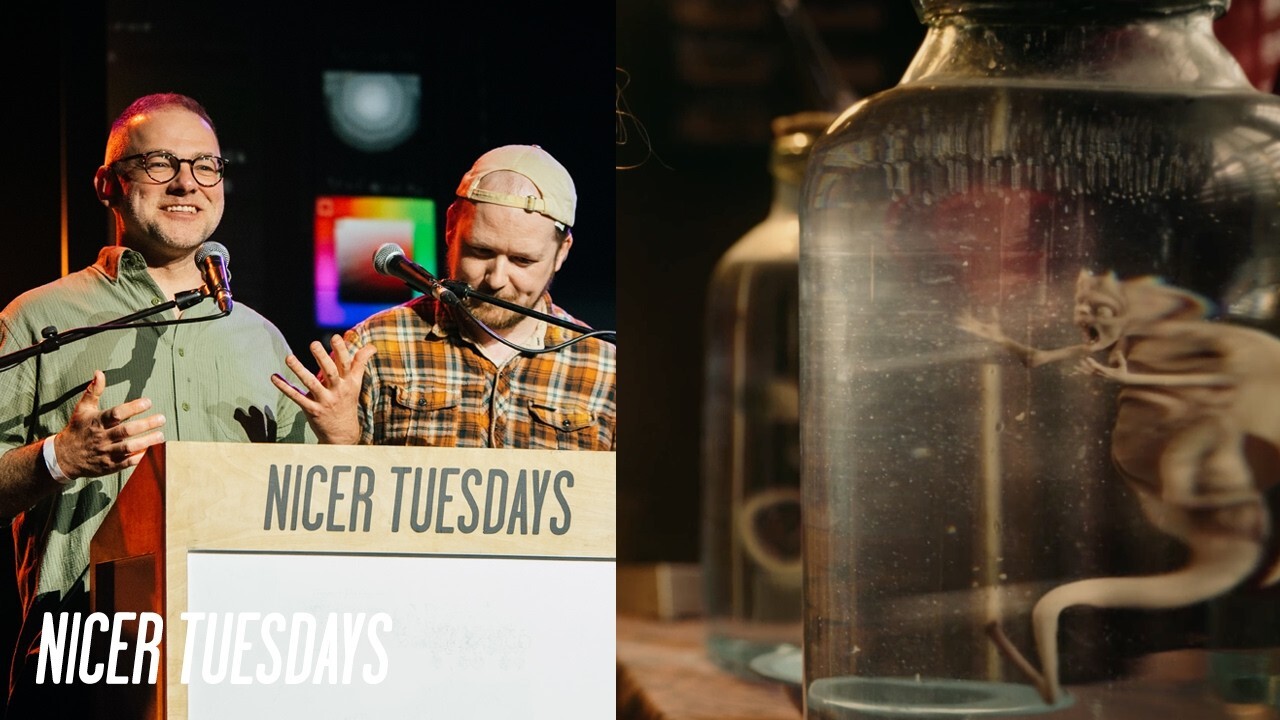
Hey, I'm Will and uh this is Ensley. Hello. And uh we're animators. We're both animators from Scotland. They let us out for one night only. And we've been making animation separately and together for the last 15 years. And has it flown by? Never a dull moment or an angry word. Yeah. You've really enjoyed it though, right?
Absolutely. Just bliss. Creative harmony and bliss. Nice. Well said. Um I deal with a lot more with digital animation. So I kind of came in through uh 2D stuff and then I moved into CG and Angley's a stopotion animator. And over the years what we've tried to do when working together is mix our styles. So we would mix stop motion with CG or whatever live action. and uh could go on and on about all these other things that you can see flashing behind us. Uh but we're not going to do that.
We're going to talk about Small Profits, which is the new show by McKenzie Krook, which I'm sure you've all heard of, the wonderful Mackenzie Krook. He uh wrote and directed Detectorrists Warzle. He's an actor. You know who he is. Why am I introducing him? Um he's not here. He's not here. No. But um we uh were animation directors on this show and I urge you if you haven't seen it before, as soon as you get home, it's on the eye player in full. Go and watch it. And if you have already seen it, watch it again because viewing figures matter. But um how did how did this happen though?
Maybe you can explain these wonderful people. Guess what? Uh I can I've known McKenzie for a long time. He um voiced a short film that I made years ago called I Am Tom Moody. Him and his son June voiced this. Um and every so often I'd meet McKenzie and we'd bandandy around the idea of doing something else together.
And then late 2022, I went to his house and down the bottom of his his his uh garden, he's got this shed where he writes award-winning television series and does craft projects. Um, I'm not joking about that. He uh and I walked in and hanging up in the corner of the room was this weird creature that he'd made out of femo. I was like, "What's that?"
And he said, "It's a homunculus, which turns out is a small artificial human or human-like being which was popularized in the 16th century by alchemists. Um, and he came across it in a book called Clea by Lawrence Derell. And in this book, this particular manifestation of homunculus can prophesize the future, which is what gave rise to this.
When he told me about these creatures in the jars, immediately it sounded like a project that should be made in stop motion, but also a project that would take some pretty nifty compositing to make the stop motion sit convincingly in the jars. So, I got Will involved. The two of us took the job on and started making some tests. These are some of the early um experiments that we did. These first creatures were just made out of plasterine.
And this is the final result that we came up with. This was done in 2023 in that shed of McKenzie's. me and Will. Um, Pierce Quigley, who's the actor who plays Michael, the DP, Nick Brown, and McKenzie got together and did this little test. Uh, these are some of the original illustrations that McKenzie made. He's an illustrator in his own right and a really brilliant artist. Um, as he was finishing the script, we realized that the puppet making job in this project was going to be vast and we really wanted to do these illustrations justice. So, we reached out to McKinnon and Saunders. We worked with a woman called Sarah, um, whose second name I've forgotten.
Sarah Mock. I knew you'd remember. Good lad. That's why we're both here. Uh McKinnon and Saunders make all the puppets for big stop motion feature films. Uh Pinocchio, all Wes Anderson stuff. And you can see the video behind me is some of the incredible craft that McKinnon and Saunders brought to making the puppets for the project. Uh in particular, there was an artist called Glenn Southern who did all the design project, the designing of the homunculus.
And here's the little creatures that arrived in my studio in Northland. uh last summer where I spent every day animating them and then sending stills to Will to composite it all together. So if you're going to zoom out of the show and see the work that we made, you're going to see something a little like this. So we were all in the shed making lots of lovely composits with glass and optics. And to do that was quite a kind of nice process. I'm a blend I'm part of the Blender cult. I um I'm a bit obsessed. So what we did instead of storyboarding, we were really close. They were really close, you know, no surprises when we were kind of making this when when we were um uh instead of drawing it and storyboarding it, we
decided that we would do previs or previsualization. So essentially model everything in uh Blender and then being able to move the cameras so that we can work out and block out our shots. And that kind of uh looks a bit like this. We make basically over the course, it was only a few hours really, we make uh the shed that's all to scale. And that's I think where a lot of maybe 3D, you know, work kind of goes wrong. And it's something I maybe learned a little too late is that if you model everything to real world dimensions, then things like the lighting and the camera and the depth of field don't give you any surprises because it's kind of based on
reality. So when it comes to actually putting the you know putting these uh cameras in place and depth of field and moving them you're it's very very accurate toward like what you're going to see in the real world. So this was like this might be at the end of episode two when uh Pierce um Michael walks in and maybe discovers something's going on in the jar. And the final shot here. So you can see there, you know, not not one to one, but we were we were made aware very quickly and, you know, through using Blender to kind of work out how we would like invisage these shots. And it also helped us kind of plan how we would do everything. [gasps] We
would work I'm I'm Edinburgh, so I'm I'm But you're actually in Northland, so we would kind of work remotely, but occasionally meet up. And we're like, this is us hard at work at our studio. were excellent obviously at photo shoots. I'm sticking my stomach out there. We're very flattering photos of us all, aren't there? Well, there's loads of flattering photos we can skip through. Maybe this video in particular captures my baldness beautifully. If you see the the way the light hits the top of my head there, it's really flattering. This was a reference video done for another animator called Steve War who came in at the end when we were about to miss the deadline.
This is a really cool little trick that we learned from McKinnon and Saunders on how to solve the camera when we were shooting the live action to then make sure that the camera was pointing at the puppets exactly the same angle. We would just have this three-dimensional red cube that we would position in every shot so that we could then line things up.
Oh, you missed that. I know. I missed that. Everyone on the shoot in the shoot had no idea what we were doing with these cubes. Like even toward the end, they're like, "We don't know what the cubes are for." But we were pretty pretty certain on it. And then, as you can see here, this is the final shot all coming together, but there's a cape on it. Why is How's there a cape on it? So, I did that bit. Um, McKinnon and Saunders would make these amazing puppets, but things like clothing were, you know, would mean that Angley would have been stuck or we'd still be animating actually probably right now. Um, we
wouldn't have delivered it in time. So, I took it on to um rig those things and make that in CG and then stick them in after. So, but uh again, Blender obsessed. O started to do it with simulations and simulation nodes in a sort of uh using the using the models that Glenn Southern had modeled when we were signing off the design process along the way. So it's a nice sort of bookmarking of things. You know, things that were used to uh sculpt before they were made in the real world were still used in the end of the process. And that's really lovely because I'm a geek.
I got really into it. And you can add collisions and you can put them in real jars and you can get them knocking over the edges of the jar and no one will ever ever see it. But this is the only opportunity I can ever have to tell you all. So I'm just doing He will mention he likes Blender. I did that. He mentioned Yeah, I did say that. Yeah. Yeah. Uh so in terms of the whole process, this kind of sums it up. We get we solve the camera and Ensley will shoot it on green screen or chroma referred to as chroma keying. I remove it and we would just uh make a transparent background. Then I would add the CG elements that I would track to to Aninsley's animation to get the cape and the clothing in Blender.
Yep. They know that. And then I would stick it all together like this. And we actually puppeteered the certain shots like this here. We had little stick. I think you did that. Had little sticks so that we could, you know, uh stick it all together. So, it's a real mix of like lots of processes, which is just a bit of a joy to kind of make. This is kind of a lovely shot, too. This shot is just um this really ums it all up. This actual shot in the show is about 40 seconds, which is madness for stop motion. I think you were making it for a week, 5 days.
Five five days to do one shot. I mean, it's longer than this, but um it it really kind of this shot, we love showing off this shot because it really sums up the show really. It it's brought all the elements together. Uh the actor who's acting in front of a jar, uh Angley stop motion and then me adding the sort of uh warping effects and a bit of corrupt chromatic aberration at the edges to give this warping jar effect. Little bits of food coming out. We should have really put the whole shot in, but you know, we're not organized. We haven't got time really, and we're just rushing through this. But yeah, I I really think the in in terms of the co-direction, it's the thing I love about it is that the work is better because we're collaborating.
So like it's really greater of the sum of its parts. Like Ensley's animation, you know, if I were just to make this in CG, it would lose something. And McKenzie was always very clear about that. We wanted this handmade look, but it's a combination of these things that made it a real joy to uh direct the animation together. And that's kind of how you're going to say something. I was going to say it also gave us the opportunity to dance together in the studio.
So, thanks for having us. It was lovely talking to you. Thank you very much. Cheers.
Latest Talks
-
Murugiah
Why you should reject the formula and make art about things you love
Watch -
Amber Weaver
How does contemporary type design translate into the wider world?
Watch -
Delali Ayivi
How does photography give us the right to imagine our futures?
Watch -
Ollie Babajide Tikare
The importance of not flattening the complexity of observation
Watch -
Marina Willer
Design thrives when you find poetry in the simple things
Watch -
Lizzy Stewart
The hundreds of drawings and writing-on-a-whim that goes into comic novels
Watch