
Ollie Babajide Tikare
The importance of not flattening the complexity of observation
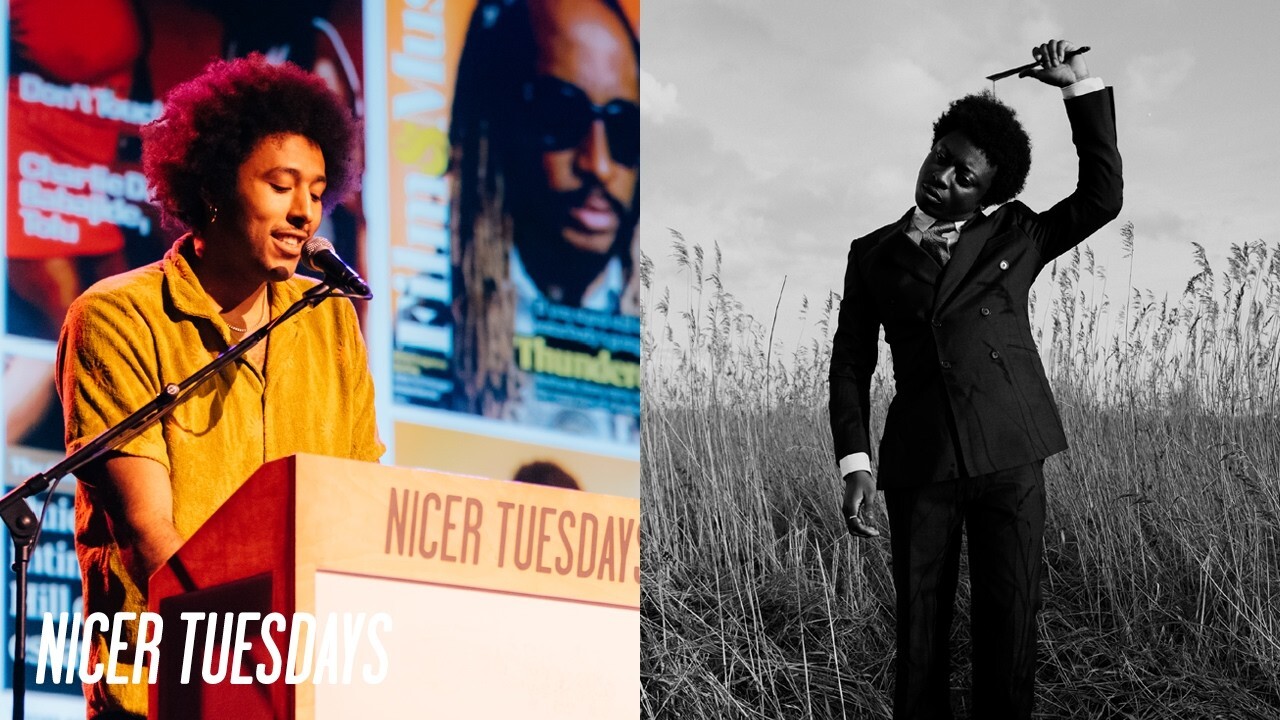
“I'm not trying to flatten my interests into one neat identity. They're very interwoven and I'm trying to hold the tension between them, between being inside something and just outside it, between observing and participating.”
Good evening everyone. Thank you so much for coming and particularly the Arsenal fans in the room who've decided to spend the evening here. So, watching the Champions League. Um, I've watched these talks for a while. So, uh, to be speaking here myself, it's a bit surreal. Um, I've been asked to speak about my book and ongoing project called Echo, which is about Lagos in Nigeria, which came out uh with guest editions last October. I think to fully understand the work though um it makes sense to look at it in terms of my wider practice. I do quite a lot of different things, photography, art direction, writing,
DJing, uh radio, and event curation. It's nice that actually described me as a multi-hyphenate creative, which sounds cool, but it's also tiny bit exhausting. I think people are a bit suspicious of the multihyphenate. Uh I think artists are encouraged to find their lane, do their thing, just do one thing over and over again because it's easier to categorize. Uh so I want to make the case tonight that even though the things I do may seem a little disconnected to some from afar, they are different strands of the same practice. I feel I'm I'm eclectic, but I feel it's coherent.
I'm interested in afrodasperate culture, music, nightlife, race, identity, sexuality, and the black gays. I like to challenge prevailing stereotypes that people might have. And I'm also intrigued by the tension that exists between being inside something and outside it at the same time. I'll explain what I mean by that a bit later.
I photograph commercially for brands like Nike and Jordan and editorially for British Vogue, Elephant Magazine, and The Guardian. My personal work, I'm drawn to people, place, texture, community. Visually, I tend to gravitate towards straight lines, balance, and a sense of quiet symmetry. In my portraits, I look for intimacy and a moment of calm uh between me and the subject. I'm particularly interested in afro realism. um and a collective sense of afrodasperic identity which has seen me document different pockets of black life no matter where I travel whether that be London, Berlin, uh Beirut or Havana.
This is also connected to the radio show and club night that I co-ounded called Don't Touch My Fro um which was established in 2019 alongside my old housemate Ben while we were at uni. The idea was to make a space where we could share for a disparate music, talk about culture and politics from a black British perspective, and eventually honour the black legacy of dance music by showcasing black DJs at our club event.
We've thrown over 15 parties now over the last few years and have built a small but committed community who consistently attend the party. I steer the creative direction for this. I curate the lineups. I host on the night. I direct the posters and uh often photographed the night myself as well as as well as DJ. Here's some BTS of us making the images for the poster which uh take direct inspiration from the black exploitation aesthetic that was prevalent in the 70s. I often cast friends or people who actually come to the party or just strange I meet on the street.
Here's some of the posters that we've made in the last few years. So, uh, yeah, I feel like my photographic practice is very connected to the event. I'm always keeping an eye out for people to shoot and, uh, yeah, a couple weeks ago, actually, I stumbled upon some gold. Um, so I was leaving my friend's studio uh, in Vauxhall and I spotted these guys, Afro Twins, Kahind and Tao, and I like ran across the street to go meet them. And I asked them a week later if they'd uh, meet up with me in uh, central London with Ben and Tabby, and we'd uh, do a shoot for the poster. And this is uh what we ended up with.
So this is next week, next Friday, guys. I hope some of you might be tempted to come to the party after tonight. Uh along through through the party, I've DJed as well around London and uh different parts of the UK as well as Amsterdam, Berlin, and Lagos. Uh my DJing style is quite eclectic. I balance sound like old sounds with new sounds flowing between house, disco, techno, and afrobe.
I hope that should give a sense of the what's sort of occupied my time in the last few years. So like what what's led me here? Well, I was always interested in holding on to things like cinema tickets, old receipts, programs from football matches. I like the idea of preservation, holding on to a version of reality that is tangible and static.
Photography in a way is just a way for me to anchor things with everything life throws at me. So from about 15, I started documenting everything around me, disposable cameras initially and then I discovered you could buy a 35 mil camera and just buy film and that sort of blew my mind. At university this documentation ramped up. I was at leads studying philosophy and politics but I photographed constantly parties gigs afters friends in the park led me to artists like Nan Golding and Gary Winterrad Evelyn Hoffer Wolf Gang Tilmans and Jamal Shabbaz.
Clubbing and night life was also big in this. It was the first time I witnessed how powerful a dance floor could be. I went out a lot. I started learning how to DJ in my bedroom. I became obsessed with the New York disco scene in the 70s and figures like Larry Levan and Nikki Ciano and the mythology around spaces like the Paradise Garage. I threw a few parties in my house and this kind of led to Don't Touch My Fro initially as a radio show and then a party. This is Ben and I in my room in third year um doing the show.
I'd also print a lot in the dark room. I pissed the head of the fine art building to give me an access card even though I wasn't on the course, which was cheeky, I know, but sometimes needs must. And in my first year there, I made a series of images in an area called Hair Hills that felt like a bit of a beginning of a style. I felt like I was starting to understand what I was drawn to photograph. Couldn't quite make sense of it at the time, but I like the idea of shining a light on something or something from a perspective that may challenge a viewer's preconceptions.
Alongside this, I became fascinated by the tension between participation and observation, between being inside something and standing just outside it. This intrigue was consolidated further during my MA in documentary photography and photojournalism at LCC, uh, which was really an important two years for me in terms of thinking a bit more theoretically about the images I was already making.
I ended up making a work whilst I was there about a group of young Syrian refugees in Beirut um who played cricket as part of the Salma Foundation in the Shhatil in the Shhatila camp. I spent two months out there teaching cricket and photographing and this led to uh the first uh photo essay I wrote for the Guardian. Now I think when most people think of cricket they think of some posh white English gentleman or something like that. They don't think kids in a refugee camp in Beirut.
So I think the work challenges this narrative um people's preconceptions about the sport and the people who play it and it also challenges more traditional NGO photography that has a rich history of often being dehumanising to its subjects. The fact I played cricket as much as I had which is also another story entirely that I can't go into uh with the time I have [laughter] um but it allowed me to connect with the kids through our shared love of the sport.
Fast forward and a work that I did that draws from similar similar impulses despite being very different in subject matter um is a project I made last year um about the NYC download in Glastonbury festival um I made this with uh creator and writer Ethan Joseph Ethan Joseph who's a friend and collaborator now I think when a lot of people think of Glastonbury they think you know they picture middle-aged white men watching Rod Stewart or Elton John at the pyramid stage or something you know they don't think legendary homo disco Um, that's what the download is. It's a living homage to the golden age of disco.
And for me, it's the closest thing I've come to experiencing the clubs I'd mythologized in my head, like the like the garage. Given that disco and house music can often feel disconnected from its origins when you experience it in mainstream spaces, a space that not only authentically honors disco's career and black legacy, but also its philosophy of inclusion is particularly special, and it's something that I've tried to inject into my own party. So, I spent one year dancing in there every night with Ethan when we were working on a different piece about the festival.
The next year, we pitched a photo essay to capture the essence of the club for Elephant magazine. We set up a portrait studio backstage and we'd be dancing and then grab someone for a portrait, then go back to dancing. We were flirting between participation and observation constantly. The idea behind the portraits was to strip away the context of the club to focus on the individuals who make up the space. You know, ultimately this is just a tent in a field. So what really brings it to life are the people who populate it. And then the images inside the club reinstate that context placing our subjects back into the action.
So you get this kind of inside outside effect and hopefully an authentic sense of the place from the perspective of people who honestly adore it. The same thing could be said of the work I made about Notting Hill Carnival for the Guardian. Carnival is constantly trounced in the press. You know, the focus is always on crime.
It's not normally on the intimacy and camaraderie between friends that the event facilitates. My photo essay brought attention to this. The camera didn't feel separate from my love for it. Felt like an extension. And I approached it like I usually would, you know, seeing friends dropping by my favorite stages. I think it's really interesting to photograph as well because of how many photographers are there. And I feel like you can always tell the difference in the imagery when someone really is engaging with the with with the carnival.
This year in particular, I ran into a friend of Filia who invited me to a prize in a flat and Labyrinth Grove. And I'd always wanted to see what, you know, the view of the parade was like from one of those flats. So, it worked very well in terms of the context of the piece of me focusing on intimacy. You know, just one of those moments of serendipity that I do love with photography.
I photographed it in the same way I'd photograph at uni. You know, as if I was at the pres like anyone else, just that I also had my camera on me. I also obviously kept my eye out for people who to do posters with and I met this guy who sadly lived in Paris because otherwise we'd have lined up a shoot. No doubt.
So this brings me to Lagos and Echo and I hope that with all that context you can imagine what my approach might be to photographing Lagos. I didn't want to just observe. I wanted to find ways to participate and connect. I also wanted to challenge the prevailing narratives about the city. You know, Lagos is often portrayed through extremes, excessive wealth or extreme poverty. I don't know if anyone's seen the BBC's show, Welcome to Lagos, but this is kind of guilty of this. I think I really wasn't interested in sensationalism.
Uh, the book itself was published by guest editions last October and it features 48 images from the ongoing body of work, 35 color plates and 15 black and white ones and a forward by Cambodia Kimu. It was also my first solo exhibition at the guest project space. It's a picture of me and Tom and Laura and my fan.
The project has since been covered by the New Yorker uh dazed and it's nice that it's stocked in the photographers's gallery and Momma recently got in touch actually to get a copy for their library which was pretty cool. So yeah, growing up half Nigerian, Lagos had always existed in my imagination. I caught fragments of it and really rode and Peckham and you know um I'd heard stories from family and my dad lived there during my teens so it felt close.
Uh but when I arrived you know I realized how much of an outsider I was there. I have fair skin looser curls culturally I'm British but I also have family there and a close friend toen so I felt grounded like I was somehow at home still you know it's that same tension again being sort of inside something and outside it. Here's a picture of my cousin Kiki when we got our hair done in the salon and Darren who would wake me up every morning to play on my camera. So, we'd often take these self-portraits.
When I started to explore, I was struck by the energy of Lagos, the beauty and the possibility. I wanted to approach it like I would any other city, not by flattening its complexities or ignoring [snorts] its realities. I didn't want to limit myself to familiar roots or safe zones. I wanted to try and create a portrait of the city that somehow reflected its pulse.
That became the guiding principle for the work. You know, do as much as possible, see as much as possible. I just booked around. I was very active. I also noticed that there was this sort of sense of ambient anxiety, like a constant vigilance that shapes daily life. um because I hadn't grown up there, I didn't carry that same sort of inherited caution around certain parts of the city that say my uncle, you know, wouldn't go to. Like these images, for example, were made in a shorty market and I told my uncle, "Oh, I'm going to a shorty market today." So, okay.
I think the fact I stood out so much as well, like walking around just open conversations, jokes, small exchanges. You know, there were a couple of moments where I felt like I was in a tight spot, but I always made sure I had data on my phone and bit of cash in my pocket. Um, and the camera kind of then became a vessel for connection. A lot of the portraits in the project came from these brief encounters that ended in mutual acknowledgement, kind of closing signature.
And that's another thing to note. You know, these images are product of happen stance. You know, random chance encounters just from occurring from my wonderings. And I think that's something that's always interested me ever since I started photographing. You know, the candid beauty that exists in everyday life, the quiet choreography of the otherwise ban.
I like to find find moments that could feel staged, though. I think, you know, this image, for instance, people often assume is set up because of the symmetry of the backdrop and the way he's positioned so perfectly in the frame. was entirely by chance. You know, I was wandering through Koi when I saw him and saw him stop completely unaware of me and everything just the line, the colors, the posture, the stillness. Um, it felt like one of those rare moments when a city of such intensity slows down just enough so you can catch something special.
As I was exploring, music and nightlife were still very much driving forces of intrigue for me. And this also this in this interest also created um other moments of serendipity that photographs were born from. I spent the day at Leki Arts Market for instance uh with this guy Chiday digging for records in his little shop. Uh when I left when I left his uh I met this guy who had a shop a few few things down and he's a fashion designer and I took his portrait and this became the leading image for the exhibition and the first image in the book. When I returned to London I recorded a mix for my analog journal
with the records I bought from Cheday which was an ode to the diversity of Nigerian music. Again, I hope this illustrates the connection between the things that I do. I attended the largest African street wear convention called Street Souk that takes place every December. And I wrote a piece for British Vogue that explored the creativity and entrepreneurialism of Lagos's youth.
I was also going out most nights on both the recent trips. I was there in December, which is party season, so there's parties pretty much every night. Um, I had my camera in one hand and a flash in the other, and I'd roll around half dancing, half taking pictures. I also saw Fei and Shay and Couti at Fellow's Shrine. And as a fan of Afrobeat and High Life, this was particularly dreamy and such an interesting contrast to more flashy modern clubs.
There's also this strange and brilliant thing that happens on Boxing Day. Uh it's like a big boxing event on Lagos Island on Boxing Day. So, it's like boxing on Boxing Day. Um which is just great. And Tosen would go with his friends. So, I got there a bit early and um uh took pictures and walked around the stands and stuff.
Then on my last trip, I got booked to DJ at this underground party called Sweat It Out. Uh this is a special party and a stark contrast again to the more flashy clubbing experience in the city. It's raw. It's queer. It's unapologetic. And again, chanting that energy of the New York disco scene that I find quite inspiring. The night felt like the clearest embodiment of everything I've been trying to say tonight. I played my set and I sort of helped shape the energy from from, you know, from inside the room. And then when I finished, I I picked up my camera and documented the rest of the night. Again, it's like this
tension between being inside something and outside it. I also explored more abstract ways of documentation. I tried to think of ways to portray the feeling of Lagos through texture and was drawn to photographing painted walls and metal surfaces. These were then used as breakers when Tom and I were sequencing the book and like punctuation that allowed the viewer to pause and consider a different flavor of the city.
So, the more images I made, uh, I the more I felt like I was building something that resisted easy narratives. As I said, I really wasn't interested in sensationalism. I wanted to document the city between the headlines, the casual pride, the style, the intimacy, the atmosphere, and in turn hopefully shine light on a side of Lagos that some may not have considered.
Of course, the images don't capture everything about Lagos. no project could. But I do think they capture my position within it. I think they document where I actually stand. And I know I need to wrap this up now. So, um I think this is the thread that's running through everything that I've shown tonight. Um so whether it's Lagos, Carnival, the NYC download, don't touch my fro or cricket in the Shhatila camp, all of it. I'm not trying to flatten my interests uh into one neat identity. They're very interwoven and I'm trying to hold the tension between them, between being inside something and just outside it, between observing and participating.
And in doing that, I hope I can make some people stop and think, to consider that there are different ways of looking at things, that your perception of something could shift entirely if you just looked a little closer. Uh, I think I'm quite a half glass full sort of guy. Um, and I think I channel that in my work. I want to spark a conversation.
And I know the multihyenate thing can make some people nervous and it makes me nervous, too. I constantly question whether I'm doing the right thing genuinely. Um, like moments of deep existentialism earlier in the year. [laughter] But what I've really learned over the years, last few years, is that there's always a common thread. You just need to look for it. Thank you very much.
Latest Talks
-
Murugiah
Why you should reject the formula and make art about things you love
Watch -
Amber Weaver
How does contemporary type design translate into the wider world?
Watch -
Delali Ayivi
How does photography give us the right to imagine our futures?
Watch -
Will Anderson and Ainslie Henderson
Bringing stop motion sorcery to BBC’s Small Prophets
Watch -
Marina Willer
Design thrives when you find poetry in the simple things
Watch -
Lizzy Stewart
The hundreds of drawings and writing-on-a-whim that goes into comic novels
Watch