
Delali Ayivi
How does photography give us the right to imagine our futures?
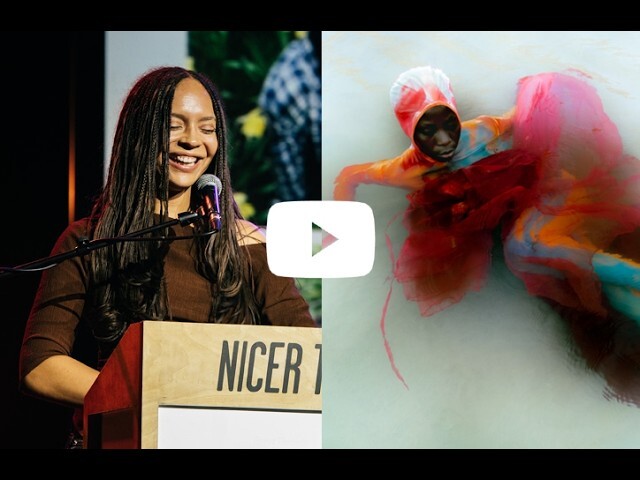
“Who gets to project themselves into the future, a future that doesn't exist yet? And maybe most importantly, who has the right systematically taken from them?”
They told me not to talk until the microphone is perfect. So, hello everybody. [laughter] Okay, I'm really excited to chat to you today um about my photography. So, I have come to realize that we are all products of past generations, mythologies, and dreams. And with this, I began to ask myself, who's granted the right to imagination?
Not just in the small and personal sense, but also in the larger one. Who gets to decide what is possible? Who gets to project themselves into the future, a future that doesn't exist yet? And maybe most importantly, who has the right systematically taken from them? These are all questions that are at the center of what I make. My name is Dalia Yi and I'm a Togoiz and German photographer and I'm based here in London and in Lumi and I want to speak to you today about the value systems that built the foundation for my imagery. In many ways, photography has given me purpose and agency to reimagine my future.
And the image that I thought of today or yesterday can essentially exist today or tomorrow. And with that I'm able to experiment with my reality and really materialize an inner sense of freedom. I was born in the US and was raised mostly in Germany and I had occasional visits to Togo of course and as a child I was quite shy and introverted and a lot of the world very much just happened inside my head.
However, I grew up in an environment of very active political discourse and the more I learned the more questions I essentially asked myself. questions about the history and the systems that I was born into and photography eventually became my way to make sense of that. My work is therefore very much a result of continuous curiosity I would say of learning and unlearning and developing a sense of self as an individual um but also as part of a community.
At 14, I moved to Malawi. And I always like to start my career story here because it was in Malawi that my head was really just broken open because I met four women, Kotana, Chico, and Jane, who's sitting here in the audience [laughter] 15 years later. And for me, it was the first time that I was really allowed to just have audacious dreams.
And together, we just spent hours letting our imagination run wild. And we had these photo shoots and came up with these stories. And you can see we were very much inspired by like the Tumblr phase. And there was no real like intellectual thought behind this. You know, we were wearing scarves and beanies. It was 30° heat and [laughter] none of it really made sense. But looking back, I can really see, you know, we were like selecting photos and editing and reinventing ourselves, but also our surrounding. And for me it was really I would say my first exercise as imagination and practice.
My teenage years in Malawi also shaped something else in me and that was a I would say a political awakening um especially around ideas of representation and what I would later come to understand the violence of the camera. And this is really important for me because it really determined how I point my camera now.
So what I really saw firsthand is that especially tourists and volunteers would point their lenses in ways that confirmed the preconceived notions they had already of Malawi or the continent as a whole. And I began to understand how the camera essentially has been and still being used to justify for example the developmental aid industrial complex or how the camera constructs reality to justify extraction without complexity.
So a few years forward, my dad placed a book into my hands and this book is about my great greatgrandfather, Alex Akaliche, who was the first ever photographer in Togo. And I sat with these images for a while and what really struck me is what how different they felt from anything I'd seen before at that time, especially I would say in a tool context. And to me, the people really felt like co-authors of their own images.
So seeing Akalachi's work really expanded my idea of what photography could be and it motivated me immensely to recreate this in a contemporary context. So with that I got to work and I moved to London to study creative direction. And it's it was here where I was introduced to fashion photography and magazines and I really began to understand that images had cultural positions.
And while graduating from university in 2020 in the midst of the COVID um lockdown, I returned to Germany and had to stay there. And I then went on to research into my childhood experiences in Germany. And the result ended up being two series that both investigate the idea of the German word for homeland and what this especially means for people of color.
And one of these images ended up being in London in the National Portrait Gallery actually. And the second series was featured on Vogue Germany and it was made with a cast and crew of 40 people across the AfroGerman community. And it was the first ever large production that we put up. Me and my friends, we hand painted backdrops.
It was all very much DIY. But the project that I really want to chat to you about today is Togoi. And Togoy is a project that I co-created with my collaborator Mallay Canabila. And I created this in my second year in uni. Togo translates to a new Togo. And we essentially created this project with two central aims. One was we wanted to complicate the narrative. And secondly, we wanted to build bridges between the diaspora and Togo. And essentially what we wanted to do was to just to push back against singular and flattened narratives that are often told about Togo but also about West Africa and its diaspora as a whole.
I would say that as to people living in uh at home but also abroad we man we have a particular uh well we face a particular kind of erasia I would say um it's a erasia of history of nuance and also the right to imagine our own futures and I would say this projection into the future is the very engine of self-determination and societal evolution and this right was historically stripped from us through assimulation and colonial projections and then it was replaced by stories of pessimism and lack and this is very much the reason why I'm so driven by imagination and the idea of reinvention I'm not interested in exact
representations of reality I'm interested in sort of playing with the boundaries of reality and interested in what reality could become and expanding yeah the boundaries of that and what to achieve this I use techniques such as compositions where I combine multiple images to make one photo for example so here for example this is a quite obvious one where I shot dancing images for da and he gave me lots of really cool movements this was shot for boy brother and friend. And again, these are three different images that I then placed together. And this is labyrinth as well for boy brother friend. And we took
multiple photos to then create one cohesive story. I also use multimedia techniques where I use um things such as paint or tapes or really anything that comes to me to essentially removed images from their context and to create invented worlds. And my images are taken both indoors and outdoors. And I'm often inspired by my environment. So I often borrow from textures and colors and then recreate them. And I get to work with incredible set designers. But in some cases, I paint my own backdrops as well.
Another really important aspect of my work is color. And it is actually often the starting point for my images. So, as you can see, I spent a lot of time just pairing colors and just seeing what color works with which and putting it in its context. So, and then afterwards I start sketching. And usually the image that I create pretty much exists already exactly the way um I've sketched it out. And these sketches, no one really needs to understand them. It's just for me, you know, a little stigma to know [laughter] where what goes. So going back to T toy um we concluded the project in 2024 but it taught me that creative productions
are catalysts. They forge community. They create professional experiences and financial support in Togo. And very importantly for me, they build bridges between communities. And what I'm really hopeful for is that ongoing creative productions in Togo will generate the mythologies that are really needed to build creative to build a creative industry that could one day sustain itself through its own productions, visions and especially gays.
So a few things that toi was commissioned for over the years was um for example the story we shot for puj and photovogue called by the grace of us and photovogue has been a really really big supporter of the project for many years and we essentially follow a um a similar formula where we take images that are grounded in reality and then abstract them.
In 2021, we were also commissioned by the Paleo Lumé, which is our National Arts Museum, to create a series called Rasindo Lim, and we were tasked to document traditional hairdressing techniques that are at the risk of being forgotten. And we also work a lot with local designers to build our story.
In 2024, we were we had our first ever large-scale production for the Dutch um wax print producer Visco. And this was the first time we had billboards all over Togo and Africa, which is a really big moment for us. And here's some behind the scenes of what a production like this looks like. Lots of beaches, which [laughter] is great.
And now shifting outside of Togoi, in 2022 I was commissioned by American Vogue to photograph um a selection of pieces and they shipped um these garments from New York to Lume. And for me, this was a huge moment because it felt like the first spark that I could be an active participant in the global fashion industry without necessarily having to reside in one of the four big cities.
And since uh I've had the privilege to really work and live as a photographer across continents and publications. So for example, this is something we shoot in Togo, which is a um editorial for WSJ. We shot this last December and I got to shoot for days in London as well and I get to work with people who are absolutely incredible and talented in their own right. So we here we have Tyler, Jodi Turner Smith and Ananda Pande which I got to shoot in Mumbai last year as well. And I got to work for fantastic brands too and do still life work. But most importantly I got to work with my community and this was a really
important shoot for us which we shot this year for Vogue Italia. So I want to end this presentation where I began and this is with the idea of imagination. One of my favorite thinkers and philosophers Felwin Sa writes in Afrotopia that the future is a site that doesn't exist yet but is one that can already be shaped within a mental space.
He says it requires an investment in thought and imagination. That there's continuity between the real and the possible. That all it takes is knowing how to properly uncover the the possible and then working to remove whatever hinders it. Limits, he writes, are always mental. And that's very much what I'm trying to do with every image that I make. I try to insist on the possibility of other worlds. To refuse that the present is the only version of itself. I try to dream collectively with my collaborators, with my communities towards something that is still in the making. And as a child, as I mentioned,
my imagination very much played out in my head. But through this work, I get to dream with other people. And my deepest hope that is that the images that we create together give someone else the permission to do the same. Before I end this talk, I want to point out that these images are never made alone and that it really takes a whole village to create them. So I've compiled a list that is I'm sure uncomplete of um everyone who's contributed to making the images in this presentation. Thank you so much for listening.
Latest Talks
-
Murugiah
Why you should reject the formula and make art about things you love
Watch -
Amber Weaver
How does contemporary type design translate into the wider world?
Watch -
Will Anderson and Ainslie Henderson
Bringing stop motion sorcery to BBC’s Small Prophets
Watch -
Ollie Babajide Tikare
The importance of not flattening the complexity of observation
Watch -
Marina Willer
Design thrives when you find poetry in the simple things
Watch -
Lizzy Stewart
The hundreds of drawings and writing-on-a-whim that goes into comic novels
Watch