
Lizzy Stewart
The hundreds of drawings and writing-on-a-whim that goes into comic novels
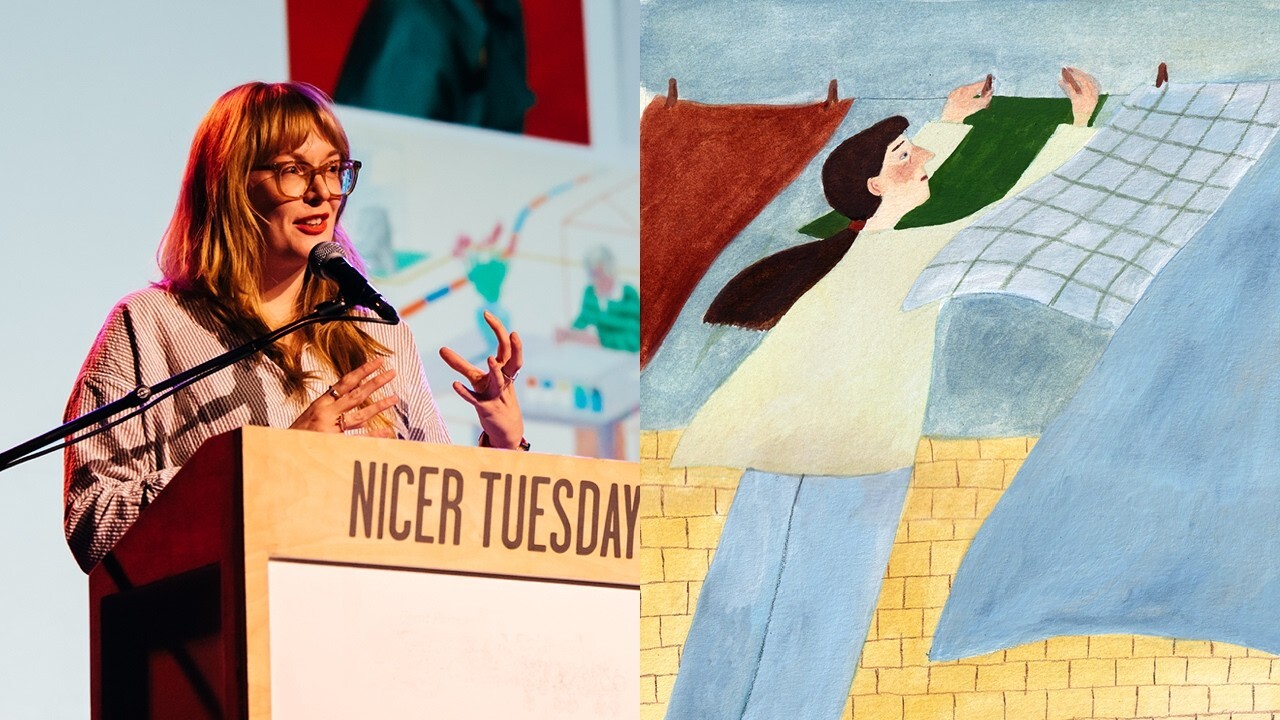
“I realized that I'd made a fatal error. My characters were in their 20s, but I was 37. I should be writing into what's ahead of me in life.”
[applause] Hi, I'm Lizzie Stewart and um as someone who's spent the last 15 years of my life alone in a room, this is frankly a deranged thing to do with my evening. Um, [laughter] uh, when I think about it, boiling down a 300page book and the process of making that 300page book to a 10-minute talk is, um, a little optimistic, so you have to bear with me while I sort of barrel through. Um, so I'm going to give you a quick potted history of me and my work.
I've been an illustrator since I graduated from Edinburgh College of Art in 2009. Um, whilst living in Edinburgh, my work looked a bit like this, which I think now I can see is the result of living in a very beautiful but very cold place. This is what my work looked like. That's what I meant. Um, for the first six or seven years after graduating, I did basically any job available to me. Um, although I graduated into the tail end of uh the first of this century's many financial crashes, um, it was actually a pretty good time to be an illustrator. there was a kind of decent amount of work around and occasionally quite a good
budget. Um, and uh, in 2016 I did my first, so this is some of my work. Um, I did my first pitch book sort of by accident and I kind of won't go into it, but it um, did quite well. Um, and being tagged in the thirsty tweets of like middle-aged women when this was on CBBS was one of the most, um, visceral experiences of my life. Um, anyway, uh, I found that being perceived as a children's illustrator really changed the work that I was being asked to do.
and and in order to kind of counterbalance being viewed as a children's illustrator, I felt it really important to keep my hand in with all the other threads of my work. Um, so since university, I've um made com well zenes to begin with and then as I kind of worked through making these self-published zenes over the years um they kind of quietly acquired more narrative and then by the 201s what I was actually making was comics. Um and uh so by 2020 the kind of main threads of my work were illustrating books and making comics and also I was a big reader. Um and suddenly as we all did had much more time on my hands than anticipated and so and this is a massive
oversimplification of the process. I merged all that stuff to make my first illustrated novel length book for adults which was called Allison looked like this. And now in two days, um, my next book, uh, The Wreck, is published by Jonathan Cape. You catch me at quite a jangly time for my nerves. I've been quite rattly all week. Um, I'm going to try and explain how a book like this happens on the off chance that you're interested. And I guess if not, think about what you're going to eat when you get home or something. Um, the first big project that you do, whether it's a book or an album, an exhibition or a play, it's kind of the culmination of a lifetime of interests and obsessions. More than likely, you've
been collecting ideas for it for years, maybe even decades, and you try and squash them all into this one thing that is like this big bold declarative statement about who you are, the artist you want to be, the kind of work you want to make. Um, this is some of the stuff that went into Allison and some of the stuff that didn't go into Allison.
Um, as much as the pressure of any previous success or failure and any expectation from an audience you might have, um, I think one of the other kind of causes of that like difficult second album syndrome thing is that your first thing is this like uh lifetime process and then your second thing, your second big project might be made over a year or two years. Um, that's quite like a vastly different gestational period. Um, so I had to ask after Allison, what did I leave out last time? What lingering obsessions might I have? What have I been thinking about um all this time that maybe I haven't realized I've been
thinking about? Allison was about art and friendship and I think creative patience. Um, it was also about class and privilege and the wreck touches on all those things because I guess they're the themes of my life, of everyone's lives. Um, but the idea of the story came from living situations, which I guess if you're under 45, we're all pretty much obsessed with like how do they live there? How do I get to live in that place? Um, etc., etc. I was inspired by a brief segment in a film about the illustrator Eric Ravilius in which it's mentioned that Rivius when he was first married lived with his wife Tzagarwood and also with his friend the artist Edward Bourwin Bordon and his
wife. That was the seed from which the book grew. Two couples, one house. So, I write first, which makes for a very boring slide. Um, I know some graphic novelists draw first, but for me, um, I'm liable to get carried away with the drawing, with the images. It's the fun bit. So, I have to make a map for where I'm going. So, I write a script. My books have a lot of pros in them, um, as well as the stuff you'd more readily recognize as comics. So, in this case, the text took me 9 months. Um, alongside freelance work and my teaching job, um, no one was paying me to write this, which is a tricky thing about fiction. You don't get paid for a first draft.
You have to write in the gaps that might exist in your life, and if there are no gaps, you have to kind of force a gap. Um, which is kind of one of the many fatal flaws in the creative industry, that not everyone can afford to be an artist or make the work they need to make. Um, so I wrote for a while about my two imaginary couples. They were young. They were living by the in the West Country because that's where I'm from and it doesn't appear much in culture except in like toy murder mysteries. Um I wrote and wrote but for a long time it didn't really sit right and I kept getting stuck which was which was okay. That's part of the process. Um
for me I kind of I write in order to work out where I'm going. Um and this is such this is such a dated reference and I'm so sorry. It's um like Grommet laying down the track in front of him. Like I can write into that bit just in front of me and that's all I need to know. It's it's like driving in a car at night and you can see the road in front but you're not going to see where you're you're ending up. You're just seeing the next bit. And I think um that is kind of all I need. I just need to know that there's a bit ahead of me that I can work towards. Um so I realized that I'd made a fatal error.
My characters were in their 20s, but I was 37. Uh, and as just as I write into that gap in front of me in terms of the plot, what's going to happen next, I realized that I should be writing into what's ahead of me in life, I suppose. So, when I decided to move my characters into their early 40s, it really broke the story open in the best way. It allowed their histories and resentments to come out more clearly.
Uh, you can be 40 and be messy. um that is not the sole preserve of 25-year-olds. That's a gift for everyone. Um so once the draft was written, my agent and I sold the book to Jonathan Cape and I had to start drawing, which is the good bit. Um I spent a while figuring out what my characters look like, which is kind of just like normal people, but I spent ages, months, thinking about their hair and clothes and body language. Um pages and pages of sketches exist for these madeup people. And this is the stage that tight deadlines and budgets eradicate from creative work. This period of experimentation where you're asked a question in a brief and the answer is the outcome and all that good stuff that happens in the middle. That's
to me that's the work. Um so I'm drawing and I'm drawing and then eventually hopefully at some point I look at a drawing and I think oh yes that's you. That's my character. There you are. This is them. I also make a massive Pinterest board, which is very millennial of me. Um, but, uh, it's the only way that I can keep track of visual references, and I make a playlist. And all of these things are like a way of tricking yourself into being in the mood to make a make a make the work, I guess. Um, I think a lot of making art is kind of tricking yourself into being in the place where you can make it. Um, which leads me to a quote.
The world's not short of shy talks with great plans. It's done when it's done. It's done where you can touch it. I read this line about when I was a student. It was on a website made by some Scottish designers. It had they the website had like all their scraps and notes and there was this this phrase and this line has been in my head for years, 16 years.
It's the closest I've ever I have to a guiding principle creatively [snorts] and I'd really like to thank whoever wrote it. Um but I don't know who that is. So the world's not short of shy talks with great plans. It's done when it's done. It's done when you can hold it. So, you just have to do it. You have to sit down every day for a year and draw hundreds of pictures. It's the only way because plenty of people have ideas. Plenty of people have brilliant ideas.
But, I guess it only counts when you actually do it. Not to on the ideas, people. Obviously, they're great. But, um, but it's always better to have done it um than to have held it in your head for for decades as this perfect potential idea. You've you've just got to bash it out, I think. So 300 pages later, I send it off. We edit it, which is um fun but boring to talk about. Um but just know that I send someone the worst in design file in the world and they somehow turn it into a book and I never have to know what they've done. It's it's great. Um the next step is the cover. Um I maintain that the best person to make the cover of a book is probably not the author. Um
no one is asking Zadeie Smith or Margaret Atwood to design their own book covers. Um, I feel sometimes that less visual people think that visual people are kind of good at all aspects of visual creativity and we're not. I am no designer. Luckily, my friend Jez Barrows is a designer, a very brilliant one. And he helped use my scraps, um, bits of bits of drawing, bits of text to piece together a design, which I worked over and over until it felt right, which it kind of sort of did. Um, it's weird to try and figure out when something looks like the cover of your book, but maybe this is as close as it's going to get.
And so now it's done. It's going to come out and I can't stop it. Um, and mostly I don't want to stop it. Mostly I think this is pretty close to the book that I wanted to make at the time. And I also accept that it isn't the book that I would make now, even just a year and a half later. Um, but that's being an artist, you have to keep moving. Um, and so now I begin again. I wonder what I left out. What ideas bear revisiting?
What thoughts can't I shake off? Um, this is one of the thoughts I can never shake off. It's a quote from Miranda July. Who are the characters I might invent to explore them? The world's not short of shy hawks with great plans. So, I'll start laying down the track again and look forward to finding out where it takes me. Uh, this is the work, I guess, and I'm lucky that I get to do it. Thanks, [applause]
Latest Talks
-
Murugiah
Why you should reject the formula and make art about things you love
Watch -
Amber Weaver
How does contemporary type design translate into the wider world?
Watch -
Delali Ayivi
How does photography give us the right to imagine our futures?
Watch -
Will Anderson and Ainslie Henderson
Bringing stop motion sorcery to BBC’s Small Prophets
Watch -
Ollie Babajide Tikare
The importance of not flattening the complexity of observation
Watch -
Marina Willer
Design thrives when you find poetry in the simple things
Watch