
Lili Ibrahim is the lead artist at UsTwo Games, known for her work on the award-winning puzzle game series Monument Valley, where she explores artful and inquisitive game design.
Ustwo Games
Inside the making of Monument Valley
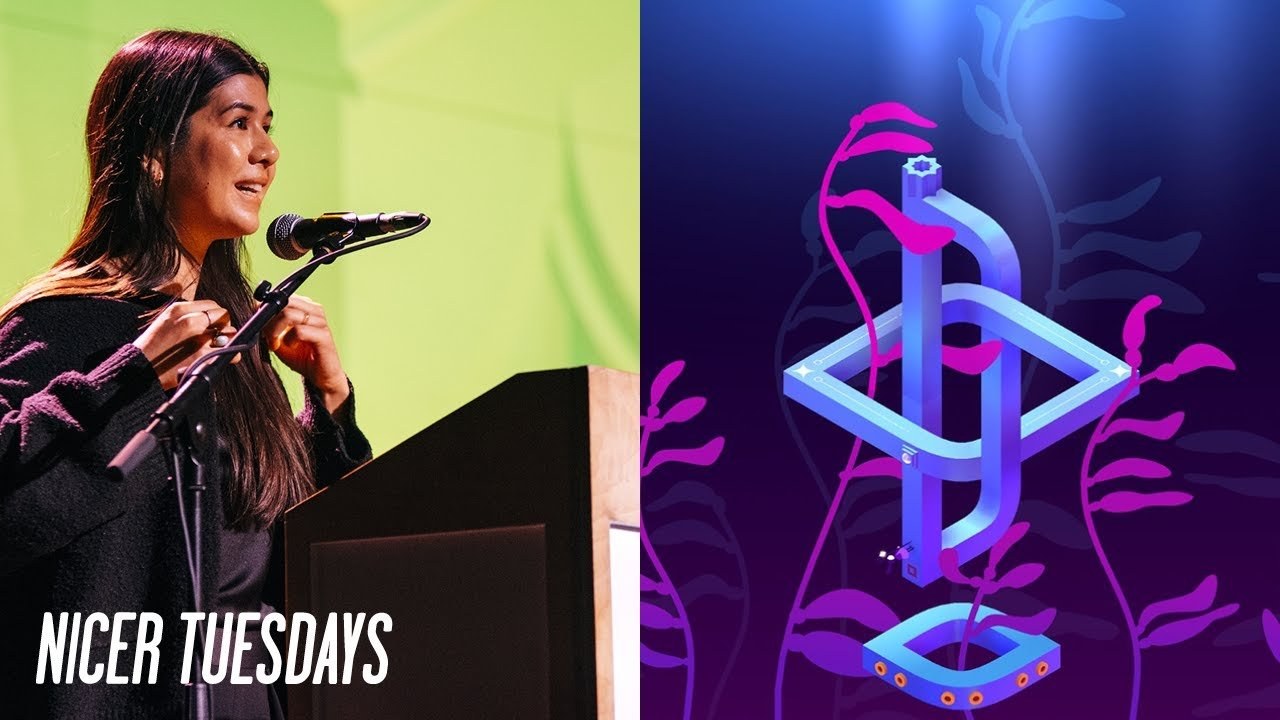
“We wanted to create a game where every screen could be hung in a gallery, not just a level to be beaten.”
Transcriptmay contain minor errors or formatting inconsistencies
[Applause]
Hello. I'm so excited to be here. , and I've never been to this space. It's absolutely incredible and you all look incredible here as well. , my name is Lily Ibrahim and I work for US2 Games. US2 Games is a small game studio in South London. We are known for making mobile games. More recently we do games across all platforms. And originally us two games was part of a design studio called us two. But after some time it broke off to become a game studio.
But I still like to think that we hold on to our roots in design and graphic design. Today I will be talking about Monument Valley which is the game that we're mostly known for. If you haven't played Monument Valley, I will describe it briefly as a atmospheric puzzle game in which you navigate dreamlike architectural environments. The first original Monument Valley came out in 2014. The second one, Monument Valley 2, came out in 2017. And most recently, Monument Valley came out in December 2024, so just a few months ago. Monument Valley, I would say, is the perfect marriage between satisfying tactile interactions and beautiful visuals. And the levels in Monument Valley really are all about balancing these two pillars. Each puzzle needs to play and feel really good, but it also needs to look really good. If if the level doesn't look beautiful, we can't release it. But also, if it doesn't feel great, equally, we can't release it.
So, it creates this really good back and forth collaboration and dynamic between the game design discipline and the art team. In terms of interaction and game play, all of the interactions are designed to play perfectly on a touch device. And they're really intuitive, simple interactions. You can, like in this video, you can rotate pieces of architecture. You can drag blocks with your finger. And you can tap on paths to make the characters walk. And really, this is the only thing as a player that you are required or asked to do. It's very simple things. On the art side, as I said, our pedigree is in graphic design and design. And I think it really shows particularly in Monument Valley. We take so much inspiration from poster design and graphic design, but we also take a lot of inspiration from architecture. So you will find levels in Mona Valley that feel a little bit more grounded in real life and architecture and they feel more tangible.
But then you'll also find levels that are a little bit more abstract, maybe a little bit more rooted in graphic design where we play with silhouettes and we play with composition and color as well. In terms of architectural references, you'll see a lot of u architecture that might remind you of things you've seen in real life.
This is a particular favorite of mine that features a wall inspired by this structure in Delhi, the Red Fort.
We have this level in Monument Valley 3 inspired by cathedral windows.
This is a structure inspired by I don't know what the structure is, but it is in the Vatican. It looks cool. , the artists have quite a lot of freedom when it comes to what references they pull into the work that they do. For this one in particular, the artist was a big fan of Mary Blair.
So you can see the sort of direct influence from Mary Blair's concept art for Peter Pan. And we we create so many levels. I mean, if you have played Monument Valley, you know that there's such a range in terms of the visuals from one level to the next. And and that's just the levels that you see as release that we're happy with.
But the art team will have to work through so many different explorations and to even find something that works. So in the end the sort of references that we pull from are really from everywhere. So you'll see architecture, you'll see illustrations, but you you'll even see like everyday objects like these suites. Like you'll get to a point as an Monument Valley artist where like you'll you'll desperately look around you for any inspiration. So, I've talked a little bit about the game play and I've talked a little bit about the art, but something really magical happens when the game play and the art combines perfectly into an optical illusion. And I think that this is probably what Monument Valley is mostly known for.
So, I'll spend a little bit of time now just talking about optical illusions. You can't really talk about illusions without mentioning the grandfather of optical illusions, McSher. He's known for creating these intricate drawings of impossible spaces. And within the team, we look to his illustrations a lot for inspiration. Some of our levels are directly inspired by his his his drawings like this one and this sort of impossibly looping water stream. The bread and butter of optical illusions in Monument Valley is is this shape.
This is the Penrose Triangle and it's a physically impossible triangle. , I would say that maybe like 80 to 90% of all the illusions you'll find in Mona Valley is actually a Penrose triangle or variation on the Penrose triangle. , and and what's interesting about this space is because it doesn't work in physical 3D like it doesn't actually function in real life. We've had to create sort of like a smoke and mirrors to trick the player into thinking that they're looking at a solid shape. So all of Monument Valley is like a long exercise of us trying to hide the fact that the shape is not real. Here's an example from Monument Valley 2. On the right hand side, you can see what the player sees when they play the game. And on the left is a video taken from Unity where we've rotated the scene to show you the seams. We've just got really a really clever tech team that let let us do this. So throughout Monument Valley, you will find this Pender triangle.
Sometimes it will be really on the nose like in this screenshot, or or in this one. And sometimes it will be a little bit more nested within the architecture, a little bit more hidden. , but if you look closely, you'll see that it is actually another Penrose triangle. Here's another one that is a little bit hidden. So now that you've seen my presentation, , you are all Penrose experts and next time you play Monument Valley, you'll see it everywhere. Another illusion that we use a lot is this one demonstrated by another Esher illusion which is the illusion of something being behind and in front of something at the same time like the ladder here. And you'll find that throughout the game as well. Here's one from Monument Valley 3 that I think is really effective with the pillars weaving in and out. This bridge from Monument Valley 3 as well. That goes in front and behind that parallel path.
This is one of my favorite illustrations of this like mirrored world. And this also lends itself really well to Monument Valley and creates some of my favorite puzzles in Monument Valley as well.
So this from Monument Valley 2 shows the this like mirrored top and bottom world which works really well in Monument Valley 2 in particular because you play with two characters. This one from Monument Valley 3 kind of takes the illusion one step further where you combine the towers into one. The next illusion I want to share with you is really difficult to explain.
This illustration by Asher I think is called inside outside. If you look really closely, you'll see that the left hand side is like a mirror image of the right hand side. I've made this diagram for you to make it easier to explain. If you look at that cube on the left, you can imagine that a character can stand on top of it or that they can stand inside it.
So this is essentially the illusion boiled down to its simplest form. , and internally within the team, we call this multistable. So, you can see it here in Monument Valley One where IDA navigates through doors and ends up like in a concave version of what looks like a convex shape. It's like really difficult to look at. Like it like it still really messes with my brain. And actually like working on a puzzle like this is really tiring for for your brain. So that might be the reason why we don't have a lot of them actually. Here's another one from Mon Valley 2 where Rose steps on a button and suddenly she's flipped over and she's in this sort of inverse version of the space. Just they are really hard to make these ones but they really like they really mess with your brain. Working on a Monument Valley title is a long string of trying to find new ways to surprise the player. Trying to find new illusions that feel obvious enough that that the player will see them but also satisfying and fresh and work Mon Valley 3 being the third one in the installment there was a it was a challenge coming up with new tricks and whoever is working on Monu Valley 4 good luck to them but it is really exciting so the original Monument Valley came out and and it did really well. We were very very happy with the reception. He won the Apple Design Award.
It won two BAFTAs. And it really completely changed the trajectory of the studio. We suddenly had we suddenly established ourselves as a game studio and we suddenly had like a fan base who just wanted more more Monument Valley. And 11 years after the original came out, we released Monument Valley 3. , the studios changed a lot in the past 11 years. As I said, we have a fan base, we have a platform now. , and with that, some of our priorities change as well. , the story in Monument Valley 3 is about climate and displacement and community topics that we feel really strongly about. And I'm really excited to say that we donate 3% of the profit of Monument Valley 3 to the International Federation of the Red Cross. Working on a Monument Valley title was really like a big it was a big milestone in my career. But being able to see the positive social impact that we can achieve with the titles has really changed the way that I view games, the games industry and the and the work that I do within this industry. I will always going forwards look for ways to pay back into the real world with the work that I do. Thank you.
Latest Talks
-
Murugiah
Why you should reject the formula and make art about things you love
Watch -
Amber Weaver
How does contemporary type design translate into the wider world?
Watch -
Delali Ayivi
How does photography give us the right to imagine our futures?
Watch -
Will Anderson and Ainslie Henderson
Bringing stop motion sorcery to BBC’s Small Prophets
Watch -
Ollie Babajide Tikare
The importance of not flattening the complexity of observation
Watch -

Marina Willer
Design thrives when you find poetry in the simple things
Watch