
Zarina Muhammad is the co-founder of The White Pube and an art critic known for her insights on making art under capitalism. She is distinctive for her role in exploring the challenges artists face in today's economic climate through her writing.
The White Pube
Anarchism, Ubers and ghosts: The book on being an artist under capitalism
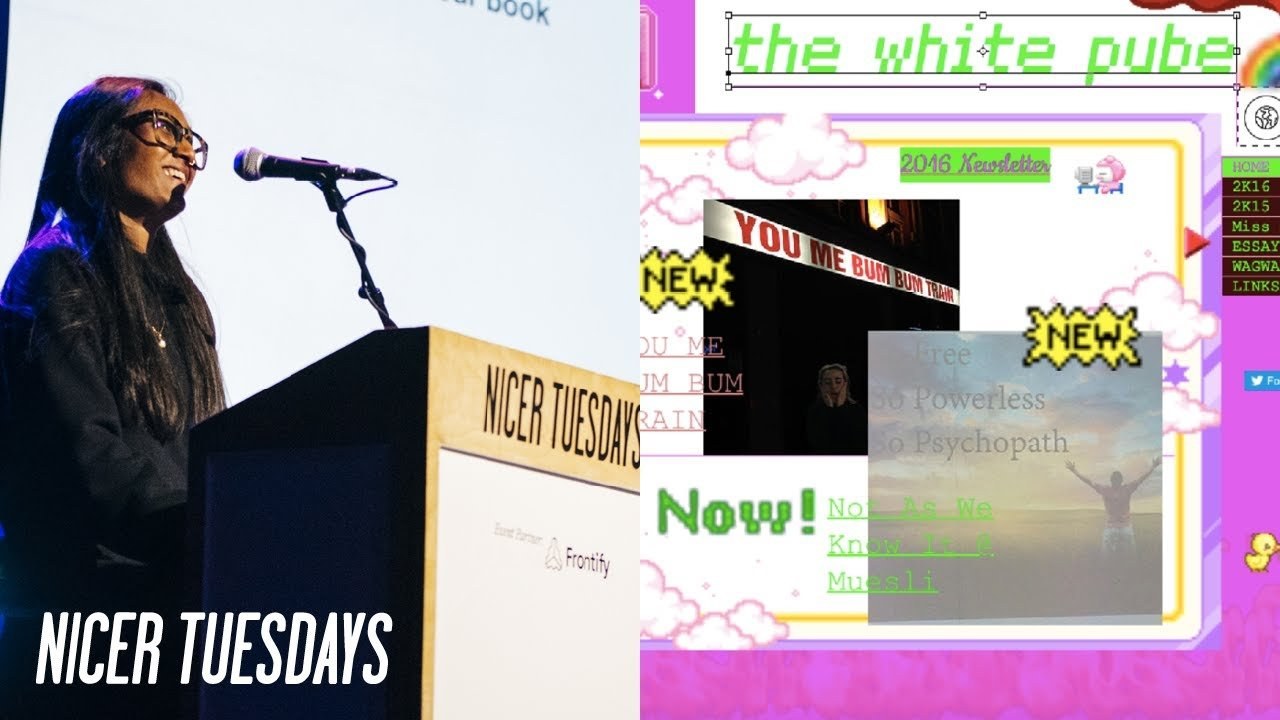
“In a time when it’s harder than ever to make a living from art, art gets made anyway.”
Transcriptmay contain minor errors or formatting inconsistencies
[Applause]
Hello. Happy pancake day. I'm Zarena Muhammad. I'm an art critic. I run the white cube which is a website www.thewhipube.com or.co.uk.
That's what it looks like. And I run it with my friend and collaborator Gabrielle Deopu. I'm from London. Gab is from Liverpool. And between these two cities, we are in a long-distance critical conversational relationship. We publish a review every Sunday, normally about art, but also like culture at large, whatever takes our fancy. And we've been writing for nearly nine and a half years. And last year, our debut novel, Poor Artist, was published, which is Thanks. Thank you. Thank you.
But that is what I'm going to talk about tonight. But first, the too long didn't read villain origin story.
We started The White Cube in October 2015 in our art school studio. We thought we thought the art criticism was boring. So, we thought it'd be really funny to just write art criticism that wasn't boring. , it would be accented, ambivalent, cynical, sometimes gossipy, sometimes confused. We wanted it to sound like us. And we carried on writing. And in 2020, we met a literary agent on a train from Germany to Belgium. A pandemic happened.
We had an idea for a book and we wrote the proposal. We swindled our way into a book deal with Penguin. Literally just swindled and we wrote it and here we are. Lovely.
That's the short version. , Poor Artist is a story about making art under capitalism. We interviewed 22 arts workers and asked them why they made art, how they made art, what was compelling them, what got in the way. The answers we got back were really actually quite bleak. We are in a world where it is harder than ever to make a living and harder than ever to make art, let alone make a living from art. And yet art gets made anyway. Poor Artist is about that anyway. We turn those interviews into a story like it's a novel. If you pick it up and open it, it reads like fiction. And it follows an aspiring artist called Quest Talukda. Quest goes on, literally a quest, a hero's journey to figure out how to hold on to this love of art despite the things that get in the way. And she meets some interesting characters. A spooky man in a castle, an insufferable art bro, Silla Black, a sentient mountain made of discarded art. I couldn't find like a good image to represent that, so just Bob Ross is what you get. Multiple ghosts, the love of her life, and this shady figure called the art king. The original idea was art dates. An anonymous creative protagonist goes on a series of dates. They just so happen to all be with arts workers. Oh my god, what are the chances? We'd interview people and turn these conversations into romantic encounters as a way of talking about art and our relationships with it in all its forms from tutors at art schools, technicians, art handlers, invigilators, collectors, art historians, like everyone across the board. But as we spoke to people, we realized that actually none of this is romantic.
It's horror or tragedy. Art plays a central role in all of our lives and our relationship to it is mediated by money. Who has it? Who doesn't have it? Who gives it to you? The caveats it comes with. Money determines who gets the time, space, resources, and opportunities to make art in the first place. It is frustrating. It is thankless. It is gling. It is a war of attrition. Our relationship to art is low-key very, very toxic. Artists are poor. The system is exploitative. Heartbreak is inevitable. But art is made anyway. Interview after interview, people told us about how the art world broke their heart. We asked them why they continued despite that heartbreak. And without exception, every single person said in some way, some form something like, "I don't know. I don't get anything back. No fame, no money, nothing.
But I can't stop. Stopping isn't an option. It's like a compulsion." and hearing that over and over low-key it felt like a really profound revelation about the human condition from the beginning of human history since humans were humans we have been making things paleolithic figurines fertility talismans self-portraits or totems horses carved into hillsides like landmarks or Iron Age monuments the dagamidle this one's my favorite because it's kind of spooky Stonehenge pigments on walls of caves animals, stars, moon cycles, migration patterns. To be human is to make. Maybe it's art, maybe it's I don't know. Whatever these things are, culture, stuff, whatever.
I don't think the word we use matters. There is joy and a satisfaction in making things, communing with the material. I don't know. As humans, I think we will continue to do that. It is an ancient thing hardwired into us. It's capitalism that's the new invention.
That's the bit that gets in the way. And it might seem inevitable, unchangeable, fixed, certain, but it isn't. It's basically brand new. It is a choice and we aren't necessarily stuck with that choice. And that brings me back to poor artists, to the capitalist hustle, right? But to our hero, Quest and her quest for a creative life. No spoilers, but I'm going to cut to the end and tell you about one of my favorite characters in the whole book. This guy, 19th century French painter Gustav Corb.
We interviewed a ghost. Love that. Quest is on her way to a fancy art party. Gustav is driving the Uber to take her there. Graphic design is my passion. But on the way, he makes quest to reassess her life and her choices. Gustav was alive in 1871 when France was at war with Prussia. The French government left the people of Paris to starve.
So the people rose up against their government and against the Prussians to take control of their city on their own terms to set up the Paris Commune. They abolished the death penalty, military conscription, child labor. They mandated the separation of church and state. They returned rent payments to tenants. The people ran the city for themselves. Workers ran the businesses. There was no government, no bosses, no landlords, no masters. And Gustav, right, he joined the comm the commune's federation of artists. The federation was made up of everyone who exhibited in Paris. The artists of Paris organized themselves, their own exhibitions, their own conferences. They published their own magazines. They abolished awards. They subsidized art schools so students could study for free. The Communist Federation decreed that artists should be equals amongst each other. That art must be free from the influence of intermediaries that the government, the church or the rich, all of them, get them out the way. The Communist Federation believed that we must entrust to artists alone the management of their own interests.
Gustav tells Quest about the Spanish Civil War. When f when the trade unions were fighting back the fascists, Barcelona was run by the anarchists. They hung black and red flags from the buildings. They collectivized their businesses. The barber shops, the cafes, the sho the shoe shine stands, the opera, the ballet, the cabaret, all of it. Barcelona's factories were run by its workers for its workers own interests. And Barcelona's cinemas, theaters and operas, its cabarets were run by its filmmakers, its dancers, its singers, and its artists. Like imagine a world when like artists run the museums. These two historical moments have a political philosophy in common. Anarchism, if you don't know, and before doing the research for this chapter of poor artists, I didn't know. Anarchism is a political philosophy that seeks to reject and or abolish all forms of authority, coercion, or hierarchy. It's the idea that no person or entity has any right to tell you what to do. You can do whatever you like as long as it doesn't exploit or harm another person. Maximum freedom, maximum equality. Anarchists look to dismantle the concentration of power in any one area. Absolute power corrupts absolutely and abuse of power comes as no surprise.
So that's where those maxims come from. Instead, anarchists seek to organize society on a voluntary cooperative basis without using force or compulsion. Entrust to artists alone the management of their interests. Now, I hadn't given much thought to anarchism until we came to write poor artists. Until I I spoke to 22 artworkers who all told me that their relationship to art was mediated by money, by the rich, by collectors, by the government, by the arts council, their landlords, their gallerists.
Like, a whole industry has settled around the raw talent that produces the art for the art world. Has imposed a hierarchy to extract that value with literally no benefit for artists. The system as it is under capitalism does not entrust unto artists the management of their interests. To make art, artists have to seek permission for money, for space, for time, for resources. The human impulse to create is mediated by power, by who by who has it, by who hoards it. And it hasn't always been this way.
This isn't inevitable. And if we are to understand these things as anarchists do, we don't have to put up with it. In fact, we shouldn't. Anarchism has interesting answers to the way resistance and change has happened in the past and through the 19th century anarchists were a king's or a government's worst nightmare. The general strike, the boycott, protest, squatting, sabotage, robbing banks to fund the revolutionary activity going on. These things are all anarchist practice. There is this thing called propaganda by the deed. Direct action intended to shock the system to demonstrate that the people in power are not untouchable or infallible.
The system is just as fragile as any other man-made thing. Now, to be clear, this was hardcore. Anarchists threw bombs into cafes and into theaters. They took out kings. They took out presidents. Literal assassinations. And I want to be clear as a Muslim in public. That is not what I am advocating. Don't get it [Applause]
twisted. It's not what I'm advocating. Stop that. They're listening. But in his book, How to Blow Up a Pipeline, Andreas Mom splits splits the hairs about the ethics of doing nothing. When you are faced with the destruction caused by a violent system, it is also violent to do nothing, to not intervene. Inaction is not morally neutral. It is arguably worse because it's a violence that believes itself to be innocent. The Paris Communes Federation of Artists pulled down a statue commemorating Napoleon and his imperial victories. They melted it down and they minted it into coins for the new republic. Destruction is not an end point. It's a beginning. It is an open space full of potential. And anyway, like Mark Fischer said, it is easier to imagine the end of the world than the end of capitalism. But if you want to like if you want a hand conjuring up an image of something difficult to imagine, ask an artist.
And like Ursula Luin once said, we live in capitalism. Its power seems inescapable. So did the divine right of kings. Any human power can be resisted and changed by human beings. And resistance to change often begins in art. The system is not fated. It is not inevitable. The reality we live in is not fixed. If we refused to give our labor to an art world that only ever extracts value from us, giving little inward would return, what would happen if we entrusted to artists alone the management of their interests. As a critic, I'd be interested to see. Anyway, as for Quest, whether she ever makes it to the fancy party, whether whether she ever stops being a poor artist and finds a way to hold on to her love of art despite the that gets in the way. I can't give you any spoilers. Buy it or rob it. I I don't care. But you have to read the book. Thank you.
Latest Talks
-
Murugiah
Why you should reject the formula and make art about things you love
Watch -
Amber Weaver
How does contemporary type design translate into the wider world?
Watch -
Delali Ayivi
How does photography give us the right to imagine our futures?
Watch -
Will Anderson and Ainslie Henderson
Bringing stop motion sorcery to BBC’s Small Prophets
Watch -
Ollie Babajide Tikare
The importance of not flattening the complexity of observation
Watch -
Marina Willer
Design thrives when you find poetry in the simple things
Watch