
Zoe Thompson is an artist and writer known for her self-publishing practice and her independent zine, Sweet Thang. She explores themes from her youth and engages with the DIY publishing community.
Sweet Thang Zine
Playing, dreaming and harnessing the power of DIY publishing
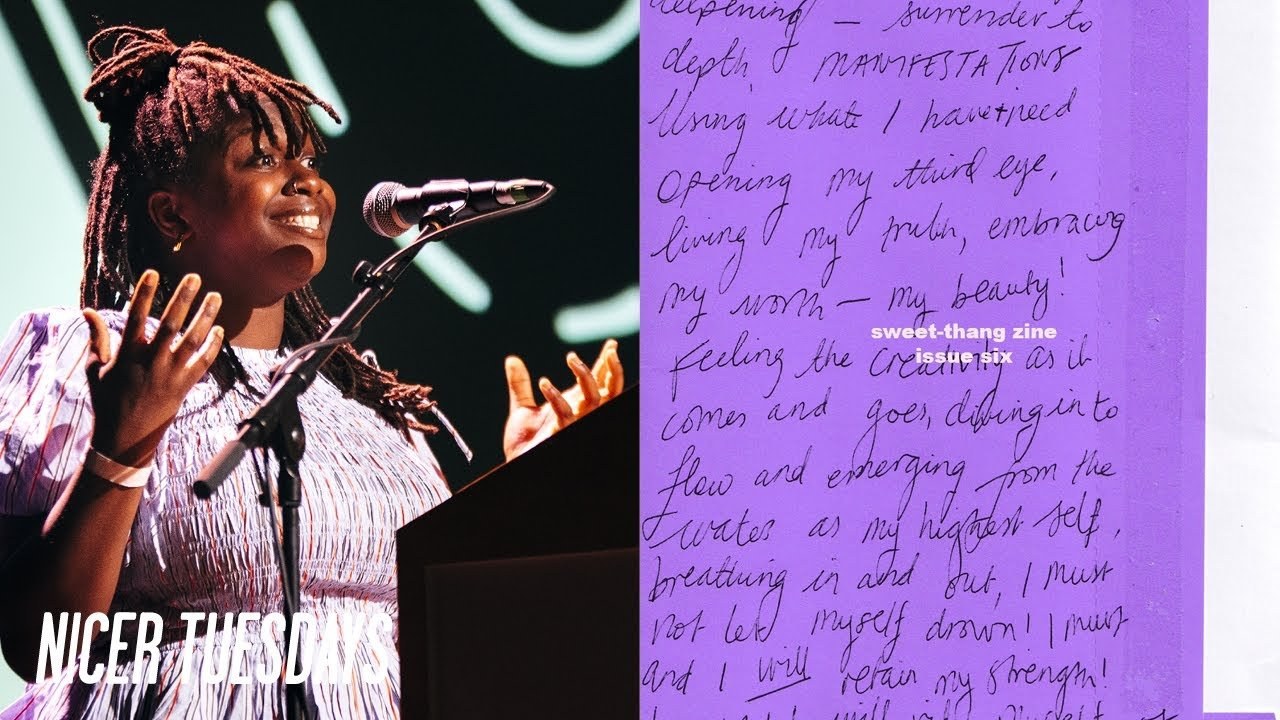
“In the world of DIY publishing, every mistake is just a step towards your unique voice.”
Transcriptmay contain minor errors or formatting inconsistencies
[Applause]
Hi everyone. Nice to see so many faces. , yeah, this is a photo of me. Very like serious, black and white. Love it.
, my name is Zoe Thompson, as mentioned, and I'm an artist and writer who makes Zen and facilitates creative workshops. I'm also the founder of Sweet Thanzine, as you all know, and we're a community press that publishes work by black creatives worldwide. Since 2017, we've published nearly 200 artist and writers in our print issues spanning the UK, Europe, the US, and countries in the Caribbean and the African continent. In my personal work, I seek to explore activism, archiving, poetry, and creative non-fiction, offering both editorial design and workshop facilitation. I've worked with companies and organizations like the welcome collection, the design museum, Kings College University, Tate Modern, South Bank Center, and many more.
I also just love making silly random zenes about all types of topics, as you can see here. There's a fan favorite among these, but I won't say which one. So, how did I get here? When thinking about my creative journey, I have to cast my mind back to being 18, so like a mere fetus.
, which was when I started Sweet Thanzine. I was imbued with this sense of excitement and life kind of felt like a fertile playground which I've kind of tried to illustrate here. When I was 18, I also thought that zebra ski pants and like berets looked cool. , so yeah, it was a very exciting kind of like messy era and I kind of loved that. , but I was kind of imbued with this sense of I was intrigued and curious about what it meant to take the means of production into my own hands and create what I wish existed.
But this didn't come from nowhere. Looking back on my journey over, yes, the past eight years, but also even like 10 to 12 years when I was in my mid- teens, I've identified that I've stumbled across various different playgrounds in my life, making play like a constant vehicle through which I navigated the creative world. As a former literature student and poet, I love a good metaphor. So in my talk today, I'm going to basically guide you through my creative journey on a timeline and shed light upon the key playgrounds that I've encountered and still play on today in my creative journey. Playgrounds for me represent spaces where imagination can run wild, you know, where rules both do and don't apply, where you're kind of like running with your curiosity and where nostalgia is present. And I think that as artists and designers and makers, I think this way of playing and working should seep its way into everything that we do. So playground number one was Blogger or Blogspot. Maybe people can raise their hands if you've like used Blogger or like still use it. Just seeing how many like how many of us are in the in the room.
Cool. Okay. Not that many. It's kind of sad. , I've I've kind of started defining Blogger as Substack's older sister, if that helps clear things up. , and it was launched in 1999, same age as me. Fun fact. So, I started a blogger page in 2014. It was called Delicate Musings. And at first, it was a way for me to literally like overshare to the two to five people who viewed my posts.
But then, it quickly became a corner of the internet that was buzzing with DIY creativity. It felt like me and other random teenagers against the world sharing our favorite books and magazines, our favorite like outfits of the day in the hope that we'd be invited to London Fashion Week and we never were. We would share our poetry, our artwork, but most of all our teenage angst. There was an energy in the air kind of like yeah this excitement about creating things and it felt like all the tools were at our fingertips. It was when I started to find the words to articulate what youth culture meant to me and I was experiencing creative independence for the very first time. I discovered and wrote about platforms like Strike magazine which heavily influenced my desire to look into self-publishing. Particularly this article at the bottom that was called DIY or Die a step-by-step guide to starting your own and taking no So you can imagine as like an 17 18year-old I was like I just became insufferable once I figured figured this out. , it was the era of messy documentation, which I feel embodies Zen culture. I wasn't trying to be this perfect writer or journalist. I'd never spend more than a day writing a blog post. It was a digital diary, a space to experiment and embrace imperfection.
So, it's only natural that I fell down this rabbit hole into this second world, this second playground, if you will, which was, of course, Z and DIY publishing. Discovering Zen was my light bulb moment. There was I'm so glad you guys find this funny. There was never a moment of questioning what they were or why they were different from magazines. I just knew Zes could be made with your best friend in your bedroom. They didn't need to have advertisements in them or be sold in a shop to be legit. They quite literally don't ask for permission as an art form. And it's no wonder that 18-year-old me was invigorated and excited to get stuck in. And I feel like this meme like perfectly encapsulates what Zes are. It's like publishing but on our own terms. Naturally, Sweet Thanzine was born out of the desire to increase the representation of black artists and writers within publishing.
I wanted to reject the limitations placed on black artistry. You know, this idea that our work had to be about trauma and oppression rather than just the weird, wonderful, wacky things that interested us in our day-to-day lives. I didn't go to art school.
I didn't have access to the top design software. I just used what I had around me again which is kind of like one of the centerfolds of Zen culture and DIY culture you know for designing operant issues I used PowerPoint because that's what I had for free at my university for reaching people and like building the community we just used Instagram and like would DM people and ask ask them to share our like call outs and things like that so starting this platform and starting the the kind of like growings that's not a word of this community it all cost 0 to begin with and when we c when it came to printing our first issue we printed around 80 copies and I think I used like a cheeky bit of student loan to cover most of it. Sweet Thang has since grown into a community that touches multiple corners of the globe and it's so incredible looking back on our journey. It was great to see that there was and continues to be an appetite for Z. So Zes have always existed on the peripheries. They've always existed outside of mainstream publishing and I think that's what makes them so cool and unique.
But also sacred. Someone recently said to me at Zenmaking workshop that Zenes are becoming trendy now, and I kind of want to resist the negative connotations of that as much as possible. In this photo, I'm pointing to an article called Why We Need Z Now and Forever. It was hosted on a platform called Bad Form, which celebrated writers and authors of color. And in this article, the writer talks about how creatives are now desperate for alternative media that not only represents their beliefs, but sees and validates and includes them. Zen to me and like the amateur press movement that that's all alternative media. And I think it's a solution to this current like hellscape we're seeing with like technological advancements and the kind of questions it's now making creatives pose about their artwork and even their livelihood.
I think that alternative media is a solution to all of that. It's a space where people can radically be themselves and for stories from marginalized groups to be heard and celebrated away from toxic algorithms and censorship. So, we need more zenes. There's there's space for more zenes always. So, bringing you back to my creative timeline and this little playground that I'm painting a picture of. A lot was going on at this time.
I started Sweet Thang in 2017. I was studying at the same time. I graduated in 2021. And all my worlds felt like they were colliding quite fast. When I graduated, I felt like the world was mine to shape. And I think that that was the power of DIY creation talking. Like I was fully equipped with the knowledge of what it meant to materialize something I wanted to create and kind of like have this community to fall into. And it wasn't because I paid like someone to tell me what to do or like did this fancy course. It was the sense of authority that DIY creation gives you. And that leads me to the third playground during this personal timeline, which was the world of work, specifically being a freelancer. Whilst the other playgrounds I've spoken about have all been like fun and crafty and nostalgic, this playground was more of an obstacle course, and I'm still making my way through it now, sometimes surviving more than thriving. I quickly learned the importance of networking in this playground and how to pitch yourself. And suddenly this bubble that I was in before kind of felt quite limited. And I was aware that if I wanted to grow and sustain my practice, I'd need to learn a whole new language. And it was that of self- advocacy and also asking for new kinds of support, which scarily included funding. And thus became my journey down the the rabbit hole of trying to trying to get funding for Sweet Thang and kind of all the questions it was making me pose. The funding applications were extractive and intense and I really had to confront everything headon from the future I saw for myself as an independent artist to the realities of trying to run a publication whilst keeping it independent and grassroots. As I mentioned, it was a whole new language and it was one I wish I never had to learn. And the energy at this time was very much giving this. It was like I can't do any more networking like just give me the money. It required a lot of energy and I was yeah even thinking when I was writing the speech I found some old notebooks and I realized that my journey with trying to apply for funding was literally like across 2 years. It was really it was a lot and during that time so around 2021 to 2023 I decided to take a break from producing print issues.
One of our favorite black indie magazines Onyx magazine used the concept of a fow year to describe when they went on a hiatus. Onyx is a beautifully curated radical publication and this is a screenshot from one of their recent posts on Instagram where they speak about part of their philosophy for paying and working with their artists. They believe in the joyful necessity of slow creation and the need for liberation focused artists to be resourced well enough in order to do the deep work needed to model systemic liberation. So, I was really inspired by this concept that they used of of a fellow year. And I think that Sweet Thangs fellow years were were kind of like a bonus playground where we were able to scope out new ways to work with our community cheaply but authentically whilst also prioritizing rest. One of the projects I did at this time was this a toz series for Black History Month where I made a zen for each letter of the alphabet and included a slice of black British history. It was a super fun research project which got me excited about crafting again and also rettaught me the importance of embracing the spontaneity of zen making and crafting without an aesthetic goal in mind. Kind of just like how I was when I was writing my blog posts on Blogspot. In the summer of 2024, my energy started to refuel and I took matters into my own hands and set up a crowdfunder to produce our next print issue, which is some something that I wish I did from the very very beginning. Although it was exhausting to run, it was a successful campaign and I was overwhelmed with the support. So that brings me to my final playground, my what's next, if you will, and that is Sweet Thang's next print issue after 3 years. Issue eight is a special one. It's a compilation of artwork and writing by 21 black creatives worldwide, and we worked with New York-based designer and educator Zoe Pulley on the editorial design. Zoe is a multi-disiplinary designer who uses textiles, typography, and digital media to explore the seemingly ordinary stories of black folks. She also gave a talk at Nicer Tuesdays New York last year, which is super cool. It's like a a Zoey takeover happening. The theme of issue 8 is dreaming and the concept of dreaming as a form of freedom making and world building. It launches this week, but as a special treat, I've included some of the mock-ups and pages from the issue here. It was such a pleasure working with Zoe Pulley. Her eye for design is just unmatched. We barely even worked with a set brief. I just had like a color palette and some editorial examples and I really trusted her to do her thing and she delivered.
We have these, as she termed it, cinematic moments in the text with big bold title pages throughout our dreamy motifs like cloud shapes and stars and yeah, she just really smashed it. You'll find so many things in this issue from speculative fiction to personal poetry to visual art collages and things like that.
I think there's something magically DIY about collective dreaming. Using imagination to materialize what you wish existed and also radically reimagining better worlds for us all. I realized that this talk is a manifestation of little 18-year-old Zoe's dreams.
And at the beginning when I described playgrounds as these fun curious places, I'm reflecting even now that dreaming and playing go hand in hand. It's been really meditative charting this journey with you all and I hope it's encouraged you to dream and play and also remember just how powerful DIY creation is. So thanks for being such wonderful listeners thanks to the it's nice that team. And if you want to buy a copy of Sweet Thang's latest issue, you can on the 9th of May.
So this Friday, we're also hosting a launch party in London. And all the deets are on our Instagram. So thanks so much. [Applause]
Latest Talks
-
Murugiah
Why you should reject the formula and make art about things you love
Watch -
Amber Weaver
How does contemporary type design translate into the wider world?
Watch -
Delali Ayivi
How does photography give us the right to imagine our futures?
Watch -
Will Anderson and Ainslie Henderson
Bringing stop motion sorcery to BBC’s Small Prophets
Watch -
Ollie Babajide Tikare
The importance of not flattening the complexity of observation
Watch -
Marina Willer
Design thrives when you find poetry in the simple things
Watch