
Sarah Elawad
Breaking graphic design rules to make space for joy, hope and activism
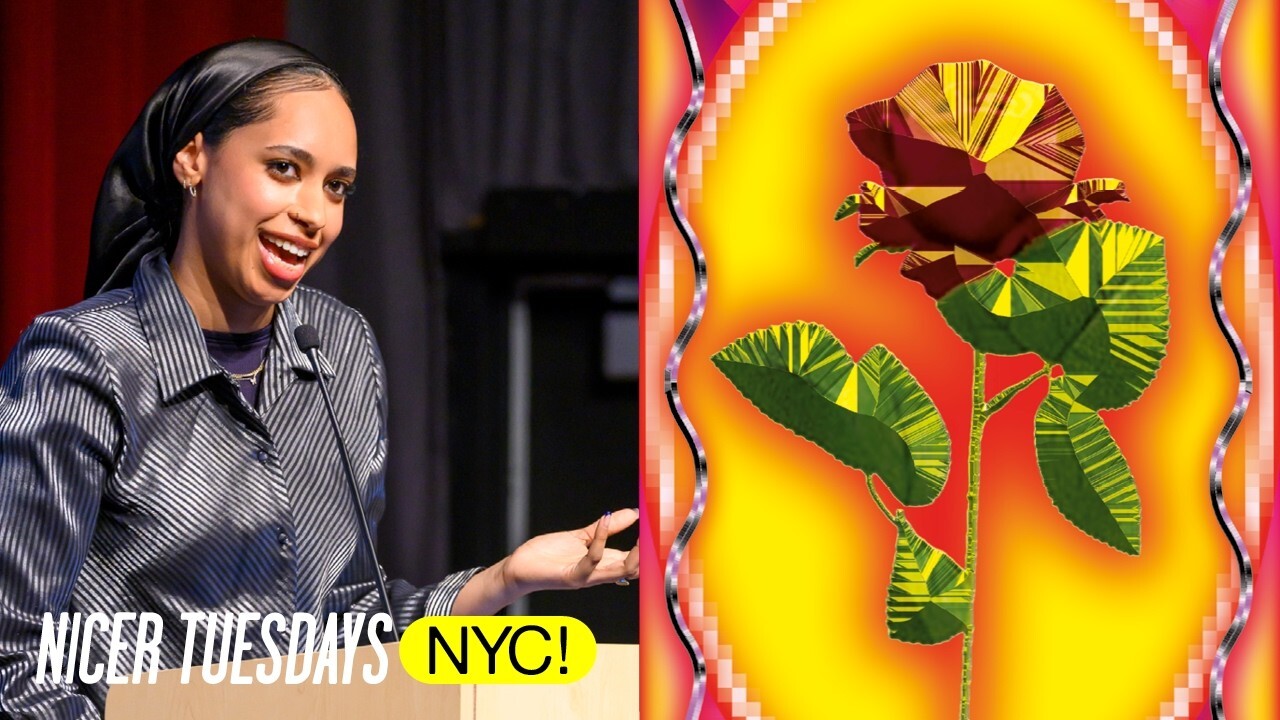
“I made it, you know, sickeningly colorful. And that means a lot that people will be stopped in their tracks and, you know, maybe take a moment to understand and learn about what's going on.”
Hi everyone. Um, sorry. So, my name is Sara. Um, I'm originally from Sudan. I was born and raised in London in the UK. Um, I went to did my undergrad at VCU Arts in Doha, Qatar and I later went on to go to grad school at the Yale School of Art. Um, and that's just a picture of my cat, Zola, for good luck.
So, I studied graphic design um for both my undergrad and my grad degree. Um, although I would say that now I do a really big mix of things. Um, I'm an artist. I just recently launched my own fashion brand called Sabah. Um, and I do a lot of other things and I'll talk a bit more about that as I go through it.
But my base is in graphic design and you'll see that influence in a lot of my work. So, a lot of my work really um is about inciting joy. And even if a lot of the topics I'm talking about are a bit heavy and um kind [clears throat] of intense, um I generally try to incite joy and think about positive ways to like look at a lot of them and hopeful ways to look at a lot of them. But before I get into my actual art practice, I want to talk about beauty. And I want to talk about it with these two images. Um so I love Shrek. I loved it when I was a kid.
I love it now. And not just because I think it's a beautiful piece of cinema, but also um because I think that it is really about this idea of like challenging societal norms of what beauty is. Um I grew up in London, like I said, and I predominantly went to white schools. I was obviously a black, Muslim, Arab little girl. And for me, a big part of loving myself um was I I really had to learn this idea of like challenging what people around me saw as beautiful. Um, and so what does that have to do with my art practice, you ask? Um, well, I'll get to it. Um, so as I said, I studied at an American
institution in the Middle East. Um, and the way that we were taught graphic design was very similar to how a lot of people are taught graphic design. It was based on like influenced by the bow house and Swiss design. And it was a lot of this, which is like less is more. Um, simplicity is key, etc., etc. But it was really interesting studying that in a city where I was surrounded by graphics that did the complete opposite of what I was being taught. And not only was I surrounded by these graphics, but I also thought these graphics were beautiful and they were breaking all the rules that I was taught um like meant things
were quote unquote good design. And so I spent a lot of my time um in my undergrad program really starting to challenge what these ideas of like good design are and trying to move away from this extremely minimalistic idea of design and move more towards a more maximalist um style and basically challenge this idea that only minimalistic or simplistic work is good design.
So the next thing I want to talk about is love. Um this project is a zen that I worked on um during co called good morning and it's a collection of these WhatsApp good morning stickers that are sent by loved ones in all different parts of the world but um I was very focused on the Arab part of the world because that was the one I really identified with. Um, and you know, I was working on this during COVID. So, my parents would be sending me these and as much as it was like, you know, it's kind of ironic, it's kitschy. Um, but it was also this really endearing and beautiful way that they were reminding us that
they were okay and, you know, we missed them and it was just like this beautiful thing. So, the outcome of this zen was really a archive of all of these images that I had multiple people had sent into us. Um, it was published by Water with Water, which is a experimental printing project I started with a professor of mine in undergrad, Nathan Davis. Um, and this project really started a lot of like my interest in the way that I started to design. And it came off that same idea of like finding beauty in these things that maybe we overlooked because we were told they weren't um, quote unquote good design or
well-designed. And so the next step out of that was that I began creating these kind of animations. Um, and initially I really designed these with just the intention that I'd be sending them to friends to like wish them a happy Eid or a happy Ramadan. And eventually I ended up sharing these and they went really viral. And I think there was just like this like a lot of people related to it.
They had seen and grown grown up seeing these things and it was really nice for them to see like a quote unquote more modern version of that. So, another thing that really attracts me about these um graphics is that they also are about like this idea of communication across borders with loved ones. And I'm someone who's moved around the world a lot. And so um I am constantly around loved ones, but I'm constantly far away from them. Um and I'm like always on my phone. I'm always talking to loved ones. And so for this project, um, I basically messaged all different friends of mine and I asked them to draw a flower on a piece of
paper and send me a picture of it. And then I also had friends of mine around me do the same thing. And I ended up with this beautiful collection of um, flowers that my loved ones all over the world had drawn. Um, and I decided to basically use this in a final design of mine for Crack magazine, uh, for their center page. Um, and designing this was hard. Um, it's obviously no one flower is going to look like another flower. Um, but it was so important for me to include every single flower because each one represented a different part of me. Um but you know I really had to let go of a lot of control
and like people who have studied graphic design you know that we learn about systems and design and this really just broke that rule completely but it was fun it was a challenge and um it was a really exciting project to work on and then the uh magazines arrived and I got to see the final design which is this um and the quote says no matter where I go you're always far away but you're also right here and it's really talking about this idea that like our our relationships but also on the tip of our fingers. Technology now we can reach out to and call our loved ones whenever we want.
And the last thing I'm going to talk about is joy. Um, and I specifically want to use this project to talk about it. Um, this is a the facade of the Africa center on Fifth A here in New York. Um, and when I was commissioned to do this piece, um, they wanted it to specifically center um, the war that's on been ongoing in Sudan.
And I chose um to focus it specifically on women because so much of my relationship with Sudan surrounded women but um I also in the war women have just been disproportionately affected. Um and so I chose the Tob which is this garment that is worn by women all over Sudan. It's just really a piece of cloth that is wrapped around the body in a specific way and there are so many different florals and patterns that you generally see on these.
And so to go about designing this, I basically created like a database for myself with different textures that I was seeing repeated in different images of toes um and then like florals, vectors that were I was also seeing and then I eventually took that into Photoshop and just you know I used to paint growing up and for me Photoshop just feels like I'm painting digitally and it's such a I have so much fun when I'm in there. Um I just get to layer and you know go crazy with it. It's fun.
Um and then you know this is just me like testing out the type things like that. And this was the final design. Um like the background of the final design. And um the biggest challenge working on this project was really the size that I was working at. I've never in my life had worked at something this large. Um I had struggled a lot with the file size.
Um and I learned a lot about it. But eventually we got there. Um, and it was installed and it was crazy. I was like getting teary eyed. I was like, "This is huge." Like it I had not even imagined the size of it until I really saw it um being installed like this. And the quote that I used is when the war is over, I will make space for my feelings. Um, and it's a quote that's actually taken from um a poet called Safi Helu. She's also Sudanese, and I've been the biggest fan of hers for many, many years. So, I reached out to her and asked if I could use her quote in this art piece and she was more than
welcoming about it and allowed me to. And um it was such an honor um to have you know a Sudanese woman's writing on there artwork and for it to ultimately be about Sudanese women. And so this is the final um installation and it's up there until May 10th. So you can go check it out if you want to. Um, and you know, for me when it comes to Sudan, like I've heard a lot of people say that no one really cares about Sudan. And I understand. I think right now there's a lot going on in the world and it's hard to focus on certain things. But this project in particular was so important to me because it's
almost impossible to ignore it if you walk past it because it's just so big. And I made it, you know, sickeningly colorful. Um, and I that means a lot that people will be stopped in their tracks and, you know, maybe take a moment to understand and learn about what's going on. Um, but that's it. Thank you.
Latest Talks
-
Murugiah
Why you should reject the formula and make art about things you love
Watch -
Amber Weaver
How does contemporary type design translate into the wider world?
Watch -
Delali Ayivi
How does photography give us the right to imagine our futures?
Watch -
Will Anderson and Ainslie Henderson
Bringing stop motion sorcery to BBC’s Small Prophets
Watch -
Ollie Babajide Tikare
The importance of not flattening the complexity of observation
Watch -
Marina Willer
Design thrives when you find poetry in the simple things
Watch