
Porto Rocha
Challenging industry standards means creating seats at the table for designers
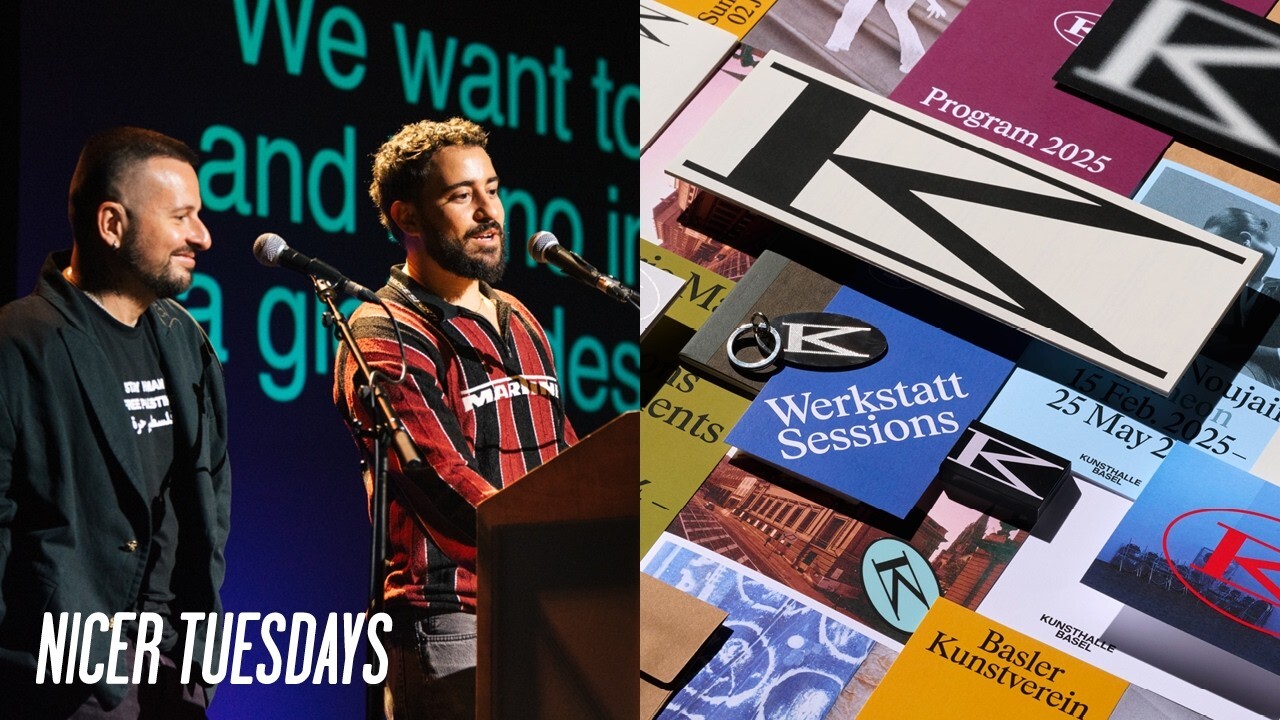
“We think designers are strategic thinkers inherently and should be part of every single conversation.”
First of all, thank you all so much for the invitation. Nicer Tuesdays. Really happy to be here speaking in London for the first time. We are Portoia. Hello. Nicer Tuesdays. I thought that slide was there already. We'll start with a quick reel so you guys get a sense of the work we do and then we'll we'll jump into the talk.
What the hell? [music] Hey hey hey down me [music] hey let me me down me down [music] me let me me down let me [music] let me Let me let me [music] [applause] thank you. Yeah, I was super excited to be here. Um, that's her name, Port Russia. That's what we stand for, which is very simple. Leo Porto and Philippi Russia. As you can see, we're not very creative when it comes to our own name, but it works cuz it it sounds fancy, but in reality, of course, uh Porto Russia is way more than the two of the two of us. This is a photo of um our team and this is a slide with every single person and I know we have only 10 minutes but I'm gonna run through all the names because I do think it's important especially because today is the first time that a lot of the men the
team members of of of port Russia are watching us which is a bit scary. [applause] So very very quick uh Philippi, Natalie, Ido, Samantha, Garrett, Fe, Jordi, Ibra, Joseph, Vika, Sia, Luciana, Pedro, Leo, [snorts] Marcus, Olivia, Martin, Gray, Hugo, Elisa, Celia, Larissa, Jan, Claren, Tales, Annie, Maya, Gabby, Victoria, Natalie, Io, Nathan, and the bill. That's that's why we're here and that's that's why we do the work that we do because of everyone that is part of of the team.
[applause] So this is our office in New York. We have an office in Bushwick, Brooklyn. And just very quickly to give an introduction to who we are, I think this is a really important slide where we talk about our philosophy, where we're positioned, and why we started in the first place. We always felt like there's an interesting kind of intersection between the world of design and culture and business and strategy. And that's exactly where we like to be situated, right in the sweet spots between these two worlds where on the one hand we're bringing really high caliber design work, an understanding of people and culture, but also making sure that every decision we make is still grounded in the strategic and business decisions that we've established for the project.
So while traditionally clients had to pick between smaller studios that had impeccable craft and design or a huge consultancy that had really rigorous strategic insights for business, we thought there was a way for us to kind of bridge the gap between these two worlds and that kind of drove the the reason why we started portro.
But to be honest, when we started kind of brainstorming around this, we were met with a little bit of skepticism. People are asking why open a design studio especially right now there's it's such a saturated industry there's so many other studios that are doing great and also you guys have great full-time jobs are you sure this is the right time to open yet another design studio and our answer after reflecting a lot about it was yes we do think it is a good time for us to start a design studio and back then in 2019 we wrote down five pillars that kind of drove us till this day I think these are as relevant as they were when when we first wrote this down that
I will take you guys through to kind of explain why Portoia was born to begin with. First and foremost, we're here to challenge. We're here to challenge ourselves as designers. We're here to challenge the industry, but we're also ch here to challenge the way things are done. We're here to challenge ourselves as individuals as well and what we can accomplish. But this is I think especially today in a world that's changing so fast, it's an extremely important u sort of mindset that we need to have in order to be to to maintain relevancy. Number two, we're we want designers to have a seat at the table.
This is also extremely important. This comes from our own experiences. We think traditionally also designers have been treated like tools where the strategists, creative directors, the stakeholders and smart people in the room, they're the ones making all the strategic and smart calls and then they bring in design to just make it beautiful. We think designers are strategic thinkers inherently and should be part of every single conversation.
Number three, we want to connect brands with people and c and culture in meaningful ways. What this means is that we think beyond just the surface level. We're not thinking about branding as a way to beautify u a brand or make it more appealing only, but we're thinking how can we actually use the power of branding and the and and how much reach and scale it allow us to have in order to be in dialogue with culture and people uh and create more positive impact through that. Number four, we will always be a designled company and not a business that happens to sell design. So, Philipe and I were both graphic designers who happen to have a design business. And this also comes, I think, from the frustration of seeing a
lot of business decisions from an agency side being made by people that barely understand what they're selling. So, when we're making design decisions, we really use our intuition as designers to make sure that we're protecting the quality of the work, that we're protecting the well-being of of the team members, and making sure that we we're not sacrificing our final output. And last but not least, we want to prove that queer and Latino immigrants can run a global design agency in New York.
[applause] Thank you. And now in London as well. So [cheering and applause] that's kind of our um reveal, I guess, or announcement of the day. We're opening and maybe you've seen this on social media because we we've been talking about it, but we're opening our London office in two days officially and we're extremely excited to be here to announce that to all of you guys. [applause] We'll have a party in two days. The list is almost over, but if you guys want to come talk to us, [laughter] we might find a way.
Uh this is a quick iPhone photo we took of the office in progress, so you can kind of see what the vibe is. And lastly, even though we're new to London, you might know us from some of the work we've done. I'll just kind of very quickly run through this. We did this Sundance Film Festival uh rebrand uh back in 2023. Twitch rebrand back in 2021.
Robin Hood rebrand last year, Nike Run rebrand also uh huge global sort of efforts uh that you guys might have seen here in London as well. And then also Google Gemini. So these are some really sort of large uh systems design that we that we've uh developed. But today we're here to talk about one project in particular with the last couple of minutes that we have.
Yeah, we chose this one project in particular. U it's a very special project to for us. It's the latest one that we published on our website and it's the visual identity for Kal Bazo. Um so let's let's travel to Switzerland. Const hope hopefully my my pronunciation my German pronunciation is not as bad.
Uh and for us it's such a full circle moment to talk about this project because we never imagined in our lives that we would be rebranding the most important art like contemporary art institution in Switzerland as Brazilians. We never thought that that would happen, but that happened. And I think that's part of the reason why why we're here as well.
And this is the building. It's one of the most important buildings in Basil. It's um yeah, Constale. Uh they've been around for uh over uh 150 years. Super important art institution. They're really important because um they're not really a traditional art museum. They don't have a um a collection, a permanent collection. They always have temporary exhibitions.
And throughout the years since they opened, they they had so many important exhibitions from legendary artists such as Van Go, Richard Sarah, Po and so on. But even more recently um they always are known by bringing emerging talents, new voices uh such as Enenhoff um John Jonah Superflex. So it was was really really interesting to work on this.
And then basically in 2024, this guy was appointed as the new um creator and director of the museum, Muhammad Amusibli. And uh with that new appointment also came his his desire to change things up and that's why we we got hired. And it was really really exciting to us uh to hear his idea of like how he sees uh this place. Um and I love this quote from him like this idea of seeing this space as a host whether it's um a living room, a gallery or an institution. So for us that was really inspiring to to create an identity also based on this vision that was super clear and we love this juxaposition of of the building and the work that they do this
connection about legacy what they've been they've done you know throughout the years but also this idea of like showing emerging art art for the future and this is so clear when you look at the building from the outside so traditional so classic, but then the inside is always a surprise and we really wanted to capture that tension in the work.
So this was the opportunity that we identified with this project to build an institutional brand with an anti-institutional spirit. So this opportunity pretty much guided us through the process um since day one and we we found a way to translate that vision into design in every single step of the way. Uh but before that before we jumped into design we actually went to Basil to see the the building to see the exhibitions to meet Muhammad. So these are some of the photos we took while we were there.
This also fun fact Leo took a bunch of photos that we used for all the mockups. Um that became the standard at Port Russia. Yeah, it really helped sell the identity when they're seeing everything applied to their real locations and real touch points. So I think I guess the point here being it's really helpful to actually do a site visit before you start designing.
Uh and this was one of the most interesting parts of of the project to really dive into the archive of posters, exhibitions. Um some you know like some of these posters we studied in school. So at the same time that was really inspiring. It was very terrifying because they have this great history of of graphic design.
And then we developed a logo that really plays between you know like this structure the tradition but also plays in this idea of like bringing more freedom to to the institution. So we created this symbol that it's a K as you can see but then suddenly it could also be a B depending on the way this so it's always it's a K it's a B we don't know um and here you can see how how it can flex through you know like these two sides of the identity which is so modular or flexible Um, and I think motion plays a huge role in that. This idea of this constant push and pull. It's constantly sort of morphing and adapting, but also has this really traditional structure behind it.
So, this is um the um look up, but then there are so many different ways we can apply the logo and I think that's the beauty of this identity at the same time that feels very institutional also breaks the rules all the time. And I think this is the best example of that. There's a fun story behind this image. When we met the director of the museum, the one thing that he said there in Basil was like, I want you guys to turn this institution upside down. And this is what we did literally.
Uh yeah, some other variations of the logo. And I think just to add one point here, this is a strategy we use to a with a lot of our clients as well and a lot of the brands that we design, which is on the one hand, we want to create something that has an visual anchor that people recognize over time. It's sort of like this obviously iconic symbol that people recognize, but on the other hand, it's contextually surprising. And we it can be surprising through how we animate it, how it behaves, how it sounds, uh the material choices or whatever it is we do to kind of give it surprising twist that keeps it constantly alive.
I also love the DVD animation is one of my favorites. Uh and then to contrast with the logo, we also introducing KB Rhymes. We thought like the most progressive gesture in this identity would be to bring a serif instead of a sincerif since most of the museums in in Switzerland they they have a sincer.
So we worked with maxi type to come up with a custom custom cut of rhymes and here you can see how that works. But then we also brought Swiss International as a way to, you know, make the Swiss vibe somehow a little bit. [laughter] And this is how the identity comes to life in motion as well. I like how motion feels very raw but refined at the same time.
We also play with the circular animation uh and some of the applications in context signage. This die cut signage that I I really liked here too. Um a lot of printed materials. I love this image. I think this image really shows this soul of this project and how you know an identity that is so institutional also can be so playful and fun and intentional at the same time. So I love this and this is more like an overview of of the spectrum of you know like of expression of the identity. And here you can see how this is something that we do for most of the projects like how can we you know create like this spectrum that goes from feeling very you know feeling very simple and standard
but all the way to feeling very expressive as well. And the same identity can you know intentionally play in different rows here. Um yeah, a few other applications and the website which is really fun to um changing a little how um art institutions the website they work and the idea was to create an experience that was much more immersive, very connected with the identity.
This is um one page of an exhibition. Very editorial, very immersive. And this is my favorite part of the website. Uh we also have a lighter and this also for the launch of the new identity they made a collaboration with Oter uh a brand that is I think they are based in Berlin but they are originally from from Basil and I thought that was such a flex.
I love it and it's so crazy like the idea of having like a big logo on a t-shirt and it still looks cool. I think that's that's so difficult to, you know, to do it, but they were able to do it because maybe the logo is really nice. [laughter] And lastly, this is a photo of two of our employees, Etienne and Claren, wearing the t-shirt.
Not the t-shirt, the shirt. [snorts] Uh, so yeah, that was Conale. And then uh one last thing before we finish uh this very short presentation. Um so basically yeah earlier this year I I had an experience in another design conference um that really really affected me and then I I decided to write about this uh just to you know to to to have in words like the way that I was feeling. Uh and then after I wrote this text, I thought about sharing with it's nice that for uh their POV series, but actually it took me more than a month to to get the courage to send to Elizabeth Goodspeed who is the editor in New York because I
was I was overthinking a lot. I was like maybe maybe I'm being too dramatic. Maybe I don't know, maybe I'm being too much. maybe it's not that serious. But then one day I was like, you know what? I'm gonna send to her. And then um right away, not just Elizabeth, but Liz and and some other people from from it's nice that they were very supportive of about, you know, like the my experience in and what I wrote. And they posted about it uh in June. Uh and I felt so much better after they posted the the article and the open letter. And so many people came to talk to me, you know, sharing a similar experience. And I just
want to finish this this talk saying that thanks thanks to this nice thanks for giving me the space to talk about it and also making me feel that I I belong here too. So thank you. Thank you everyone. Thank you. Byebye. [cheering] [applause] Sync to video time
Latest Talks
-
Murugiah
Why you should reject the formula and make art about things you love
Watch -
Amber Weaver
How does contemporary type design translate into the wider world?
Watch -
Delali Ayivi
How does photography give us the right to imagine our futures?
Watch -
Will Anderson and Ainslie Henderson
Bringing stop motion sorcery to BBC’s Small Prophets
Watch -
Ollie Babajide Tikare
The importance of not flattening the complexity of observation
Watch -
Marina Willer
Design thrives when you find poetry in the simple things
Watch