Na Kim is an acclaimed designer and art director at The Paris Review, known for her ability to balance multiple artistic outputs and for her insights on the creative process.
Na Kim
A balancing act: The challenge of juggling three artist outputs
“Creativity isn't a straight path; it's a maze of experiences that shapes who we are.”
Transcriptmay contain minor errors or formatting inconsistencies
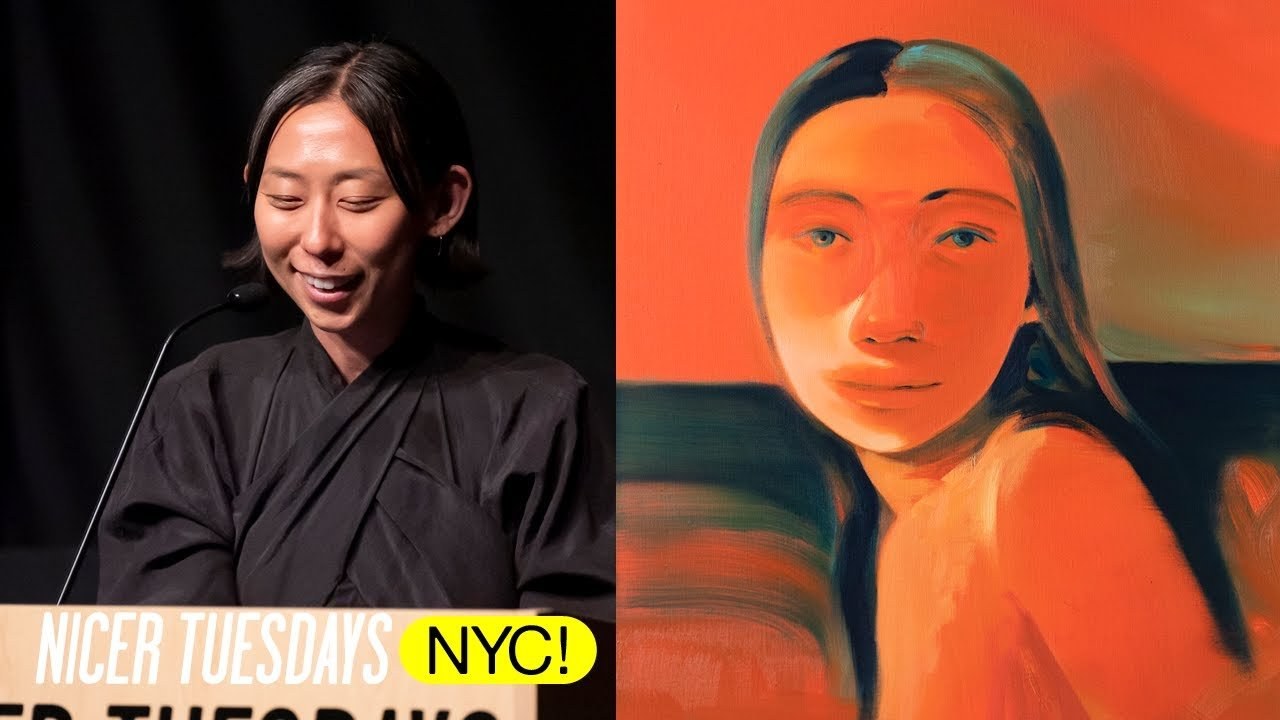
Guys, I'm scared. It's like the landlord from Animal Crossing standing behind me right now. So, , hi. Please forgive me, by the way. , hi, my name is N Kim, and thank you so much for being here and having me. , like Julian said, can we just say out loud how weird it is to talk about yourself? , I'm really in awe of anyone who could do this and you know, like I can feel my body dysmorphia kicking in. So, but , lately I've been trying to be less afraid of all the things. So, here I am. I had a really hard time putting this presentation together because I do a lot of things and I had a hard time boiling it all down. So, I guess the easiest place to start is by answering the question, what do I do? , well, I do a few different things and the first is that I currently work as the creative director of Ferrar Straeneru where I've worked since 2015.
I work there alongside creative directors Rodrigo Corral and Alex Murdo and an amazing team of designers and we create book covers there for literary fiction and non-fiction. , it's a really unique task I think that requires constant shapeshifting. , I like that each cover begins open-ended with the opportunity for new ideas and solutions each time. , I've designed a lot of covers over the last 10 years and these are a few of them. Since 2021, I've also been the art director of the literary magazine, The Paris Review. I often joke that there I serve as a onewoman art department. The job involves curating, designing, illustrating in many different forms, big and small, including merch. I do every spot illustration, editorial illustration, even the invite. So just anything art related. But my favorite part of the job is working with artists that I admire and learning more about their practice and getting to share it with the readers of the review. Some examples of the portfolios that we've commissioned since 2021 with the beta blockers kicked in I think. [Laughter]
I also still work as a freelance illustrator and that you know can be a lot of different things including editorial work makeup packaging whatever. , I'm trying to learn how to take less work, but still some projects feel kind of impossible to turn down.
And then in 2023, I started to paint. , I it's a practice where I paint every day. They're mimemetic serialized portraits. They're not me, even though you want to think they are. And a few months ago I closed my second solo show of paintings at Nicola Vel Gallery and without meaning to it's kind of become the focal point of my life and like you know my love and obsession and I also just make things for no reason like bread shoes, ceramics, drawings about my life. Stillness is hard for me. So, , how did I get here? Well, I guess I'll start at the beginning. , in 1986, I was born in Soul, South Korea. And as a child, I wanted to become one of two things, a painter or a doctor. And, , my initial attraction to art wasn't entirely pure. Growing up, art was the only thing my parents told me I could do better than my older brother. , they were kind of just like, let's let not have this one. So, I really needed a win. So, it stuck with me.
, and then I moved to the States in 1992 for the first time and subsequently moved back and forth almost yearly between the two countries until I was 15. So, like 15 times. I But Polly kind of stole my thunder by saying he moved 17 times. So, , my parents lived in two different countries. Often financially things were pretty bad. All in all, it was a pretty confusing and tumultuous upbringing. , in high school, I took AP classes and ran varsity track, but was also addicted to cigarettes, skipping class to the point of not graduating, and some heavy heavy shoplifting. , it's during this time that I discovered my love and skill for lettering through forging signatures. So, pay attention to what you're passionate about. , my dreams of med school were quickly crushed after a year of depression and one flunk semester. So, instead I needed to lean into the only other thing I really knew. So, I decided I'm going to art school where grades don't matter. , and I ended up going to Micah in Baltimore Maryland Institute College of Art. And I first enrolled as a painting major thinking I was good at it. But almost immediately realized that I wasn't good enough and you know becoming a fine artist was something I couldn't afford anyway.
So I spent the next four years of college kind of shifting between every major aside from graphic design and then eventually landing on illustration because it felt pretty practical and safe to me. Miraculously I started getting illustration work during my senior year and it seemed like I had sort of figured out my path. All my teachers were like, "You're gonna be fine." , but then I wasn't fine. I was was they were completely wrong.
, I knew how to draw, but I had knew nothing about how to have a successful illustration career. , I was broke, had no internet, no software, Photoshop, website, none of it. , I barely knew anything about working digitally, let alone like the basics of graphic design. And like I didn't even know the difference between RGB or CMYK which it turned out to be a very big problem.
And then you know like I just didn't even have a working cell phone. So like I would miss calls and commissions all the time and you know working at the restaurant meant that I couldn't take on the like editorial jobs that came my way because they had like a one-day turnaround. So, , I basically choked and gave up and decided that I was just going to be a full-time bartender for a few years. But during that time, it wasn't all bad. , one call I didn't miss was from Charlotte Strick, who used to work at FSG, where I work now, and she hired me to illustrate and letter book cover years after seeing my work at my senior thesis presentation. , I knew nothing about publishing then, but I love to read, so I was intrigued.
And in my mind, a design job signaled financial security. Like I wanted nothing more than a 9 to5. So, , and also it seemed like a design job where I didn't actually know how to design, which was like very, very appealing to me. And so at the age of 26 or 27 I asked if she knew anyone who was willing to take on an intern and she eventually got back to me saying that she knew somebody who could take me on for two days a week and I really had nothing to lose and so I started taking a bus up from Baltimore to New York every week for this two-day internship. , I lied to Patty, my old boss and art director at Bloomsberry about my design experience, saying I knew how to do things I definitely did not know how to do. , my first three months there were spent mostly googling and YouTubing her requests until I eventually figured it out. And like I don't know, like I really was like, "Oh my god, I have to do this." And to be honest, it really wasn't like a passion for graphic design that drove me.
I think my love and appreciation for design came later, but it was it was driven by more of a survival element. And it kind of felt like my oh my god, I have this one chance. And you know, failure didn't feel like an option.
So I was like, I'm going to fake it till I make it. And you know, in that process, I learned that delusion can often be backed up with a lot of hard work. And you know, the only thing that was really going to lead me to confidence was competence. So that takes a lot of work. And I worked my ass off. Like I really really hauled ass back then. , fast forward to 2021. I was living my dream of having a 9-to-f5. , I was now the associate creative director at FSG and also somehow the art director of the Paris Review. , on top of my new job at the review, between FSG and freelance, I think I was designing around 70 to 80 book covers a year.
, on top of that, doing a ton of editorial illustration work and also moonlighting a couple days a week at Apple as an illustrator. I kind of just said yes to anything and everything. That was the you know I think like co really people up in a lot of ways and that was kind of what happened to me is that I just became so addicted to working. It was kind of my escape and you know I started to really feel the weight of it and kind of found myself thinking often like I think I made it but am I actually happy with what I'm doing? I'm so sorry for this slide. I'm unwell. You know I was kind of living this life beyond anything I could have imagined. You know like this really privileged life. I I had done the things I needed to do but yet in a really up way without this sort of fear and drive to survive. Like I felt pretty lost.
But the Paris review was quite special in the way that it introduced me back into the world of fine art which I had kind of left behind and forgotten. Suddenly I was doing you know visiting galleries weekly doing studio visits with these artists that I really admired and just the cumulative experience of that really woke something up inside of me. I mean, I was like witnessing people following their dreams and giving it their all in real time. And, you know, the effect of it was really profound.
And , for a lack of a better word, it it's just so inspiring and it made me want to paint again. , but you know, like I get into these little obsessive spells where like these little side quests and I thought painting would be like that, like a kind of a temporary distraction from my day-to-day. And for instance, like right now I'm like obsessed with cooking and I've been doing it obsessively, but it's just really a coping mechanism and it will end and I won't cook for a while. Or even the time like I randomly dated a finance guy for a month for no reason. And I kept this intense diary of every single thing that would happen on the date to share with my friends as a PDF the next morning.
But I became obsessed with it and would stay up till three or four in the morning editing it until we broke up. But and I was like this is not sustainable and I let that go.
But I thought painting would be like that just kind of a temporary distra distraction.
So I really didn't have any expectations for it. I just wanted to see if I can do it and get better at it. And so I kept doing it and a few months later Matthew Higs Earth Angel and curator of white columns reached out randomly and asked if I wanted to show some paintings at independent art fair. And I was like what? Seriously? And I didn't understand it to the point I thought it was a joke. Like kind of like those movies where you get asked out to prom as a joke. And but he was serious so I was like damn I need to be serious too.
So, it was like I was like embarrassed and I was like, "Okay, I got to really really work hard and I wasn't going to waste that opportunity." so, I started painting every day with more intent and very seriously, like seven days a week. And every moment I had outside of my jobs was spent either painting or thinking about painting. And I I was completely obsessed and I still am. , and you know, in the process of all that, I completely fell in love with it. And like I'm scared to say like nothing has ever felt so right, but it does feel like that. And in addition to becoming like a full-blown addict with this, , it's kind of inadvertently become the a very like meditative safe space for me to get to know myself and go inward, whereas all my other jobs involve doing work for other people. And it's just a place where I feel really grounded and it's the feeling of like where my head you fills up and empties out at the same time time. It's like pretty amazing for me at least for now.
And then I don't know I guess like two years have gone by and here I am you know full circle. As a painter like weird about saying artist because I have imposttor syndrome. The art director in the Paris Review and you know still the creative director at FSG and sometimes an illustrator and bread shoe maker. And sometimes it can be difficult you know the dichotomy of my role as a designer which is to create solutions and then my role as an artist which is to ask questions and sort of create problems can be really confusing. Sometimes conflicting but also sometimes it's really great.
And then they kind of unexpectedly show up in projects and sort of converge and inform each other like the different practices inform each other in other exciting ways. I don't know. It's kind of fun, right? , and you know, like even though it was my original dream, if I look back, I don't think I could have become an artist at 21, in a strange way, I really think I needed to kind of experience all of these things to be where I am now. This loopy journey from derelict to waitress to designer to art director to painter to who knows what. , you know, it's how I found discipline and it taught me how to see in new ways and it still does. And you know really learn the value of having your own voice and to appreciate the voice and perspective of other of others and you know to recognize opportunities when they come my way. It also granted me the financial freedom that I personally needed to allow myself to dream again about what I really wanted. And it, you know, gave me the confidence to at least try.
And I'm not sort of glamorizing this idea of maxing out and having three jobs. Okay. That's not it. , I don't think it's about being a girl boss. No offense to any out here in the crowd today. , you know, it's it's not really the healthiest way to live if I'm being honest. And I wish I knew how to live, laugh, love a little bit more, but for better or worse, this is the only way I know how to be. And it's something I've sort of accepted and that I'm working on at the same time. Anyway, the point is I don't think we always have to recognize the path that we're on to we're on to move forward. It's not always a straight path.
I think it's for me at least it's more about just doing the thing because for me at least I don't think the path ever will end and it'll just keep going and going. But so I guess maybe it's not about that. Who knows? Like quite frankly I don't know.
But I think maybe a good place to end is that maybe sometimes it's better not to know. Yeah. Thank you.
Latest Talks
-
Murugiah
Why you should reject the formula and make art about things you love
Watch -
Amber Weaver
How does contemporary type design translate into the wider world?
Watch -
Delali Ayivi
How does photography give us the right to imagine our futures?
Watch -
Will Anderson and Ainslie Henderson
Bringing stop motion sorcery to BBC’s Small Prophets
Watch -
Ollie Babajide Tikare
The importance of not flattening the complexity of observation
Watch -
Marina Willer
Design thrives when you find poetry in the simple things
Watch