
Alex Tan is the founder of Mouthwash Studio, known for its innovative multi-media projects that blend graphic design and art direction.
Mouthwash Studio
How Mouthwash Studio make creative decisions across the multi-media landscape
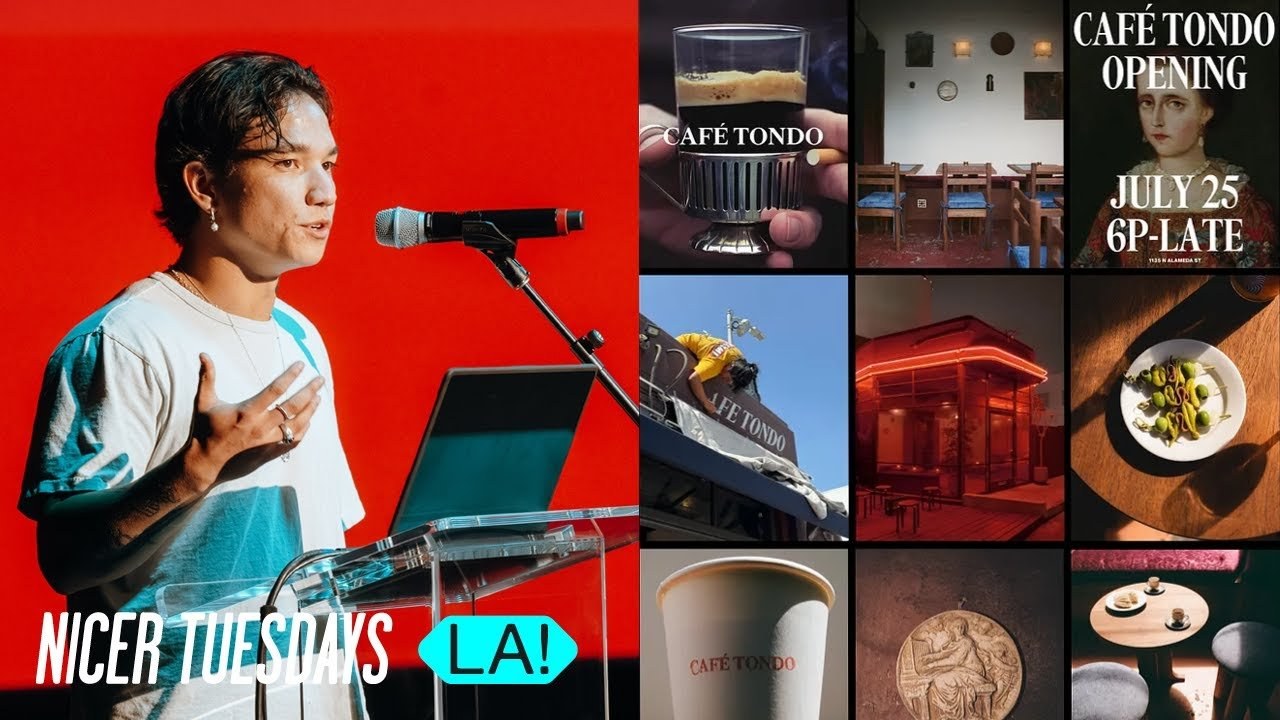
“There is no right way, just the creative way.”
Transcriptmay contain minor errors or formatting inconsistencies
Heat. Heat. Heat. Heat. Hi everybody. Well, first of all, I just want to say thanks to It's Nice That and for bringing this like wonderful series to Los Angeles. It's something that we've watched and admired for a long time and we just feel super honored to be be a part of it and to be here tonight with you.
So I have a lot to get through get through. So lock in. The title of the talk today is called designing the world that we want to live in. Which kind of leads to this thought that I think every designer has which is I'm literally going to design everything.
But I think like the thing that we want to talk about today and kind of take people through the journey of is yeah kind of this journey that Mouthwatch Studio has been on. And to to us, I think we exist much greater than a design studio or an agency, but really a group of people that have great ideas that s a different kind of intersection that kind of really push culture forward.
So I'm going to start with the studio. Mouth Studio again is a design studio. We're centered on new ideas and defining experiences. And we've gotten to do that for some really wonderful brands. I know you've seen that in that reel, but everybody loves a nice looking logo list. And and we've done this with between the four of us partners Abe, Mackenzie, myself, and Ben with the help and support of like 20 plus wonderful full-time team members who live across the globe. And hundreds and hundreds of freelancers that make it all happen. Those people who I think are the best most talented people in the world kind of exist across six different departments at the studio strategy our direction design operations technology and motion and these are like kind of the core the the core areas that we feel like really make a mouthwash studio project special so I'll get more into that in a minute but again my name is Alex I'm the strategy director and co-founder at Mouthwash Studio we started the studio about seven and a seven years ago almost six and a years ago.
, and we've been on such an amazing journey. , a lot of people ask like what's what what is strategy? I don't even know what that is. And the simplest way for me to kind of explain that is that strategy is the exercise of using context to build confidence around creative ideas. , and sometimes that just starts with like listening to people in a conference room worry about stuff. , and trying to like create a sense of clarity out of that. , or combining that with things that are happening in culture, right? So, what are the signals and the cues that the things that are happening in the world tell us about consumer behavior and the way that people respond to things? And hopefully the the thought in all of that mess is that it ends in a moment of clarity or whatever it feels like to look at this crunchy sunset.
I think maybe it looks more like this in a practical sense. , I think we like to take the work up front to to really ask questions to to really get an understanding of what it is that we're going to do and how we're going to do it. , which then leads us to a really clear concept and a design that is not only beautiful but is beneficial and effective for the people that we're designing for. , I'm also a writer, which is I find to be quite a horrible thing.
, I'm also a tennis player, which I also find to be quite a horrible thing. , and I'm also like a jazz enthusiast. , I don't play jazz, but I'm sure that would be horrible too if I did. , so often times I find myself like this in the world just trying to like enjoy life in whatever way I can.
But I think strategy really for me is not just like my job, but it's the way I think about things. It's the hobbies that I have. It's the it's yeah, what I like to do, the things that I'm attracted to. , but regardless about like me and aside from me, like I think today, and this is an illustration from an illustrator named Tim Urban, who's amazing. , you know, at one point in time we were born like seven years ago.
We were born actually nine years ago, but I'll get into that in a minute. And we made a bunch of decisions that have gotten us here today, , here at Nicer Tuesdays. And thank you for being here. And we're going to make a bunch more decisions in the future, and that's going to lead us somewhere else. And I don't think there's a right way of getting to where it is that you're trying to go, but I do think the decisions that you make are important for getting you to where you're trying to go. And often times we look at design studios, we look at artists, we look at like the wonderful people that we admire in the world and all we see is the tree, right?
But we don't see the things that are kind of happening beneath the ground and and realize that the the distance of what's actually been rooted in the ground is sometimes twice, three times, four times longer than what we actually see out on the surface. So, , enough about the studio. I want to talk about Instinct.
I want to talk about, you know, 9 years ago, , I moved to Los Angeles. , eight and a half years ago, nine years ago, I moved to Los Angeles. I met, , Abe and McKenzie. , and we had this really genius idea to start, , a print magazine because that's a really great way to make a living. , and and and the idea was that what if we actually made something that didn't have to live online? Like, what if we made something that didn't just go on Instagram and people scrolled past? And so, , we gathered up all our money. We talked to all our friends who donated their their time and their efforts to make what we called mouthwash magazine which at the time was uh you know an expression a visual expression and a verbal expression of the things that people were thinking about that had different themes. And the idea of mouthwash was that it was a breath of fresh air something different something that isn't common at least in the world that we were operating in. , and while we were making that magazine, you know, we were like, man, if we make this, we spend all this money on it, like, who's going to buy it? , and so we had this initial idea to create a podcast in which would create an audience to to kind of hopefully buy it whenever it came out, right? So, we started talking to some of our our the people that we admired, some of the people that we thought were leaders in the space, and gave them an opportunity to talk. And sometimes the episodes sounded like this.
>> Season four. >> Okay. So, >> dude, starting is always the hardest part. I know. >> Once we get this dual lingo straight, like we did a whole thing in French. Just chat. >> Okay, let's start. >> Hey, let's just chat. >> Yeah, let's just try. >> It wasn't always great. , so we we start to build this audience, right? And mouthwash becomes this thing that's online. It's a place to tell stories and you know we're like man we got to celebrate like this magazine's coming out like we got to make it a big moment. And so in Chicago at the time we booked a venue that for a launch party to launch the magazine that would hold maybe 100 people and the poster went viral and 600 people showed up and and that was really kind of the moment in which we were like I think we have something special here.
I think we've put something out in the world that people like kind of care about, right? , and that really kind of gave us the confidence to to keep going and we we created a digital platform to tell even bigger and better stories. , so we started to host long form interviews and , different types of storytelling with people that we admired, especially in LA as we were just kind of moving our moving here and kind of getting familiar , with the city.
And we also developed like objects and clothing that would be sold through the e-commerce site as well. So really we started to build these worlds around Mouthwash and the people that we were kind of collaborating with and and Mouthwash in and of itself kind of became a brand, right, where everything was considered like the the promos, the the website, the the the way that we activated it when it was time to sell or time to to launch something. And eventually people started asking us to do it for them. And so a couple years into that we opened up Mouthwash Studio.
This is one of our first offices in Chinatown. And really the curiosity that led through all led us through all of that really started to lead us to cultural leaders in the space which led us to projects like Waka who's an amazing furniture designer here in Los Angeles director Solomon Lightheel who is in New York City and even like fashion brands like Goodfight who is a LA based designer fashion designer.
So the strategy for us was really simple and it was like go find people who are doing really interesting things and things that we really care about and then go do what we're really good at for them, right? And so it created this magnetism I think around not only the brands that we were serving but around who was the people behind that is kind of elevating some of these brands that are or these makers in LA. And so my first takeaway from all of this is that like before you have money or before you have connections or resources or experiences, like I think the one thing that we all have is is instinct. And so for us, like to follow that instinct, to follow the thing that you feel like you should do is a strategy, right? It just hasn't really been named yet or you don't really realize it until it's over. And so that's kind of that kind of really guided our early years. And as we get into the studio, like you know, we think about like why we exist, right? There's a million agencies in the world. There's a million people designing and doing amazing stuff all over the place. And the thing that we've kind of settled on and other people have probably said it too, but I think we have a different lens on it is that like we really exist to influence culture. And so for us what does that look like? For us, the lens that we view that through is is paying attention to what has been ancient and true since the beginning of human history. What has been good will always be good. What are the stories and the things that people resonate with and tell their friends about and sit around the fire circle and and share stories if people do still do that? Juxtaposed with like what are the needs of consumers today? What are the platforms that they're on? What are the way that they kind of move through the world? And so that approach has always been the same and whether or not that's like a technical problem like it was with Air Company. , and sometimes that's like an emotional problem like it was with like OEM, , or an emotional thing to tackle. , the the objective is really always the same and it's to bring some level of clarity to complexity. And so regardless of the industry, like it's really kind of allowed us to like be really malleable and adapt to the different types of industries that we can accomplish this in. , and so I'm going to show a few of those a few of these projects or examples of these. One is a brand new project that has just come out for seed which is a probiotic company based in Los Angeles. They're one of the you know most successful direct to consumer brands of the last decade I would say. And they came to us asking the question how do we take our brand that feels a little bit static and put it on a scale that can adapt to be humanly expressive but also scientifically precise and it looks a little something like this. Heat.
Heat. Heat. Heat. Heat. Heat. Heat. Heat. Heat. Heat. , Bass is a company owned by Coinbase, , which is, , their Ethereum L2 chain. , they rebranded and came to us and said, "Hey, we need this to be a big impact moment. , how do we put this all together in one video that feels like something that could really kind of move the needle for the people watching? Heat. Heat. Missouri is an architecture firm in Barcelona. They came to us after 10 years of being in practice saying, "Hey, we actually want to evolve who we are and what we stand for and what we're capable of." coming to us knowing that architecture is not just about a building but its relationship to the environment, the people that walk through it, the objects that fill the space. And so we really trans helped transform them and reposition them into a model of a model for creativity. And the North Face came to us asking us what does it look like to inspire the next generation to to connect back with nature. , and so we helped them stand up a multi-yearlong , , initiative called the power of nature. It's our nature to be in nature. The iron in our blood was born in stars. Our breath borrowed from the trees. Nature isn't quiet. It's calling loudly, urgently, and wildly. As we've surrounded ourselves with screens and noise, we've lost sight of ourselves. But step outside and remember, when we're out here, we reconnect to who we are and who we can become.
That's the power of nature. And finally, we created a global digital experience for Nike's After Nike's After Dark Tour, which is a series of nighttime running events for women across six different cities. AC across the globe.
So for us when we talk about influencing culture, it's really about this act of participating in it and and participating in the makers and the brands that are are deeply rooted in the in the way that we engage with the world. And so, , for us, the Nikes and the the the Seeds and the North Faces of the world are great, but even at a smaller scale, , really partnering with people that we felt were, , really kind of influencing the way that we navigate life, , through, , you know, Wakaaka, furniture designer or, , a good fight, the clothes that we wear on our bodies. , for us, like really getting close to the core of what people care about and are paying attention to, I think is , really what moves the needle for us.
I think all that is held together by a belief that kind of glues the team together and one of those things is like commiss a commitment to holistic work. I always say that like mouthwash studio is not really a service. It's more of like a product. I don't really want to look like this guy. I don't really have aspirations of being a landscaper.
But I think like one of the main differences in what we do versus like what other studios do is that you know we have a belief about how we go about the work. And so it's not for us it's not about accepting the check and then being told what to do.
It's more about joining that person in partnership to you know follow our our proven practice and a proven way of how we actually get to great results. There's an amazing quote by Blair Ens if you don't say this is how we do it clients will tell you how they want it done. And so I think we've really kind of held this close and hold this idea close and and because of that have developed a structure for the type of work that we take on.
So we call this holistic work. Really it's it's in our best interest to do work that kind of sits at the intersection of design, direction, technology, and strategy. It's what makes mouthwash studio work mouthwash studio work I think is what we've realized over the years.
And only coming in to do part of those part of that project or multiple parts or only like you know half of it or one of one part of it has never really resulted in the five projects that I I showed earlier. So for us, like we're really focused on this centerpiece. , and often times that puts us in a position where we have to say no to things that come through the door.
But I think it's made everybody happier. It's made the work more impactful. , and really committing to that to that vision I think is something that like really holds us all together. The other thing that we , talk about too is like team standards. , some of you might know who this is for those of you who care about sports. , his name is Mike Shasheesky. , >> Shashevski. Shashef's key. >> And if you can't remember that, you can just like imagine him in a chef's outfit. , he's one of the most accomplished like men's basketball coaches of all time at the University of Duke. , the most decorated for sure and the most wins in division one history. And I think one of the most astonishing things about his approach is that he never had any rules. , he had what they called standards. , and that's something that we've kind of adopted at the studio. , and so this is kind of our manifesto and things that we've kind of agreed to as a team.
And , it's not rules that if hey, if you don't follow this, you're going to get in trouble. It's more like, hey, if somebody drops the ball here, the commitment that we've made to one another in this working environment is actually broken. And so what are we going to do about it? Right? And so there's things like every project is a case study. Like everything that we touch is something that we're going to be proud to show. , the the work reflects our skills, but it's not our identity. Like these are these are the reason why things don't get taken personally. And critique or feedback. , or to just remind people to say things simply and and try to say like more with less. , but I think like the thing that Mike Shashevky says about this difference between standards over rules is that rules don't unite a team. , standards do. And actually when you commit to that standard, you actually commit to each other. , and so we are really inspired by that. Hoping that there's some translation of being the most decorated coach in men's basketball history to being an accredited design studio, but we'll see. We're still testing that.
I think the the main thing from this like around this idea of belief is that it belief really is a force. Like it turns distance into connection. It's what allows like a team of over 20 to work globally with each other day in and day out to to stay aligned. It turns talent into chemistry where relationships kind of get formed within the practice and it turns the work into something that the world can actually feel.
So I think like it's easy to see when work is maybe not made with conviction, right? And so these are the standards and the things that we've agreed to as part of the studio. And the other part of what it is that we do is is the curiosity. So, I'm going to go through a couple of different things here, but the first thing is a vertical that we have called research center, which Elizabeth mentioned, just a moment ago. But for two weeks out of every year, we shut down the studio, the client practice, and we just give everybody the opportunity to freely explore. And some of the things that have come out of research center have been like so extraordinary, right?
Like the opportunity to do things that you've never you don't have time to do because you're in Zoom meetings all day or you're replying to emails. Like what if we just took a break, right? Like what if we actually invested in our curiosity to understand how technology was changing, how it's going to impact our industry, how the needs and and the the ways that we go about things don't get dated because we're just always doing the same thing over and over again. And so for us, like we really invest in this pause. We invest in our own curiosity and our own creativity to just give ourselves a chance to explore what is actually out there. If we gave ourselves a chance to to really explore that, right? Nobody's going to give you the chance to explore besides yourself.
We also do a newsletter called findings which is really kind of a pulse on the invisible forces that are kind of pushing our culture forward. , this is part of what my team does at the studio in which we write about a number of different topics that are kind of coming top of mind as we're kind of working through work and kind of giving us a a place to to jot these things down. , it's on Substack, but there's like a story that we just wrote about a cafe that we just opened about this idea of presence and how important presence is in a digital first world and how that's only going to become more and more valuable over time.
But even things like are we running out of brand names or what happens if we just stop everything? Like what happens if we just stopped going to Zoom meetings? I don't know if anybody wants to try that. Don't tell them I told you to do that.
But we also have like taken design off the screen, right? When we got our newest office in Chinatown, we kind of set out to say, what if we did this differently? What if we designed an office that felt more like a living room as opposed to or a home as opposed to the office that we see over and over again? And so collected artifacts from all different different regions of the world and different centuries and we worked with a really close collaborator of ours, Aunt Studio, to kind of help design the space.
This is my dog. His name is Miro. He's perfect. But but like even like taking that interest in what can design be? Can it be something bigger than something that just exists on a screen? And that curiosity became an even bigger beast in which we opened up a cafe called Cafe Tondo. I don't know if anybody's been here or not and it's in Chinatown. But it's been like an amazing endeavor.
We didn't get hired to design this space. We we are owners in in the space. With the bet that physical presence is actually going to be something that the world needs and will continue to need. , but it's been such an amazing like brand exploration, right, of like what does it look like to have brand and experience for somebody to walk away and been like, "Man, I just had a really great time." , and that can come to life through graphic design, through food, through interior, through space. , people love it, which is great.
Thank you, Eater, and wallpaper and resi. , and on any given night, it it looks like this. , or mostly on the weekends. Don't get scared. It it it's chill on like a Tuesday or Wednesday.
But it's even it's it's become such a cultural reference point that even artists like Tam and Paula have asked us like, "Hey, can I come play a set?" >> I run back to the dark.
Now I'm sticker up. My friends are saying just get in the car. I just want to be right where you are. I'm not going to play the whole thing, but so my point is here is like curiosity isn't what we do or what you should do when you have free time. It's it's really how you make time matter. I think we all have the time somewhere.
But I think the things that feel like we don't have to do it are maybe some of the things that are most important. It's like really what keeps the heartbeat of the studio alive. It's really been in our DNA since the beginning where we never had to wait to be told what to do. , and so curiosity and instinct are these things that I think like really continue to push you forward.
, and so I talk about this and I talk about the studio, but I I want to talk about the future as well and and kind of what Mouthwatch Studio will will do next ultimately. People are like, you've done literally everything. Like what could you possibly do next? And I don't think we think that way. Some people like think that we've already pushed the rock to the top of the hill or whatever.
So I have a few thoughts. Maybe if we keep around we'll find out. Which is not a bad trajectory according to this guy. You know maybe maybe if we keep being positive we'll find something on the other side of the rainbow or maybe if we are more productive than everybody else which is this is me every day those frames you know what I'm saying but like yeah all that aside like I think the real question is like are we as a team and as individuals and as designers in the world like moving towards what matters to us or are we moving toward what matters to others and and that's a chase, right? It's a choice that you have to make in terms of what is it that you're going to do that actually matters to you and and again what's personal is actually universal like Elizabeth was saying earlier. So when we talk about the world that we want to live in, back to the title, like I think we really imagine a world where like ideas really create momentum, where design actually imagines what doesn't exist yet. And where creativity shapes how we live, not just what we see. , and so to think about what that actually looks like, I think we are on a mission to not just keep doing the wonderful things that we do at the studio, but to design runway shows like our friends at Pone Studios or design retail spaces this wonderful one from Acne Studios in in Sweden. Design cultural institutions.
To own fashion brands, not just service them. To maybe get back into print publishing because it still feels like something that we love. To publish our thinking, right? Malt Müller web design is architecture or even if somebody really wanted us to to design a city like Space 10, right? And so my point is here is that like design is not limited to graphic or illustration or decks or whatever it is. It's really whatever it is that you can imagine it to be. And I think through that like design has this power to actually shape the world that you want to live in and and will navigate. So you know today as a studio we use service culture but I think tomorrow we're going to create it. Thank you.
Latest Talks
-
Murugiah
Why you should reject the formula and make art about things you love
Watch -
Amber Weaver
How does contemporary type design translate into the wider world?
Watch -
Delali Ayivi
How does photography give us the right to imagine our futures?
Watch -
Will Anderson and Ainslie Henderson
Bringing stop motion sorcery to BBC’s Small Prophets
Watch -
Ollie Babajide Tikare
The importance of not flattening the complexity of observation
Watch -
Marina Willer
Design thrives when you find poetry in the simple things
Watch