
Lakwena is a widely loved artist known for her vibrant use of color and large-scale works. She draws inspiration from songs and diverse themes, making her art distinctive and engaging.
Lakwena Maciver
Lakwena on why songs, colour and large scale make her work fly
“I've always believed that working on large scales allows me to connect with the world in a more impactful way.”
Transcriptmay contain minor errors or formatting inconsistencies
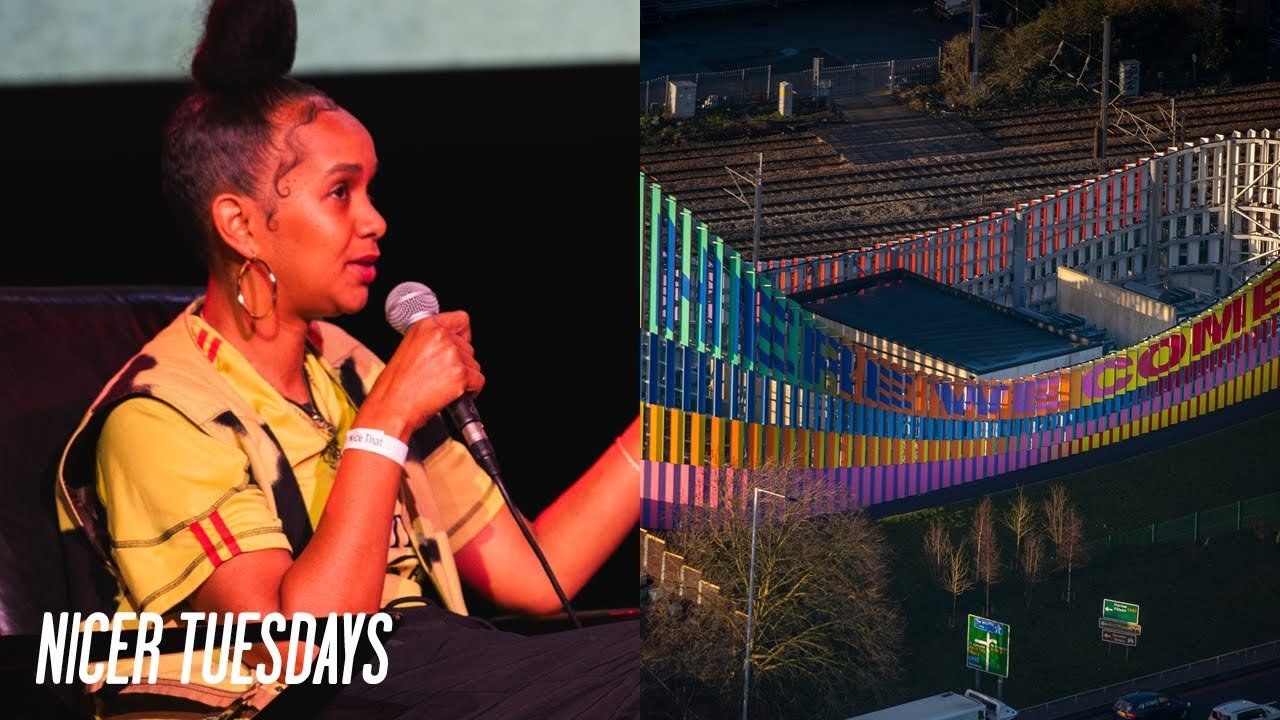
Hello hi hi everyone hello how are you doing yeah I'm good thanks you're good yeah it's nice to be here really nice to be here I'm excited to talk to you this evening actually before we start I saw your artwork here we come here We rise on the M1 at Brent Cross for the first time the other month I drove past it well no actually I didn't drive past it I can't drive which is embarrassing to admit on stage but it is massive I don't know if anyone maybe some of you haven't seen it.
But it's a wrap around electricity substation right there's images of it on the screen in a second is it it's bigger than the Angel of the North right is that true bigger or equal to something like that I can't remember what in notes somewhere.
But yeah it's yeah and is it weird do you feel responsibility for it do you visit it often and wake up worrying about it I I have a license but I don't drive either okay great so we're in it together.
So I yeah I don't get to see it that often but people tell me about it which is really nice and that was a collaboration with Architects if do I should say so it wasn't me on my own involved a lot of people making that happen but yeah it's it's a really special one that I think also when news broke about it I remember seeing this statistic I looked up up again actually before this interview it was estimated that 6 million people would see it every year by car and train which is incredible numbers something I wanted to ask you about that is sort of What kinds of spaces you want to make for people because six million people there's millions of people every year seeing that on their commute and it's shaping their you know their daily they basically their dayto day yeah what kind of spaces do you want to make for people what do you kind of think of as an ideal space when you thinking that way I guess I think a about when people ask why make work what reason it started it started out of a place of feeling like life was really difficult and trying to make something that was hopeful out of that.
So in terms of the spaces that I want to make I guess I Want To Make spaces that are that that give hope that point to hope for people.
And then also I guess a huge part of it is like also that that is a a direct impact thing like so many people some of the first things they say about your work is color or how visually impactful it is I just did talking about the size of that substation I kind of like to go back a second to understand that a little bit what are some of the earliest kind of visual memories you have or references that really impacted you growing up can you remember any that's also quite a hard question I'm asking you to remember when you're like five or whatever yeah. I was thinking about this the other day actually cuz someone was asking me what are your Inspirations yeah kind of thing.
And I'm often when people ask that if you're not in the headp space you're like I don't know color I don't know but but I was thinking about it the other day and I realized that I was thinking about Sesame Street actually not that. That's necessarily the biggest but I was thinking about Sesame Street I don't know how many of you guys watch Sesame Street growing up.
But I was thinking about it it was great the old ones and what was noticeable about it was that the the words you know they made a really big thing of each letter of the day or letter you know the letter and the number and it was incredible basically that the the just the visuals in there.
So I think that was things like that I think when I when I think about what has had an impact on me and and sometimes people like oh what artists you like or what kind of art do you like definitely the stuff that impacted me more has been stuff that is just part of our everyday visual culture which probably in this Gathering most of us probably feel that way things like yeah like music for instance music album covers adverts that I might have seen in my in my brother's basketball magazines that type of thing.
So there was nothing I didn't have like a super cultured upbringing or anything.
But I think just those kind of everyday things that I was gathering I remember random things like my dad in one of his jobs well he he had a lot of jobs and he had a folder of business cards quite old school it was like kind of long I think it was probably two by4 business cards you know with like plastic wallets and I remember looking through that as a child I was probably about seven and really interested in like the bits that were emboss the gold bits the flags you know.
So I think little memories like that it was always words typography yeah that was always what captured my attention yeah cuz it's interesting what you're saying there like song lyrics slogan Sesame Street the the best example of those there so often in your work I mean there's a lot of protest imagery you know Banners are a big theme.
But then.
There is song lyrics you know like I feel like some of them are like Florence nine Karine Lee you know what is it about Sol lyrics what do they give you like what about that kind of helps you in a visual context and especially when we think about like protest images they're being so direct messaging the like comparing that in comparison to how open saring lyrics are or like how many different ways a pop song could be taken yeah what about song lyrics is that that really helps you in your practice I think so I I've come from quite a musical background like I was always singing growing up my my mom was always singing out our family's Always sung music is really important part of like I guess our family culture and I think the interesting thing about songs is the way that they repeat you know it's almost like a mantra it's also something that people do together in unison and yeah you repeat a verse or you repeat A Chorus it's a really it's almost kind of meditative and I think there's something really powerful about that you know thinking about what you're singing the messages that you're singing when you think about the songs that we sing in our culture the songs that we just play on the radio the things that we're hearing again and again so I think the reason that.
So I just connect with song lyrics I think they're beautiful and I also love the fact that they are something that people can connect with and I think a lot of my work has been trying to find ways of I guess trying to find ways of connecting with people.
And that's what songs do and I I always sang growing up and my sister actually she she went down that path and became a musician but in a way I've my work has become almost like a visualization of song in a way okay to some extent yeah and it's interesting there cuz you're saying it's kind of almost not even like the words of the lyric it's that recognition that we have yeah nice I think maybe jumping forward now we've talked a little bit about the artwork at Brent Cross but then you've also transformed a juvenile detention center in Arkansas barket B ports there recently the front steps at christe's the auction house so obviously hugely different clients I can imagine super different demands but what's a good commission for you in in your mind what makes a good canvas for a public artwork. That's a great question it's nice when there's creative freedom M obviously boundaries are also good as well though you know sometimes someone says you can do whatever you want and you're like you it's just too too too blank the canvas is too blank I think you know like in terms of like a dream dream commission or dream project I'm really interested in things that involve Community one of my favorite projects that I worked on was for fuchi and it was oh yeah it was a Zen right that all that might be a more recent it it was a whole collection right and they basically gave me a lot of creative freedom it was a bit chaotic like the whole way it was it wasn't like kind of a well Machine you know it was quite but I so I designed the collection.
And then we also did a shoot we worked with this photographer Ruth oai who's a friend and I again it was Rel to music. Actually my sister was part of a choir growing up. And so we did like a reunion of the choir oh nice and they wore the clothes so we and we did it at a local community center the whole thing it was so much fun cuz it really felt like holistic and it was about the clothes the patterns on the clothes obviously but it was also about the community that came together to make this thing happen and then we made a Zen that kind of documented it.
But that for me was amazing to work on a lot of work you know involved so many layers but so much fun because yeah it just it just it connected in in so many ways you know not just an image but in all these ways it brought people together I think also when you were speaking then something that came to mind that I think about all the time with your work is that images of specifically like looking at an image kind of level hands always come up for me in your work and also when we're thinking like you were saying there about a community you know these hands are often like outstretched reaching out and they always stand out because they're quite figurative in these like very graphic against these very graphic backdrops where has that come from for you is it quite instinctual to be drawing hands yeah where's it come from I think hands are there.
And I use them so much in my work I think you know obviously I'm I'm doing stuff with my hands um that's where it came from really I think the first time I used the hands was in oh was in a painting obviously I did a painting in my home I took over my my home. Basically during Co during lockdown I painted my home.
So I made these paintings I hung them on the walls I painted mes around them.
And in one of the paints ings it it was it read this will be a safe space and it had these two hands reaching down I think and I don't know why at that point I decided to put them in but it was it just felt like I needed to do that. And I think I wanted to move Beyond just words you know I painted two portraits many years ago like in 2011 I think and so that that was the first time I was painting something figurative but it it was really nice and then I ended up I made a series of paintings about basketball called the jump paintings and again hands obviously are a big part of basketball.
So I decided to use the hands in that as well. And it just it made sense to me because it was this idea of connection and hands can can can really be a beautiful way of conveying that you know yeah and also Sal a is a theme that comes up in my work and the hands were coming down you know from above and I think these are some of the themes that I've been like playing with and and kind of exploring and thinking of ways of communicating that.
Basically it's so true what you were saying about gem paintings there because they do show up differently like the fact that in in that series it looked like they had just thrown a basketball. There was like a lot of different aspects the maybe for people who don't know about Gump paintings could you tell us a little bit about why you were thinking about basketball during that time.
So basically the you mentioned the the Juvenile Detention Center in Arkansas so I I was commissioned to to do basically take over this really gray depressing Courtyard in a juvenile detention center and I painted that and there was a basketball hoop in there.
So I painted that you know that area little basketball area and then a couple years later. I was commissioned to create artwork for some big basketball courts also in Arkansas and it. Basically got me thinking about basketball. And I'm always interested in you know the reason for the song lyrics and music is that it's like I said it's a way of kind of connecting with people and basketball again seemed like a kind of universal thing that people connect with so I thought okay well maybe I make a series of paintings exploring this further. And I end up making in these kind of abstract portraits of different NBA legends and so yeah they involved the hands and it was about. Basically using it as a way as a metaphor for thinking about flight you know jumping hope aspiration dreaming all those types of things that I'd been exploring before I also didn't know from that series I learned from from seeing those series of paintings that the dunk was banned in 1967 for for like almost decade right it was and I did like those paintings were kind of also about celebrating the the heights of that movement and also kind of maybe some of the politics that went into that decision right to ban the dunk yeah yeah it was interesting yeah learning about it. Basically learning about the game.
And I guess the politics involved in it. So it was trying to be this kind of celebration of that celebration of it also it was predominantly black men in terms of the players and trying to celebrate this joyful incredible kind of thing that they do in terms of how they play and how it shaped the game. So that was definitely element of it as well I think also so often I kind of really learn a lot of historical things through some of your Series this is a bit of a a different leap but your Series last year at Yorkshire sculpure Park a green and pleasant land haha that was sort of H is called haha it inverted it's not I'm not actually laughing at the series name yeah that was kind of an inspiration behind that was a fence right or one of The Inspirations behind that could you maybe just give us a bit of context about that series and also that that historical image basically that was it was really fun to work on CU it was like so they invited me you know to Yorkshire Sculpture Park to do a show. And I was like okay what do I do and while I was there. I found a map and just the standard map not secret map there was a map in the back back room to a secret treasure this interview is about to go somewhere different there was a map on the leaflets they give out. And it. There was something labeled on it called a haha and some of you might know I vaguely knew because there's a road in willage called haha Lane right okay and and I think I'd heard I'd seen it before. And I'd been like okay this is like an ancient Old English term but it means a sun can ditch and basically.
So I noticed this on the thing. And I was like okay there's a couple of them here. And it turned out that yeah a haha is a sunken ditch which was used by it was used in English landscape gardening I think 19th century as a way of keeping out Intruders or animals and if you were in the big house looking out you would have a haha built or dug like it's like a trench dug and it was discret so you couldn't see it from the house but obviously if you walked boom it' be like this stage if you walked you'd suddenly drop so you you would know it was there.
But it meant no one could get in but your beautiful landscape wasn't messed up you know the the vision and basically I was like okay this is really interesting and I I basically ran with it and used it as a metaphor to think about how there can be boundaries in terms of speech that mean we can't say certain things or we're having to kind of censor ourselves but there is an illusion of Freedom so I was kind of that's what I was kind of exploring yeah because one I was like looking at Google images of ah fances this is maybe too much background now I'm like telling you about my search history.
But it really does give like an illusion of naturalness like in a landscape it's kind of wild if I had a Mana house I would have some haad it is it just you just have this kind of perfect it looks seamless and I that's I was interested in I was interested in using as a metaphor for how I feel sometimes things are in terms of our culture that. There is this appearance of freedom and there's an appearance of openness but there sometimes there.
There are these very clear boundaries that we can't pass and I was interested in exploring that and what things were you noticing around that time like if you know you were you were noticing that kind of feeling or restriction or maybe there was a forc naturalist was there any kind of specific things or was it more like something's off. And I feel that it is and this was a I think it's kind of like you know people speak a lot about polarization of of of political you know political polarization yeah and just thinking about growing up and obviously I was a child a while back but but just thinking about as I've got older as I've come to adulthood how I've seen this kind of division of people I did a project I don't know if there's an image of it here.
But I where I created this stage this was in Hall in hum Street Gallery a couple of years before. So it was almost like a warmup ha and that was about it was this stage that I that I that we built I didn't build it someone else built I drew it someone built it. And I painted it. And it had two platforms and the point I was trying to make was that it never.
Actually ended up being a performance but my intention was that there would be a performance and that if only one stage was taken there would always be an absence very evident so people would see that. There was only one side of the story being told so it's kind of that's kind of what the whole haha project was about it was about genuine diversity trying to point out that. There is I don't feel there is genuine diversity in terms of how we speak I feel like there's sometimes the appearance of diversity in terms of how we look but in terms of what we think sometimes we're all thinking the same thing. And that's kind of what I was trying to point out question you know challenge us to say if we are the kind of the culture makers The Gatekeepers are we are we making space for people who think differently from us not just who look different from us but who who think differently from us you know.
So yeah that was what it was about it was very fun I I loved doing it because I was able to go a bit deeper you know yeah also in all the things you were saying there I guess in haha exhibition you kind of use slogans again to do that. There was very like rigid statements like do better you know take notes things that maybe like we're used to seeing like on Instagram maybe that kind of thing that was the point yeah and generally with my work I try and be I try not to shout at people I try not to kind of tell people what to do or kind of preach at people.
But these paintings were quite preachy and to me quite patronizing and condescending and the whole point I was kind of laughing at basically that kind of self-righteousness and we had this soundscape of laughter which was so much I actually accidentally played it on my laptop the other day and yeah we we gathered laughter from lots of different people.
And we had that playing so it was kind of eerie kind of weird but this laughter playing as you looked all around so yeah it was it was really good yes that that laugh track I think I heard some of it online it was like donated by a lot of people right they they laughter just people contributed their laughter I recorded my son it was brilliant I just kept making him laugh your kids are easy to make laugh it was harder with adults but yeah load of laughter my friend Gowan hu who's a sound artist he he he made a soundscape basically so he kind of you know brought them all together curated them we even had like comic clips from comics and stuff it was really it was beautiful also there we've kind of just got glimpse of it you working with sign designers and your works are so large scale not even just public artworks but exhibitions you know they're really sprawling in terms of scope so often I'd imagine that you're directing half as much as you are also physically creating with Architects you know huge scales of people like working on massive murals what is that collaboration with lots of different voices like for you do you find it the structure helpful is it quite nerve-wracking to have control spread across you know broad teams what's that like I guess it's just out of necessity I've had to do it you know sometimes it's annoying because I want to be more involved sometimes I'm not able to be as involved as I want as handson as I want to be and when you're busy and you haven't got a lot of time you've just got to delegate you've got to you know work as a team and get people to be your hands but yeah just kind of has to happen because you can't do all on your own I think actually we're coming up to time.
But we do have some questions from the audience if you're happy to answer some of those thank you for submitting those today everyone so the first is from Tony do you ever redo your murals or touchup colors Etc I always love seeing the Seven Sisters one every time I go by do you ever touch them up do you ever the Seven Sisters one needs a touch up why thank you for highlighting that is it Tony Tony's trying to say it's time to hint right the seven SS one is filthy it has been touched up once I don't have time right now but normally if it's something like that it would be the person who commissioned it when it's a public artwork. So it's not your fault it's yeah it's actually the responsibility of whoever commissioned it to maintain it but like I was saying in terms of being Hands-On increasingly now like if it's if it's a something.
That's abroad I'm not able to go and paint it I've got to send a drawing although my plan is in a couple of years when I have more time to just find ways to make sure I am just going out and doing it even if it's not like kind of efficient or make sense in terms of what I'm getting paid because it's is so much fun like I miss it when when I've had times where. I am CU now I've got three kids three little kids so I can't be just like going backwards and forwards but it's just the most amazing thing like when you're you know late at night in LA or in Vegas and it's like it's hot at night and you're just painting into the night it's the most fun thing.
So I definitely plan to go back to it but just this season of my life everything's got to be quite I guess efficient in a way and kind of I have to be like kind of shrewd about where I put my time also that made me think about how many of your artworks must be permanent you know like the longevity of some of these pieces must be massive are you sometimes like how old are some of the oldest ones that are up you know well to be honest not all of them have been permanent so the most permanent is probably the Brent Cross one which will hopefully be there it could be there for a hundred years you know we don't know.
And it's it's around a substation.
So yeah that's probably the most permanent one but a lot of them have been really ephemeral like they'd be up for a year maybe up for a couple of years.
And then they're repainted over or that kind of thing which I'm kind of cool with cuz it's you know other people maybe want to have the space to for their voice to be there and yeah I'm just keeping it moving I would like if you were like known no one can ever make anything once you have been touched a space that's it it remains mine yeah okay. So Pete there's a lot of maybe even slide digs in these questions here has asked what has been your biggest creative failure which is a good one yeah it's kind of a deep question isn't it to to reveal all here.
I think it's a funny one because basically there's projects that I'm not necessarily got on my website for instance because I'm not the biggest fan of them.
But I wouldn't call them failures I think every so I don't really have a story to tell you know it's just that I wasn't not that much a fan of how that came out.
But I think I kind of make everything work you know not necessarily work to the extent that I'd want to show it up on that screen but I make everything whenever if if it is a commission for instance or a painting that I'm working on I make it work. So it's itn't really I don't feel like there are failures and that maybe sounds like not the greatest message but I think you just make it work you know yeah and sometimes also there success and other things sometimes success is like it's finished you know exactly I don't feel like yeah.
I think if it were a failure maybe it just the the the projects that never happened maybe that's the failures right. But yeah.
I think projects that I'm not that much a fan of how they came out I just kind of I wrapped them up you know finished them off did them to a good enough level and move on yeah that makes sense a last one from the audience questions is how did you get your first Big Break which I think is also quite interesting when you consider like how do people get into or like into such large scale public artwork I think that is also you know.
That's a good question so probably my first big break I'm always able to answer this is probably when I painted a mural in Miami in 2013 right that read I remember paradise and how did I get that. Basically I so I studied graphic design but I ended up making massive paintings but then I graduated and people didn't need massive paintings they needed Flyers logos you know all that kind of thing.
So that's what I started doing and I just kept doing that I do any job I did sign writing I did everything.
But then a friend one of my friend's friends had a gallery in LA and she knew about my work and she asked me to send those paintings that I'd made to La so we did that I showed them there. I wasn't there.
But I sent them I don't know if I did get them back. But it took a long time.
So I was like okay but then about a few years later she said oh yeah I know this guy who's like curating some walls in Miami you know do you want to be put forward for it. And I was like yeah this isn't going to happen but okay and then it.
Actually happened and so that's that's what it was and because the paintings I'd made had been large scale I mean this was way big this was like 132t long 20 ft high like proper probably probably about as long as you know from there to there yeah this quite a big first first one to go in your first M so yeah I basically just said I can make yeah okay. I just always said yes yeah you know they say just always say yes and figure out how to do it.
So that's what I did and I made it happen I was very scared very scared but you know pulled it off and not on my own I had like the couple people helping me to paint it mainly me and my friend who went out with me.
So yeah that was probably my first big break and Beyonce actually took a picture in front of it but annoyingly she didn't tag me. So that didn't actually equate to anything.
But it was just incredible that she took a selfie in front of that wall yeah but yeah that was probably the first thing.
And then once I'd painted that people knew that I could paint on that scale and I think also when it happened I think it was almost like the I don't know when Instagram began but it was probably like the early days of Instagram before like the algorithm was trying to fight you you know it was like a time when it was probably it worked you know in terms of making big paintings so I think the timing was quite good people saw I could paint on that scale and then they started to ask me to paint more on that scale and it just kind of snowboard so that was probably the big break but it came from having done these other things do you know what I mean it it's not it didn't come out of nowhere yeah and so like if you had said no to all of those other things you would never you know yeah.
So it's it was kind of and this friend's friend I didn't know that she knew this guy who was curating this thing you know so like she's not an artist I didn't know any I didn't it wasn't an obvious connection. But it happened so yeah.
I think also we've spoken quite a lot we've gone like back and forward a bit about your career today I wanted to end with just one more question about what you're thinking about now like what's on your mind right now and kind of what bearing that's having on the things you're making or might make in the future what am I think about.
Now I'm thinking a lot about Community which is something. That's always been a bit of a funny one for me because I know it's like a people love to talk about Community but I've always been somebody who's been kind of done things on my own figured out things on my own not being the most kind of extrovert person.
So I think but I think I've had these kids I think partly having them has made me feel more connected to community in a way and yeah. So that.
That's what I'm thinking a lot about now. And in terms of my the next project that I'm working on it touches on community I won't go into the details but you go into the details feel free I don't want to yeah I don't want to talk about but but basically it's the idea what I'm excited by is the just the potential for to make these paintings but to actually bring people into it you know. And I know.
There are people who do that who I really admire and I I want to do that more and more I think as as I have more control over things even like I'm moving into a new studio space on Thursday oh yeah yeah yeah yeah which is which is it's a big space it's local space and I'm just excited about the idea of bringing people in more bringing people into what I'm doing and and also you know talking more you know. I was speaking about the haha and this kind of polarization but bringing people into the work and people from different walks of life people who think differently and and sharing you know around the work because that's what it all started with for me I made the work because I I felt like I was marginalized in terms of society and I was making the work because it was a space where I could speak you know. And that's where it began it's almost been a way for me to connect with Society me to kind of find a place you know.
So I think that's that's my vision for the work is that it will bring people in more and and connect with people and and you know sounds idealistic but connect with people who are on the margins as well that would be a dream I can't say that I'm making it happen yet but that would be my dream that it would really bring people in yeah yeah it's kind of like the remedy to like the ha fence is like almost you know in a way exactly yeah yeah.
So we'll see fingers crossed amazing well thank you so much for coming it's been lovely having you on the stage Round of Applause for Lana
Latest Talks
-
Murugiah
Why you should reject the formula and make art about things you love
Watch -
Amber Weaver
How does contemporary type design translate into the wider world?
Watch -
Delali Ayivi
How does photography give us the right to imagine our futures?
Watch -
Will Anderson and Ainslie Henderson
Bringing stop motion sorcery to BBC’s Small Prophets
Watch -
Ollie Babajide Tikare
The importance of not flattening the complexity of observation
Watch -
Marina Willer
Design thrives when you find poetry in the simple things
Watch