
Julian Adon Alexander creates instantly enchanting charcoal illustrations and has collaborated with high-profile clients such as The New Yorker, NBA G League, and Nike. He emphasizes the importance of quantity in the creative process to build unique visual languages.
Julian Adon Alexander
Quantity can become quality: transforming reality through charcoal
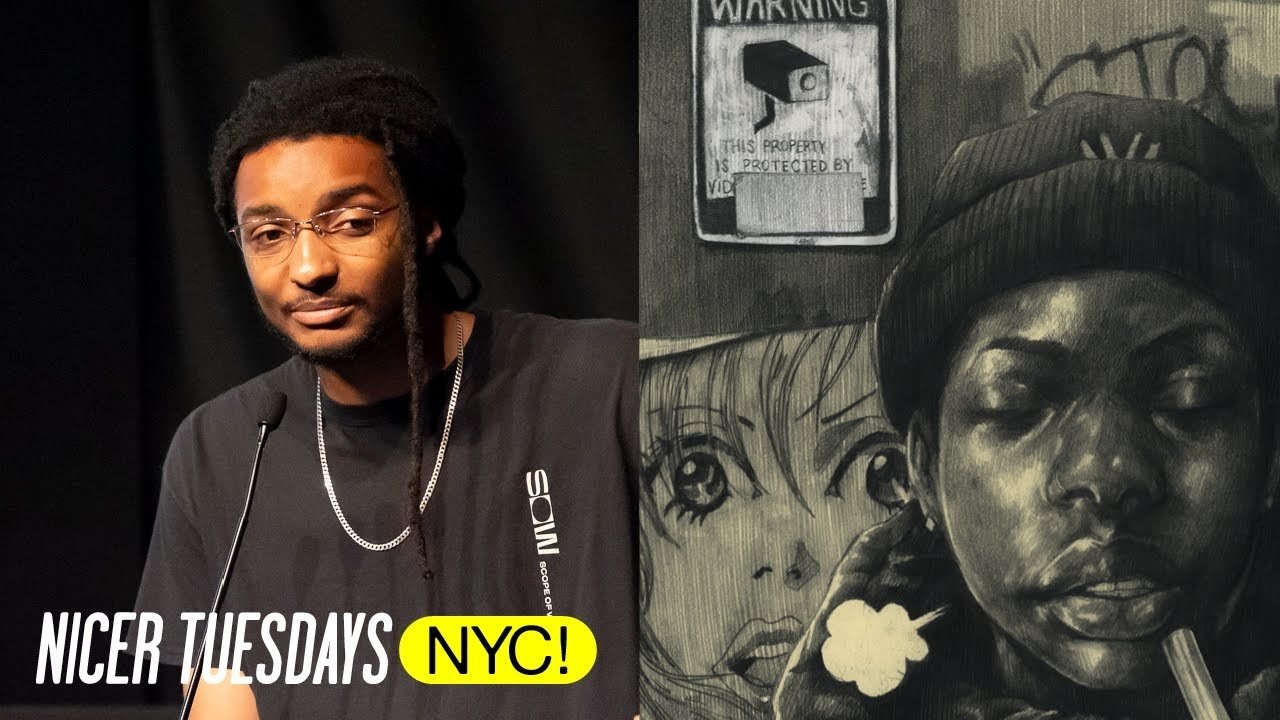
“Sometimes, the best ideas come when you stop trying to be perfect and just let your creativity flow.”
Transcriptmay contain minor errors or formatting inconsistencies
Hello.
This is crazy. I can't really see all of you, but it's a lot of people. , and I'm excited to talk to you. So, my name is Julian. , I'm a fine artist and illustrator. , and I'm just going to talk a little bit about my process. , first I'm going to introduce you to what my work looks like. Then I'm going to talk about why it looks like that. And just my creative philosophy so to speak.
So this is what my work looks like right now. A lot of my personal work is these small scale graphite drawings. Some of them are ink. A lot of them most of them are monochrome. There might be a little bit of color but very very minimally sparsely used. Start to see some collage elements. , yeah, this was like a promotional image. You guys might have seen this one already. , yeah. So, client work. , I've done some work with the New Yorker.
This was like my first, , one of my first, , editorial jobs, , was these two illustrations for The New Yorker. , and it was cool because it kind of embraced the style that I was already building and, , developing after I got out of school. When I was in school, I was making paintings, but we'll talk about that a little bit later. Worked a lot in music. These are cool because I love music. Who doesn't like music?
But they exist mostly digitally. These were never printed.
And then later on I got the opportunity to illustrate and design for a a vinyl package.
So this was my first like client work that existed in the physical world as a collector's item. Something I'm personally very proud of. That's it.
So that's me. , now I'm going to talk about how I got to be making this type of stuff. , this was these are images from my first solo art show. So, the first time I had got introduced to kind of the fine art space, , it was at a gallery in Brooklyn called Swivel Gallery. , and when the curator came to my apartment to see what I was working on, I had a whole bunch of paintings because I thought that you just had to have paintings. Like, you're doing a gallery, you got to do paintings. They got to be big and colorful.
That's what sells, right? And I had these drawings that honestly I was way more excited about, but I didn't speak about them that way. I kind of told the curator like, "Hey, I got a couple of these. Maybe we could like, you know, throw like three or four of them into this show, this painting show." and he was like, "Nah, like just do the drawings. You clearly are more excited about the drawings." and that was my first kind of like exercise in fearlessness. And kind of just doing what I was doing and and believing in it.
So I'm I'm eternally grateful for that experience. Did some more shows, did one in Tokyo, got to like leave the country, see the world, experience new cultures because of these drawings. So again, just gratitude is like a huge thing. , and gratitude to other people for platforming me, but also to myself for leaning into it, just doing the drawings and not really looking for permission. , this is another show that I did in New York.
This was my first art fair. , natada in New York. , this is a book that I did.
This is my first like monograph. , and there's 276 illustrations in here over like four years. And it's a bunch of like sketches too and like sketchbook pages. , because to me this is probably controversial, but it's something that I really want to say.
I think it's important for young artists to hear. , I think quantity is actually more important than quality. , I need to make a lot of stuff. Like I just need to one to get it off my chest. , but also to avoid myself from paralysis. Like if I'm too worried about the quality, , then I'm not going to get anything done.
So I think it's important to just make a lot for me personally. Keep making, keep making and edit later. Every day just doing it every day, right? So quantity is important. , my studio wall is like I'm making a lot of small work. They got a you got a light switch for scale. , that's in my apartment. So, like these are super small drawings. It's like 8 and 1 half by 11, which is a super automatic size, right? Like that's 8 and 1 half by 11 in is the first paper size that I'm sure you guys have drawn on probably like if you got something out the printer or at the library you're just like drawing.
That's all your worksheets you're doodling on or 8 and a half by 11. So, there's some intentionality to that scale in my work. And it's also allows me to work fast. Sketchbook practice is important. , this is the probably boring part of the talk, but there's really no shortcuts around it, but observation is super important. So, like I'm constantly just like going out taking photos in my community wherever I go. Like, I'm just taking photos constantly and just building up that muscle of learning how to draw representationally. , and as you get that confidence and you start to build that, then you start to change it. You can add things. You can add figures to those compositions. You can change things around.
But the only way to build that confidence is through quantity. Honestly, it's just constant iterations and not being too hard on yourself, but just doing and just getting things done. As you can see, I think there starts to be a little bit more confidence. Just building new things into the composition, creating new imagery that wasn't there. Yeah, but it's but it's all based in observation. , and through that, as you start to build that confidence, you can build visual language. , as I said, I'm an illustrator and a fine artist. , illustration by my definition is telling a story without using words, right? , and that's that's that's really all it is. That's all I do. , even in my personal work, without waiting for a client to tell me to do something. So, I personally one I do have to acknowledge that it is crazy like looking at all these faces and like I'm the only one talking.
It is weird. It's weird. There's no there's no way around it. It's weird. But as somebody who has like personally struggled with and and and constantly works to deal with anxiety and putting myself in uncomfortable situations. A lot of my personal work reflects that journey. So, as I think about like anxiety, there's certain ways that that physically manifests itself. For me, braids were a pretty automatic, excuse me, a pretty automatic relation to that because braids are a protective style. So, if you're protecting your hair from breakage, from the elements, you could also be protecting yourself emotionally. So, I thought this was just like a quick visual metaphor and kind of automatic for me. , so I made a series of works where there were people with braids kind of highlighting their hair. , not having them face the camera, very like inaccessible imagery because we're so used to portraits being like , I'm on display for you and I didn't feel like always comfortable , expressing myself that way.
So that's where that imagery came from. Excuse me. Same thing with the coats. , I think coats are interesting. I love the winter. I love wearing coats cuz when I'm wearing a coat, my body looks exactly the same as somebody else who's wearing that that coat, you know? There's an anonymity there and like a comfort in that. So, I did these series of coat drawings where they're empty, but they're kind of like suits of armor. You guys ever been to the Met Museum and you see like those suits of armor like sitting out?
That's kind of what this is. I'm also from New York, so like that's super automatic imagery. Just like the big puffy North Faces Monontlair. It's like that's my whole visual diet as I'm growing up.
, but what happens is when you make a whole bunch of work like this and people get super used to that. , another good thing about quantity, like I was saying, is that it allows you to build up a body of work. So, I've been h having this expectation that, oh, Julian's work looks like this. Julian's work is these introverted like figures and they're away from the camera and there's coats and braids and winter and all this.
And then when I have this piece, you know, now it's suddenly front-facing. It kind of subverts that expectation.
So that's just another benefit to thinking about your work in in quantity, thinking about bodies of work. That's something I would encourage everyone to do. Just think about cohesion and what you you know how the audience might be perceiving it. And how you can subvert those expectations or play into them. , so this one is super important to me as well.
This is the last like major principle that I want to talk about. But, , accessibility , I think as somebody who works in illustration and in fine art, it can be, , really interesting to see, especially from the fine art side because that whole market is about exclusivity. Like the whole the whole thing is there's only one of this really exclusive object and it's worth a whole bunch of money because you can't have it or you have to do a whole bunch to have it. Even if sometimes even if you have enough money, you're not supposed to have it because they want to sell it to certain collectors. Ethically it's been an interesting thing to try to navigate because my first introduction to art was like anime and like manga and comics.
, that's the first art that I was able to collect and so it's the stuff that really excited me. , this is just like some of my like me flexing some of my collection. Shit's kind of crazy, right? The one on the right is a figure I don't have, but cuz I don't have space for it, honestly. , but yeah, this type of art is, I guess, seen as like kitschy or like low art, pop art type of thing. And as somebody who was starting to have my work seen in galleries and like seen with a certain level of like seriousness or academic rigor I think is still there.
I think my I take my work very seriously but I also wanted to kind of reappropriate that imagery into my own work.
So I'm borrowing like paneling structures, speech bubbles, some of the literal characters are are showing up in the work to help tell the story. I don't have a lot of time. Otherwise, I would explain to you exactly all the metaphors and the reasons behind why these characters are in here, but y'all should just talk to me after. Um but basically, it's just me pushing accessibility and kind of trying to change the way people think about art because I think a lot of storytelling mediums are are very valid but aren't necessarily looked at that way. So, again, another exercise in fearlessness. It's not it's not really like me asking for permission, but I'm really like mining my mining my experiences and getting work that's supposed to be as pure as possible. And a lot of that is coming from quantity. I'm treating like a diary every day, you know.
I hear some laughs, but yeah, this one I don't know. I'm I'll tell this story. If you guys know about the game Animal Crossing, cuz it was like super popular in the pandemic. Everyone got was Animal Crossing. There's a character in that game that loans you some property. And this is crazy cuz like this piece is called Financial Anxiety, the ghost of Tom Nook. And it's about how like everything you do, right? Like you owe him some money. And that's such a real experience.
I think a lot of people play video games to escape, but there's I was not like that's a very Animal Crossing is a super stressful game. I'm in debt. Like that's crazy.
But then we'll be in debt in real life like credit card debt, student debt, cars, all this insurance. Crazy. And the lot a lot of the ways that I was dealing with that with these financial pressures was by like buying like fast food, like sugary drinks. So, this character is like drinking bubble tea and they got this Tom Nook character like looming in the background. Some more collage elements in the bottom left there's like a a stamp card from a bubble tea place I was going to.
So, I live my raps. Like that's all super super real. More on the point of accessibility. I sell t-shirts. I'm not necessarily selling the t-shirts to you. That's not what I came here to do at all.
But I think it's important to talk about because my friends wear them and I think you know a lot of my friends can't afford like my original works my I got to pay rent. I got to price my work at a certain point just to make a living. You're selling in galleries. You got to you got to do what you got to do.
But I don't think that means that anybody should be excluded from experiencing artwork. , accessibility is super important to me and I I kind of have to embody that in everything I do. , same thing I do prints, Patreon, all that. Again, I'm not No pressure, but I think it's important as artists for us to think about the ways that we embody our values. Point blank period.
I think we should all try to be more real and we should try to do that every day. So, thank you. I appreciate your time.
Latest Talks
-
Murugiah
Why you should reject the formula and make art about things you love
Watch -
Amber Weaver
How does contemporary type design translate into the wider world?
Watch -
Delali Ayivi
How does photography give us the right to imagine our futures?
Watch -
Will Anderson and Ainslie Henderson
Bringing stop motion sorcery to BBC’s Small Prophets
Watch -
Ollie Babajide Tikare
The importance of not flattening the complexity of observation
Watch -
Marina Willer
Design thrives when you find poetry in the simple things
Watch