
Jessica Vaughan is the programme coordinator at Studio Voltaire, where she emphasizes risk-taking and the centrality of the artist in the commissioning process. She is known for her work with challenging and provocative art, specifically in collaboration with artists like Turner Prize nominee Marvin Gaye Chetwynd.
Jessica Vaughan
Why an artist’s work resists explanation and what gets lost when describing it
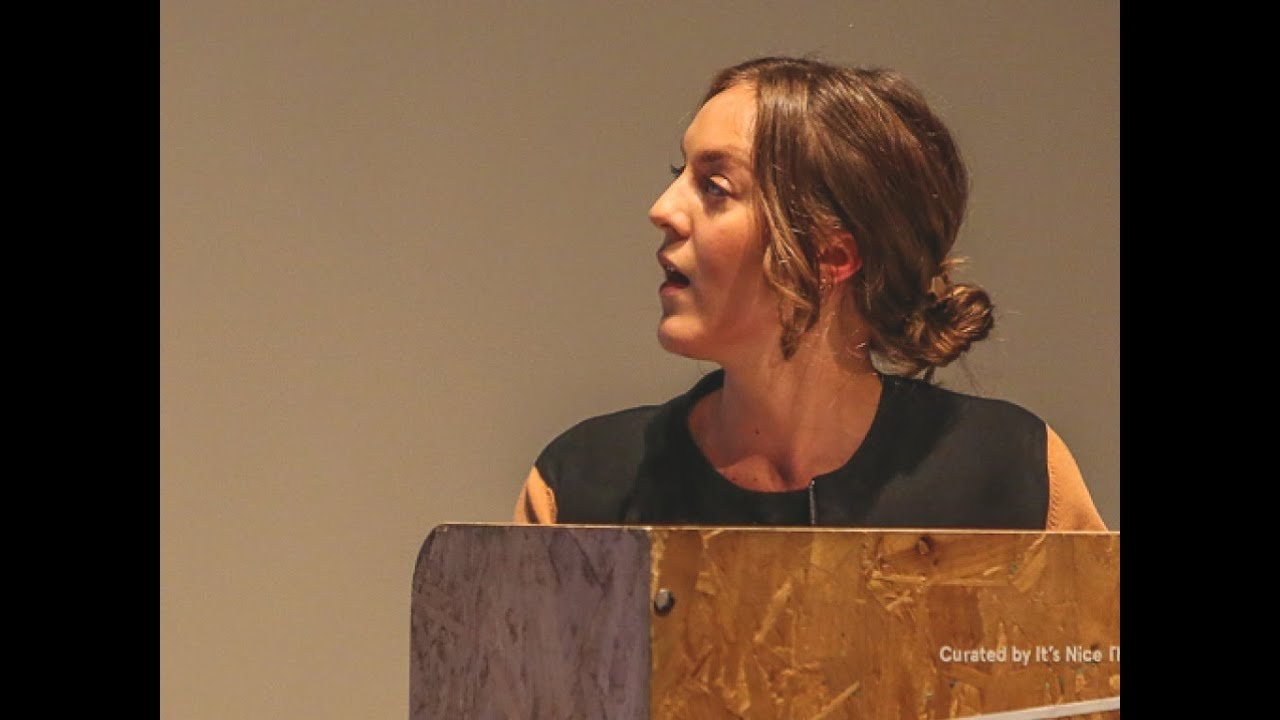
“There is a huge emphasis on risk-taking, and putting the artist at the centre of everything we do.”
Transcriptmay contain minor errors or formatting inconsistencies
Hello so I'm going to talk about our current commission which is with marvin gaye chatwind it's called hermito's children 2.
Some of you might know her as spartacus chatwind she changed her name last year but just to avoid confusion because that's what I've been dealing with a lot recently so I'm going to talk about how this particular project was curated but also how we curate our program as a whole the majority of our exhibitions are new commissions so what that means kind of commissioning versus curating and how the process is different the way we work it remains really close to the creative process so we place a huge emphasis on risk taking and putting the artist at the center of everything we do in this presentation I thought therefore I'd consider what kind of a curatorial like what you have to think about when you're curating an exhibition or a program so I guess context purpose of why you're doing it the timelines audience artist development and interpretations so I thought I'd say a little bit first about what I do we I work with artists rather than existing art objects to make a project happen so it's really important that we support them to enable their ambitions to be achieved this is one of our projects with alex birken we don't currently use the title of curator at studio voltaire but this is what I did study curating contemporary after my master's and my program my role as program coordinator means I work on the projects from concept to realization I would be considered a curator in the sense that I'm constantly in really close dialogue with the artists and work as an artist liaison so at the beginning of the project that will be studio visits talking to them about what they want to achieve from the commission.
And then there'll be a constant communication throughout the project and you know seeing how the evolution of the project is going at the moment when you're a curator you spend a lot of time doing funding as well so trying to make this work and obviously we discuss at length how the project will be displayed displayed in the space and write text to make sure that the project is accessible and clear I'm just kidding I mean no um so basically I wanted to give you a little bit of context about what what we do and what happens at studio voltaire so we're based in south london in clapham 2014 marks 20 years of studio voltaire as one of london's leading not-for-profit art organizations and we exist to support artistic practices and create a space for experimentation we are an arts charity and we're supported by the arts council england we a really important thing for what we do is support emerging and underrepresented artists and practices so as a direct result of our activity lots of artists have gone on to do kind of have much bigger exhibitions and shows this is philadelphia's project with us in 2010 and very soon after that she had a show a two-woman show at the serpentine and then went on to be awarded the davine commission at tate britain and she was much older when she had her show with us she was in her 60s and that's something we're kind of non-generational even though we work with emerging artists it's not really it's we're not really interested whether those emerging artists are 20 or 60 which is quite a unique thing in terms of organizations of our scale so I'm going to talk to you guys a bit about marvin's work.
This is an image of a work that she made called an evening with jabba the heart in 2003 this is a stilts from one of her performances homemade tasers and then.
This is an image of the performance that took place at studio world's hair in september hermita's children and this is a clip of it being filmed in our space so this is the gallery space so marvin's work is done generally characterized by a kind of joyful anarchic deconstruction of grand narratives she she constructs collective performances and it's deliberately amateurish and raw she also has this kind of quite brechtian collapse between the audience and the actor and so it's kind of completely non-hierarchical and she she skins many 21st century concerns with a humorous touch whether it's political disenchantment reactions against slick professionalism or the breakdown between real fictional and virtual world worlds at studio voltaire we we work with artists to develop long-term relationships and quite often work with them on multiple occasions this is an image from 2005 when marvin was known as lally which was her original name before she was spartacus. And it was it's called the walked over and it was an off-site commission that emulated the narrative of charles dickens's novel david copperfield marvin led a seven-day walk from london to dover with a group of victorian urchins and as david copperfield foraged for food the group also did this copperfield's journey tracked his shifting social status and explored class structures in victoria england and when marvin was doing this she wanted to draw comparisons between the deck prisons of victoria and london and contemporary credit card culture this is quite an interesting project to talk about when we talk about deferred value studio voltaire is still a really quite a small arts organization but when this was made in 2005 it was made on the whole project was made with a budget of 3000 pounds and joe who is the director of studio voltaire who's also actually one of the characters in this performance was telling me that it was shown to about 10 people at a screening in the gallery in the last nine years it's gone on to be shown at white chapel tate white columns in new york and arts council england and reached about half a million people in terms of audience so almost 10 years later we are showing marvin's largest film commission to date it's an ongoing project that takes the form of an experimental television crime drama this is the second iteration of it and the first is in the take collection now each episode follows a female detective called joan shipman who is actually joe scotland in drag and she uncovers and solves sex crimes the crime in this particular second episode is catting which is the female equivalent of dogging and only takes place at sea yeah.
So it the commission has been filmed over the last two years in various locations including gozo glasgow australia and then finally london at studio voltaire the film combines live footage of live performances and then staged cinematic sequences and we hosted the final performance at studio voltaire in september which kind of is the climax of the whole film. And in that performance which is called listen up we had kind of 30 members of her troop in the gallery space which is set up the installation is remains now. So if you go and see the exhibition.
That's what you see and there was an aerialist rigged to the beams of our church space who was jumping over a nine foot puppet of a bull and like a kodo drama with a six-foot drum and it's a really bombastic mad thing that she does and creates so the film and performance combine an eclectic range of sources from history literature and both high and low culture hermeneutia's children too includes catwoman minimum bull leaping star wars and mary reynolds the king must die the film's not chronological there is an overarching narrative to do with the kind of mysterious disappearance of hamito's children but the the story the episode includes sex violence blackmail amongst other things.
But it jumps around from time and place as an artwork it deals with lots of 21st century concerns it's a kind of it's there's an idea of transformation and coming of age in it also of lower culture and how kind of television series and forms of culture like that can communicate ideas and I think personally very interestingly and something that comes across very strongly is gender politics and this is something that goes on throughout all of marvin's work.
So I don't really want to over explain what happens in the film too much because having worked with her for quite a long time it's not really how her work works and they're it's quite mad so it's quite hard to explain it and when you do explain it you lose something.
So I've included a short kind of minute long excerpt of the film so you can see a bit what I've been trying to communicate the show's on at student voltaire until december so if you if you want to see the rest of it I'd urge you to go down and have a look let's see if this works with the sound you know what it's over it's over it's over it's over it's over it's over 1000 goodbye
Latest Talks
-
Murugiah
Why you should reject the formula and make art about things you love
Watch -
Amber Weaver
How does contemporary type design translate into the wider world?
Watch -
Delali Ayivi
How does photography give us the right to imagine our futures?
Watch -
Will Anderson and Ainslie Henderson
Bringing stop motion sorcery to BBC’s Small Prophets
Watch -
Ollie Babajide Tikare
The importance of not flattening the complexity of observation
Watch -
Marina Willer
Design thrives when you find poetry in the simple things
Watch