
Jeremy Deller is a Turner-prize winning artist known for his participatory artworks that engage the public in the creative process, emphasizing the importance of simple, positive political messages.
Jeremy Deller
Letting go of control and inviting others into the creative process
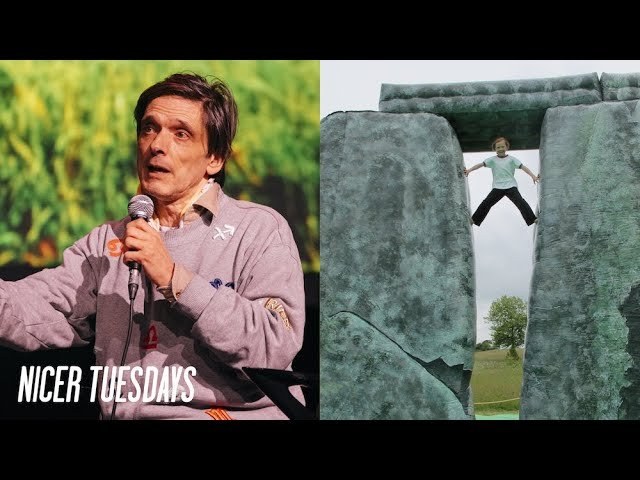
“Art should be a public playground, not a private gallery.”
Transcriptmay contain minor errors or formatting inconsistencies
Thanks for coming back I wasn't I wasn't sure anyone was going to come back how are you doing I'm good I mean I'm quite s Blown Away by those two talks they were so different yeah and in their tone but I sort of learned a lot in both of them 100% so much absolutely so you know hope I can round the evening off I think so definitely and welcome to nice of Tuesdays I'm excited to talk with you this evening maybe it's right here on the table last year You released a book congratulations I did here it is gorgeous was a nightmare writing it.
But I enjoyed I enjoyed the im images and putting everything in one place trying to everyone's got books basically. And I didn't have one and you go through the books you know art great you know artist books and you get to darar and then s delvo and then you realized Dela is not there.
So I just I just needed to have my name in those things it's just a horrible ego thing.
But I needed it and there were some alternative titles I think in the book.
There were I mean it was quite there were alternative titles I'll read them out but basically I settled with this one and as and as a lot of you are graphic designers I basically realized I had to have a title that was both positive and short so it could be seen in you know in bookshops because what all the titles I'd come up with were like like like really self-deprecating to the point of being actually negative so they were like 30 years of hurt you you can't do that. That's not art call that art what's the point of that these are things that people have actually said to me what were you thinking and and the other one was going to be called the midlife crisis so I like that one that was good yeah but in the end I settled with what you see on the screen really CU I just felt I had to I'm not necessar a very positive person.
But I needed to sort of make a positive statement about what I do and about art itself I think so that was why I came up with that and one of them you just said there was you can't do that did someone told you that once they did about a project you're going to see and it was actually an artist I told him I was doing the project with the miners working on the miners strike he was absolutely horrified and and this was an artist who makes very hardcore work literally and he was like so upset doing this that I was going to do this work we'll talk about in a minute I'm sure but he was very very he just couldn't understand how it could be made basically which was interesting yeah it's I mean it's specifically very interesting to me because he said you can't do that but you're seem to be very good at getting people to do things and getting people on board to do things you know what it's actually quite straightforward with this is the project I made with this a brass band This Is The Brass Band very traditional at the time they wouldn't allow women to be members of The Brass Band they do now not because of me but for a number of reasons but it you know very traditional group of men basically if I can put it like that like when when I went on tour with them it was like being on tour with two Rugby teams cuz there's 30 of them. And it was kind of felt a bit like that.
And I'm not really into that sort of banter amongst men but where were sorry what were we talking about you're good at getting well. Basically the pro the thing is I work a lot with the public and I've never had a problem working with the public often the problems happen is when you go to an institution you go to a museum or Gallery but also other institutions they are not used to working with the public and they're a bit afraid of the public but on the whole the public are up for doing stuff doing things and working with an artist to do something.
But it might be a bit different from what they might usually do but people on the whole are up for it making art or being or working with an artist and I learned that by calling the manager of this band and I didn't use the word acid house cuz I knew that was a bad word to use because of the sort of drug stories of the late ' 80s early 90s I said I've got some contemporary electronic music that I'd like you to make do versions of and he said okay we'll just do it once and we'll see how it goes and I was so nervous asking him I thought I'd have to convince him over weeks and weeks but he agreed immediately and it.
Basically it's that power power of someone saying yes is what keeps me going effectively what I rely on and why acid brass like what why did you decide to combine those two things well it's sort of explained here before I did the work.
This is the explanation it's like how do you tell the story of a country through music in the 20th century how do you tell the story of a country going from being an industrial society to post-industrial you can actually do it through music there's a narrative in music and music and popular music is telling a story. But also is is is you can't separate it from history often you know when you look back you realize how important the music was in people's lives but actually it was telling you a story there's a great quote it is music is prophecy it's an incredible quote just those three words I wish I had thought of that saying that because it.
Actually shows you the future potentially what a future could be like how people could be with each other about technology about human relationships and so on. So it was basically how do these two things have anything in common.
But they actually have they're all about communal music making and music making in the open air and and communities effectively but also about how the state will will attack those communities like either miners or trade unions or ravers who want to go into a field and dance that was like two or 3 years after the minor strike so the police would treated them like they were striking miners effectively in their tactics and how they heavy-handed they were maybe we can actually go to that project because you have a which one perhaps this the Battle of orre exactly here.
So that's arguably maybe your most well-known perhaps to this day I think in the book you call it your Stairway to Heaven I call it my stere you know like it's it's the song I have to always play in a sense and this is this is it this was me I was wanting to recreate a battle I'd seen as a child on TV from the minor strike with thousands of people taking part as like a histo historical reenactment but a political historical reenactment and I this is a photograph from 1984 by the way I did this in 2001 and this is a a minor clearly from his physicality I would say talking to a metropolitan police officer who probably had done something very bad because that's what they did you know the and police with by far the worst and so it was for me trying to work out in my mind what would happen that day so I wanted to restage it like the way you restage of crime and but we're working with thousands of people in the end we worked with a thousand because of the budget and many other things I mean on the day itself the battle might there might have been up to 14,000 people involved police and pickets and striking Miners and so we made it.
That's that's a still and from from the F Well it's not even still from the film we made it with former miners but also the majority of the men that took part were reenactors because I really wanted to to work with reenactors because I wanted to sort of challenge their view of history of British history and get them to reenact a political battle from a a war effectively a cultural War and so people who do this at the weekend I wanted them to just wear regular clothes or or work or dress like a police and then fight amongst the miners to meet the former miners which was very interesting as Two Worlds colliding two versions of sort of political versions of men and masculinity sort of colliding and they were the miners were in a minority there's about 300 of them and 700 reenactors but they totally intimidated the reenactors because of their camaraderie and their sort of love for each other effectively totally intimidated the rean actors so we had to sort of swap things over a bit.
And then I guess that's super interesting to me because we're talking about how we have you know two people or two groups of people who are coming at it from a very different angle what was the approach of how did you tell people who are X miners to get involved in this project how did that word of mouth get spread or well it's Word of Mouth you know it took two years to meet people for them to know who I was I was just this funny little bloke from London who was interested in something that in 2001 it was preck war it was new labor was in its height the labor party would wanted to bury the minor strike and never mention it because it was embarrassing to them so just the fact someone wanted to talk about it but could see that I was sort of on their side and so I met progressively more people you'd start with a couple when you meet people in pubs and You' have big meetings and I just told them what I was going to do and I think if you kind of straightforward with people that is very helpful and also I was I think they like the idea they saw the absurdity in it they saw how ridiculous it was to do this and they also saw that as kind of there was a sort of profound idea in it as well because it was a public event and their families could watch it.
So it was a sort of Act of sort of witness in a way and they got it instinctively the reen actors just on the whole didn't I didn't I didn't engage with them that much because I didn't want to lie to them.
But the guy who was working with re actors just said told them it was going to be a non-political reenactment which is actually impossible anyway.
But it's of a iCal event from a political sort of campaign but they were happy with that. And so that was fine but I my I I was sort of more interested in the miners and sort of nurturing them and talking to them really. That's quite interesting because how do you work as a director you know so you're working with two different two different groups also all the time often hundreds of people maybe in some of in some of your more like participatory artworks what does maybe like a pre-show pep talk from you look like what kind of a director are you quite Hands-On you know I try and be really relaxed and not lose it.
And sort of I'm not a shouter I might be shouting inside but I try and be really sort of calm and just be straightforward with people with this I'd lost control of the project it became a film shoot effectively so I was just again I was just wandering about and just like not knowing really what to do I mean I could have if I'd have been locked over by a bus a week before it still would have happened as much the same as it happened on that day so it wasn't I wasn't really needed I've done my work effectively my work was really talking to people and not documenting it not filming them not photographing them as I saw them or recording them even it was just sitting and chatting not checking my phone or anything like that you know. And so it was very it was very just about meeting people and convincing them that this was the right thing to do you said something really interesting there which was about kind of like loss of control it became a film shoot when you're working at this kind of scale I'm imagining you're having to surrender Over Control that is just a part of it maybe to a certain extent maybe for example I think I read in the book on one of the days the weather was really on one of the days grief yeah how do you find that do you think that giving Over Control helps the work enriches it do you find it stressful I'd imagine you have to give people a space to bring their own I mean they I'm not an expert on the minor strike those men were who were in it you know they were literally living history they are the experts so you have to let them give them a space to do to improvise to do things which was really important I quite like losing control up to a point I mean I think it's quite good to do that. And if you if you're working in the public realm you immediately lose control you you know the most important thing you you can't control is the weather.
And then it then you know it all takes one person to do something and that could be very you know someone to throw a proper punch or something to go badly wrong and that's it.
But there's an excitement there. And I like that I mean you don't really get that in galleries so much you know which are places of of control effectively which is why they're so great you know.
That's why people showing galleries because they can control the environment I quite like both up to a point I like uncontrollable environments I like messiness that's where interesting things happen when things get messy I think I think we have to yeah let's move on to so this project also relates really well to what you're talking about here.
So this is definitely perhaps you say one of your most controversial or full Hardy projects think full Hardy risky stupid projects in that order it was a I got a car a car was destroyed many cars were destroyed in Baghdad in the sectarian war that happened after Invasion effectively the Civil War and I wanted to put one on the fourth plinth to rot in public and so people could watch it rot and disintegrate and make a horrible mess based in the center of London clearly was never going to be commission.
But it was shortlisted so that's something.
And I just thought I need to re actually do something get a piece of evidence from Iraq from that sectarian Civil War and tour it around Britain or America and in the end I got the opportunity to go on a road trip and I toured a crushed car it was crushed for a number of reasons but it was got from Baghdad from a car pound where all the cars have been blown up the bomb was not in the car but the car was sort of killed by the bomb effectively and we just went around America with that sign on the side and with an Iraqi citizen the guy sitting there and an American Soldier and we just talk to the public I mean the incredibly irresponsible thing to do potentially you know people could have shot us literally you know you just don't know what most you don't know what traumas people are having who walk around in a street we met Iraqis who were at a university who were training to be doctors on some scheme. And so they talked about it in a very visceral way.
So I you know you know when I see that I can smell it's the smell that comes back.
And then you meet former soldiers you meet Vietnam Vets everyone in America has some connection to the military it seemed so it was very it was not stressful as such but you had to treat everyone equally and just we gave Flyers out we talked to people in a very Bland way we weren't political at all there you know there's no need to be political about that you just you just take it places and people will talk to you it's now in the Imperial War Museum actually how long did it t about three weeks and we went to the Steep South we went to Alabama Tennessee Texas Arizona we went to Ohio we went to potentially quite hostile places but Obama had just been made AE president and it was quite calm I mean I don't think you could do anything like that.
Now I think you'd you'd really be in a lot of trouble if you did but it was weirdly calm and never mobbed it was just people passing by and talking to us it was it was my favorite project. Actually I think also something you said there about you could never do it.
Now in the book you say that this you didn't film the public you film them as minimally as possible right. And that's really interesting to me because it I think that you said it was about not making them feel self-conscious they were part of content maybe and that or maybe not but that feels like feels like maybe something that people.
Now if they're entering a public artwork on the street they maybe feel like I'm signing myself up to be part of content basically or they take a picture of it with their phone that's what most people do and they see something now.
But I didn't want I didn't want to we really underdocumented it as you can tell this is I was the only photographer I had a crappy camera that had a black smudge in the middle of can you see it there's like a black smudge on every photograph so we really underdocumented it we did film people in a very rudimentary way we didn't want to intimidate people with cameras especially if they're talking about their family or religion or politics all these quite sensitive subjects even for Americans they were quite wary they thought it was a trap basically they thought it was some sort of trap from some sort of political party or or something or some pressure group which it wasn't I mean it was an art it was an art project.
And so we were just trying to get people to talk and you know some people really didn't want to see it some people hated it some people liked it but everyone was respectful which taught me a lot about America I was quite heartening really do you ask how do you feel about permissions do you ask for permission a lot to do what any of these things you we had permissions to stop at places okay and that was about it.
But yeah that was about it. And some some were public spaces where you could just stop and so it was you know within our rights to do that.
But we didn't we never we got stopped by the police once or twice but they were just interested in it they want to know what kind of car it was which you know that was a lot of men just wanted to know what kind of car it was and try to work out.
But then you got on to some more maybe more interesting subjects so this is I mean very different working with students six home students right these are students yes these are a group of students in North London in a a state school had just been made an academy but it was effectively a state school and why did you choose to work with students so this is a still from a recent film of yours everybody in the place which I mentioned earlier it's kind of an incomplete history of Britain right.
That's what it's called well it's why did I I should yes why do I work with these young people I gave a talk at a school I was asked to give a talk at a school. And it was to a group of teenagers and I don't have kids and I was just like faced with this group of like 150 young people. And I just thought they're going to hate they really going to hate me who am I to tell them about anything. And in the end we had it was an amazing talk and I just thought oh when I then.
I was commissioned to make a film about London and clubs I just thought there's nothing more boring than this subject in a way clubs in the'80s because it's just regurgitated and it mythologized but it's about acid house and I thought well. Actually. That's a that's a story of Britain effectively it's a national story. Anyway.
So I thought I'm going to go back and talk to these young people politics class that between 16 and 18 and talk to them about my view of Britain at that time and how it created this environment where this music would happen and become like a social phenomenon and most of those young people if not all of them most of their parents were not born in Britain so they had no knowledge of British politics all the all the music scene so for them it was like watching the news but in a very but also very very oldfashioned version of Britain as well pre- internet and pre-mobile phone and all this you know the way people looked and dressed and so on.
So they were kind of fascinated by a view of Britain they didn't really know about even though it was 30 40 years.
So they saw some footage of the minor strike and they couldn't believe theyd never seen anything like it like 15,000 white men in a field fighting each other you know it just didn't look right to them they couldn't work out why that was and so it was very it was it was so interesting seeing it through their eyes so basically. And this is a moment in the film where we just playing with some equipment this is a that's a great moment of the film she was fantastic and you know.
So I basically in the end you're making a film about the past but it's actually about the future it's a it's not about the past Britain's past it's about the future of Britain because that's what they are effectively and it a year it was two years after the brexit vote and they'd all been racially abused in the street apparently I mean it's so depressing you know hearing about it.
But they were very hopeful about the country and very interested in things. And sort of full of life in a way that you might not expect and yes so one part in the film we just have some equipment and they have a little play on it it's just a kind of breakout session. So it's very sweet and it's quite weird when you make a film and you spend three months editing it.
So I spent 3 months with them afterwards in their presence you know the whole summer thinking about them and looking at them and and I bump into them occasionally some of these the young people maybe we could actually you have a trailer here of the film.
And it's I it really encapsulates kind of everything quite perfectly yes I'm going to show you the trailer it's a minute and a half long it's very noisy but it shows you all the elements I talk about to them it's an incredible track that builds and there's like this orgasmic moment but also the film isn't as exciting as the trailer it never can be but I just wanted to make something that really just had every element in terms of historical archive but also U them as well these young people so hopefully this will work yeah go on come on come on come on come on on come on come on come on come on come on come on come on come on come on come on come on come on come on come on come on come on on come on come on come on yeah.
So that's the trailer oh let's take off you know it's funny in that I mean because it shows so many of the elements perfectly but what we don't see is you in the classroom acting as kind of like a a lecturer I'm a teacher that day I was teaching the young PE teaching talking to the young people about the 80s and early 90s as I saw it.
But yeah I'm not going to be in the trailer it was I mean it's awful to see yourself on the screen and hear yourself as well.
But I'm I'm in the film a lot it's actually at 180 Studios at the moment there's an exhibition called Reverb and it's on the whole film you can see in a big projection.
But it was the most tiring day of my life talking to those young people they're very well behaved but I mean teaching is like it's acting effectively it's insane it was it was great to do it so but I am in the film unfortunately yeah and in the film you're I mean like we're saying you're a teacher.
But it's kind of interesting to me because so much of your work I mean the first chapter of the book is all about music right. So much of your work is about documenting music. And I'm kind of interesting what what you think your role is there is it like a Critic fan like a lecturer do you know what I mean it's meant it's just meant to be a friendly face just trying to explain I I think even during the film and telling them how how I see these things connected I do say to them you know.
This is just a personal opinion I might be totally wrong so I'm not teaching in that way I'm just giving opinions about how music affects society and is part of society you know that diagram I showed at the beginning you know with the arrows is that's the script for that film is basically that diagram which I made in 199 6 you know. So it's it's been on my mind to make a film like that.
So I'm very glad I made it. And if I was to make it again I'd add an elements one of which is this.
This is cue to go into a club called Shell's L laser Dome one of the most sort of legendary nightclubs and I just thought how similar those images are of people going to work in sort of early Edwardian time some of the first footage of Working Class People in Britain were outside Mills and factories they filmed leaving and entering work.
And it was a way to gather get lots of faces of people who then would go and see themselves at the cinema two weeks later once they developed the film. So it's a very clever kind of marketing technique and but you know these young people are going into a site often they' you going into former factories and warehouses to to to enjoy yourself rather than to work and they're very young they're like teenagers you see them this crowd this queue going in they're literally like 13 to 16 year old most of them and of course child labor and so on.
So I just thought there were these Echoes of the beginning of a century and end of a Century about work and enjoyment and social lives and so on where are we going now oh you wanted fans you like fan work don't you.
So yeah I one of my favorite projects of yours is about depes mode fans thees mode fans thees mode fans this is manik Street Peter that's okay I will go to thees mode fans perfect this is Teran probably mid90s I made a film about toes mode fans I was asked to by the record company mute it ended up as like most films do kind of minor disaster because it was never seen for a number of bizarre reasons but the film exists and does get shown and there's just a few photographs from it that we interview a guy who lives in Canada now who was a fan in the 90s and 80s with these incredible photographs of him and his friend just talking about what happens in tyan in Iran when you were found with cassettes by bootleg cassettes by the band and there's a big section on Russia and how that band changed people's lives because they were sort of connected intimately with the end of Communism the end of the Cold War because they was very popular in Russia anyway.
And this kind of Liberation through music happens no kind of similar to what happened to Americans with the Beatles but happened there but times 10 I would argue so this is I mean what an amazing photograph of these fans in Red Square probably early '90s and there's you know they would meet up thousands of fans would meet up often young men wearing their mom's clothes and stuff you know dressed in very outlandish ways you know with their hair dye and all that kind of stuff teenage boys often with girls as well but just like all meeting together and they still meet and talk about the band and young people meet and talk about the band that's on Dave G's 44th birthday there's like big meetups and parties I think also something I didn't realize until seeing this documentary is how dedicated specifically Eastern Europe is to that band and then you're kind of dealing with this sort of sanctity of this icon of what this band means to people what is that like in terms of does it affect your creative decisions no it's just brilliant because these people are so extremely happy to see you because you're making a film about their favorite thing in the world. And so they just treat you like Gods basically.
That's what happened so that was really great and maybe you know in in Russia we're more or less kidnapped by a group of fans they just took us everywhere and gave great interviews and were very funny and very warm to us you know.
I think people you know Russians I've been to Russia quite a lot. And it's it's so tragic now with the country but I've always enjoyed being around Russians you know in the in these situations especially but and in Mexico as well they take it very seriously like a religion it's almost part of Catholicism for a lot of people in England it's very different you know we we filmed in a church but it was forgot Goths this church in Cambridge had a goth service and they played the pression mode songs it was all very dreary and gothy and English you know it's f self-pitying it was fantastic you know.
So it kind of brings out National characteristics when you make a film about a band and how people react to it. And this is a notebook by a young girl who did these amazing drawings about her life with the band Her Fantasy Life with the band all in felt all in brro so you can't really correct brro so it's just amazing two books made of like stories of her own mates dressing up. And sort of marrying the band and then.
This is a German family that sort one of the reasons the film was never seen because they didn't they had fun with the band They dressed up as characters from the videos and a lot of German fans were absolutely horrified by their behavior because they weren't taking them seriously enough so that. But they were great well.
This is kind of I mean well maybe it's sacil here in terms of me speaking against F mode but this is maybe like a lighter controversy in comparison to maybe some more recent works like you've been doing a lot of work with the Murdoch family not with them I I mean maybe you have I don't think so but against against the I did a print that was like 50 Quid fundraiser for people affected by the bush fires in America and I made a bit of very basic Photoshop I I didn't actually do it I did it with Fraser work with Fraser mugridge a lot.
And we knocked up something quite quickly and this is laand Murdoch's house being engulfed by a bushire I mean it's a it's a visual ization of it it didn't happen and then some members of the family literally wrote To Me Murdoch family saying how dare you do that there could be a child in that house it's like yeah but it's a print it's it's a Photoshop print it's not actually a real thing and you just it makes you realize these people they're the best education money can buy presumably and they're still totally not in a reality that we would understand so I did that's that's roer that's a test burn of rer and we we made a sculpture of rer and lacklin and it Burnt Over a 12-hour period in Melbourne in their which is their Hometown as their base as where where they were born basically their family from and it was just kind of unannounced because you didn't want people to know what it was in case it got shut down for whatever reason or picketed and it was the first day out of a 210 day lockdown that people could leave their homes and and socialized and so people came and watch rer Murdoch come to see this.
That's how they spent their day of freedom first day of fre and you just said there that you work with to do the paintings that's quite interesting because what painting that one this one here exactly it's a gra design of graphic design which is exactly what I'm going to talk about next it's a very good segue if anyone know should we talk about the posters let's talk about posters there we go that's that's a kind of insert in the freeze artfare newspaper called Welcome to the show it was during a lot of problems with brexit in 2019 I wanted it as a big poster as you arrived at Heath airport first thing you saw as you getting your bags just worked with it I mean it could have you know again with Fraser and Fraser and I have worked a lot together and he sort of facilitates ideas I have and this is an exhibition of Prince he was involved in a lot of them.
But I mean there's nothing going back to the first Speaker really there's nothing better than seeing your work in the public realm on a billboard this is Broadway Market I'm sure you a lot of you know Broadway Market sure and this is dur this is during lockdown.
And I was asked to create a series of posters for World human rights day so I chose about a dozen places around the world in Britain but also America and Europe and elsewhere where human rights were not being respected and just made this statement and so that's the big sort of spot at the at the end of Broadway Market but to see something in the street is so so much so thrilling for me personally cuz you can you know can look at stuff like on your phone all the all day it doesn't it's not real for me until it's on the streets and so I've done quite a lot of things since that was that was a week before the election I I' had this phrase we have been swimming in which is you know it has a double meaning obviously and the people who did that other poster fantastic company called build Hollywood they they will give you poster sites if they like what you're doing they're quite political but also they do campaigns for Nike or whatever.
And then they they give artists space and of course this that being during lockdown.
This is one of the Premier sites in London no one was advertising during lockdown. And so you could get these incredible sites and coverage so we did that. So we had that.
So there's yeah there they are build Hollywood so we had 14 years of hurt which refers to the song You Know 30 years of hurt the the football song three lines and then.
I made a few I've done you know the street is the best place to see work I think to see art so thank God for immigrants was a poster I' made and I thought we should make it to a very very pop culture version of it you know but two men whose both their fathers were not born in Britain who were quite famously immigrants maybe less Andrew Ry his father was a yemeni Egyptian so and then you know other ones it's basically sort of propaganda effectively you know in a sense it's just like sloganeering but I love it.
And I love doing it you know maybe I would have been in advertising if I had taken a kind of odd route but I guess before because we're flown by before we get to some audience questions I just had one more which is some of these posters especially we've been swimming in very funny as well what makes you laugh oh I you know I'm I'm a human being so most things make me laugh you know I know I my humor I don't want to reveal too much because my what do I watch at the moment I I I oh most things I'm obsessed with Alan Partridge but most men in My AG are cuz we you know you slowly turn into him you know whether you want whether you want to or not basically.
But I do like Steve kougan I mean you know. I think he's something of a genius. Basically.
But I like lots of stuff you know okay I watch loads of Telly I love watching telly so I watch most comedy on telly and we getting questions we're going to do some questions now just haven't got time for many so actually this one's maybe a big one we'll just end with this if you could change anything what do you want to change about your industry that's from all projects my industry who's that from all projects I think it's not a name but maybe that's such a that's such a good question I mean I in I think you mean the the art World by industry I think so I think it's people feel very alienated from art a lot of the time because because there's such a concentration on value and money and auction prices and how much things are and I think that's a real barrier to people enjoying art and and thinking about it sensibly so why I think children are very good audience for art because they're not interested in how much things cost they just want to connect with it in a very visceral straightforward way.
So I think think that and the sort elitism of it as well I mean it's very interesting being an artist you know what literally one day you can be in a prison talking to people doing an art class in prison the next day you're speaking to some sort of billionaires a billionaire or Billionaire's wife or some people with insane amounts of money you know to be honest I've never sort of I don't think I've met more ill-informed sort of racist people. And I have sort art dinners sometimes you know people who are absolutely think they know what's going on in the world cuz they're rich and that's that gives them the the entitlement to sort of tell you what they think about these people or those people so you you do get a lot of that.
And I've I've lost my patience with that. So it's that can be quite testing but I'm quite happy to go to those things and meet those people just to remind me in a sense why it is I do what I do rather than something else I think this is the inflatable Stone Henge by the way I know we don't have long do we I think yeah we're gonna have to but we can end on these images we can end on these images well. That's that's a sign I did with Fraser yeah we should end on the images apparently I can sign books for like another 20 minutes in the shop it's true if anyone wants to get a book signed there will be the bar is going to be open for about another 15 minutes where you can find Art Is Magic Jeremy thank you so much yeah thank you very much thank you
Latest Talks
-
Murugiah
Why you should reject the formula and make art about things you love
Watch -
Amber Weaver
How does contemporary type design translate into the wider world?
Watch -
Delali Ayivi
How does photography give us the right to imagine our futures?
Watch -
Will Anderson and Ainslie Henderson
Bringing stop motion sorcery to BBC’s Small Prophets
Watch -
Ollie Babajide Tikare
The importance of not flattening the complexity of observation
Watch -
Marina Willer
Design thrives when you find poetry in the simple things
Watch