
James Junk is a graphic designer and content creator known for centering human emotion and moments in his work. He emphasizes the importance of emotional responses to contemporary issues through design.
James Junk
Graphic design won’t save the world – but it can centre emotion and humanity
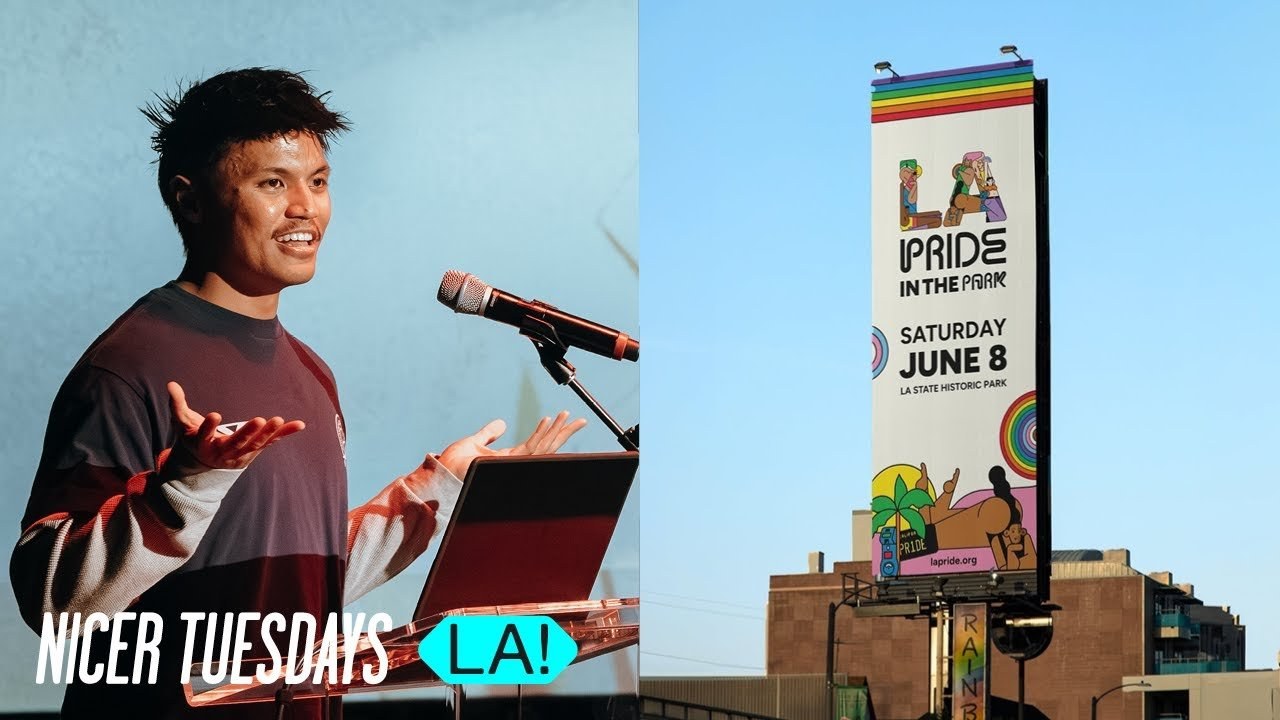
“My graphic design won’t save the world, but it can start conversations that matter.”
Transcriptmay contain minor errors or formatting inconsistencies
[Applause]
Hi everybody. , this is quite the side quest. , thank you first of all it's nice that for inviting me and for all of you for taking the time out of your day to be here. I know that commute at 5:00 p.m. To get here at 600 is not easy. Okay. , my name is James Junk and I actually my name is Andre. But no one no one no one care no one knows that no one cares about your real name.
I think if you if your username sounds good and is like an illiteration but it's okay. I'm rolling with it. Hello.
, okay. I am a freelance graphic designer and I like to consider myself the only graphic designer in LA. Mainly because I I have free will and no one's really challenged me on that yet and no one's like come up to me and be like no I am the real graphic designer in LA so if you know anybody actually wait there's a lot of us here so maybe never mind about that bit then we're good I'm going to skip that one okay here's some of what I do now I work with brands and people that I believe in I like to work on projects that live in the worlds of culture, community, sustainability, you know, the vibe. You'll see some pride campaigns, cover stories, packaging design, a lot of cultural and social good projects, really just work that helps people see themselves or something or someone else differently.
And then there's the other side of my practice, the self-initiated work. Visual essays, posters, video series. They're kind of all orbiting around the creative process in life as a human being on the internet itself. These are where really I think out loud, which you can probably tell if you've seen one of these. I question things. I overanalyze my existence and just generally generally try to make sense of the chaos. Anyway, I didn't realize that I didn't have to come up with a title for this talk.
, and by the time that I did find out, I was already married to a title, so I'm gonna keep it. My talk is called My Graphic Design Won't Save the World, but I still wanted to help, which is long, dramatic, and kind of exactly what happens when , an exarketing major discovers graphic design during a global crisis. , anyway, so back to where this actually started. In 2020, I was a marketing student on Zoom. , I was reading a lot of self-help books, , taking notes on purpose, meaning, all of that, and just generally, you know, spiraling and descending into madness. , the world outside felt really loud and painful, but also important and seinal, but inside I was supposed to turn in homework and learn what checks and balances are, whatever those are. , and it just felt absurd and gross. , it was kind of like working with two tabs that had nothing to do with each other.
So I needed a release right or at least something that would help me think through these things that I was realizing about the world, myself, everything in between.
So I was like okay I am going to start posting this little reflections online. It was the pandemic. Okay. So everybody had an account you know some people had fitness accounts, sourdough accounts. I had I had a spiraling account. Okay. , and you might be thinking, yes, I could have just typed it out on my notes app, took a screenshot, and, you know, posted it and called it a day.
But unfortunately, I have taste. So, I wanted it to be pretty. Okay. Yes. , and I So, what I did is I opened up Illustrator, which I had technically taken a class from or about because of that marketing curriculum. , and I just pushed some pixels around and I posted the poster on a brand new account because I don't want my name on there. , and here it is.
This was the very poster I ever made and posted on that account. It says, "Nobody knows what you're doing and that's okay." And I mean, it's rough. Okay. , it's really derivative of 2021 graphic design, which is when this was posted. And that gradient I think took literally 30 minutes to figure out because one Illustrator is not an inviting place. Two two is I was literally just freeballing it. But posting this felt cathartic enough to where I did it again the next day and the day after that and the day after that and it became this ritual of getting feelings out visually.
And then I just started doing it all. I went all in.
I did a 30-day poster challenge. Oh, okay. Spoiler. Oh, okay.
I did 26 days of the type. I kept on going. I And as you can see, these posters primarily are just my own emotional responses to the things that have gone on in the world. This one's a poster inspired by '90s gadget ads. , it uses that both that era's tone and design to show how to be a trans an informed trans ally in an age of cultural regression and disinformation. This 80s vapor of Miami one calls out the Supreme Court for playing games on people's bodies and reproductive rights. This one uses textures and colors from vintage comics for a poster calling for an assault weapons ban because this country's gun control is comical. This one was in response to last November's presidential presidential election. Yikes. Okay. , this one's a triple feature. Anti- capitalism, anti-gay rhetoric, and fighting my demons, I guess. Like I said, we cover everything in this house. And this one's just a reminder that I have a juicy ass incorrect opinions. Okay, it never hurts to let the people know.
And here is a vintage newspaper red looking poster to usher in 2024, which was a time, if you were there, of geopolitical stagnation and theatrics. Which brings me back to where the title comes from. My graphic design won't save the world, but I still wanted to help. When I first started getting more purpose-driven work, I bought into this idea that design can save the world, or at least change it. But to be honest, the more I do this work, the more inclined I am to say that it doesn't always feel like I'm changing the world by designing. And I don't think that it should. At the same time, I don't think that what I do is meaningless either because on one side there's a lot of pressure in the creative industry to be world changing to make something bold, big, seismic and on the other I have seen how only a piece of design, an image, a phrase, a moment can land with somebody which makes me think that most of the change that truly matters especially in this age of over information and intelligence happens in small human scale ways. And I think that's what I'm getting at here is that my design might not might not save the world, but it can still participate in it meaningfully. And that's where this idea of help really start to take shape. Because when I say help, I don't mean solve. I mean help in the way that design actually can and does through meaning, emotion, humor, connection. The work I make isn't about fixing problems, right? But rather it's about reframing them, feeling through them. Sometimes even laughing at them. And so here's what that looks like in practice, at least in mine. , this is Gat on Grass.
This is the Earthy campaign I helped create for Young Maven, which is a hemp based clothing rooted in sustainability. Instead of leaning into guilt or being alarmist, we went for warmth and humanity. A really tongue-in-cheek call to literally and figuratively get on grass. And the message here is that sustainability doesn't have to feel punishing, at least not always. It can feel alive, even a little weird. And yes, before you say it, original idea was to call it Go Touch Grass, but someone had already trademarked it, so no dice. I digress. And here's the LA Pride rebrand I created with Josh McKenna, who's a talented illustrator. We wanted visibility that felt celebratory, creative, unapologetically communal instead of corporate. We approach design as affirmation instead of assimilation. And for photo which is a brand that turns waste into 100% upcycle disposable cameras. Very cool. The goal was to make sustainability feel delightful and joyful instead of moralizing. Lastly, here is a recent collaboration of mine with change, which is a social action clothing brand. This actually started as a poster that I designed in response to the ICE raids all over the country that started in the summer and are still going on today. , we turned it into a t-shirt where 100% of the proceeds were directed to immigrant defense funds and alongside other designs got hundred on $1,000 in donations which is a big number and again confirms and affirms that something made out of emotion in this case anger and frustration can end up becoming actionable and important and impactful. Which brings me to the other half of my practice again, my personal work like midair and paperless publishing where I talk about the creative process itself, which to me is also design that helps because it helps people feel seen in the weirdness of being a creative, not as experts or creative geniuses, but just as human beings with fluctuating emotions. So, as you can see, my work exists between these two spaces, the com the commercial world and the curious world. One feeds the other, and together they shape how I think about design as something emotional, humorous, and human.
And in doing all of this, I've come to realize that I don't really fit into the traditional idea of what a designer is supposed to be. I don't necessarily have defined style. I haven't had a perfectly linear creative career. And I'm not God's big, great gift to graphic design. Say that three times in a row. Okay. , so now you probably are asking, "Okay, James, then what kind of designer are you?" Which is a valid question. And if I had to define it now, I'd say that the kind of designer I am is just a designer who is intentional in how he participates. As designers, we have the power and the responsibility to choose what we give form to, what we pay attention to, what we make visible. And it's not about having, you know, a signature aesthetic or one big message, right? It's about noticing, digesting, and reframing, and doing it all with some sense of humor and care. [snorts] Because ultimately, the primary reason that I design is because my brain has feelings. I don't design for the world. I don't have all the answers. I'm not an artist. I'm not here to save lives or end injustices. I am literally just the only graphic designer in LA. Thank you. [Applause]
[cheering]
Latest Talks
-
Murugiah
Why you should reject the formula and make art about things you love
Watch -
Amber Weaver
How does contemporary type design translate into the wider world?
Watch -
Delali Ayivi
How does photography give us the right to imagine our futures?
Watch -
Will Anderson and Ainslie Henderson
Bringing stop motion sorcery to BBC’s Small Prophets
Watch -
Ollie Babajide Tikare
The importance of not flattening the complexity of observation
Watch -
Marina Willer
Design thrives when you find poetry in the simple things
Watch