
Harry Hardie is a photography lecturer at the University of Westminster and the founder of Here Press, known for creating concept albums in book form that tackle complex projects.
Harry Hardie
Photography is really about ideas and finding new storytelling devices
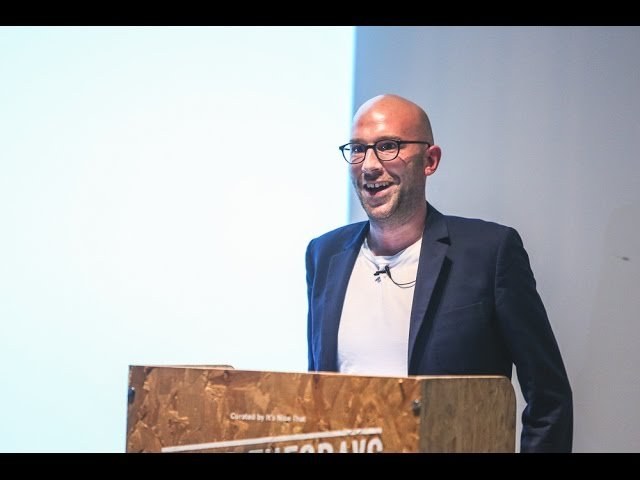
“Photography is about ideas; it’s about finding a device to tell a story.”
Transcriptmay contain minor errors or formatting inconsistencies
Um this is highly embarrassing but I'm going to have to start off by saying I'm not a photographer. And I'm not I don't take photographs at all almost religiously I refuse to take photographs having said that I've worked within sort of with photography for the last 12 years. And it's kind of my big passion I guess and the other thing I'd like to say is really nice talking it's nice that event because I think I'm right in saying that it's nice that founders were from a design background is that right.
And I think it's really important to always think about like how design and photography are best friends really I mean when talking about photography and I'm really interested in this question is is do you ever not see do you ever see photography no sorry let me write it differently you you never see photography without it being in the hands of design ever whether. That's in a magazine or on a billboard advert or on you know the screen of your iphone or you know on a website everything photography is always held by design which I think is fascinating and I think sometimes that's sometimes forgotten anyway. That's a complete tangent so yeah I'm not a photographer.
But I am a publisher. And I publish works that have photography at their heart I'd even go so far as and this might be bad for the university of westminster where I teach but I don't even know how interested in photography I am I'm really interested in ideas and stories and I find I'm incredibly lazy and photography is an amazingly brilliant way of telling stories very quickly that's why I guess it's used in advertising quite often I'm assuming but anyway. So in 2011 myself and a guy called ben weaver who's an art director set up here press and we're a small publisher of books that use that have photography at their heart that are used in telling stories and I'm going to show you three projects tonight that that I'm quite interested by that we've been working on strangely two of them are quite political or could be seen as political and we quite often get asked if we're like a political publisher.
And I don't we've never really figured out the answer to that one apart from like an incredibly pretentious answer which is surely publishing is a political act which I think it probably is anyway the other thing I want to talk about is is sometimes I find photography there's lots of conversations about photography and the art world as in they're kind of opposing each other or they work with each other. And I just think it's incredibly boring to have that conversation whereas I quite like using the an analogy of the music industry with the photography world. And I think it might help with this presentation to think of so we're a publisher.
But I think a nice analogy is we're a bit like an independent record label that's how I see ourselves and we I guess you could say that we make kind of prog books or kind of concept albums in book form when I'm not interested in making a greatest hits record sort of you know 20 of the best pictures by irving penn or someone like that that just doesn't interest me at all we'd really like to make find projects that are really problematic and then try and make sense out of them. And that's kind of the three I'm going to show tonight hopefully have that in there somewhere.
So I've got really bad coffee this is this is some pictures by a guy called ben roberts who's a young british photographer. And I'll tell the story behind the work first and then I'll talk about the publication side of it is ben roberts okay you all know about the the occupied movement obviously that happened all over the world but was quite interesting in london at st paul's and finsbury square anyway ben roberts was on a train down to brighton one day and he he's a slightly left-wing guy I reckon and he he was on this train and he sat down and next to him was a copy of the telegraph and he's not normally a telegraph reader I assume ben roberts and on the front page of the telegraph I don't know if you guys remember this story that the daily mail and the telegraph both ran it was this thing about the occupied movement and they were both reporting that. Actually they'd had helicopters fly over the occupied camps and had heat sensitive cameras on them and actually.
There wasn't anyone there it was a bunch of middle-class kids that went and set up tents and then went home to mum and dad's house in guildford or somewhere like that and like quite rightly I think ben roberts got off his seat got off at the next stop and said that is ridiculous. And I need to do something about that that is the most horrific daily mail story that. There is you know. There are people all over the world in brazil in south africa you know do it making this movement that was really really fascinating is still really fascinating and and important I think and so we thought of a way of like I need I need to do something about this I need to sort of dispel that horrible daily mail myth that they were they were setting up so he had a it's just a very nice example of an incredibly simple project that is incredibly poignant I think and he had this idea at the train station that he got off on on the way to brighton and he turned around got on the next train back to london and on the way he phoned the the chief press officer for the for the occupied movement which is someone called something naomi calvin I think anyway she she happens also she was also the press officer for the occupied movement in london was also the chief writer about occupied for the guardian which was quite interesting and he said look I need access I want to photograph I need two nights I need to photograph the tents of occupy and I need to photograph these individuals tents and the communal tents but I don't want anyone in them.
So I want I want to do a story essentially about how of course people are living in these tents but how I'm going to do that is photograph these tents without any people in them. And I think I've you know we've had numerous conversations with ben but I think I don't know if any of you go camping but I think anyone that's ever been camping ever realizes that however hard you try to keep a camp a tent neat and tidy it's not possible you get so much crap in a tent whatever you do and so he he felt that by photographing the tents without any people in them he could immediately prove that of course there's people at the occupied camps which of course.
There were so this is a series of pictures of the empty empty tents of the occupied movement in london and when I first saw these I remember that it's very clever the way he sequenced these when he first showed them to me is that you have them some of them are just incredibly abstract and you have no idea what you're looking at you don't really understand that it's a tent and then some of you some of them are much more obvious and also I think they're fascinating you know at that moment when I first saw these I didn't quite know the scale of the this kind of occupied exercise you know they had I.t tents they had hospital tents library tents religious tents were different kind of religious communities that were taking part in the movement and so it felt incredibly important to make a publication about this of this work. But also to make it affordable and on a kind of quite mass printed you know to print it on mass as it were which sadly we couldn't do because we don't have that much money but we made this publication called occupied spaces it was it cost 12 pounds 50 in the shop it was incredibly simple it had a few quite nice design elements to it whether essentially the spine which is where the essay is which is an essay something I feel very strongly about photography books is no one wants essays about the photography that's the most incredibly boring thing in the world because surely the photograph should do that. So it's an essay by naomi something it's really embarrassing I can't remember about the occupied movement and and the situation it was at that time globally and I wanted to show this this publication because it's quite a kind of low-fi thing partly because it's done very well.
So we printed a few hundred copies because that's all we could afford at the time.
But it recently I don't know I don't know how photo bookie nerdy people are in here.
But there's there's these books that have come out there's been three so far by martin parr the photographer and jerry badger the critic and photographer called the history of the photo book and they're very important they really are the history of the photo book in terms of the last hundred years.
And so on. And in the latest one this is featured as one of the most important political books of the last 50 years which I'm not saying it is but they think it is so that's great it also means that I always I held back 50 well I held about 30 copies and I can sell these now for about 250 quid which is great because originally it was 12 pound 50 and as soon as we knew it was going to be in that book we printed another 200 copies and sold them again for 12 pound 50.
So we're all about I want people to have access to the books it's just whether I can afford to or not but I also sorry I also thought I'd just talk about this book because there was a going back to this idea of concept albums I want to make the concept albums of books is that everything has to be so considered and there was something quite interesting in this just as a anecdote about kind of sequencing which was they're all really interesting pictures but I couldn't work out what the sequence would be I mean the easiest thing to do would be well that one looks quite nice next to that one and that one's complicated so let's put it next to a kind of more simple a simple picture but that just didn't seem really good enough and then it was just there was a very nice conversation one day when we were in the studio and ben roberts was there.
And we were just talking about the camp and so on and he was explaining the camp and he was saying oh it's quite fascinating how it works it's it's you have the sort of individual tents the individual people's tents on the outskirts of the camp and then as you walk into the middle of the camp you go into the more communal tents like the it10 the news 10 the press 10 blah blah blah blah and then as you go out to the other side of the camp it goes back into the sort of individuals tense and that was of course like the sort of moment when we realized well.
That's how we edit the book we must edit it as a map of the camp so it starts the book starts with the individual tent pictures and then goes into the communal ones then it has the essay in the middle it kind of acts like a spine which may be a bit like a tent maybe not I don't know.
And then communal tense and then back out to the individual tents and it's always those things that probably no one will never notice that that.
That's how the book sequence but for me it makes me very happy so that was a really interesting moment and then I want to talk about this book controlled order house which I've been trying to figure out how to talk about this in such a short piece of time.
This is a book by edmund clark that we did a year or two ago.
And I don't know if I'm sure some of you are aware of what a control order is they've actually changed their name. Now in the uk but they're kind of still referred to as control orders a control order is something that the home office set up which is okay I find it so hard to explain if you're if if the home office suspects you of terror of terrorist activity they can issue a control order on you which means you will be put in one of there's 43 of them around the country one of these houses that is owned by the home office and you have to be put in this house it's normally very far away from your family and where you originally live but it's a normally quite suburban house very normal house and you have to you have to sign a control order basically which which is essentially it's a bit like a tenancy agreement basically but a little bit more complicated obviously and so how I just find it really hard to explain this.
So basically edmund clark managed to gain access to a house one of these 43 houses that exist in the uk where someone is being held under suspected of terrorist activity under a control order which is insane that he got that access why on earth would the home office want an artist to be there I mean just doesn't make any sense now the other thing about control orders is they're incredibly sort of kafka-esque I mean they're insane in in what you have to sign off to so the other another interesting thing about a control order is if if you are suspected of of terrorist activity and held under a control order neither you nor your lawyers are ever allowed to know what you're suspected of okay.
So you have to go to court and your lawyers have to you know represent you.
But they don't know what you're suspected of at all nothing you have no information. And this exists in this country right now.
Anyway so edmund clark who is basically the king of getting access to things he managed he got signed off from the home office three weeks to be in the house with a man suspected of terrorist activity living living with him and he wasn't allowed to to show the man but he was allowed to document the house and after two days the home office obviously someone signed it off who wasn't the right person because after two days after literally 48 hours someone arrived at the door and took edmond clark police escorted out of that house and he was they looked at all his photographs and actually let them have the photographs but but yeah that so he he he was actually in there he was going to make a film and he came to us afterwards and and he said you know I did this thing. And it all messed up because I didn't have the access and blah blah blah and I thought I'd be in there for three weeks but I was only in there for 48 hours and we were very interested we're like what have you got you know what did you do in those 48 hours and he said I did something you know all I did is I had a I had a camera like a digital camera and I just mapped out the house like every single inch he literally walked around the house taking a picture there picture there picture there picture there like incredibly boring and we realized that this was actually quite interesting this idea of control and mapping of something.
And I should sorry going back to the idea of what the the guy who he was in the house with who's referred to always legally as ce and I don't know his real name. That's all he's referred to ever and edmond won't tell me is he has to sign this control order which is like I said it's like a tenancy agreement so and it literally it's it's amazing yet the the detail in it that it says in it he's not allowed to drill into walls he's not allowed to hang pictures he's not allowed to redecorate the house I'm sure that's not top of his priority but like he's not allowed pets he's not allowed to I mean it goes on and on.
But then it gets slightly more complicated like he is allowed out of the house at certain points but if he bumps into someone he knows he's not allowed to talk to them for more than three minutes and it's literally this list endless list of what is a control order the contract essentially the tenancy agreement he has to sign with the home office anyway.
So we so basically we can't we had this pro this kind of this problem-solving idea is so edmund came to us with 542 of some of the most boring photographs you've ever seen in your life and one of the driest yet really important stories and endless legal documents he had a control order what you have to sign he had his correspondence with the home office and then he had the court case because eventually ce did go to court and maybe I'll tell you about that later and and we this this book you know this this funny little book took a year to make because we just couldn't work out how to do it.
But the sort of moment came much like the map the mapping of the camp in the in the occupied book is that we realize that we can't we it would be wrong to control this I mean partly because there's there is like 542 of pictures like this which are incredibly boring and uninteresting and not very good pictures I mean they're just uninteresting completely it's the moment came when we realized we just don't edit them let's just make a book of 542 pictures of inside this house and let's put every single legal document in there.
So I mean if you want to look at the book later I can show you and there's there's other other elements to it we got an architect from the pictures to design what he thought the house would make and there are these pretty impenetrable legal documents but but they are worth a read but then we also intersperse that with kind of commentary so if you didn't want to go into a 40 42 page legal document you could just read the commentary that kind of sums it up because we wanted it accessible and then I wanted to talk about this book.
So okay the other thing we did with this book much like we tried to do with the occupied book is it's a really important issue I think anyway personally so we we've made it as a downloadable pdf on the websites you can download the book as a pdf form for free on the website just because it's important to spread the word and this book I'm not I'm I've sworn that I'd never cost what the unit cost for this book cost because it's got like seven different paper stocks and it's on all different fancy whatnot but it's incredibly bad way of making money printing books like that.
So anyway normally I don't know if again I don't know how nerdy you are about photo books or artist books but like quite often there's this thing where people do a kind of artist edition of the book which is where you you know you sell the book in a nice box with a print and I I'm always really shy away from from that kind of idea because to me it just looks like you're trying to make money which is why I don't make much money because I kind of sneer at that which I shouldn't it's incredibly juvenile but with this book we decided to do a collector's edition which comes in the black box with the elevation of the house but the most important thing is I couldn't think you know we thought we'd do like an edition of 25 and they each come with five different prints but what print do you want I mean they're the most boring pictures in the world.
But then we came across this guy here right.
And it's just beautiful how this worked but in five of the pictures of these four 542 pictures this guy crops up and there he is down there okay but you may laugh but this is this is really really big news this shows how absolutely kafka-esque this is is ce bought his cat with him okay and because he's got this cat the home office obviously didn't see this when they went through edmonds pictures or they didn't care maybe they didn't care but because ce has this cat in this house ce could now be charged fully with terrorist activity because he's got a cap because he's broken his control order so actually suddenly doing a special editions you if you're interested we've still got some for sale you can choose which which cat picture you want and that comes with the book.
And then I'm going to kind of come full circle just to finish and talk you know I mentioned the music industry and like how that I really like that idea of you know the books we make I mean edmonds book was really like that tricky third record do you know what I mean that people talk about maybe not anyway.
So I want to talk to you about a book called nirvana by jason lazarus who's an american artist who uses photography I guess he kind of takes pictures but he kind of uses pictures as well and he's a really interesting guy jason lazarus I think he's fantastic and okay to put it really simply jason lazarus just asked the number of people that he knew either online or in person and he asked them the very simple question of like who introduced you to the band nirvana that's all he asked right.
And then I I think what I'll do now is I'm just going to show you some pictures and read through read through the the people in the pictures comments about who introduced you to nevada to the band of varna my daughter caitlin introduced me.
So these quotes I'm reading go with the pictures right my daughter caitlin introduced me to nirvana I took this picture of her in the caribbean in 1994. In the week after this picture was taken she broke her back and spent the next six years in rehabilitation I remember clearly cobain's voice as a soundtrack of this time when she lost so much my uncle used to fly me out to los angeles as a kid he was my early introduction to music especially the ramones and joy division he paid me a hundred dollars to co-check at his parties as an eight-year-old I listened to never mind with him for the first time straight through at the kitchen table I lost him to aids in 1994.
Becky was my neurotic friend who had a stalker in high school and who came to her bedroom window repeatedly while playing with the taser her mum brought her in her bedroom becky played me in uturo all the way through soon after I bought it dave was my cover boyfriend at high school he introduced me to nirvana and mushrooms he carved my name into his arm with a razor blade when I tried to break up with him he also read me a love poem over the phone that I later recognized as a song from dark side of the moon with my name inserted at significant moments mickey my mum's second husband introduced me to nirvana's never mind record he was around till I was just 13. Philip introduced me to never mind in his bedroom in vienna austria he was my first boyfriend and we were each other's first lover later he told me that he kept the bed sheets from our first time he died a few years ago in a tragic motorbike accident and that's the book and the book. Actually.
This is like a rough dummy of the book it's not the actual thing.
But I guess the big decision here was to take the text away from the pictures and we kind of wanted to do it a bit like the pictures in the book become a bit like the songs and then the lyrics are on the back you know like you used to get on an old lp or on a cd or whatever.
But I think that makes you spend more time with the book and yeah I'll just say one more thing about that what I love about this project is it's not about nirvana I couldn't care less about nirvana I really really do have no interest but everyone's got a nirvana story you know I've got one I'm not going to tell it now because it's desperately sad but but it's not about nirvana it's about growing up it's about you know that first cigarette about having sex for the first time it's about losing someone for the first time it's also like about american history a certain moment well not even american but that book is particularly american but you know you know with the age with the uncle dying of age and all of this.
And I just love that he he found that device photography is really about idea for me the photography I'm interested in is just about ideas and about finding a device to explain a story so jason wanted to make a book about growing up. And so he asked people like to tell him stories about nirvana or ben roberts wanted to you know to make a comment about the occupied movement so we just took the people out of the pictures when the occupied movement is all about people it's not that tense it's about people and edmund clark's book I'm still working out what that one's about yeah thank you very much
Latest Talks
-

Murugiah
Why you should reject the formula and make art about things you love
Watch -

Amber Weaver
How does contemporary type design translate into the wider world?
Watch -

Delali Ayivi
How does photography give us the right to imagine our futures?
Watch -

Will Anderson and Ainslie Henderson
Bringing stop motion sorcery to BBC’s Small Prophets
Watch -
Ollie Babajide Tikare
The importance of not flattening the complexity of observation
Watch -

Marina Willer
Design thrives when you find poetry in the simple things
Watch