
Hannah Lim is an artist known for her multidisciplinary practice that blends flamboyance, ornamentation, and function. She explores the 18th Century aesthetic of Chinoiserie through the lens of her mixed Chinese, Singaporean, and British heritage.
Hannah Lim
Building a practice that blends flamboyance, ornamentation and function
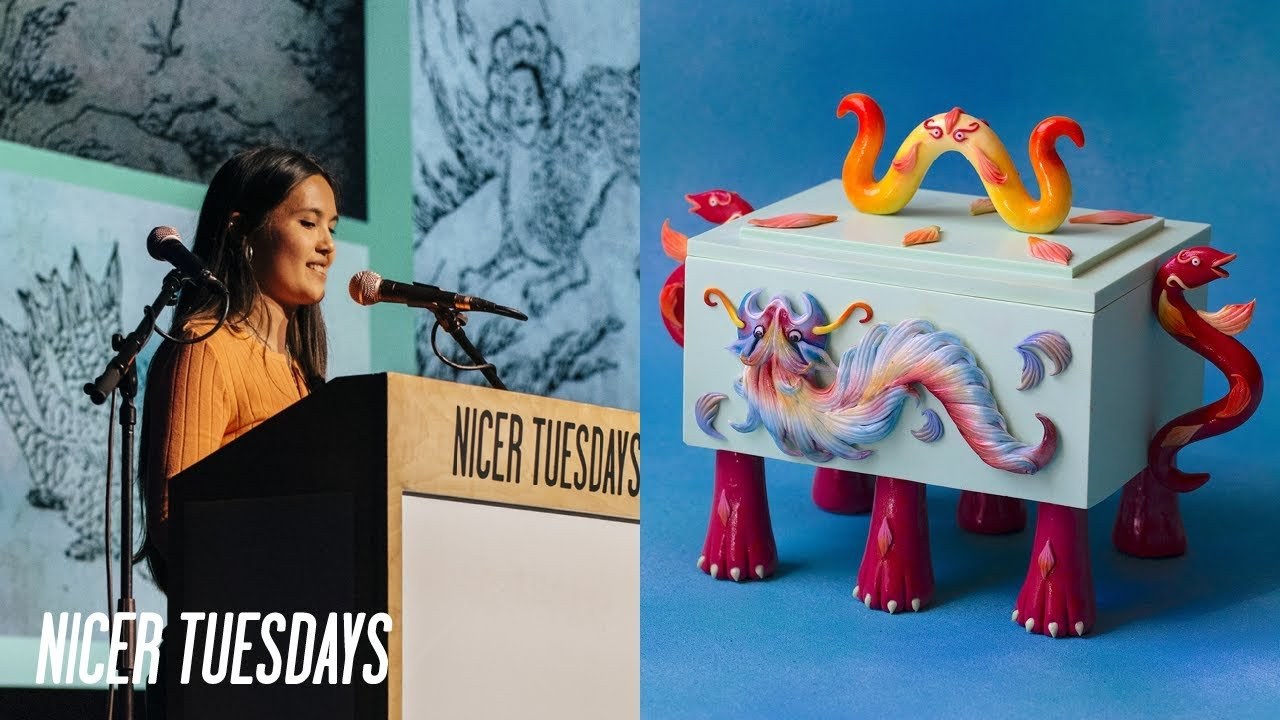
“My work is a reflection of the chaos and beauty of my heritage; it’s not just about aesthetic but about identity.”
Transcriptmay contain minor errors or formatting inconsistencies
Hi everyone. , thank you for coming today. I'm going to be giving you all a little introduction into my practice and my journey into becoming an artist, whilst also sharing with you a little overview of some of my recent projects. I mostly work with sculpture, but my practice also includes painting, installation, and functional design. During my foundation, I found I was quite interested in sculpture. I hadn't had much opportunity to explore it in depth during my A levels. So, it was something that was new and exciting and surprisingly suited my approach to making work. I ended up doing a degree in Edinburgh in sculpture at Edinburgh University where I was able to really figure out what interested me as an artist. I'd always been interested in exploring my mixed heritage through my work. My dad's Chinese, Singaporean, and my mom's British. So, I became particularly interested in researching the relationship between these cultures and how this has been reflected historically through design, objects, artworks, and architecture. Through this research, I became intrigued by the design style Shinazeri. Shininoazri is is an 18th century aesthetic trend in which Chinese designs and cultural practices were recreated and imitated in relation to European aesthetics and tastes. The images you can see up on the screen are taken from various architecture and furniture design books featuring objects, buildings and artworks created the shinazri style.
Shinazri is often characterized by its flamboyance, vibrance and very ornate features. For me, there's always been something kind of intriguing but also conflicting about Shinwazeri. Whilst I'm intrigued by the exuberant, ornamental, and fantastical nature of Shinazeri, as well as its ability to capture this mixing of cultures, I'm also aware of its colonial history and its imitation of cultural styles. In my work, I wanted to kind of reimagine Shinazari in a more appropriate way, using the practice as a means to explore and reflect upon my own mixed cultural identity whilst cherishing the original exuberance and vibrance of the Shinazri style. Many of these works blend together ornamental and functional designs. They often resemble furniture-like structures whilst also capturing different cultural motifs. The work on the screen appears to look like multiple things at once. Flames, a dragon, a heart. Almost all of my large sculptures are also flat packable created through laser cutting segments of wood that are then hand painted, lacquered, and slotted together. There's a mixture of more traditional as well as more modern techniques used in my process. Some of these works are more functional whilst others are more ornamental. I like playing about with the functionality in my work and in recent years functional design and furniture design have become more prominent in my practice. Here are a few images from recent shows and projects. I really try to embrace color and playfulness in my work. As you can see, I've always liked this idea of making my work feel more playful.
I think this playfulness really invites people to investigate the work and engage with its cultural context. This particular piece is made through the same process as my other works, but is made with bronze and stainless steel. Whilst it look might look quite dainty and delicate, it's actually surprisingly heavy and solid. What's interesting about the laser cutting process is that it can be used with a range of different materials and applications. The table structure of this piece is all made from laser cut stainless steel, whilst the orchid at the center of the work is cast in bronze and has been made from a model that was originally sculpted in clay.
The work was then airbrushed to get to give it a very pristine finish. I've mostly worked in the art world, but more recently have started collaborating on projects more focused on design. This piece is a chest/ seat based on the traditional Italian Cassone that I made in collaboration with Dolce Gabbana. With this piece, it's nice to see how my more experimental sculptures can be transformed into something more functional but still retain their vibrance and playfulness. The inspiration for this work was both related to my research into Chinese mythology and also inspired by the mythology rel related to Mount Etna in Sicily. Finally, here we have a few images of a series of public sculptures I created last Luna New Year for Greenwich Peninsula.
I think these works really show how sculpture can be used to brighten and celebrate public spaces. These flame style sculptures are created with my signature cutout shapes that are inspired by chi shino fret work and Chinese paper cutting patterns. I'm going to move on now and talk a little bit about another important part of my practice. Up on the screen are a pair of snuff bottles. Snuff bottles are small objects that were originally created to hold powdered tobacco. Often made from ceramics, glass, or carved ivory. These objects were both simple and functional, but also extremely decorative, often painted or carved with intricate symbols or creatures. I'd always been intrigued by the intricacy and functionality of snuff bottles. Ever since I first came across them in the Chinese collection at the VNA, it seemed every time I visited a museum in the UK, they always seem to be a vibrant collection of snuff bottles, and they became for me a kind of visual emblem of my heritage. In 2020, during the lockdown and the final year of my degree, I started creating my own snuff bottles, a series of intricate and all sculptures much smaller than my previous works. My own snuff waterlike works are far larger than the traditional designs and are often anthropomorphized with arms, legs, and eyes.
Initially, these works were designed in a way to highlight certain personal aspects of my heritage, and over time, they've come to reflect different elements of my research. Most recently, my interest in Chinese mythology. I become particularly drawn to texts such as the classics of mountain and seas, a Chinese bestiary. , and a bestiier is basically a a book of of beasts and mostly kind of enchanted mythical creatures. , the class of mans and seas features prints and descriptions of mythical creatures and landscapes. I've also been drawing inspiration from medieval bestiaries and illuminated manuscripts. What's been so interesting for me is the similarities and the crossovers in the creatures that are depicted and described in these texts that come from different cultures and time periods. Here are a few more of my snap water works that I've been creating over the last 5 years. They've evolved continually to reflect different places, objects, and histories I've been researching. I like displaying these works on wooden shelves created in the same way that my largest sculptures are produced. It's a nice way to connect these words, connect these works visually, especially when they're shown together.
I also paint.
This is something I've more recently reintroduced to my practice. I usually create my paintings combining watercolor and acrylic paint. These works are then set in painted wooden frames that slot together. These frames are created in the same way as my larger sculptural works utilizing cutout patterns. And so again, there's this nice connection between all the different parts of my practice.
The imagery for many of these works is often also inspired by my research into mythology as well as medieval bestiaries and illuminated manuscripts. I'll finally be highlighting a couple of recent projects and collaborations. I've been working as an artist for four years, but in the last two years, I've been able to really expand my practice working on brand collaborations and public sculpture projects as well as exhibitions. In September, I collaborated with Bulgari, who asked me to design an afternoon tea experience inspired by my work. This involved bringing together all elements of my practice.
I created a vinyl artwork design for the facade of the hotel, a set of bespoke handmade pastry stands, and a collection of napkins using my artwork. I was also able to work with their executive pastry chef to design a series of pastries inspired visually by my artworks and incorporating European, East, and Southeast Asian flavors.
It was a really really exciting project that required me to adapt my work in lots of new ways and I think it kind of highlighted to me that you never really know what you could end up working on as an artist. Finally, I'd like to mention a project that I've been working on with Houndslow CPP that recently opened along Houndslow High Street.
I grew up in the bar of Houndslow in West London about 20 minutes from the high street. So when I was commissioned to do this project by Hanzo CPP and Hanzo Council, it sounded like a lovely opportunity to give back to the area I grew up in, an area that has had a lasting influence on my work. For the commission, I created a series of tiles that can be found in shops along the high street. The works reflect upon the history, stories, and cultures of Hounds High Street, as well as my own experiences as an artist who grew up in the burough. From November 2024 to January 2025, we recruited a group of local story collectors who interviewed business owners and shopkeepers on Hansow High Street to highlight its independent businesses and the communities that use it.
In response, I created a series of works that single out particular symbols and motifs. These include the griffin, a prominent feature of Houndsow's crest, and the orchid, a symbol of resilience that features regularly in my work. That's all from me. , thank you for listening. [Applause]
Latest Talks
-
Murugiah
Why you should reject the formula and make art about things you love
Watch -
Amber Weaver
How does contemporary type design translate into the wider world?
Watch -
Delali Ayivi
How does photography give us the right to imagine our futures?
Watch -
Will Anderson and Ainslie Henderson
Bringing stop motion sorcery to BBC’s Small Prophets
Watch -
Ollie Babajide Tikare
The importance of not flattening the complexity of observation
Watch -
Marina Willer
Design thrives when you find poetry in the simple things
Watch