Clay Hickson is an illustrator, designer, and co-publisher of Caboose Books, known for finding self-expression through his sketchbooks and pens. He emphasizes the importance of drafting and practice in his creative process.
Clay Hickson
Why the sketchbook is an illustrator’s best friend
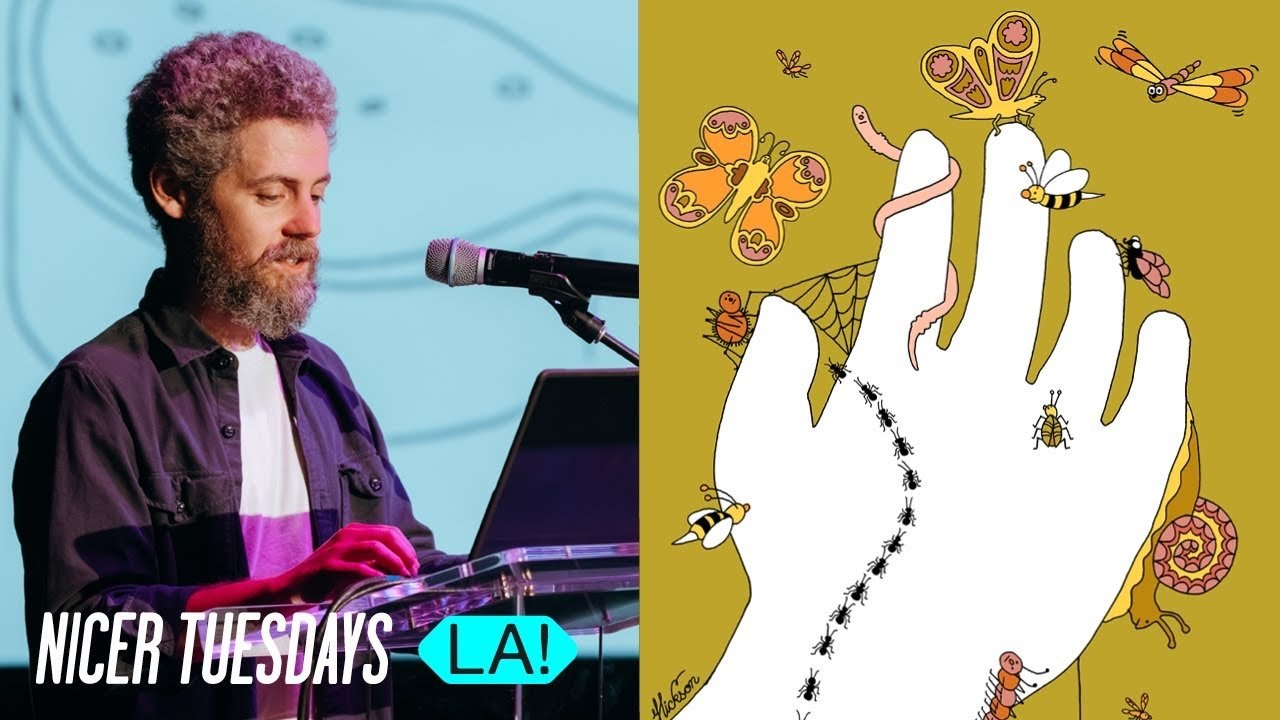
“The sketchbook is where ideas go to find their voice.”
Transcriptmay contain minor errors or formatting inconsistencies
[Applause]
Hi everybody. , everybody else was so cool and casual up here, but I had to write mine down. , I also [clears throat] came up with a title for mine. It's called, "What pen do you use?" [clears throat] , so my name's Klay Hixon. I'm an illustrator here in LA. , tonight I'm going to let you in on a few little secrets behind my process that hopefully won't expose me as a fraud and tank my career.
But first, a little background. , [clears throat] so I've been lucky enough to work as an illustrator for almost 15 years now. I've worked with bands on album covers and merch, worked with some beloved local establishments on logos and posters and with some bigger global brands. I've done lots and lots of editorial work for newspapers and magazines. Gotten to design some greeting cards and holiday cards and some little billboards for important local causes. , I've even had the chance to illustrate a few books, [clears throat] including this one about winter soup. And most recently, this big one about Texas, which coincidentally also involved a good amount of soup.
But I didn't actually set out to be an illustrator. , in school I studied printmaking, as you can see. , at the time, I think I imagined I would find a career in a screen printing shop. , I never even took an illustration class because I'm an idiot. And, , it never crossed my mind that I would be doing this.
Just between you and me, I don't even know how to use Adobe Illustrator, but it's fine. , [clears throat] so after graduating and bouncing around a few jobs in different print shops, I found that I didn't really love the work. As [clears throat] much as I loved screen printing and the poster community, it turned out that staying up all night printing like 10,000 metallic gold Aon posters was not my calling. So instead, I took the lazy screen printers approach and in 2012 I bought a used riggraph printer off Craigslist and started the regrettably named Tan and Loose Press. , which is a terrible name [clears throat] that for some reason we continued to operate under for eight years until we rebranded as the only slightly better Caboose books.
But we had fun with it. , [clears throat] nowadays you can find a Rizo on every street corner, but back then they were a little more niche. I had never actually used one or even seen one in person until I bought mine and started tinkering with it.
But as many have learned since then, it's a powerful and alluring tool. , I never had any real plans for the press, but eventually I started inviting other people to use the Rizo, and it soon became a means [clears throat and cough] of collaborating with some of my favorite artists, and it gave me something to do when I had no other work, which at that point was most of the time. , so after a few years of just making Zen and putting on print shows, my wife and fellow illustrator Lyanna were toying with the idea of producing some sort of monthly publication, but we couldn't quite settle on a theme.
And then after the 2016 election, when we all felt betrayed by the internet and the digital world, our mission became a little more clear and the time felt ripe for a turn to physical media. So in January of 2017, the Smudge was born. >> [clears throat] >> The Smudge was our answer to the underground presses of the 1960s and 70s.
A sort of radical activist newspaper made by two ill-informed and timid home bodies. But Lyanna and I along with countless friends and collaborators donated who donated their time and work produced the smudge every month for five years out of my aunt's garage in the Hollywood Hills. The [cough and clears throat] paper became a sort of catch-all for every dumb idea we had. , it was a place where we could play around with illustration and design in ways that we couldn't in our freelance work.
We had total creative control and no idea what we were doing. It was always a side project for us since we were both working other jobs. And because of this, we were chronically behind schedule, always scrambling to fill space and find contributors and trying to fix our broken down machines, spending hours and hours every month sitting on the couch folding and stapling and stuffing envelopes. , it was the most fun and exhausting projects I've ever been a part of. And the pace of it forced us to stay nimble and open-minded because there was always spaces to fill and no time to fill them. [clears throat] So, in a pinch, we would often just reach for our sketchbooks and pull something out to fill any last minute spaces.
And that brings me to what I want to talk about most tonight, sketchbooks. , so I've maintained a regular sketchbook since August of 2009. And I know that for a fact because as you can see, I've meticulously cataloged my sketchbooks since then. Which I know this seems a little insane. But one thing I know about myself is that I work much better with some limitations. If I have too many options, I just get hung up and overwhelmed with the possibilities. , so apparently in August of 2009, I decided to commit to one sketchbook, the Moleskin Soft Cover Classic Unlined XL.
I didn't know they were going to be giving away Moles Skins tonight. , and that's the sketchbook I've used ever since. And a couple years later, I settled on a pen. It's my trusty yellow Lambie Safari fountain pen.
This is the only pen that I used for about 10 years until a couple years ago when I was gifted this vintage ultra fine line Coenor Repidigraph. So now that's the pen that I use. [clears throat] , so while some artists are exploring the rich and varied forms of self self-expression and creating beautiful tapestries of color and texture and light, I'm sitting at my kitchen table with my one black pen, terrified of getting too close to the edge of the paper. [cough and clears throat] , so my illustration process has changed a lot over the years, but the one constant has been my sketchbook practice. I draw on it almost daily and I find that it's the place where I can draw the most honestly and have the most fun. , it's where I'm able to achieve a looseness that I strive for in my professional work. Drawing without the pressure of knowing that someone else will see it has been crucial to my growth as an illustrator. In my sketchbook, I take risks and I make embarrassing mistakes and sometimes I learn from them and sometimes I just embrace them. I draw in my sketchbook because I'm not a naturally gifted draftsman. I don't have a great understanding of how things are put together. I can't just like draw a skunk from memory. It's something that I've had to force myself to work on and dedicate thousands of hours to practicing. It can be a miserable exercise, but for whatever reason, I feel compelled to do it. And somehow it has become my job. Still, every time an email comes in about an illustration job, my anxiety spikes and my immediate reaction is there's no way I can do this and I have to say no. But because of ego and greed and capitalism and flattery, , I say yes and I just sweat my way through it.
And between jobs, I keep practicing in my sketchbook because I don't want to be caught flatfooted when someone comes to me in desperate need of a skunk drawing for their new email marketing corporate synergy campaign. , but the other things that these sketchbooks have become for me is a sort of self-reference library. , they're an archive of drawings that were made without a deadline and exist only for personal exploration. So, when I'm stuck on something in my professional work, the sketchbook can act as a sort of menu of ideas. I often scour old sketchbooks for drawings that might already fit or can be molded to fit a project I'm working on. , this drawing on the left, for example, was not a sketch I made for this job. It was just something I had lying around that I thought with a few little changes would work well for the project. , and more often than not, the sketchbook drawings just act as a jumping off point. They can offer a theme for me to build an image around. , this drawing, for example, gave me the idea of using sign language as a way to highlight accessibility and inclusion in this design for PBS SoCal. And , sometimes to warm up before work instead of drawing, I'll just scan drawings out of old sketchbooks and experiment with them. So, I might just add some type and make fake book covers to try and bait art directors into hiring me. , these random drawings can just take on new meaning within this context. And they're always really fun to make. And you'd be amazed by how many people see these and think that I've actually written novels, [clears throat] which is probably not helpful for getting illustration jobs. , this was a poem that I wrote one morning before breakfast that I thought would make a nice little animation. ♪
>> [Applause]
>> , [clears throat] so if I'm really happy with a sketchbook drawing, I might even turn it into a screen print. I really like doing this because even though I don't print them, they're printed by my friend Elizabeth. They make me feel like I haven't completely abandoned my printmaking roots. Here's another one that became a screen print.
And just a quick side note here, you might notice that the drawing on the left is not from my typical sketchbook. , and that's because this year Lyanna cursed me with a 365 page sketchbook and the task of filling one page a day for the entire year. So, this is a drawing of an ice cream sundae that I ate on the 56th day of 2025. A lot of times other than tidying a little tidying up, I don't change much with of the original drawings, but for some reason I often feel the need to justify making a screen print by giving it some sort of message or larger context.
So I usually just add some type to spice it up a little bit. When I made this one, actually some native plant dieards got annoyed with me because those aren't real California native plants. Whatever. Sometimes I add text just to pander to a very specific market.
And then at the end of the year, I send a bunch of my unused sketchbook drawings to my older brother, WY, and together we make an annual calendar with mashups of his drawings and mine, so nothing goes to waste. , but [clears throat] ultimately my sketchbook is just a place to mess around and hope that I stumble into something special. It's a visual diary where I can reflect on things that I did that day, like a movie I saw or something I ate, but more often than not, it's just drawings of our cats. , [clears throat] I usually draw first thing in the morning when I'm like hopped up on coffee or late at night when I can barely keep my eyes open.
The little accidents that result from my shaky hand dragging ink across the paper become the thing the things that make the drawings unique to me. And that's what I notice most when I look at work that I love. The weird mistakes that somehow make it warmer and more personal and more human. I work in pen without sketching anything out first. So every drawing kind of feels like a roll of the dice.
But I draw slowly and I try and anticipate what will come next. But inevitably, I screw up. And I love that. It's why I'm always excited when I can use something from my sketchbook. The mistakes start to become a flourish of my personal style and because they show my hand. , so now I'll leave you with this. After much practice, the skunk drawing. [Applause]
Thank you.
Latest Talks
-
Murugiah
Why you should reject the formula and make art about things you love
Watch -
Amber Weaver
How does contemporary type design translate into the wider world?
Watch -
Delali Ayivi
How does photography give us the right to imagine our futures?
Watch -
Will Anderson and Ainslie Henderson
Bringing stop motion sorcery to BBC’s Small Prophets
Watch -
Ollie Babajide Tikare
The importance of not flattening the complexity of observation
Watch -
Marina Willer
Design thrives when you find poetry in the simple things
Watch