
Charlotte Mei is an illustrator known for her multidisciplinary practice that emphasizes the importance of colour, shape, and composition in her work. She has developed a distinctive style that makes the act of creating visible in her portraits and landscapes.
Charlotte Mei
Inside Charlotte Mei’s portfolio of Lord of The Rings fanzines and chainmail bikinis
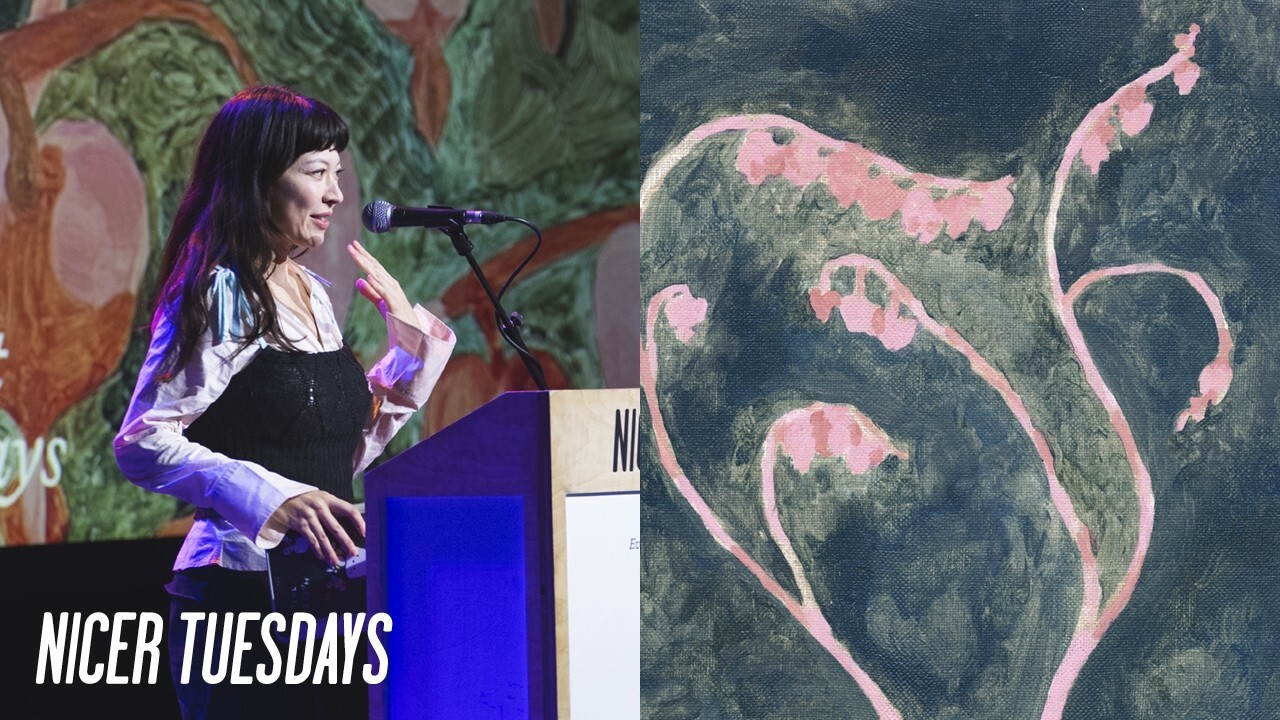
“You never know who's watching and collaboration really does open doors. All this came off the back of doing a poster for my friend.”
Transcriptmay contain minor errors or formatting inconsistencies
[applause] Um, welcome. Thank you for coming. It's really nice to be here today. I'm really happy that I get to talk about the thing that I am most obsessed with in the world, which is making art. [gasps] Um, growing up, I had no idea that you could actually be an artist as a job. Um, I I thought that all artists were like old and dead. So, it's actually quite a nice surprise to be here and um not be old and dead yet.
Um, but I did know I just loved drawing pictures. Um, I grew up in a family who moved around a lot. Um, my mom was a hard-working single parent who came to the UK when she was young. And like many parents in her position, I think she was quite keen for me to have a proper job like uh something nice and stable.
[laughter] So, the idea of being an artist um as an actual career wasn't really on the menu for me. Um yeah, when when I was 15, I did my work experience at Crown Court and um got to watch like some drug dealer trials, so it was anyone's guess what I was going to end up doing with my life. Um um but yeah, I you know, I I guess I didn't really know that this would be an option for me until I was pretty much doing it. And I don't think I'm unusual in that. Um I think yeah, I think that's kind of common for a lot of us. And but looking back, the signs were all there clearly. Um I [laughter] [gasps] I spent my childhood obsessing
over comics, anime, video games, and I would draw constantly on little bits of printer paper. My little Pokémon drawings. Do you like them? [laughter] This is a project I did with my friend Chris. It's a a fanzene about Lord of the Rings. And Lord of the Rings was a much obsessed over era spanning from when I was like 10 until now. So, um um so yeah, these these kinds of like I mean like films and cartoons and stuff has always been a really big influence for me. Um anyway, [snorts] so art was my favorite thing to do before having any context or name for what I was doing. And um I I I I did it at at school, but um I was never really
planning to pursue it until like a very kind art teacher recommended that I applied to go to Campbella, which is where I studied illustration. Um on the day of my interview, I kind of like got a little bit of imposter syndrome and actually didn't go to my interview. I think I'd like on some level internalized the belief that studying art was pointless for someone like me. So, I just didn't go. I quietly gave up and went back to my job at M&S.
Big up. Um, but weeks and months went by and I actually got a phone call from Campbell saying, "Oh, like we um we have some like interviews for people who couldn't come due to illness. like, "Were you ill?" And I was like, "Oh, yeah, maybe I was actually." [laughter] So, long story short, I I told a friend of mine who was like, "Hey, I'm driving to London that day. You should get in the car." So, I went with her and I got my place at Campwell and I guess for me the rest is history and I feel like I genuinely still owe so much to that moment. Um, and suddenly I was moving to London to study art.
Um, I I loved it. I had such a good time. Um, and I really felt like I stepped into myself properly for the first time. Um, I was on an illustration course and so we were always thinking about narrative and stories and I think that is a thread that still runs through my painting now. And I made loads of friends who are still my besties today.
Some of you are here. Hi. [laughter] Um, but yeah, after leaving and joining the grown-up world, I like knew I had to make it work somehow. Um, I didn't have any connections or a f financial cushion. So, I did something I'm not sure that I would like morally or legally recommend to anyone, which is I um I took out a £10,000 loan from the bank saying I was starting a business.
Um which I guess I kind of was, but I had to like write a business plan and stuff and um but they gave it to me. Uh so I used the money to get myself a studio and I thought okay let's give this a go. So the first few years um were a mix of like enthusiasm and excitement and also al also hustle. Um I reached out to people that I admired. I collaborated.
I worked for free and cheap and I just said yes to anything that sounded fun. Um, and yeah, I think that kind of combination of naivity and excitableness really powered me through that and the internet paid played a big role. Um, so many of my opportunities early on came from sharing my work and experiences online, possibly oversharing So, one of the first like big breaks that I had happened because I illustrated a poster. This is actually, isn't it? Sorry, I haven't done the slideshow very well. [laughter] A poster for my friend's um club night in a pool hall in Peekom called Canavans. May it rest in peace. Um, and we like stuck the posters all around Peekom and I did it for free because it
was my friend's night. And then one day I got a phone call, which is so crazy now cuz who phones you? But so my phone rang and it was a man and it was like he was like I'm I'm from a nerd agency. He wasn't American, but he was a professional man. And um he he asked me to come in and um and talk to them and I was like, "Oh, wow. That sounds really serious." And so I did and um he'd seen the posters around in Peekom and he liked my work.
Um and the me the meeting ended up turning into a big job for a chain of shopping centers uh across Europe and Asia which these are some of them. And um yeah like it I I got to see my work on billboards and also like the the pay was amazing. like I I was just able to like pay off my business loan straight off the bat and I was like, "Damn, being being an artist is crazy."
[laughter] [gasps] Um, but yeah, I think like that experience shaped a big belief for me like a you never know who's watching and b collaboration really does open doors. Um, all this came off the back of doing a poster for my friend and yeah, it was kind of the first big thing and it really motivated me.
Uh, yeah, since then I've been really lucky to work with lots of fun clients. Um, these are some bits I did for a brand called Lulu Guinness. And I've also been lucky enough to work with Yeah. like you were saying like Hermes, Nike, the New York Times and I've also had some really really fun gallery shows as well which has been so cool. So I had this show last year at now gallery in Greenwich. It was this massive space that I was tasked with filling. And I mean like I paint usually so it's like fairly small format, but I was really thinking about like how can I make this space full and like impactful and kind
of feel like um I wanted it feel like a fantasy. So I I kind of made these big cuddly toys like you can see this kind of angel cat spooky sculpture in this photo. Um um worked with metal, made some like chain mail bikini and swords and stuff and that was so much fun. Um and we also did some workshops. This was like we filled the gallery with teddies from charity shops and we had like a upycling hybrid teddies workshop which was amazing. Um and I currently have a show on at Fortnham and Mason in Piccadilly as well. So that's been absolutely surreal.
Anyway, alongside the kind of girl boss stuff, I was squiring away in the studio developing my art practice. And over the years, I think my visual style has kind of evolved a lot and is quite eclectic in a way. I used to be really insecure about my work not looking consistent. And I really admired artists who had a clear visual identity. Mine always felt like it was bouncing around cuz I love like learning new techniques using material new materials, making mistakes and changing it up. And and it's only really after like many years of doing this that I've realized that this kind of spirit is actually at the heart of my practice. The change,
the experimentation, the curiosity, like that's the thread really. So yeah, um like I I'm not like talking about any of my projects. Like [laughter] but um I don't have much time so basically it is just really surreal to be able to make art for a living. And because there are people from all sides of the creative world here, I wanted to say something frankly that being workingclass in the arts is hard. And workingclass and low-income artists are woefully underrepresented.
Not because of lack of talent, but because the industry isn't designed with accessibility in mind. like it requires lots of unpaid time, flexible schedules, networks, rent, equipment, and like emotional stamina, which is a lot to expect of anyone. Um, but it's possible. It's not easy, but it is possible with community stubbornness and with people who kind of open doors instead of guarding them. And I've been really lucky that people have believed in me over the years and taken a chance on my work even though who am I?
So I do feel really strongly um that as people in this world in the creative industry we have a responsibility to support uplift and showcase diverse perspectives. um we will all be better off for having them. Um and there are some brilliant organizations who are shining a light on the issue of creative accessibility. The Working Arts Club and the White Cube are two that springs to mind. So, please check them out. And if you'd like to hear more from me, I'm I've been Charlotte May. [laughter] Thank you. Um, go check the show at Fort Mason out. It's free to visit. Um, and thank you so much for listening. It really means the world.
[applause]
Latest Talks
-
Murugiah
Why you should reject the formula and make art about things you love
Watch -
Amber Weaver
How does contemporary type design translate into the wider world?
Watch -
Delali Ayivi
How does photography give us the right to imagine our futures?
Watch -
Will Anderson and Ainslie Henderson
Bringing stop motion sorcery to BBC’s Small Prophets
Watch -
Ollie Babajide Tikare
The importance of not flattening the complexity of observation
Watch -
Marina Willer
Design thrives when you find poetry in the simple things
Watch