Lexie Smith is a baker, writer, and sometimes artist known for her online archive Bread on Earth, where she explores the intersection of bread with personal and cultural identity.
Bread On Earth
Falling hard for bread and biting into its potential
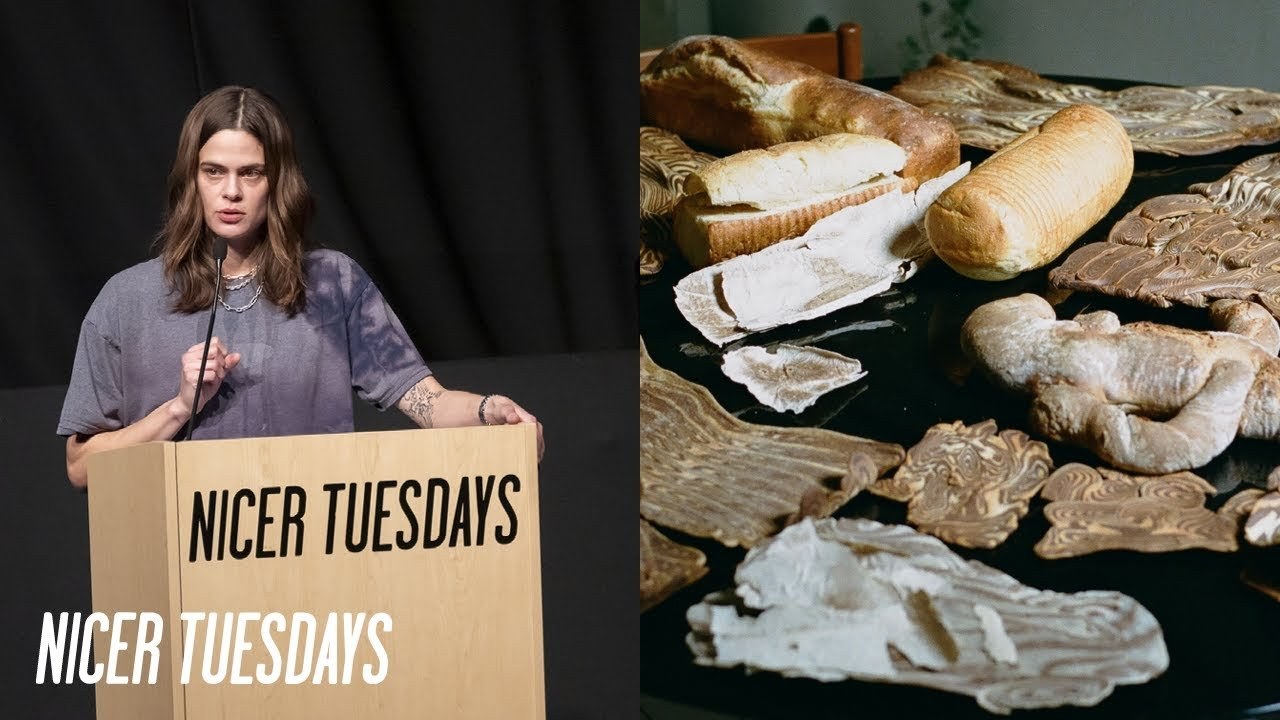
“Bread is not just food; it's a little piece of humanity that connects us to our past and to each other.”
Transcriptmay contain minor errors or formatting inconsistencies
And thank you all for being here. , I'm Lexi Smith. I'm a baker and a writer and a sometimes artist and I have a project called Bread on Earth. , that's why I'm here tonight. I'm merely its avatar. So, if you're wondering how a baker ends up on stage at the TED X of contemporary design symposia, it's a good question and it's one that I had too when it's nice that invited me here. And not one I immediately had an answer to. So, I thought we could spend the next 15 or so minutes trying to figure it out.
This is little me in my tiny studio apartment in Bushwick in 2016 around the time that I founded Bread on Earth. It was also around when Trump was first elected, which we'll get to in a little bit.
, bread on earth is a project that I characterize often clumsily as a kind of archive and umbrella for the research and experiments that I undertake to better understand bread, which is a material and an object and an idea that I find to be a gateway to bigger conversations about what it means to be human, the things that we share, the things that we take from each other, the things that we do to each other. , and it became a kind of public effort to help people, mostly myself, see this really mundane thing a little bit more clearly and then maybe see ourselves a little bit more clearly, too. And I mentioned Trump not because he's like the guy dour, but because it was actually his Muslim ban right at the end of 2016 that initially prompted me to see bread as this kind of connector piece this agent of personal and cultural identity and something that could also be seen as potentially more complicated and dangerous.
So these are flatbreads obviously from all around the world. They all go by different names and they're incredibly reminiscent of each other obviously. Flour, water, salt, maybe a little fat baked quickly on something hot. Flatbreads have been around forever everywhere. They're the prototypical bread and we all kind of came to the same conclusion however long ago when we were given finite resources and those conclusions were yufa padina lessa casab you can see for yourself etc etc there's lots more that couldn't fit on the screen so it felt absurd to me that someone would dain to put nationalism ahead of this history and humanity when it was incredibly obvious to me and I think anyone else who had look that were all literally made up of the same stuff. So, this project was born around then in earnest about 8 years ago, but I started baking a lot earlier than that. , I've been baking compulsively since high school and writing my own recipes about the whole time. , it was this kind of form of creative control that I hadn't experienced before and the alchemy and suspense of it was unlike anything else that I had felt and kind of still is. And he ended up working in restaurants and bakeries during and after college, which is what I had wanted to bake and cook professionally. And it only took me like eight years or so of this to realize that I didn't have the discipline to make the same thing in a restaurant kitchen every day. And around this time of disenchantment, I was invited to participate in an art show downtown. I'd kind of kept up a lowfi art practice. , and I kind of couldn't convince myself anymore that I cared as much about drawing or print making or whatever as I did about baking bread. So, I made a bunch of loaves of sourdough and I hacked them into pieces and I stacked them into towers in the gallery. And I wanted to see how people would interact with something with bread when it was offered in a space that wasn't traditionally designated for eating. And this picture of me setting up is the only one I could find of that night. It was before cataloging everything that we do became a kind of knee-jerk reaction to being alive. And as you can see, it's not exactly a groundbreaking offering, but it was actually pretty revoly for me. I stood in the back of the gallery for like an hour afterwards and I attended to a stream of people who wanted to talk to me about bread, my bread, but also their bread and their grandmother's bread and their country's bread, but also like medical diagnoses and politics and memory and loss. And it was unlike any effect anything I'd ever called art had had before. , and it felt like a kind of new language. And it was at this point that my interest in a really tactile and literal thing became an obsession with a metaphor. And it was also basically the birth of bread on earth. Things moved pretty quickly from this point. I quit my job in a restaurant and I started making bread in my tiny apartment kitchen. My bed was like just out of the frame. , and I was doing bread that making bread that was like really visual and I was doing a ton of material exploration. And these are some of the earlier images I made when I was falling really hard for my muse. In addition to making images, I was serving bread at events. I was writing recipes and sharing them. , I put it all online and I put it into magazines and into art spaces. And I was also writing about food and doing some recipe development on the side for a little cash, like a really little of bit of cash.
These are some installations from around this time. I was always trying to make sure that the bread got all eaten up by the end of it. Unless it was covered in plaster and wax, which it sometimes was. And some magazine collaborations I did with some photographers. , and to my surprise and delight, people were into it, especially in these highly visual contexts. And early on, this was kind of challenging for me because I was making this thing that I felt was really imbued with so much spiritual and sensory heft. , some more of my photographs from a while back when my process was really about exploring bread as this really physical , medium. And the more obsessed with bread I got, the easier it was to convince other people that they should care about it also. So using primarily Instagram as a method for sharing my work. I was using images mostly photographs and sculptures. Sometimes working with other photographers and sometimes taking the photos myself using them as kind of a ruse, a way to get people into the room and talking about things that are maybe a little bit unexpected. Cultural memory, gender dynamics, regional agricultural systems, labor structures, and yes, aesthetics especially when it came to why we make certain things certain way and what happens if anything when they don't look the way that we think that they should. And this went on I started teaching some workshops in more like institutional spaces. It seemed like students were more willing to indulge me on topics like how we could use bread making to see our roles in the cycles of production and consumption or how making it could break us from patterns of subconsciously upholding a status quo or how recipe writing could make a new authoritative voice in a room or so on and so on. I got really annoying about it. It got really high flutin and I was baking bread all of the time, but I was also falling down these kind of philosophical and political rabbit holes. And this happened to peak around 2020 when bread took on a much more literal weight again. Now, you may too remember what I like to call the bread boom and bust of 2020. #crumbshot when everyone everywhere wanted to make sourdough. And I wasn't super surprised by this trend because bread throughout history has always responded to crisis, but many people didn't have access to flour or yeast. And so I ended up sending out around 2,000 packages of dried sourdough to strangers in 39 countries and becoming basically a virtual hotline for bread making troubleshooting. And it took up the better part of my spring into summer. And it brought me back to bread as above all a really valuable currency for both sustenance and for comfort. But images of bread online were becoming really trit, you might recall. And Instagram was starting to feel like a trap for me. , so I was steering clear of it at this point. And I had just moved up to a farm upstate, Skyh High Farm, where I still live today. And there was room for me to plant grain in the fields. So, I also spent the first few months of the pandemic tending to this small wheat plot. , I wanted to better understand the process of making bread as it might have happened thousands of years ago. So, I spent my mornings weeding and eventually handh harvesting and threshing and winnowing and afternoons drying sourdough and sending it out in the mail. And throughout this process, documentation was really important for me.
I wanted other people to be able to kind of witness this very personal but also very universal process. And part of this documentation was a video I made called the work which is 11 hours of me hand threshing emmer. Emmer is a that I had grown. Emmer is a really ancient grain with a really stubborn husk and hand threshing or threshing rather is the process of removing that husk.
, it's traditionally done by heavy machinery or historically by like beasts of burden, but never with your fingernails. It's a totally insane thing to do. No one would normally do this, but that's what I spent my time doing during the pandemic. And a couple months later, I showed it in a gallery on loop next to two tiny loaves of bread I made with the resulting flower.
I think those were like 6 in each. , so Instagram doesn't host 11-hour videos and no one on there or anywhere actually would watch that. , and around this time I became more involved in the farm and I was less interested in making images just for the sake of making images.
And this proved to be a problem in my mind to continually connecting with an audience online which I thought was like a requirement for keeping Bread on Earth alive as a project. And when I did make visual work around this time, it [clears throat] was distanced from my more literal bread sculptures and from myself as the author. I was using more found images and using text or doing installations, thinking through ideas like the one in the top right, where visitors could exchange a fingerprint for a bag of sourdough starter. And my obsession with bread and my belief in it as a kind of lingua franca was still there.
But I was less and less interested in aesthetics and I was more interested in these kind of more invisible forms of research. Living on a farm and becoming simultaneously disillusioned with social media had me wanting bread on earth to become more utile and freestanding.
So this is when I committed to really rebuilding the Bread on Earth website which had always been a kind of repository and archive for like random experiments that I had done. And I wanted to turn it into the cornerstone of the project. So for the last 9 months or so I've lost track.
I've been working with two amazing designers, Hannah Nathans and Ilia Yavnishan, who are both here tonight to build the bread web, , which is a database of global bread types. And it's based off of research I've been doing for years and new research done contributed by about 40 volunteers over the last couple of months. And we're almost done.
This is a peak at the site so far, , with just a fraction of the content that will be available on it when it's finally ready for launch and beyond. And each bread entry will be connected to others that it shares characteristics with, or as I like to call them, its bread relatives. , and visitors to the site will be able to comment and submit new entries. And I had kind of been sniffing my way towards this public database idea ever since 2016 when I started Bread on Earth. , and this will be the homepage of the new website. And there will be subsidiary pages like this one which is a gallery of bread related images organized by theme. I'll also have an area for recipes and a sort of editorial bloggy type space and a reference library. [snorts] And this feels like a really appropriate culmination of 9 years of obsession in which I'm finally mercifully subsumed by it and made mostly invisible.
So, we'll launch the site with as many bread entries as we have. , I think that right now the number is hovering around 700, but the public will continue to help build it indefinitely. And I actually hope you all will sign up for the newsletter and follow along on Instagram. I still need it, turns out, , so that you can be notified when it's finally launched and then also add submit breads that are important to you if they're not already on the site. And the breadw webb is totally unfinishable and insurmountable. And I think that's what I like the best about building it. Building a virtual space that's maintains a really simple interface and it draws people in without relying too heavily on images and [snorts] it doesn't feel stodgy or overly academic and it translates a lot of information while also allowing for interplay between visitors and content has been a design challenge. , but I do feel like what we made ultimately reflects the essence of the material that it's both obsessed with and dedicated to, which is that on its face, it's really basic, it's really simple, but inside it is teeming with life. Thanks, [Applause]
Latest Talks
-
Murugiah
Why you should reject the formula and make art about things you love
Watch -
Amber Weaver
How does contemporary type design translate into the wider world?
Watch -
Delali Ayivi
How does photography give us the right to imagine our futures?
Watch -
Will Anderson and Ainslie Henderson
Bringing stop motion sorcery to BBC’s Small Prophets
Watch -
Ollie Babajide Tikare
The importance of not flattening the complexity of observation
Watch -
Marina Willer
Design thrives when you find poetry in the simple things
Watch