
Aries Moross is a design legend known for their distinctive work in creating posters for both indie bands and high-profile artists like Kylie Minogue, while actively promoting inclusivity within the creative industry.
Aries Moross
Designing for music and fighting for a more inclusive industry
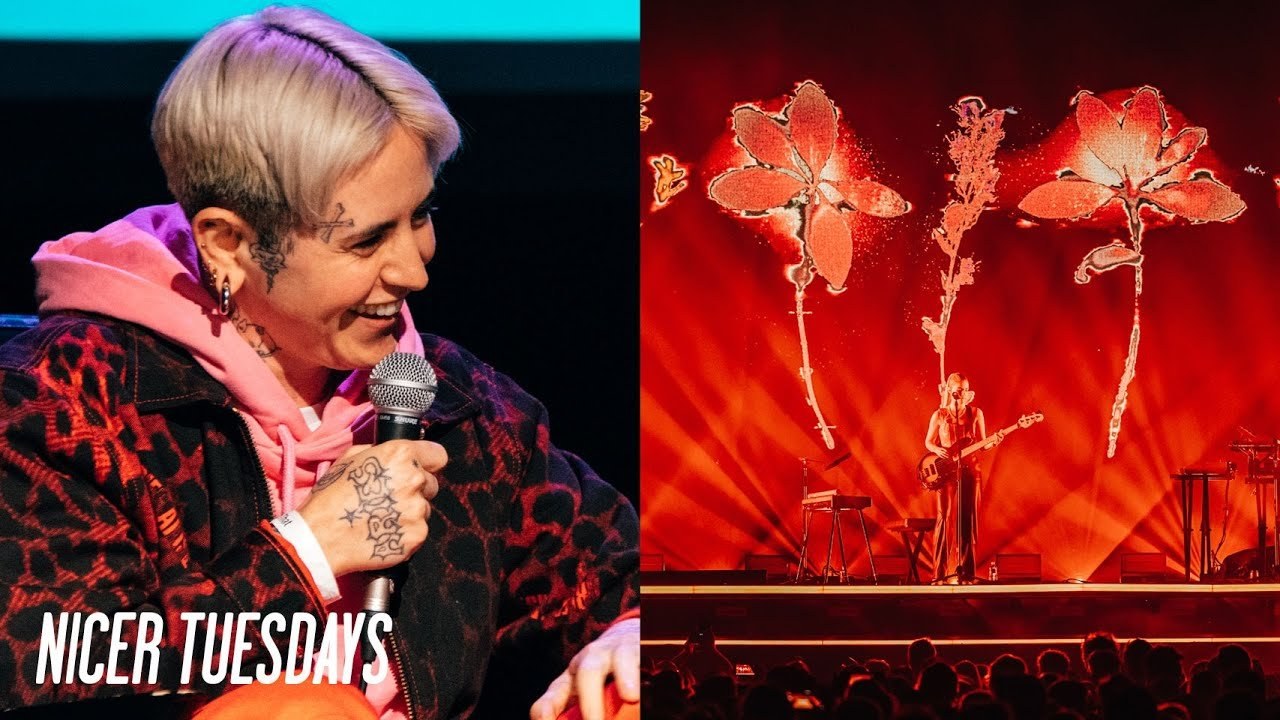
“Inclusivity isn’t just a checkbox; it’s a commitment to creating space for everyone to thrive.”
Transcriptmay contain minor errors or formatting inconsistencies
Hello hello hi hi welcome to nice Tuesdays thank you for having me how are you doing I'm good have you just have you warmed up yet no not quite yet first of all how was Sydney I feel like yeah you were there fairly recently yeah I got back last week it was very intense yeah.
So I worked on Kylie's show with a big team for Sydney World Pride so that was nail biting I had to do like a magic trick to get Danny Minogue to like just appear on stage out of nowhere.
And it was all very stressful but it was very good had a good time yeah it looked epic I mean I was wondering if you could just maybe start by talking us through that project and how you approached it because yeah as I say it looked it looked incredible yeah well we've been working with Kylie for a few years and obviously we worked on the Disco album but that was mostly during lockdowns we didn't get to do any live shows and since kind of coming back into the real world we've worked on a couple of shows are usually co-direct with Rob Sinclair who's like production designer show director but he couldn't make this one so I had to do it on my own it was pretty scary it's like 20 000 people big queer Festival and also like live streamed across the world. So it was it was pretty intense it was a big Ensemble we put together the visuals worked with the choreography the staging yeah it was it was good fun was that one of the first times you've worked on the kind of the full scope of all of that stuff from the visuals to the the choreography to everything I've done some other shows but this was this is the first time that I was like the one that would get in trouble if everything went wrong so yeah it was probably my biggest sort of individual performance that I'd worked on before yeah well congratulations I mean it looked it looked amazing yeah kind of got it I wasn't there.
But I guess as I said in the introduction you've been immersed in the music industry from right from the get-go in 2007 when you kind of were first illustrating flyers for the for the Indie music scene in London I guess first off just to give us a bit of context maybe can you just describe how the music scene helped you get your start in in design and illustration yeah I mean back in 2007 this is sort of like early internet this is the the generation of Indie music I don't mean by genre but like independent music scene streaming had just sort of illegal streaming anyway it just sort of started Myspace era basically I'm showing my age now.
But yeah I I like drawing I liked illustrating but I wasn't very good at drawing anything.
So I just was drawing lettering because I was okay at bubble writing and yeah it was the time where people were throwing loads of parties and they would have like 25 DJs so there wasn't much room for any figurative illustration on these posters so I just sort of started drawing these flyers and posters that were all over East London at the time and through the scene I met people who have gone on to found like big record labels and become a r labels and that kind of brought me into the music industry through that sort of Lo-Fi party scene and yeah.
I just really loved working in music. And it was always my goal and I looked up to a lot of designers that worked in the music industry who've since most of them turned out to be rubbish human beings but at the time I thought they were great yeah.
I think it's music has yeah continued to be as we mentioned like a huge part of of your practice and and Studio moross's work as well even to this day yeah we love working in music it's it's a really challenging industry as I'm sure anyone here who works in music whether they're musician or a Creator there's never really great money but there's a lot of room for creativity there's a lot of room for individuality so it's something I've always wanted to retain in like my practice and in the practice of the studio and it's certainly something that I think attracts people to coming to work at Studio Ross because it's a joint interest that we all have yeah whether it's pop music bangers or something a bit more left field like everyone in the studio enjoys music in one way or another.
So they're always excited to work with musicians and I guess I mean one question about you mentioned the kind of NDC in back in 2007 I guess do you think it's as easy today to get into working in the music industry as a designer or illustrator or is has that scene slightly shifted and do you I mean yeah it's maybe a slightly different question.
But I find it to have a job right now let alone getting into an industry so it's kind of hard to to respond with any like clarity as to how it is now versus then I feel like back then you know having any online presence was different like made you stand out. And now it's like we're in a sea of online presence so it's much harder to stand out.
But there's certainly more platforms more outcomes more bands more interest in music now more than ever. So in some ways there are more doors but it's just you know making a living out of it I think is challenging it's challenging for a company like ours that have been doing it for years so as an individual I'm sure it's also really challenging I'm sure music will come up again and again throughout this conversation I also wanted to say that yeah obviously behind us there's visuals from Studio moross's work and aries's work as well I wanted to move on now to talk about how you began your own Studio because you've spoken about in the past how you can almost fell into running your own Studio I think is the words you used hardest about making that shift from independent creative which you yeah as you were when we were first kind of talking about to being a Studio owner well I think for me the reason I started the studio was just because I wanted to make more than just one type of work.
And I felt like I didn't have necessarily a fully rounded skill set to like create and produce every single piece of work in its entirety so I wanted to work with other people. And I also just enjoy working with other people like I think one of the biggest challenges of being a creative is working alone and a lot of people I'm sure in this room like sit at home alone every day making things. And it's quite a lonely profession.
So I've just always wanted to build an environment of people to work with and share ex like share style and experience and conversation. And I've always enjoyed being really bossy so I think like having a studio suits me I've had to get better at that over the years.
But I really just enjoy the nature of teamwork I know. That's a really cliche thing.
But it's something I really treasure I think teamwork I mean that collaboration thing is is it's a really interesting point because yeah as you say you're as a independent creative you're often working on your own to your own deadlines or at least to your own kind of schedule but actually yeah that that sense of as you have to collaborate with the team and work with the teams yeah and so much of what we do isn't necessarily what goes on to the page it's like we design the processes of making the work we design how we communicate with each other we design how we want to work within the industry and a lot of that is a much bigger practice than like Graphics or or video it's like a lot more holistic and that's the thing that keeps my job interesting for me like I'm well over 11 that's our studio 11th anniversary this this month actually so you know you have to keep keep the keep things keep things developing and I don't want to work in the same industry that existed 10 years ago I want to be in a new Progressive accessible industry and that's something that as the studio we we really Pioneer yeah yeah I'm really Keen that we come on to that.
And we will definitely talk about that I mean I guess like one of the biggest difficulties being or challenge has been when when it comes to yeah running your own studio and learning because it sounds like you almost have had to learn that as you've gone right yeah around the studio still still learning yeah yeah.
I think you know I've only ever worked in you know for myself and within the studio I've not had many experiences of working in other teams and companies so I've really just had to make stuff up as I go along and and borrow and and listen to other people about how they experience business but also like work practices and and things like that so a lot of it is all just working that out as you go but also yeah really digging into capitalism and how it functions and how we can make work in in a way that doesn't feel harmful or or bring harm to whether it's our team or the people who we're making the work with or for or The Wider world is like a big part of how we practice I mean I wanted to touch on this because I think it's you kind of mentioned that you've learned from a lot of other people about how to run a business or how not to well mostly how not right not to yeah yeah because I guess now it feels like you're pushing the industry to do more and particularly in terms of inclusivity I watched a talk you did a semi-permanent Festival last year and you talked about how it's impossible to make inclusive work without inclusive teams I appreciate that was a 45 minute talk or 50-minute talk and we're yeah we don't have that much time.
And I guess it's one question.
But I'm sure our audience here would love to hear just your thoughts on yeah I guess inclusivity at Studio Moross and how you've thought about it like that you have to consider like who is making the work how the work is being made who the work is being made for what that work is saying who's gonna access that work is going to be affected by it I mean it's it's like just a infinite Chain of Thought that you have to have around everything.
And I think in terms of the studio our approach is that everyone is different has different ways of learning communicating understanding connecting like the idea is just not to make any assumptions about anyone or anything and just constantly be listening and asking questions and understanding each other and the client and the audience and just yeah.
I think that's our goal obviously we can always be improving and and making things better but yeah I mean there are not that many queer-owned or trans-owned companies let alone Design Studios so we have become you know someone that people turn to for those types of projects which I really enjoy because we want to be making work about those topics and I'm Keen to be active in in creating work for my community as well.
That's really important to me one of the things I found really refreshing and interesting is someone who works for a company as well about that talk was you're talking about policies and the importance of policies in a company and how sometimes they can be seen as a bit you know unsexy yeah right and actually how important certain policies are and to have that design talk they don't want to hear about corporate policy is this just me sorry I know something I'm very passionate about.
But yeah I mean I always thought like rules and hierarchies and policies were like bad and I just wanted to live in a flat hierarchy with Utopia and all of that. And then I realized that it was a bad idea.
So yeah we we we write a lot of our policies together some of them we don't write together.
But we we work together to to make systems so that we don't have bias ultimately like if you don't have a policy for something then you're judging you're making decisions without rules and if you make decisions about rules you you favor or unfavor people. And so that is important in the workplace as well yeah yeah [Laughter]
you wrote a piece for us a couple of years ago now about the challenges you faced when changing your name publicly particularly someone with their own Studio platform yeah and profile I guess yeah what are some of the difficulties that you encountered there and also there were some positive aspects to that change as well I mean I have to tell you like before I wrote that article I was absolutely terrified like I think two of my friends are here that I sat at their house like on a chair like read them the article aloud and I was like is this okay like it felt so incredibly emotional to change my name in such a public way I mean a lot of people experience name changes and it's very personal and emotional thing to do just in your own Community but like you you have this public-facing Persona that you have to also sort of navigate yeah and actually after it was done it was whatever that was like a walk in the park but up until that point I was really terrified but it has been it has been quite weird to publicly transition and and go through that process and and but it's important to to to be visible and like show people that you can change your name it's okay it's not the end of the world like people will adapt and your business won't collapse and all of these things that I catastrophized for myself didn't happen so hopefully that means that other people out there will you know there's not been that many public name changes in the world like probably name it like 10 or something.
So yeah it was very scary but now I just have to deal with everyone asking if what's my star sign and then I'm like I'm an Aries and they're like oh my God you're you're yeah yeah and then I'm like yeah yeah I chose the name myself so that's kind of the bigger problem now of the choice of name that was part of the the reasoning I didn't think about it like on that level but that is the consequence so if anyone here is thinking about changing their name star signs are hard like not every Star Sign works as a name. But if you have a good star same name then don't pick it unless you're open to having a conversation with mostly queer people about what star sign you are every day every day including on stage apologies when it comes to I guess inclusivity in the creative Industries it's kind of something we touched on just now but how far do you feel we've come in the past five years ten years.
And I guess on the other side how much further do you feel we need to go and I'm assuming it's a lot further I mean we are so I mean we've made such a small impact on the industry and then the World At Large there's still so much so much to work on I think you know only in the last five to ten years have we managed to get interns paid which is such a simple thing. And it's still like there's still plenty of people out there who aren't being paid fairly for their work let alone access to work for people with low incomes there's still so much racism and bias and and sexism in the industry as well as homophobia transphobia all of these things workplaces are still not accessible they're still harmful places there's so much work to be done and that's you know something that I always talk about because like my talk in Sydney was about how everything under your roof is your fault as an employer because that's a lesson I learned as an employer is that like no one is at fault other than you as the employer when something happens at work and you know how do we operate under white supremacy how do we operate under capitalism and like how do we fix this. That's so fundamentally broken without changing the entire structure of society and like design is an area that I'm in so it's an area that I can try and make changes in but you know you've got to start somewhere yeah yeah I mean it sounds like yeah a long way to go still definitely yeah but you know we are seeing more visibility at conferences and talks and things like that people are talking about getting paid making sure other people are getting paid we are having these conversations in workplaces now that formerly weren't have happening I think that creates more harm in some cases because these are topics that lots of people don't know how to talk about carefully with consideration and thought but you know at least the words are coming out of people's mouths a little bit or on slack or whatever which is somewhat more terrifying but you know.
I think the fact that we're even having this conversation.
Now this never in a million years with this conversation have happened 10 years ago at nicer Tuesdays so the fact that we've been talking about this stuff in the design industry is important yeah is there a danger that I guess with people understanding a bit more the the language around such issues there's a tendency to pay lip service to them without.
Actually doing the kind of the groundwork yeah all the time I mean we get briefed in jobs all the time where me and the entire team Ellen who's here has a mug a special mug trick because I see you Allen that she holds over her mouth when the client says an awkward thing about something that we have to just sit there. And we're all like keep a straight face guys because you know those conversations that clients are having to ask about what oh we've brought you on because we want blah blah blah and we're like okay we're those guys today you know we still have experience that all the time so lots of mugs on Zoom calls to hide the awkward Smiles in almost like sports direct mugs we need to get some Sports Direct Express it's [Laughter]
they're just the biggest mugs I've ever seen I mean like okay I don't even know how you get them you can't do you buy them from the shop no more air time we'll move on I'd love to get your thoughts as well on on visual culture more broadly about again five or six years ago this was you spoke to one of my colleagues on the site about how you felt the world of design was too homogenized and everything was kind of looking the same yeah I'm tempted to ask you this question but when you look at the world to design today do you feel there is more space for self-expression for individuality or is it still feeling very identical well this crossed my mind actually when I was in Sydney for semi-permanent because I was speaking to a lot of Aboriginal designers and and there were a lot of speakers who were talking about using their practice and their cultural work like in their design and arts practice and I just thought this is so exciting because now that we're actually standing out and calling calling out cultural appropriation or people appropriating other visual cultures in their work that it's not their own we are now seeing the rise and and the emergence of more authentic work made by people from those cultures so we are getting design Trends and worlds from people who are directly influenced by their own backgrounds made by those people not copying not being copied by Western white people or whatever you want to call it.
And that's really exciting because I think we aren't just all copying each other anymore we're actually going to see the emergence of design Trends from other countries from other communities being adopted and used by those countries and those communities and heralded and and put out into the commercial world and celebrated and developed and designed and I think you know we've seen that tonight so I think that.
That's really an exciting thing and that I hadn't thought about that when I wrote that piece with the uni of underground but yeah I'm so excited to see authentic work from people who are inspired by their backgrounds their communities the spaces in which they grew up in and new trends and new new design worlds built from that and that I guess is yeah that's work that yeah I guess you also need people to be interested in commissioning that work and supporting that work as well I think that's slowly happening whether it be lip service or tokenism for now but you know eventually these Trends will become part of the design fabric of the world and you know they'll grow roots and hopefully that will you know determine a whole a whole range of new design like trends like I said that we'll be talking about in 50 to 100 years I hope so anyway yeah that's a really positive view of yeah the future because I think yeah there's not a lot of positive views on this feature that we are in so yeah we'll take it thank you another I guess you talked about the trends there which you know that word is I guess can be a bit true yeah yeah and I don't want to kind of touch on that in this this question.
But I guess Nostalgia is something that you've brought to a few of your recent projects the Spice Girls tour visuals I think you said were kind of yeah they were kind of nostalgic but with a nice bit of modernity in there as well and your recent work for Park life Festival 2023 also leans into some really fun aspects of nostalgia I guess what appeals to you about bringing those slightly older references into your work I mean I think Nostalgia is just inherently powerful because it's it's emotional it connects people to that woman fuzzy feeling and I think there's not that much they're not that many emotional Tools in design that we can use necessarily that that do that so for me Nostalgia is really exciting it's also for like the Spice Girls we had a huge Archive of Decades of of visual design of culture or fashion of trash to dig through and celebrate and rework like Mariana is here the type designer that reworked the original typeface so it was nostalgic but it's also been brought into the now and yeah.
I think we were just excited by that tool and it really resonates with people when they see something on a screen at a gig and they remember something from their childhood I mean it resonated with me I was Posh spiced in the school play you know like those things yeah I I'm also Posh so it kind of worked but those things like you know they they tie together your present and your past and I think I love playing with that and and it's also can be truly authentic because you're digging into your own memories and history and and other people connect with your memories and your history. And it's a way of creating sort of a space around something as sort of simple as a gig yeah yeah and the park life work is is so fun it looks like the team had an amazing amount of fun doing it yeah yeah I mean we've been working with them for a long time now and one of their key cornerstones of the park life brand to guy field who's who used to work in the studio has always been pioneering is like Easter eggs like we love Easter eggs we love to put things inside of things forever.
And now the brand has been going for so long we like put itself inside itself it's like Infinity but yeah the most recent work we did was recreating The Prodigy video for the launch of the of the film and and that was a lot of fun like we basically took the original video and created our own version of it in an animated form and it was really good fun yeah it looks amazing yeah I feel like if anyone hasn't seen it yet definitely check it out it makes you want to go raving yeah but that was also where the Nostalgia came in because I feel like you used the park life logo and put it on some brand like old Brands is that right oh yeah like Snickers yeah yeah we were we were referencing old Rave flyers and we sort of sorted all the old Ray flies into like themes and one of the themes was like dupes or like sort of fake things so like we remade like Marmite as a park life logo or like all these old Rave Flyers that referenced product and yeah. I had a good time with that yeah nice we are going to move on to some audience questions now yeah great there were some great ones but these are going to go all over the place there's no there's no theme or Rhyme or Reason to this first question is from Craig do you or have you ever experienced imposter syndrome yeah yeah all the time right right now ♪
I'm I was very blessed for being like a very obnoxiously confident person.
But that doesn't mean that I don't experience moments where especially as I've gotten older where I'm not as cool not as confident and not as aware of like what's going on in the world potentially so yeah definitely I think sometimes that am I good at my job like should I even do this anymore you know when I was in Australia last week I was having to make these really intense decisions and was like am I even qualified to make these decisions and let's just hope yeah. I was and it was fine but you know it happens to me all the time.
And sometimes when I'm in these very intense scary situations it comes out more yeah it's interesting that like yeah the kind of confidence of Youth but you. Actually need that expertise like I guess expertise and experience that you have from a few years in the industry to actually make those big calls yeah.
I think also you just have to go with it sometimes and I think one of my solutions to imposter syndrome is to just prep a little bit more like sit down and do a bit of spend an hour just looking over what I'm working on and just reassure myself that I know what I'm doing and this is the plan and okay it will be all right yeah yeah yeah just thinking about it's kindly I always think that it really shows your age when someone says Kylie to you who do you think of because for me there's only one Kylie but I feel like younger people think of maybe Kylie someone else I don't know who that could be anyway sorry I'm not gonna answer that one is from gem how important do you think it is to spend time in art college how much did it affect your part so again it goes back to like my individual individual experience I was privately educated I went into art school relatively straightforward process of coming out of school going into uni I don't think that art school was necessary for me also when I was at Art School I was probably 10 90 cheaper than it is now I I personally don't think going to art school is necessary I don't think going to University is necessary I think so many people have access to self-teach and train themselves online and I think that's really valid and Brilliant way of getting into industry I think art school is a time to carve out space for you to work things out and experiment and do things without an audience potentially but it's not essential and I think you know we should be encouraging people to not go to university and and get in and get access to training and Industry through other means which is something that we you know try and do by bringing people in from school age into our spaces and and and give them an experience of a working environment because something I think the statistic is just three positive experiences of a workplace for a young person specifically as well marginalized young people can increase their salaries by like 25 to 30 percent just by having a positive experience at a workplace so those are the sorts of things we can all be doing by working with young people and giving them positive experiences of work to make their Futures better yeah the next question is from Luke how did you make graphic design work for you financially was it hard at times again I think it's difficult for me to answer this question like I had Financial privilege when I was growing up.
So I didn't necessarily need to make graphic design my everything like to pay the bills and I I did work when I was at Uni so I was working independently graphic design is a really difficult place to make money I also worked as an illustrator whereas at the time when I was coming up in like the mid to late 2010s illustration was booming like I kid you not like you could get a campaign for like 250 Grand like at at that time like and now the same budget for that project would be 25 Grand so it's a very different time it was when art buyers and ad agencies used to look at physical portfolios and it wasn't online it was like in-person interviews it was like Mad Men era but like not that long ago.
So it's a very different time than it is now.
But I think just my advice would be to check your hourly rate check your day rates make sure you're working at a competitive level make sure you can afford your practice and what you're doing and calculate everything that you need to spend money on and make sure you're really charging your true value as well as what you cost to like as as what it costs to make the work physically like your lights your power your computer your subscriptions don't forget anything that costs you money include that in what you charge the next question is another question about advice from Therese do you have any advice for a small Studio taking the leap to hire staff for the first time which I'm assuming is something yeah you will have gone through and and potentially agonized about a few years ago yeah hiring is a really beautiful thing I hold it so high in my like in what I do in terms of like the process of hiring it's very very very challenging and it takes a lot of thought and care to like work through the process of hiring and you have to really think about everything.
So I think my advice would be to really consider what you need from someone who's coming into your team also what they like be aware that like someone is never going to fit your job description you're always going to have to adapt to them.
And that's the beautiful thing is that you'll find like more things through the person and what their skills and interests are that than what you want them to have and you'll find your company will grow in so many different directions and Studio Moss has been I think we've had over 30 employees in the 11 years that we've been running and every single employee has brought something new a different vibe different interests different tastes different history different experiences to the work and also we work with wider Freelancers and and collaborators so the studio is like the the great like the whole is greater than the sum of its parts and it continues to develop and grow Beyond me and and everything.
So yeah that's a lovely way of thinking about it because I feel like lots of companies think about hiring us or we need to inculcate someone into our culture and they need to be part of our brand or whatever.
But actually you're saying they can bring their own interest in and you need to nurture that and encourage that yeah I mean it's something I could definitely be better at but I think you're never going to ever find anyone who cares as much about the job as you are as you care as a director of a company so you have to get to grips with that a lot of people are like they don't care and it's like they don't care it's a job like it's not that important to most people they just want to come to work have a nice time and go home like you have to understand that as an employer that is the agreement you know. And if you're lucky you do find people who are passionate and and in the time in which they're with you they they give you what what they what they exchange and and you make great things together and you develop relationships but I think also boundaries really important as an employer your staff aren't your friends they're not your family they are people who agree to come to work for a certain amount of money and go home at the end of the day and it's not personal when people want to leave I always say to my staff like if you want to leave that's totally fine talk to me like I'm not going to alienate you you get to stay part of the the team to some degree forever you know all the people who have left they come back.
And some people leave and actually come back into employment some people will come back with their babies and their families and hang out and have a cup of tea you know. So it's always important to to create an environment that's boundary but also open yeah and a final question from from Haley how do you convince a client to push their brief or do you never have to I mean I think really in a former life I was probably like a salesperson like a like a car salesman or something my team will often like throw me into a situation where I need to somehow like twist dare I say the nipples of whoever is talking to me to try and get them to where I want them to where we I essentially want them to go I think a lot of it is listening firstly to like what someone wants and then reflecting back to them you know your thoughts about their ideas and then also making suggestions and not being afraid to say I don't think that's a good idea or this doesn't work and and as long as you have something to back up your opinion I think that's a totally okay way to approach something especially if you feel like their idea of crosses a boundary or a line in creatively or culturally or whatever we do spend a lot of time like guiding people in another Direction.
But I'm not one of those designers that's like this is my idea.
And if you don't want to do it off like absolutely not I still think the client is right the majority of the time. And so much of the work that we've done has been Guided by the client and even though I might sit there and be so annoyed of the changes that we have to make ultimately like the work turns out better because of it so you have to have sort of a balance between the two there is it's been an absolute pleasure talking to you thank you I'm afraid that's all we have time for but thank you so much for for joining us and for sharing those stories and insights everyone thank you
Latest Talks
-
Murugiah
Why you should reject the formula and make art about things you love
Watch -
Amber Weaver
How does contemporary type design translate into the wider world?
Watch -
Delali Ayivi
How does photography give us the right to imagine our futures?
Watch -
Will Anderson and Ainslie Henderson
Bringing stop motion sorcery to BBC’s Small Prophets
Watch -
Ollie Babajide Tikare
The importance of not flattening the complexity of observation
Watch -
Marina Willer
Design thrives when you find poetry in the simple things
Watch