Anthony Burrill is a legendary typographic artist known for his work that intertwines music and protest with design. He is celebrated for his motto ‘work hard and be nice to people’ and his optimistic outlook towards politics and life.
Anthony Burrill
Why music, protest and being nice are important to design
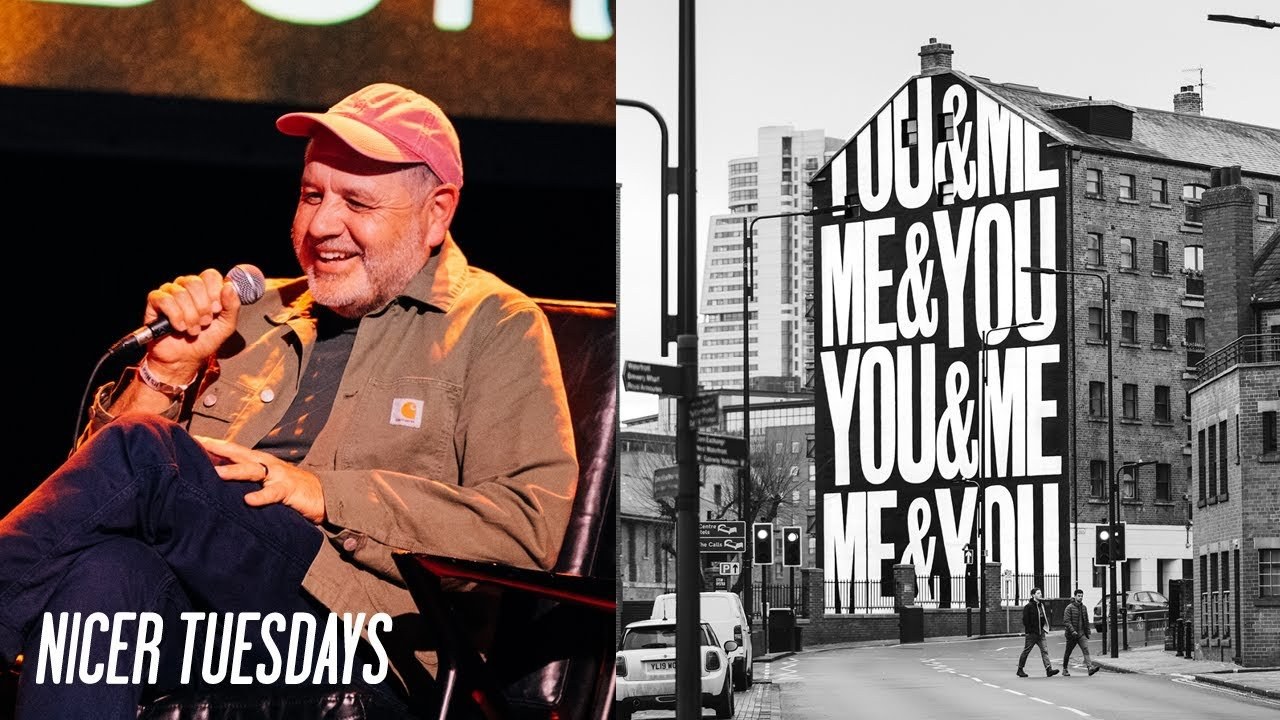
“Work hard and be nice to people isn’t just a motto; it’s a design philosophy.”
Transcriptmay contain minor errors or formatting inconsistencies
Evening. >> So, funnily enough, the last time I actually saw you was at Glastenbury. I me and my friends had stumbled into this tent on the Thursday and we're having a great time, some proper good bangers, and then we look up and you're DJing, you're behind the decks, and I was like, I know him. >> Yeah. What's happening?
So yeah, it was yeah, my friends Dan and James were technically DJing, but I was >> kind of in control of the vibes, I think. You know, like picking >> I really really got that impression. >> Yeah. Yeah. Why Why don't you play you know Outer Space next and stuff like that, you know? >> That's literally the one when I came up to you. Yeah. >> Classic. Classic.
So yeah. >> Yeah. >> Yeah. >> But you weren't just there half DJing. You were actually also had some work in Silver Haze. , and I think it's maybe a bit of a less known part of your creative interest is that you're really into music and it's often intersects with your creative work. , I'd just love to start off by asking how that's happened and why you love music so much. >> , yeah. Well, yes. So, like I was at Glastonbury with Warchild, so that was a kind of , yeah, fantastic opportunity.
But yeah, I've always I suppose yeah, rewind to when I was like 12, 13 years old. I start first started getting into music. , and I bought Craft Work, Man Machine. That was like the first record I bought. It was a kind of and just to have that that kind of combination of imagery and music together was so yeah, it just kind of took me to a different place. And I think, you know, so I was into like drawing logos of my favorite bands like Adam and the Ants and people like that and kind of it was just it kind of took me away to into a different place really and I think it was that I kind of wanted to be in in in that place where this amazing stuff came from. >> Yeah.
Lovely. And you said that you actually ended up designing Craft Works website. >> I did. Yes. Yeah. Yeah. That was that was kind of like late ' 90s when I was doing website stuff with my brother-in-law Kip. >> So Kip was first person I knew who was on the internet.
So I used to go around to his flat and look at the internet. And he said oh you we could design a website and put it you know online. I said yeah great. So, we didn't have a scanner or anything. So, I drew all the designs in MS Paintow >> on a on a PC.
, and then we made this website called Get Jet Set >> and we called ourselves Friendship. So, we it was a name that we nicked off the back of a Craftwork album. >> So, we we launched our website. It was like demon slash you you know it's like one of those massive HTMLs and then we got an email from from somebody in New York saying would you like to pitch to design a website for a German electronic music band? I said is this German electronic music band craft work by any chance? And she emailed back and said yeah it's craft work.
So I'd kind of had like my entire life had been preparing me for this moment. So So I kind of put together this this kind of rudimentary website and yeah, they loved it.
So yeah, Zoot that is that is very impressive. I can't wait to tell my dad. , you mentioned previously that you were working with Warchild at Glastonbury and you've worked with other music charities like music declares and other ones that aren't music focused, Grenfell Projects, Oxfam and many other causes. Why is it so important for you to align yourself and your work with these causes and communities?
I think kind of like looking back at my work you know I kind of it's kind of grounded in in that language of protest. So, so when you know when I tell people about my work, I kind of look at the suffragettes and you know kind of civil rights era protests in America and you know kind of going going through the 70s and kind of CND and and all those kind of like really vital important uses of graphic design and I really love graphic design and I love visual communication and and I think when it's when it's allied to to those kind of messages and amplifying those kind of voices.
I think that's when it's it kind of serves a purpose and it feels meaningful. So it's something that that yeah I feel really strongly about and yeah I just want to be in that space where the work that I make is you know is for the good of of of people >> and I feel like although you can obviously engage with quite emotional and quite weighty topics there is this per pervasive sense of positivity that runs through everything you do. Would you say this comes naturally to you or you have to sort of purposely manifest that?
>> Yeah, I think I'm Yeah, I'm kind of annoyingly optimistic. >> You know, I always think, you know, things are going to kind of sort themselves out and things are going to be okay and, you know, there's always a kind of way through things and, you know, it's kind of especially at the moment, you know, it's kind of it's difficult to kind of find optimism in the world. And I think it's I think I think humans are kind of naturally optimistic creatures, you know, and I think we we kind of connect through optimism and you know, through joy and happiness and you know yeah, much less than the the things that sort of divide us, you know, the sort of you all the bad stuff.
So yeah, I think that it's kind of just naturally in my work I think and an extension of me as a person. Mhm. >> So maybe the pinnacle of this positivity and what people may come to is the your piece work hard and be nice to people. It's 21 years since that piece was born, arguably your most famous. And I've heard that there's a great story behind the seed of that manifesto. Could you tell us a bit more about that? >> Yeah. Yeah, I was in I was in the queue in Sainsbur's on Clappam Street. Shout out to Clapper My Street. Yeah, when we used to live there and there's an old lady in front of me in the queue and she was just getting her shopping and she was chatting to the to the woman on the till as well and she was just saying now you know the the secret to a happy life is to work hard and be nice to people. And I was like, "Oh, that's " it was just one of those phrases that I kind of try, you know, remembered and kind of and then my family and I, we moved down to Rye in East Sussex and I found this amazing letter press printers, Adams of Rye. , and they had like an amazing letter press room that was kind of pretty much untouched and it just felt like that phrase and Adam's kind of connected in some way.
So asked them to print it for me and we printed like a few hundred copies and I sent them out to friends and and then gradually it kind of got more traction. Then started selling copies for 20 quid each bargain. Cuz they're all less press and and it was I think my genius move was making it an open edition. >> So yeah, so we're well over maybe like 100,000 copies of it now. Yeah. Amazing. Do the math >> and the rest is history. , going back to the supermarket, I love this kind of idea of you going about and like collecting words and collecting phrases, but it seems like this collecting has always come quite naturally to you. I saw that you when you were younger, some of your earliest memories of words and print was collecting bus tickets and various ephemera when traveling with your granddad. , what do you think was that initial thing that drew you to these quite simple everyday things and what they represented? >> Yeah, I think that Yeah, cuz yeah, my granddad retired and he wanted to travel and I was kind of hanging around and he was like, oh, you know, so he he took he took me with him and we just went on these amazing journeys. You this is kind of like mid70s to kind of like mid 80s.
So we went to like China and Russia and kind of you know just traveled all over Europe and I just used to collect like scrapbooks full of stuff of like tickets and bits of ephemera as just a souvenirs really.
And then I'd kind of bring them home and kind of like have them in little books and like with the photographs and things like that. So it's just a kind of and I I think being exposed at that young age to you know kind of like different visual signage and you know just just the amazing amount of visual information I was kind of looking at was yeah it definitely went in somewhere. So on the subjects of words, I came along to one of your workshops a little while ago and I'd signed up because all the others were very creative and hands-on and I was like, "Oh, words." It was all doing things with words. I was like, "I can do that.
I'm a writer." And then I actually found it incredibly difficult and and couldn't do it. Because it was all about thinking about words in a different way and not in the correct way. , and I found that really interesting. So, I'd just love to know when you've collected these words, how do you what's your process of turning them into something and going, "Yeah, that's what's going on that poster." >> Yeah.
I think it's again, it's like the kind of collecting thing and and thinking about words as found objects. So, things that already exist. It's like all my work is is built out of like pre-existing things really. , so looking at words and and their kind of meaning and their sort of like abstract form as well and how they look typographically. , so yeah, all those things kind of kind of work and somehow just almost like reveal themselves to me, you know? I don't I don't kind of kind of sit down and think, right, I'm going to think of a little phrase now or something. Is kind of stuff that kind of comes out of conversation or some experience that I've had with, you know, along the way or something I've seen written on a wall or yeah, anything really. And I think it's about observation and looking at the world, you know, kind of like trying to soak up information, you know, it's like being in this incredible space, you know, this is, you know, the kind of sense of history in this space. And yeah, it's kind of stuff like that that's kind of quite indefinable but becomes really powerful. >> So you just sort of let it marinate and come to you over time. >> Yeah. Yeah, that's the idea.
When whenever I try and think of something, it always kind of I kind of it always kind of doesn't feel 100% right. It just has to kind of come, you know, for like a moment of clarity almost. You know, it's going back to Glastonbury. , so we've talked a lot about the words and the phrases. I'd love to like get into the nitty-gritty of the visual. What is it that you love about the letter press medium? And do you remember your first ever interaction with it? >> Yeah. Yeah. The first time I ever did it was a summer job that my dad lined up for me. , so it was a friend of his was a commercial printer and I I went along for, you know, to kind of like see what they were doing and everything. , and they were printing beer mats , using letter press.
So they had these two plates, I think one for like red and the other one for green. And just seeing the material go onto the press and then come out and be printed just looked I was like fascinated by it. , and I think that's the first time I'd seen anything physically being printed like that. And I think it was, yeah, it's another one of those kind of quite formative memories really.
And then I think, , going to college, so when I was at the Royal College, , Alan Kiting was the letter press tutor and the letter press department was down exhibition road. It was part of the VNA.
So I used to go down there to escape from the other tutors and kind of just get on like with mcking about with type really and kind of printing out letter forms and and kind of creating o overlays and textures and stuff. >> Wow. And you've also said there's something about this idea of restriction and that doesn't only you know translate in the letter press. It's also in your use of color.
You quite rarely go beyond anything other than two colors or really black and white. Yeah. >> , what is it about restriction that you think really helps your work? >> Yeah, I think, you know, just having because I kind of grew up in an analog era. I've definitely got an analog brain, so I kind of see things in a very particular way, you know, kind of , so I think stuff like that kind of came out of necessity really.
So I worked on a photocopier to make my work when I was at college and you know to kind of to print more than two or three colors was just yeah kind of yeah seemed ridiculous really. So you know you could have like colored paper and print on it in black and you know ju just kind of having those like real simple restrictions. And I think I think now you know you you know we've all got computers and kind of you got about a million different alternatives and you but still I think when you reduce things down to their core elements and you know reduce things to the simplicity you know mo most simple kind of version really I think that's when it becomes the most powerful. >> Yeah.
It's it's interesting that you say you're, you know, sort of analog at heart because you're certainly not afraid or averse to technology. Did a brilliant project last year, I think, with Osman Tickler where there was a book and printed of these experiments you did where you mix letter press with creative coding. , I'd be interested to know, especially in the current climate, how do you think technology and analog creativity can sort of synthesize and become one rather than fighting against each other really? >> Yeah. Well, I don't know.
I think it's like the previous two talks, you know, both people were showing work that ended up being part of the physical world. And I think I think just actually making work that doesn't solely exist on screen is is really important as well to kind of see work out on the street, you know, whe whether it's kind of like a printed flyer or a poster or something.
And I think it for me that kind of sort of connects with the the history of visual communication. You know, it's like the ultimate for me is like to design a poster or, you know, to design put some text onto a onto a piece of paper and and put it out into the world. But but yeah, things are changing and you know, who knows?
But I think, you know, we're all we're all humans, aren't we? We all like to kind of mess things up and you know even though we're kind of like being forced feels like we're being forced down a road where technology is going to take over and you know we're just going to not necessarily be completely part of the creative process.
But I think I think there are enough people who will kind of reject that and and kind of carry on making work you know in an analog way. Is that optimism coming through? >> Yeah. Yeah, we'll be fine. It's fine. You know, but I remember telling my wife that the internet was like, you know, it's never going to take off, you know, and I think history proved me right on that. >> I think so.
I think so. >> so, another one of your pieces that I love is think of your own ideas. , obviously as we mentioned, your work has been subject to a fair few copies. Is this a little bit of a jab or is it just a bit of a manifesto for people to think big and think beyond trends?
>> Yeah, I think so. Yeah, it's kind of both really. I I think it's I think with a lot of my stuff, you could kind of read it in a few different ways definitely. And it's yeah, you know, the first way is like the angry like think of your own ideas and then it's like the other one is like why don't you think of your own ideas? It's kind of and it's like it's how you it's whatever however you want to read it really.
So yeah, it's it's definitely maybe it was a response to like people, you know, kind of appropriating what I I'd done as well, but yeah, I'm quite I'm quite relaxed about that stuff really >> because it came d was it the first the second one after work hard? >> Yeah. Yes. Yeah.
So I started Yeah. Yeah. It was kind of like it's supposed Well, actually the one I did directly after work hard was it's okay for me to have everything I want. , which some people took, you know, to mean literally. , and it was more, you know, it was like a kind of comment about stuff, but , I think it kind of landed slightly wrongly. >> So, yeah. So, I kind of gently withdrew that one. >> I was going to say, I don't think I've seen that one. >> No, no, you wouldn't have. Oh. , so you've, you know, had on that a very like long and successful career, , and managed to sort of evolve, stay really relevant and just keep experimenting. , what advice would you give to people who are maybe at a similar point entering the midpoint of their career, maybe feeling a bit lost and just wondering how do I keep afloat of all these changes, all these different things? >> Yeah. Yeah.
It's kind of I think it's kind of when you in your kind of late 30s kind of around 40, that's that's when it kind of hit for me really. And I was like, , I don't want to work for idiot art directors for for the rest of my life. Who'd be like, "Oh, can you move that a little bit to the right?" It's like, "No, I don't want to do that." And it was and it was almost like by work hard and nice people was a kind of savior really because I started to get, you know, be able to sell copies of that and it kind of created a kind of yeah, kind of like an income really. >> which was fun. , and I think it was like I'd kind of reached that point where I'd kind of I wanted to do more stuff, you know, for me and kind of stuff that felt meaningful. And I think that's when I started working , you know, more with kind of like charity stuff and and kind of getting involved in in things like that really. And and it started it just kind of naturally evolved and it became part of what I did and it kind of grew in in different ways and it's like I kind of I sort of didn't really do much of the kind of branding stuff or you know kind of working with with kind of big clients so much. , and it just kind of like forced me to kind of like find different ways of of kind of working and kind of moving forward and kind of producing my own stuff and yeah, then you know and it all kind of just happened really. >> And it sort of makes me think your work hasn't just lived on the page. You've done very many different formats, but there's obviously the me and you in Leeds, which is on the side of a building, and as you've probably seen skateboards, >> did this sort of come from the desire to for you to just see your work in different places? >> Yeah, I think so. It's Yeah, it's like with the leads mural that that kind of came out of Laura Wellington. She she runs um kind of yeah, lots of great projects up in Leeds. I studied there.
I did my degree in up in Leeds. >> Mhm. >> And there was this kind of vacant gable end of a of a building. So, so I kind of made the design and then it was kind of painted on there and it kind of the ambition was to kind of make a landmark for the city and it's kind of it's it's kind of happened and it's kind of you know it's those ideas like placem and not necessarily I don't know just kind of connecting lot lots of of kind of threads through one piece of work and I think working at scale as well that's something I've always wanted to do.
So yeah more yeah more bigger and more amazing work please.
So yeah >> and what is the significance for you having that in Leeds where you studied but also in the north of England having you know big pieces of like you were saying placemaking art and this creativity going out to these countries above London. >> Yeah. Yeah.
Well, as you can tell, I'm I'm from the north. , and it's kind of, you know, it kind of shaped my character and it shaped who I am as a person. And I think I think part of of that kind of upbringing was about communication with people as well and kind of connecting with people. And I think the written words kind of really important part of that.
So yeah, and I think it's Yeah. Well, people from the north are nice, aren't they? >> They're very I can corroborate they are very nice. , I think I might go on to some audience questions because we've had some really brilliant ones in. Just let me >> let me get there.
So, we've got one from Deia. , how important is readability when it comes to type heavy projects, especially when using type as the primary graphic visual piece or project? >> Yeah. Well, yeah, for me it's all it's kind of Yeah. Sometimes I kind of like to play around with legibility a bit and kind of yeah experiment with kind of like cropping off type and you know to kind of like illustrate a meaning or something like that. But but yeah, words are really powerful and typography is really powerful and I think it it should there should be a kind of they should it should be legible and it should be able to understand what you know kind of what's being said.
But yeah, it's kind of but I suppose it's kind of a byproduct of of the way that I work. You know, I use lots of kind of high contrast black and white and kind of simple bold type faces. , so yeah, I suppose it's it's kind of it lends itself to a kind of legibility. >> And a great one with from Luchia, which I think is in response to the postcards that we've got on the seats. >> Oh, yes. , >> make make sure you pick pick them up. >> What question are you trying to answer through your work? >> , that's a very good question. Thank you, Luchia, for that one. , I think I think all the questions are are kind of questions like all the work really is the messages to myself primarily. It's like things things that I need to reinforce or to kind of think about or to kind of yeah to to to be sort of present in in in my kind of physical realm really I suppose. , and I think, yeah, the question I'm I'm always asking is is, you know, what's going to come next and, you know, how how can I sort of progress and how can I kind of get my work into different places and where can I make the work feel meaningful and and engage with people. >> Lovely. , and this one I'm actually really intrigued to know the answer. It's from Richishy. , how do you feel about all lowercase letters in a sentence? >> Yeah. Well spotted. >> Yeah.
Apparently there there are these things called lowercase letters, but I've >> I've never encountered one in my entire life. Yeah. >> Yeah. I'm definitely on the uppercase team. >> Yeah. It's funny they're they're saying that Gen Z don't like capital letters. They're all using lowercase. >> Oh, really? >> Yeah. >> You make me feel old now. Oh. , so I think yeah, just a final one from me to round things up. , what do you believe from your perspective, from your viewpoint, the future of letter press and print work looks like? Has there been anything that you have seen recently that's really excited you and how do you think it might live on? Yeah, I think it's for me it's like letter press can be a little bit kind of of a kind of closed world where you know there's a kind of you know whatever you print in letter press looks great so it doesn't really matter what you're saying through the work but >> but for me letter press is really connected with the history of design and the history of communication essentially so I think I think when you do commit something to print you know it has to be meaningful and it has to connect with people and I think I've kind of taken letter press the the kind of visual language of it and kind of taken it into different places and I think and I think it needs to expand and and kind of change and I think I think because yeah it it's it's about connecting with people and let you know letter press is from a different era it's from different time and there's a kind perceived authenticity about it, I think. And those type faces weren't designed by type designers. They were designed by, you know, lettering people and and it's kind of got a a kind of it feels like it's from a from a different time. , and I think that's something that is it kind of feels different to what's happening in the moment. So, I think that's why it kind of stands out a bit really. But you know I do lots of workshops and you know when people come into into contact with letter press and understand the physicality of it then I think it really it makes you kind of value words because you know it's really hard to set some really nice bit of type you know it takes an afternoon to set a sentence and make it look good.
So I think it it kind of it helps you to to understand where you know what words mean really and and the meaning that we get from words. >> Lovely. And anything you're particularly excited about any creatives or >> I'm not I'm kind of I don't know.
I think secretly like most creatives we only really like our own work. Yeah. And you see other people's stuff and you kind of think, "Yeah, it's all right." But yeah, there are lots of great people doing lots of amazing things. >> But yeah, it's kind of um but yeah, I've got to be truthful on this >> and maybe just one final one just because it's its birthday with work hard. What would you say is the one thing you've taken from a piece just growing a life of its own and becoming something so momentous in the creative industry? >> Yeah, I think it well I think it's just it was for me it was just another thing that I that I made and kind of put out into the world.
And yeah, I'm always going to be known as the work hard and be nice to people guy no matter what I do, you know, for the rest of my life. That's that's going to be my epitap really. And you know I think it's true. >> Yeah, >> we should all work hard and be nice to people, but you know, but work hard in a good way, not just like working hard for the sake of it, you know, kind of work hard at like making every day count and yeah, just being being nice to people. >> Perfect. What a brilliant one to end on. Amazing.
I think that's all we've got time for. >> Great. Thank you very much. >> Thank you so much, Anthony. Thank you.
Latest Talks
-
Murugiah
Why you should reject the formula and make art about things you love
Watch -
Amber Weaver
How does contemporary type design translate into the wider world?
Watch -
Delali Ayivi
How does photography give us the right to imagine our futures?
Watch -
Will Anderson and Ainslie Henderson
Bringing stop motion sorcery to BBC’s Small Prophets
Watch -
Ollie Babajide Tikare
The importance of not flattening the complexity of observation
Watch -
Marina Willer
Design thrives when you find poetry in the simple things
Watch