Annie Atkins
Designing film props is like specialising in forgery
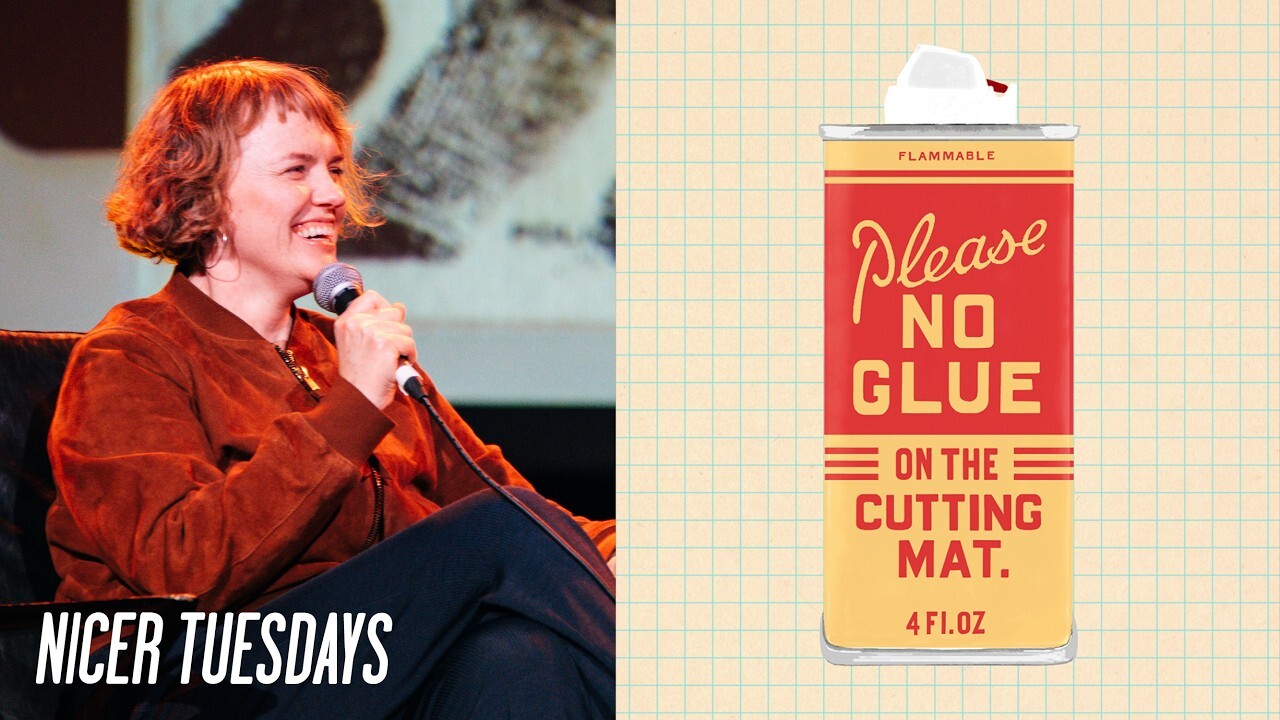
“A lot of what I do in film is really just forgery, you know. I'm copying stuff. I have to make a banknote look like a real old banknote. I have to make someone's diary look like a real old diary. There's a lot of imitation.”
[applause] >> Hello. Hi. >> Hey. Hi. >> [laughter] >> Um Now, if you think you're seeing double, you're not. Um I have already been mistaken for Annie, and I'm sorry I could not sign your book, but luckily Annie could sign your book. So, um >> [laughter] >> Somebody came up to me just now and said, "Are you Olivia?"
Um So, thank you so much for being here. I think the last time we had you was 4 years ago, but it was online. So, it's an absolute joy to have you here in person. Thanks so much. I'm so happy to be here. I was supposed to be here in December, but I got the super flu. God, it was going around. >> [laughter] >> It's pretty bad.
Um but yeah, great to be in London now. So, just to get started, I suppose you would have what many people would describe as the dream job. Um I'm sure many would love to know, how did you first come to work in film? I think I read somewhere that your first job was on BBC drama The Tudors, Yeah. which I remember watching with my mom and absolutely loving. So, >> [laughter] >> what was that like, and how did you get there?
Yeah, The Tudors was a great first job because um it was about Henry VIII, uh set in when was Henry VIII alive? The 15th century, I think. 14th century, 15th century. Um and prior to that, all I had done was digital design. I'd worked in an ad agency. I'd been a graphic designer for years, about 4 years.
Um and then I went to film school, and I did a little snippet of production design on that master's degree, and I got a job on um The Tudors, which was shooting locally to me in Dublin at the time. Um but it was all I mean, it was all like designing stained glass and old scrolls and antique maps and things, you know?
I'd done anything like that before. All I had done was design, you know, like digital logos and things for websites and magazine spreads. Uh so, I was really thrown in at the deep end. I didn't know what I was doing, actually. Um but what I did have was um uh an art teacher mother who taught art in a primary school. So, when I was little, you know, I did a lot of papier-mache and crafts and, you know, making treasure maps and tea staining paper and all that kind of thing.
>> [snorts] >> Um so, I did have a kind of a love for craft and making fun things with my hands. Um I just hadn't done it for 20 years, you know? So, I kind of had to tap tap into my my childhood experience of making art, which was really fun. Um but it was also there was a lot of pressure on that job because I was new to film. I didn't know who was who. I didn't know who the different head of departments were. I didn't know who I should be talking to, who I shouldn't be talking to.
Um it was terrifying, actually. Um and one of the things I do with my workshop students is I really try to uh teach teach them a little bit so that they don't feel quite as terrified on their first job as I was. Would you say that path that you took looks very similar today, or would you say as the film industry has changed and TV industry has changed, it's changed, too, that route in?
Um I mean, the routes into film I mean, I suppose I did it in a quite a traditional way in that like I had I already had a craft. I was already a graphic designer. And then I went to film school and learned the craft of filmmaking and I kind of married the two things, you know? Um I don't think you have to go to film school to work in film. Um in fact, most people I know working in film never went to film school at all, you know? I think I think it's I think the best way to get into film is to go in with your own craft, whether you're an electrician or a carpenter or a graphic designer or a costume designer
or makeup artist or whatever it is. Um the really important thing is you know your onions in your own trade, and because of that's the people we're looking for is the people who understand the craft of what they do. Um So, yeah, I don't I don't think you need a filmmaking degree to get into film, but that that is how I did it.
One thing I would love to know, even before you sort of get on set or or or get started, what does the brief often look like when you get a role or a new job? I think lots of people here will probably know what a brief looks like in graphic design traditionally, but what would a brief look like for you? Yeah. I wish there was a brief.
It's funny cuz when I worked in advertising, yeah, there was always a brief, you know? Um we don't have a brief so much as we have we have a script. We have storyboards. Uh we have sometimes we have concept art, so we understand what a set might look like. And then we have um notes from the production designer, who is the person who oversees the look of the entire movie, and the set decorator, and the prop master, and who whoever else we're making bits and pieces for. Um and those notes are sometimes printed lists of notes, and sometimes they're just somebody yelling at you down a corridor.
Um so, it's kind of it's kind of chaotic, and I think I think the thing with film is and one of the things that I I I do thrive on in a way, but I also hate is that chaos and trying to make order out of chaos and you know, it's all very confusing. Time is always against you. There is no clear brief. Um but we are all working to one vision. Um and we kind of muddle through, really.
You know, you muddle through and you get everything to set on time and the show goes on. Um yeah, it's it's exciting, but it it's chaos. And and how niche can it get? Has there ever been a day where you're like, "I can't believe I'm making this or this needs to be used"? >> [laughter] [gasps] >> What the the actual props?
>> Yeah, the props. Yeah, I mean yeah, you you do make some some strange things, I suppose. Uh I mean, I thought I think I think I think a lot of what I make, though, a lot a lot of what graphic designers in film make is actually quite um pedestrian things. It's quite ordinary things. Um you know, like documents, the forms that sit on a lawyer's desk.
One of the things I always get my workshop students to make is what I call the boring form. Um and it could be a hospital form. It could be a police form. Uh but, you know, it's just like a grade with some typing on it and rubber stamps and things, you know? Uh And we make a lot of that kind of thing in film. We also make a lot of motorway signage, fake motorway signage, fake forms. Um >> [snorts] >> So, so you know, a a lot of things we make are very utilitarian and ord- ordinary and everyday, and those are the things that create a film set, really. And then every so often, once in a blue moon, you know, you get
to design a beautiful pink chocolate box or, you know, something like that. Um I mean, I'm trying to think of something peculiar I've made now. I can't I can't think of anything off the top of my head. Uh I think on that note about the mundane elements that you make, on your website, you've written that maybe 90% of what we make for film belongs firmly in the background.
Would you say this is disheartening, freeing, or maybe a little bit of both, knowing that things you sort of have to seamlessly blend into the set? Yeah, we do a lot a lot of what we do is for the backgrounds. Um I mean, I don't know if 90% is right, but it feels right. Um it might even be a bit a bit more than that.
Um The thing is with background work is you know, you can get away with a little bit less detail, but even then a set decorator is not going to want to dress things into a set that aren't right. So, a lot of the time you are making these background pieces almost as detailed as you're making your hero pieces.
Um but I I actually love the backgrounds dressing because the background dressing is is the stuff that the actors see. And when the actors arrive on set and they start nosing around the set, you know, and they're being transported to this world that the whole art department have worked together to make, you know, the big set pieces and also these tiny little details like I don't know, a little note tucked in a drawer or something, you know? These are the things that um I like to think help nudge the actors a little bit further into character. I mean, I'm sure sure most actors can act without props at all, but you know, I I
I I do like to think that they help a little bit. That's a really lovely idea. So, it's almost as much for the actors as it is for the people viewing it and the people who experience it. I think I think more so, yeah. I do think more so. Yeah. Cuz cuz they're the ones who see it, really. Yeah. Yeah.
Um So, if people wanted to see some of your work in person, right now there's a brilliant exhibition at the Design Museum of Wes Anderson's archive, uh and it's running until July. It's brilliant. Get down if you can. Um what's it like returning to your work for Wes a decade after it was on screen? Um yeah, it was amazing. You know, the the first time I worked for Wes Anderson was on Grand Budapest Hotel, which must be is that like 12 years ago now or something?
Um I feel like I was a baby when I did that movie. Um it was the first feature film I ever made. Um I ever worked on, sorry, didn't make it. Um I had done a lot of TV shows. Uh I had done an animated feature, but that was my first live action feature. And um again, I was thrown in at the deep end with that job as well, I think.
Um And when I went to the exhibition uh in December at the Design Museum, it was really amazing seeing all that work in one place and like so beautifully curated and so beautifully displayed and um yeah, I think I just like I felt quite emotional about it, you know? And uh yeah, it's it's really it's it's an amazing exhibition. Like it really it really reminds you what an artist Wes is. And I do I do feel like whenever I'm making a piece for Wes that like he's definitely the artist and I'm the technician. And you know, that's the dynamic that that that I worked with on I I think I did three of his movies.
Um And when when you see all his work like that together you really understand why that dynamic works the way it does because he has got such a clear vision and such a you know, he he really has his own style. And it it's such a privilege to be able to to make those things for him, you know? And why do you think his work and maybe in particular the Grand Budapest Hotel stuff still resonates so much? People are still really obsessed with it or rediscovering it now and are just blown away. Why do you think that is? I don't know. I I I I don't know if it's for me to say, you know? I I feel like I'm too
too inside the box. Um I mean, when we made the movie, I mean at that point, I mean Wes was already like massively popular um incredible filmmaker. So like I knew like what a privilege it was to work on a film for him. But even when we were working on Grand Budapest, I still didn't quite understand what was going to happen.
Like when we made the Mendel's box, I didn't understand that that pink chocolate box was going to become an icon for the film or like a an iconic film prop. We had hundreds of them made. They were lying around all over the place. When we wrapped up on that shoot, like they were literally lying around all over the floor. We were stepping over them.
Um I wish I'd taken a huge crate of them home with me now. Um I think I took three with me, you know? Um Yeah, so so I I I didn't know what was going to happen with the movie. I didn't understand that it was going to be such a kind of beloved uh film with so much um amazing artwork in it. Um we we were just I think we were just too busy making the stuff, you know?
Yeah, it was very special seeing that Mendel's box in there. It's it's a beautiful piece. It's so beautiful. Um but one thing I'd love to ask you more specifically about is handwriting. Um I think across all your works at the exhibition, what most struck me was how many scripts you've either produced or had to art direct. And obviously handwriting is such a personal thing.
And I I struggle sometimes to even reproduce my own handwriting, it feels like. So when designing for films, how much are you acting or playing pretend getting into the mindset of the character who would write that and trying to emulate that? Or is it much more just creating something aesthetically pleasing?
Yeah, well I think handwriting is a great example. I I love doing fake handwriting. Um it's one of my favorite parts of the job because I only do really period pieces. So I don't I don't really do anything contemporary or futuristic. Um all my projects would be kind of set pre-1970s really. So there's always a lot of handwritten pieces in them.
Um so you have to create different handwriting styles for different characters, right? And I I could never use my own handwriting because my own handwriting is like block capitals. I mean, I think everybody writes in block capitals now, right? I think like like cursive handwriting is kind of a thing of the past now.
Um but yeah, I I do like designing different handwriting styles for different characters. Um it's it's one of the fun parts of the job. It's way more fun than most way signage. And do you ever feel like you really have to sort of like become the character or is it much more sort of just like imagining? Well, sometimes you have to actually become a particular character. Yeah, because I mean a lot lot lot of the work I do is for historical pieces, you know? So you actually have to write in the style of Marie Antoinette or Virginia Woolf or um Anne Frank, for example. The those examples of real people's handwriting
that I've had to copy. And but but it's actually much easier to do that because you can find documents that they've written and you can trace them and you can actually practice their handwriting and it has to then be a perfect match. Whereas if you're [snorts] making handwriting for a fictitious character like a character in a Wes film I think so so in the Grand Budapest Hotel Madame D, who was the elderly lady played by Tilda Swinton she had a will that she had written herself.
And I found an old will that I thought the handwriting was really perfect. And then when I did my research, I realized it was actually Elvis Presley's will. >> [laughter] >> But but I I don't think it was Elvis Presley who'd actually written it himself, you know? It was written by somebody with like very old-fashioned cursive handwriting. Um so that then became the reference for Madame D's handwriting in the film, you know? So some some of those things are kind of unexpected.
But they work. [snorts] That's a great little fact. Um on sort of your attraction to period filmmaking how important is his historical accuracy to you? Do you give yourself room to invent and break the rules a bit or do you try and stay quite true to what would have been of the time? I think at first, it's so important to me. Like when I first start researching a piece, historical accuracy is everything. And then as I develop that piece the story becomes the most important bit. And I get to throw away bits of history and reinvent things and really make it work for the story and the character because that that's
you know, that that's the important thing at the end of the day. I think I think a really good example is period newspapers. And I find this time and time again with different directors. Um if you're working on a piece set in say like the early 1900s the British newspapers that the British broadsheet newspapers of that time didn't have headlines printed on the front pages.
Um it was all like small ads, so very small print. And I think it's important as a film graphic designer that you know, you you know these rules and you can present them to the director and the production designer and say, you know, this is what a newspaper actually looked like at the time. But they're always going to throw that out because newspaper headlines are such a driving force in film prop narrative. You know, you you see a character read a newspaper and there's a headline saying there's a war on. It's so simple. It's such simple signposting for the audience to tell the audience where and when they are in a in
a time or place. So nearly all directors are going to say, forget about the historical accuracy. We're going to put big newspaper headlines on camera. So interesting. So that's just completely historically inaccurate wow. Um and what does your research look like? How important is uncovering and finding past ephemera to your work?
Yeah, it is it's really important. Um I have absolutely tons of it now uh which I mostly collected in maybe the first 10 years that I was working in film. I mean like physical pieces. So old documents that I would have bought mostly from eBay, um sometimes from flea markets, um sometimes like in antique bookshops you might find a box of old ephemera.
Um and it's all kinds of things like legal documents, love letters. I like I have a love letter from like the 16th century or something. Yeah, so cool. I was like 20 quid on eBay. Like it's you can actually find things so cheap because it's really a lot of it is just rubbish really, you know? Um postcards are great for collecting handwriting samples.
You know, telegrams. Telegrams are great things to collect because they're so they're so unscrated. Like they're really like a little slice of history. Um but directors love putting them in movies because they are so old-fashioned. Um so then I think select they also again, you know, they're like 10 euro, maybe 20 euro for an old telegram.
So I have boxes, shoe boxes of things. And um when I first started collecting, I did like categorize them really neatly and put them into uh very careful photo albums and labeled everything. And I haven't been doing that for some years now. So now I just have like boxes and boxes of junk. Um but it's really important to me because I I need to see them. I need to feel them and I understand the texture of things, understand the scale of things, know what's printed on the back of something. Um it's it's much better to have physical things than it is just to rely on photos on screen where you might
not be able to judge those things. Okay. Okay. So your first book was a way to sort of memorialize all this prop making for film that you've done. What was it that wanted to you you to immortalize your work in this form in something that people could also, you know, pick up and see? I can see a lot of them in the audience today, actually.
Yeah, my book about film graphics. Um I had been writing a little bit about it online on Instagram. And an editor at Phaidon uh the publishers uh got in touch with me and said, have you ever thought about putting all this stuff into a book? And I had thought about it. Um but I just I think I just I it was like I just needed somebody else's permission or something, you know? I needed somebody else to say it.
Um and she said, well I'd be interested in developing it with you?" And um, yeah, I started putting it together and it was fantastic. It was it was amazing going back through the through the troves of all the work that we'd put together on various period pieces. And just write a little bit about the making of it because you know, back then, I mean, I think there are more books about it now, but back then, a few years ago, there there was no book about film graphic design, amazingly. I mean, there were there were books about certain elements of film graphic design, but there wasn't a book about the craft
in general. Um, so that was really exciting to to kind of put that together as a first. Um, yeah, I really enjoyed that. Yeah, it's kind of mad there was nothing about it cuz it's such a central part of filmmaking. It feels Yeah, I it's strange, you know, it's on on one hand, it's like a niche area because, you know, there's not a huge amount of crossover. Sorry, I had I had contacted a publisher previously about this idea.
Because I I yeah, I I had thought it was a good idea for a book and I had contacted another publisher and said, "Hey, would you be interested in a book about film graphic design?" Uh, and I put a little synopsis together and they came back and said, "There isn't enough crossover. There's not enough crossover between film world and design world for this to have a market."
Uh, so I just kind of forgot about it then. I was like, "Okay, fair enough, you know, there's just not enough people out there who would be interested in that in that little niche world." Um, but I think the opposite is true, actually. I think loads of people are interested in it because even if you're not necessarily a graphic designer, if you're any kind of designer, I think you see those things when you watch a film and you see when they're wrong. Uh, definitely. Like, they really jump out when they're wrong. So I think a lot of people are at home watching movies and TV shows. Um, I think they did I they
they I think they do have an interest in it. Yeah. I bet that publisher is kicking themselves now. >> [laughter] >> We've spent a lot of time talking about how you use your skills to tell other people's stories, but you also have written and illustrated children's books. Um, what why is it important for you to use your talents to tell your own stories as well as other people's?
Yeah, it's this is something I've just started recently. So I had my first children's book come out last year, a Christmas book. And I've got another one coming out in July, which is about witches, which has been really fun to make. Um, but I think I think what was happening was the the more and more I worked in film, the the more I honed my craft and the better I became at making these props and doing like vintage woodcuts and period typesetting and I was getting more and more detailed with it.
And I really wanted people to see it. And I've said and I've already said tonight and I've said for years, you know, it doesn't really matter the background dressing, you know, the craft of it is the fun of it. But I think I was getting to the stage where I just really wanted people to see it in closer because I was putting so much effort into it.
Um, and then the other thing I think is, you know, for film film prop design can it can feel like a very creative area and it is in many ways, but it's more crafty than creative. Like, a lot of what I do in film is really just forgery, you know, I'm copying stuff. I have to make a banknote look like a real old banknote. I have to make someone's diary look like a real old diary.
Um, there's a lot of imitation. And I think tonight, you know, seeing Derek's work and seeing Leah's work, I was just so inspired by that. Wasn't it just so fun? Like, that there's so much imagination in it and there's so much humor in it. Um, and I think that my work in film wasn't really tapping into those things.
Like, when when I first started on my first job, the departing graphic designer said to me that she was going off to work at a design agency because film design work wasn't creative enough. And I remember at the time thinking, "That's crazy. Like, it's so creative. You're making stuff with your hands all day."
But over the years, I did begin to realize what she meant. It is more about copying and imitating than it is about being imaginative. And I think that's why I'm really enjoying working on books now, especially children's books, is because I get to practice my craft. All all my books, by the way, have props in them, so you can pull the prop out and follow the story through the props as well as through the main narrative.
Um, so I get to practice my craft and make these paper things, but then I also get to use my imagination more. So I get to tell my own stories, you know, like I've written this story now about witches for kids. Um, and it just means I I I it just feels to me that little bit more creative and it also means that my props now, instead of being background dressing in a movie, they actually end up in the hands of the audience cuz the kids who read the book can actually hold them and study these things really up close, which is fantastic cuz, you know, kids are like the worst critics ever, right? So
>> [laughter] >> you have to you have to make these things extra good now because their little eyes are going to be on them. So lovely. I bought the Christmas book for my niece and she absolutely adores it. She loves it. Um, so I want to do a slight pivot here because there's there's another part of your practice that I'd love to explore, which is you run workshops teaching designers how to create graphic props.
Many people tonight in the audience are designers and makers, so it'd be great to know how do you just get into this type of making? Like, how can designers start experimenting with these techniques maybe alongside another job or just like in their spare time? Yeah. Yeah. Um, so what I do with my workshop students and I think this is really fun project is, so the first thing I do is, you know, I'll assume that most people are already contemporary designers.
So what I get my workshop students to do is to pick a story from another time or place, you know, so it could be a period piece, something set in the past or something set in the future. Um, or just something from another world. But take a story that is familiar to people already. So, you know, don't make up a story.
Um, don't use anything obscure, but take a story like um, Dracula, for example, that everybody's sort of vaguely familiar with even if they haven't seen a movie about it or read the book. Um, and then make five props for that story that will tell that story. So that was when somebody opens your portfolio, they'll know what they're looking at. So that might be a newspaper page, it might be something fun like Dracula's passport.
Um, but you've made it in great detail and you've made it as actual paper props and you've done all the printing out and the gluing and the sticking and the handwriting and um, and and your aim is that just by looking at these five pieces, the audience will understand the story that you're telling. And I think by doing that, you can really push yourself into starting to make your own paper portfolio.
And then just add that collection of props to your existing portfolio because the other thing about film is, you know, we're we're not looking for um, you you know, we're we're looking for people who have like a wide range of skills, you know, I'm not asking any of my workshop students to throw out any of the contemporary stuff they've already done, you know, they're massively valuable pieces in their portfolio. But just adding one collection of paper props, I think, is is a great challenge.
Another thing I'm sure a lot of people are probably wondering is if most of your work is handmade, what's the best way to have a portfolio that you can send to someone to really experience your work in the best light? Yeah, I think you just need to photograph your pieces really well. Um, and then mixture of like handmade paper props and then maybe also some like signage drawings.
Um, and then take beautiful photographs of your little props and your boring forms and your vintage cigarette boxes and things in close-up. And I think, you know, if you're not very good at taking photographs, I think now is the time to ask your friend who is good at taking photographs to take them for you because it's really important that these things are photographed nicely. It'll make a real difference.
Yeah, make use of that network. And obviously a lot of your work is handmade, but do you ever transition into the digital, use digital techniques and what sort of ones are they? Oh, yeah, all the time. Yeah. Yeah, I mean, I think I think like I think I have a reputation that my work is all handmade, but that's not true. So I would say like I would say like my day in my studio is probably half drawing and cutting and sticking and half on my computer using Photoshop. Um, yeah, I'd say it's about 50/50 and I have a scanner and I scan everything and bring it into Photoshop and keep all my layers so that I can edit
things digitally because we have to remake so much stuff in film all the time. Yeah. Um, so I'm going to transition into some audience questions cuz there were some really brilliant ones in there today that I would also really love to know the answer to. So, one from Ervin is, how much last minute designing happens on set and do you ever feel very precious about the props you've made?
Um, I generally try not to feel precious about my work. I mean, I think this is something that I've carried through since my art foundation days. Uh, you know, when they teach you to just rip up your drawings and Um yeah, I'm I'm I'm generally quite amenable to just starting over on a prop or anything.
Um because I do understand that the you know, the story is the most important part so we have if we're if we're not telling the story properly with what we're making then we do need to start again. Um last minutes a lot of the stuff we make film is very last minutes, especially if I've missed something um you know, like I mean I I think I I was working on a Spielberg film in Germany and I had just completely missed a prop in the script. It was a it was a scene where there was like this baddie character was handing like the goody character a brandy and the goody character was Tom Hanks and he was like not sure if the if
the brandy was poisoned or not. So it's a pretty key scene for for a graphic prop, you know, like that's pretty important scene I think. Like Tom Hanks isn't sure if he's going to be poisoned or not. Um and somehow I had just completely missed the fact that they would need a bottle of brandy. Um so it would have been my job to design the label for the bottle.
And uh I was radioed up from the set from from the prop master saying, "Do you have a brandy label?" And I was like, "No." And they were like literally lighting the scene. Um so I just had to quickly make something, you know, and just print it out on my desktop printer and send it down to set, you know, in about 20 minutes. Um that happens all the time.
Uh it's yeah. >> [laughter] >> That that's what I mean about chaos, you know. That sounds really stressful. Yeah. >> [laughter] >> Um So this is from Pep. What's something nobody expects that you have to consider when branding a fictional business? Yeah, I mean the the fictional businesses that I brand are all um very old-fashioned, right? So it's you know, the the all the work I do comes from a time before branding really existed.
Um you know, I don't I don't I don't think branding as we know it really existed until like the '70s or something. Um back in the olden days, which is the time that I work for, I use that term really loosely. That there wasn't really like matching luggage branding as we know it today. So like for example the sign on the gates of a business would have been designed by the ironmonger and the sign on the windows would have been designed by the sign painter and they probably would never have compared notes. So they're designing two completely different letter types or different logos even if if a logo was a
thing then. Um and I quite like that because I think I'm really bad at branding but I'm quite good at like pretending to be a Victorian ironmonger. Um So when I started doing that for films I then started getting approached by actual real brands who wanted their brands to look like it didn't have branding. Um so for example I do for some reason I do a lot of work for um the Korean beauty industry in branding. That's that's that's the branding work I get now and they they they come to me when they want their cosmetic packaging to look like a movie prop.
Um so that's really fun because it means I get to kind of throw modern I ideas about branding out of the window and you know, just draw something fun for them that looks like it was done by you know, George and the sign painter or something. So all that fake branding has led to real branding. >> Yeah. That's incredible. Wow. Yeah.
Um So I sadly think we've only got a few minutes left. So I've got some final final questions. Quick fire questions. Um How do you stay motivated in a field that can be so detail heavy? Do you ever just get bogged down by the detail, a serif that won't serif or something like that and how do you get yourself out of that?
Um I think it's pretty easy to stay motivated in film because it's all so quick and you're designing so many different things and no two day days are ever the same. So it doesn't it doesn't get really repetitive. Um it's always kind of interesting and you're always looking at different references like you know, half the day might be spent on an Art Nouveau design and the other half might be spent on I don't know, like something futuristic even.
Um so I don't I don't know that motivation is an issue really. I think I think the I think yeah, it's it's um I I I don't think you have the time to even think about that. It just keeps coming at you. Yeah. [snorts] And this is this is quite a big one. Very broad, but do you have a prop that remains a favorite of your career so far? Do I have what? A prop that remains your favorite of your career so far.
Oh, um I I think probably the map for the Indiana Jones movie because I was such a huge Indiana Jones fan when I was a kid. I loved Indiana Jones. And when I heard they were making another one this was a couple of years ago. Um I I felt like my nose was really out of joint because I wasn't working on the movie. I was like, "Why do they need to make another Indiana Jones movie? The original Indiana Jones movies were perfect." And then I got the call about the map and I was like, "Yeah, of course." Yeah.
No problem. >> [laughter] >> Um yeah, so that was a real treat. I think I think anything that you loved when you were a kid is so amazing to get to work on when you're a grown-up. Um but also I think the the other thing that I love is the Grand Budapest Hotel book, the pink book because it's so rare to make a prop that has the name of the movie on the prop. So I love that one as well.
It is a beautiful one. And just finally, is there any type of film or book or creative project that you haven't yet done that you would love to do? Um I don't I I don't want to say any film because I feel like I've been so spoiled. Like I just feel like I've been so spoiled with the films that I've got to work on.
Um and I used to say when somebody asked me this question, I used to say, "Okay, well if I had to pick something, I would probably say Tim Burton." Because um I just love his style. Uh but now actually my partner Neil is working on his uh series Wednesday, you know. Um and actually like I'm so relieved I'm not working on it.
>> [laughter] >> It just so busy. I imagine. Well, I very sadly think that is all we have time for, but I could sit here for ages longer, but it's been an absolute joy to be able to speak with you here and thank you so much for coming all this way to speak to us all. >> Thank you so much. Thank you everybody.
>> [applause and cheering] >> Thank you.
Latest Talks
-
Murugiah
Why you should reject the formula and make art about things you love
Watch -
Amber Weaver
How does contemporary type design translate into the wider world?
Watch -
Delali Ayivi
How does photography give us the right to imagine our futures?
Watch -
Will Anderson and Ainslie Henderson
Bringing stop motion sorcery to BBC’s Small Prophets
Watch -
Ollie Babajide Tikare
The importance of not flattening the complexity of observation
Watch -
Marina Willer
Design thrives when you find poetry in the simple things
Watch