
Andrew B Myers
Magnifying miniature worlds through photography
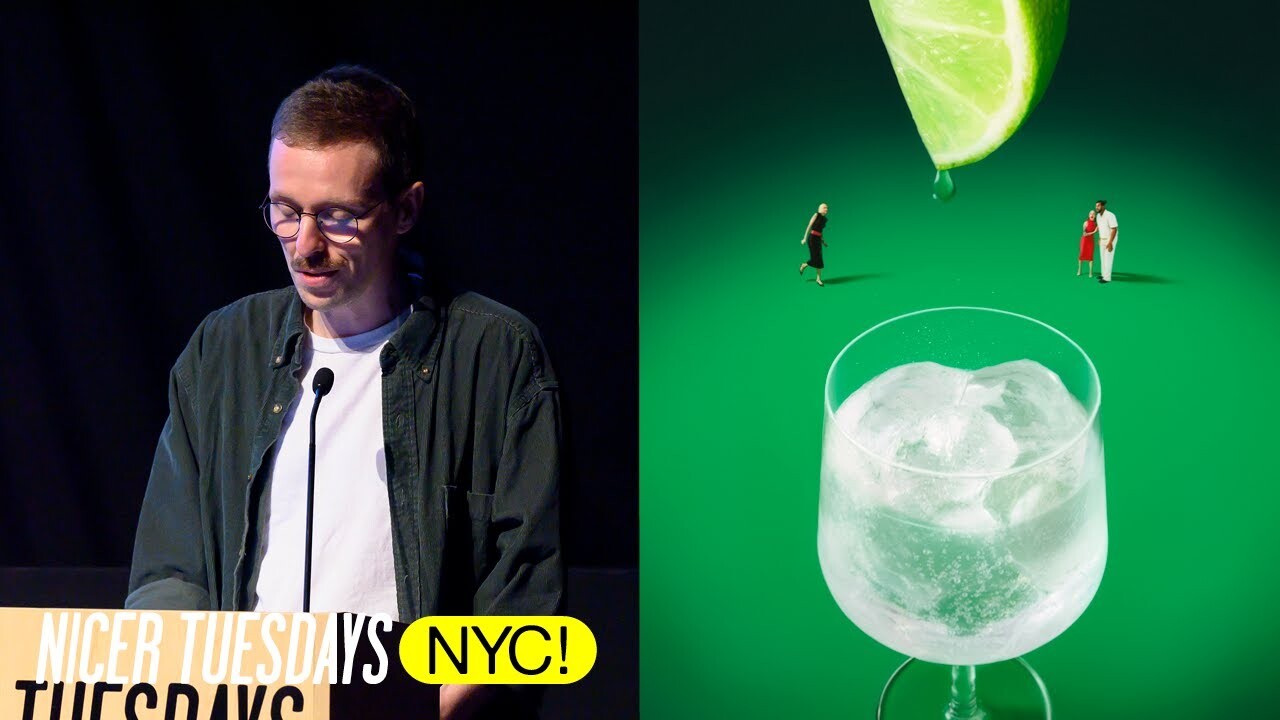
“I ultimately found it wasn't so much the new or old processes separately so much as the mix between them that I found interesting – like blending these really warm organic manual processes with digital ones like scanning and Photoshop. I found really thrilling to mash together.”
[applause] Hi. Hi. I'm Andrew. Uh, I'm not a designer as you can tell because this is my title card compared to everybody else. But, um, thank you so much for this opportunity and I'm very flattered to be asked to be amongst these wonderful creatives also speaking tonight. So, it's quite an honor. And one thing to note is I really hate talking about myself. So, I'm very nervous and I normally go through great strains to avoid this kind of thing, but I'm trying a lot of new stuff this year. So, here goes.
So, as Elizabeth said, I'm a photographer, director, and art director that was based in Brooklyn for a decade until April when I moved to New Haven. I'm a millennial, by the way, so I'm older than the other people. So, yeah, I was a decade in New York. Um, so I think I'm known for making very curious still life images or oddball handcrafted stuff that's always based in studio that I then photograph or film. I also work editorial on advertising projects as a career, but this talk will get into the craft of what I do primarily. So I can get a little into how I started doing all this. So um, I grew up in the
countryside in southwestern Ontario. Are there any Canadians here by the way? All right. [laughter] More than I expected. Uh, and so it's a map of southwestern Ontario, I guess. Um, I was gay in a conservative small town and also lived in a church rectory. So, my world became very internal through my youth. And I found that making things really helped me have control over something or rather anything in my life. It's also how I became really fine-tuned to detail as an observer more than a participant to a lot of things. So, I think a lot of queer people would echo things like this. And uh, so then I went to art
school in the city of Toronto. And this is where I realized that I really like the act of building things up in a controlled environment to then depict them rather than to shoot from the hip or to try to find the decisive moment or anything like that. So here's me in an apartment I lived with some art school friends back in the day hanging a donut from a stand for a reason I can't remember. But not a lot has changed in terms of what I do and I still often worked hunched over on the floor building things. So I now spend every day in studio. So this is my little space in New Haven which is a lot cheaper than New York. So if you guys are thinking of moving, please feel free. [laughter]
Um, and this is where I can work quietly by myself in a meditative way and slowly build environments to photograph. So, nothing makes me happier than this. So, I can start to speak a bit about process in terms of what I do there. So, my goals are usually to do something unexpected in my work or to take a scene from out in the world and find a way to reconstruct it inside the studio. So, this challenge uh to me is delightful and I think it often makes people guess how I do what I do because it's not very common tabletop work.
So to show an example, here's the process of initial ideation to the final image. The image on the right, by the way, is not the final image. This is also a sketch. This is ideation. But um this little food highway was very sharp in my mind when I wanted to make it. Coming from thoughts about supply chains and then wanting to turn that into a goofy road race between pantry items on a highway. So you can see my original sketching here. And I organized and printed out various food packages I finessed, which I later cut out, folded, and arranged in scene. I also hand painted this highway leading into the little hillscape complete with robust cumulus clouds. And finally, here's the image that was photographed. So, turning
a little notebook sketch into a reality is deeply satisfying to me. Here are a couple of other sketches formed into handcrafted sets and then final images. So, these little examples were all made on tabletop. So, I'm used to working with barely any space. I then take on ch the challenge of fleshing that small space out into something that I hope feels more grand. So the way I'm I make work now where I use limited space and supplies and to try to make the most of it truly began to oify as a guiding principle in my apartment in Brooklyn around 2017 when I was working mostly with video. So I wanted to make a series of video vignettes almost like ethereal
screen savers and the idea was exciting to me but I had to figure out how to realize them in my living room as I didn't have a studio at the time. So this is one where I want to bring 3D animation into flip book form to create this contrast between very old and very new styles of animation. This was then filmed on my floor, flipping all the way through and sped up to playing with shifting gravity within the frame.
[clears throat] Okay. [laughter] So weird seeing stuff this big behind me. Um, I then found a guy who raised tree frogs on Craigslist nearby. So Craigslist is the best source for anything if you don't mind being creeped out a little bit once in a while email. He gladly accepted the idea of them being in the scene and came over and I filmed them in kind of a frog circus on top of my table. This is the frog I'm kind of zooming in on, I guess, without his knowledge.
So here's the final shooting a lot of frogs jumping around separately. Um, so this is a big constructed shape on my little dining table at home. And I was really proud of this one tree frog for jumping through the little hoop I set up on the left. This was a bunch of little rotating motors that were attached to a switch.
And I put a handful of tiny designs on each of them that would turn around slowly. So, I really wanted to show a face being revealed in this case McCully Kulkin and Home Alone Screaming. And this was inspired by the scene in the '7s movie called Parallax View, where a bunch of people are holding up cards that form together a face. So, I wanted to make something like that, but in a tiny space. Anyway, that's the last scene I'll show, but it was 17 of these in total that formed a full project. And this whole project ended up winning me the webbby that Elizabeth mentioned. And that was very emboldening considering I did most of this on my living room
floor. It was under this category of weird [ __ ] which I thought was very apppropo to my point of view and still is. So this led to other projects including this little dock about designer bags for Vogue that I made. So bags I'm not that passionate about, but working with a single subject and finding different ways to craft things around that certainly is. I guess Anna Winentur liked this video which I thought was very funny considering how DIY and unpolished I can be when making my work.
Anyway, so this is kind of when CO was just about to hit and um I continued to work with small space on and around my kitchen table during lockdown and during that time I needed a small and conceptually light project to stay sane. So I started making these little meta scenes with miniature items on my table floor or in this case my husband's bushy eyebrows at home. This was kind of before miniatures became this memeified things online thing online. But I realized that there are some really wonderful mini artisans out there. You can order things from around the world.
So here's some mini stuff. All right. So after a while, I wanted to keep making small stuff, but I was thinking about how to expand the subject matter so that these small scenes went beyond the tabletop, if you will. These were early experiments kind of with the vibe of arrival but with mundane little objects incorporating views from satellite imagery which I I've always been fascinated with. I had this vision of a giant isolated escape button that comes that came from a dream that I had.
And I should note that I have a very vivid dream life and I try to record my dreams every day. Um so as you can see this is an incredibly small set. So eventually an editor at the New York Times, so shout out to Jess Bell if she ever listens to this. um saw the escape button and like the idea of me making a series for them centered around wellness challenges for the new year. So, this was over the holidays that I made these.
And I've always loved classic Hollywood tricks and practical effects. So, I really like the idea of creating the illusion of size and atmosphere using relatively simple tools. I was inspired by the miniatures they used for the movie Independence Day, for example, to create these massive shifts that ships that felt impossibly large from miniatures.
This is the pause and play buttons from a remote control. So, this is super super small. So despite the this depiction the depicting the Paloo region in Washington, I made most of these on my husband's old bedroom floor at his family's home in Tulsa, Oklahoma using this one little light that I brought.
There's a couple more. So not long after this, I started making all kinds of small things look big and imposing. So for example, this bagel over New York. I used satellite imagery of the city and then drew with pastels on top of prints of that to give a painterly feel as if looking through an atmospheric caves from high altitude.
This was an outtake I found from the perfume image from the last slide which my little with my little color checker which is something that you use in photography to fight find white balance. And this is to show this whole scene was depicted in camera. So I found a way to very carefully warp the environment to account for the lens distortion. So everything is there and there's not really any post here. So handmaking things and implementing super practical processes was getting so exciting that I wanted to push it further. So eventually I started getting obsessed with old poster illustration and wanted to see how to create a bit of that look and feel with photography. So I learned how to actually use airbrushing techniques
with paint directly on images I printed out and then refographed them. So this technique used painstakingly crafted penc stencils I measured and then cut out with a cutting machine. These were some of the first images that I made this way. Then I started wanting to work with characters in studio again inspired by old movie posters and ads like this basketball player for instance or this suited businessman kind of feeling like an 80s Wall Street villain. I ultimately found it wasn't so much the new or old processes separately so much as the mix between them that I found interesting like blending these really warm organic manual processes with digital ones like scanning and Photoshop I found really thrilling to mash together. I think now this is a common thread in my work.
So now I make all kinds of stuff using this mix of processes to explore little ideas that I uh I have that come from endless looking at archives, dreams, and little observations out in the world. So process itself though has become so sacred to me that I like to show a little tease that something was handcrafted when I post an image online.
Here are a few images I made recently with some behind the scenes. o this image was kind of a fusion of rear window and studio still life photography. And I used a bunch of layers from the cutout binocular holes to the model window to the sky to the table in the distance of the studio resin. It's all really there.
Here's a contact sheet of a scene where I slowly painted a backdrop and created a large bouquet of flowers out of color tissue paper. Here I wanted to make a giant topiary, but kind of messing with the idea by using a really cynical commercial item like a handbag. I made the bag and grassy scene out of fel and then trunk down a model into the scene like a cool guy Edward Scissor Hands. I then painted over a print and refographed it.
Here I photographed my partner on a pool ring, printed that image and cut him out. Placed that cutout over a handmade pool with plexiglass over it to mimic water. Photographed that, cut it out and placed it into a tableau made of felt. And then scanned that. Here I want to mimic a spacew walk. So being tethered to a shuttle and floating in space which is a real thing and seemed freely and seems freeing but also deeply eerie and uncomfortable and I wanted to see it through the reflection of a pupil. This is my iris that I shot in macro and lit a model space shuttle and reflected it in my own eyeball. So the lens was like this and nearly impossible to focus because I had to look at the screen to make sure that it
was in focus but then look back through the lens. Anyway, this is in camera except for a couple of extra reflections I erased. This was trying to mimic the effect of fat morgana. So miragees you see on the horizon in hot places and in the distance over water. So I took simple images of props, printed them, and then scanned them dozens of different times until they had the mirage effect that I liked.
This was this neon outline I wanted to make of a house. So I carefully cut out this outline and placed different gels behind the openings and then photographed a guy on a couch, printed that out, cut him out, and then pasted him onto this scene. and then lit the whole thing from behind to get this practical Tron style glow. So there's it just hanging there behind a in front of a light.
And then finally, this was me wanting to Oh, sorry. And then finally, this was me wanting to make an image kind of like these old ' 60s educational illustrations that have these insets. And I leaf through a lot of this type of image when I was volunteering at the picture collection at the New York Public Library. So, I photograph real stuff with a phone camera through a microscope and then cut those out and place them over a print of said microscope.
So, I want to keep seeing what kind of disparate processes I can mix in the future and really lean into this as a practice. I can be fun to keep people guessing a bit about how you made something, but also it's fun to show people a little behind the scenes to prove that it is handmade. I think craft is important and I think that this is and and I think that in this time as images and sensory experiences become more quick and disposable, it just makes me want to stubbornly want to do things the hard way but the way that I find the most interesting. So, thank you very much. I appreciate it.
Latest Talks
-
Murugiah
Why you should reject the formula and make art about things you love
Watch -
Amber Weaver
How does contemporary type design translate into the wider world?
Watch -
Delali Ayivi
How does photography give us the right to imagine our futures?
Watch -
Will Anderson and Ainslie Henderson
Bringing stop motion sorcery to BBC’s Small Prophets
Watch -
Ollie Babajide Tikare
The importance of not flattening the complexity of observation
Watch -
Marina Willer
Design thrives when you find poetry in the simple things
Watch