
Ana Flores is a photographer known for her work documenting the indigenous women of her Peruvian birthplace, focusing on themes of adornment, identity, and cultural heritage.
Ana Flores
Documenting the indigenous women of Cusco, Peru
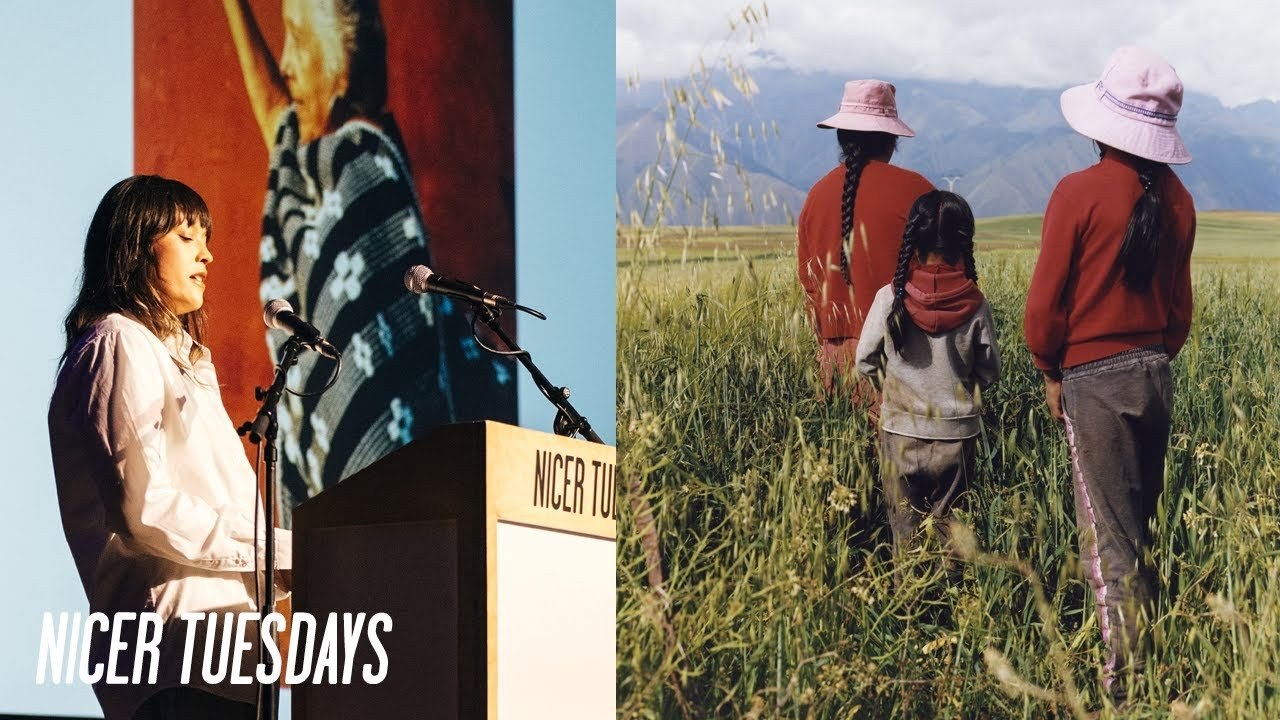
“When I decided to leave law for photography, it was like choosing to embrace uncertainty over security.”
Transcriptmay contain minor errors or formatting inconsistencies
Hi everyone. Thank you for coming. , thank you. It's nice that for having me. , so I'm Anna Marita Flores. I'm a Peruvian Swiss photographer born in Cusco and raised in Geneva, hence my French accent.
And I'm based in London. So tonight I'll be talking mostly about two of my ongoing projects. But before that, I just wanted to briefly introduce my practice and my background. I work mostly across fashion, documentary, and portraiture. And I like to blend different styles and play with my surroundings, props, , set design to create images that both feel seralistic and authentic. In my personal work, I explore themes of cultural connections, , belonging, identity, community, and specifically like to challenge representation. My photography journey started in 2021 when I finally decided to listen to myself and switch careers from law to photography.
I moved to London and started a degree in fashion photography. I knew I had to trust my gut and as soon as I did it, everything changed. I felt a strong urge to learn more about my country, which also meant learning more about myself and my own identity.
So every assignment during my degree became a chance to research Peru, its society and its history. And through that I started to understand my parents' experiences and what shaped them. It was so validating because for the first time I was reading scholarly work that put into words things I had experienced but never fully understood or knew how to explain.
So this personal introspection and research led me to create my first ongoing body of work with my patternal grandmother Analia titled Asalas Rees which basically means reach for the stars in Spanish. It mixes staged and documentary images celebrates her femininity, resilience and love for dance and f and and music and fashion. , the title comes from a Peruvian saying she started telling me every time we were on the phone, , Chavez. , for the backstory, it comes from Horge Chavez, the first Peruvian aviator to fly over the Alps. , she says this to remind me to keep going and chase my dreams. If I'm standing here, it's because because of her. She opened the doors for us when she decided to move to Switzerland in 1993 to look for better opportunities for her children. She made the decision during a very chaotic time in Peru when terrorism was happening and there were very few prospects for a better future. She left her job as a teacher which she she has held for over 30 years and joined her sister who was already living in Geneva. When I started my degree, I felt the urge to physically return to Peru. And in 2022, I traveled and stay with her for 10 days. I had no plan but to spend time with her. While we were together, we shared personal stories.
, I shared my passion for photography and she revealed her love for dance and fashion. One day I was on the phone with my maternal grandmother. , and she told me to play Peruvian music and see what happened. So seeing my patternal grandmother dance for the first time revealed a whole new side of her beyond just being my grandmother. The way she carried herself with pride and confidence while dancing reminded me that she was she wasn't just my sweet and caring mama Anna as I call her. She was also a woman who used art and fashion as a way to express herself. This ongoing body of work is a love letter to her and everything she has done for me. I'm actually returning in May and will continue the series with her. In 2024 I started a project called Dond Flores Estas Flores where these flowers bloom which grew from this journey of self-discovery and exploration of my roots. , it originally began as my final year project and this series explores how Andian indigenous women express their identity and preserve their cultural heritage through fashion despite globalization and the pressure to assimilate to western norms. , this project has so many layers, but for the sake of this presentation, I'm going to stick to the inspiration behind it, how it came about, and where it's going. So please bear with me. So it took shape organically between February and April 2024. I traveled twice to Uruamba in Kusco where part of my family comes from and where some of them still live.
But the idea took took seed a year before when I met Elba, Leonardo and Cleto from the Kaklakarai community in Maras doing a tour in a workshop organized and created by the restaurant Mal and the research center Mater. While sharing their knowledge of the land and use of its vegetation on a daily basis for textile dying, for example, I realized that it was the first time that I was directly exchanging with communities from Peru.
And informed by my fashion photography studies, I realized that it was also the first time that I questioned the legacy of colonalism. And so fashion as an act of resistance and resilience.
So I was proud I was proud of these women that belong to this land to this country and where I belong to and impressed by their capacity and willingness to maintain ancestral knowledge despite centuries of repression and discrimination. And finally, I was angry at my own country for neglecting them, undermining them and creating this fake idea that because of the color of their skin, language, customs or even lack of formal education, they were they are seen or considered as inferior.
So the research I started while studying my degree informed this project and gave me the tools to understand that everything that mentioned was just pure product of colonialism. And with this body of work, I don't only want to create empowering images, but also a positive create a positive visual representation of women that look like them and that we often like in the Peruvian and in European fashion landscape, for example. So, when I say that everything came together organically, I really mean it.
, every single person I met played a significant role in shaping the series. My first trip in February was all about building connection, exploring potential opportunities and scouting locations. And I wander through nearby villages for photographing anything that caught my eye and hoping to find inspiration.
So this is the day I met most of the women from the female lead craft collective that I collaborated with. It was a day after I arrived in Urubamba Cusco at a craft fair and here we were having shots to celebrate international craft days. And I met Damian and Jessica in the picture a month earlier during my trip, my first trip. That day I re reintroduced the project and gave postcard size prints to those I had photographed previously. Then they invited me to their community in Ankoto to continue working together. I presented the project in more details to Yana, the president of the collective in blue and she translated it into Ketra. And those who wanted to take part came to me in this little open air studio that I set up which was in the middle of their communial communal space.
By the way, they all speak Spanish, but they communicate better in Ketwa. But so I was able to talk with them easily. Before taking any picture, I introduced myself and had a little chat to get to know them and start building a trusting relationship. And the day of the crat fair, I was introduced to Maria from the Miss Mina community. And same process I explained the projects to her and she immediately wanted to be involved and invited me to hers. So with this project I wanted to explore different forms of collaborations. , so I set the set up the camera on the tripod in Maria's front yard, hadn't heard the shutter relays cable and I wanted them to have control over how they presented themselves giving them the agency over their image creation and over the time I've built relationship with some of these women and still keep in touch with them through WhatsApp.
So that's how like I could send them the images. I was able to send them the images. , and now I'm working on continuing , the project by opening a dialogue with a younger generation of women about their connection to heritage.
I want to explore how they preserve their cultural tradition, how they incorporate them into their daily lives and personal style. As I said, this project has many layers and one of them is fashion. Not only did I want to communicate my love and respect for these women, but also for their garments, , which by the way, tourists love to photograph when traveling without questioning its legacy. , and so together with Lea Lataro, a Peruvian creative director based in Paris, who is also a friend, we explored and imagined new ways to honor these garments, we collaborated with Mora, a model based in the city of Cusco. And I wanted also to extend the celebration of Indian women beyond the borders of Peru and reach out to Anela Kamacho and Iaketa indigenous woman and activist based in London. We used Anklla's poetas and anaga poeta skirt and aas skirt and shot this in Bethnel green. You can't tell, but my friend Cayatano Garcia, an amazing art director and stylist who is here tonight, is behind her and helped me holding this massive piece. It was really hard.
And so while in the process of creating Don Flores Flores, I understood that I was actually it was actually deeply personal. Not only was I showing my admiration and appreciation for the woman who took care of this land, but also for the women who took care of me. And it was therefore essential to include both my mother and grandmother either through family photo archives or new ones that we created together. And this is a picture of my mother in Cusco by my dad when she was pregnant with me in the fields. And the other picture is my my grandmother back when she sold handcrafted in Cusco. And this is her in 2024 in Geneva. She usually refuses to be photographed, but I think she agreed to be part of this project partly because I did the this other project with my other grandmother. And finally, this project was also my way to reconnect with the country I was born in but did not grow up in.
After the project was published in Mola magazine u for the first time it got featured in many platforms such as another magazine. It's nice that thank you by the way. We present Atmos now creative review and British journal photography and it was also exhibited in London at 1014 gallery in Dston last year as part of a group show exploring the act of holding space presented by Thursday Charles Club and created by Ashley Kane, Daphne Milner and Jamie Allen show. Thank you again for making this happen. And it was also selected and shown a month ago in Milano at the photovoc festival. And tonight I'm very excited to share that I will I received a grant to exhibit the series in October 2025 this year in a gallery called Malissa in Urubamba Cusco located where the project was originally shot. And I invited my partner in crime, Ellis Leon Morales, who is here tonight, a creator and photographer based in London, , to co-curate it with me. , she's been part of the journey from day one.
So, it felt right to invite her officially on this chapter. , it was so important for me to give back, not only , artistically, but also financially. So, with this grant, I'll be able to pay all the participants and give them , a print. This whole journey has pushed me to think deeper about my positionality as a Peruvian and Swiss photographer living in Europe and in the ways to give back to my people and especially to those that those at the heart of the project. It also taught me to trust my gut to follow that instinct inside of me that pushes me to learn to connect and to create and to embrace the process rather than obsess over the outcome. So, if I can leave you with something tonight. , if any of you want to start a project, start with yourself, follow your gut, and trust the process. Thank you so much. [Applause]
Latest Talks
-
Murugiah
Why you should reject the formula and make art about things you love
Watch -
Amber Weaver
How does contemporary type design translate into the wider world?
Watch -
Delali Ayivi
How does photography give us the right to imagine our futures?
Watch -
Will Anderson and Ainslie Henderson
Bringing stop motion sorcery to BBC’s Small Prophets
Watch -
Ollie Babajide Tikare
The importance of not flattening the complexity of observation
Watch -
Marina Willer
Design thrives when you find poetry in the simple things
Watch