
Yumna Al Arashi
Challenging Western stereotypes of Muslim women through self-portraiture and ancestral histories
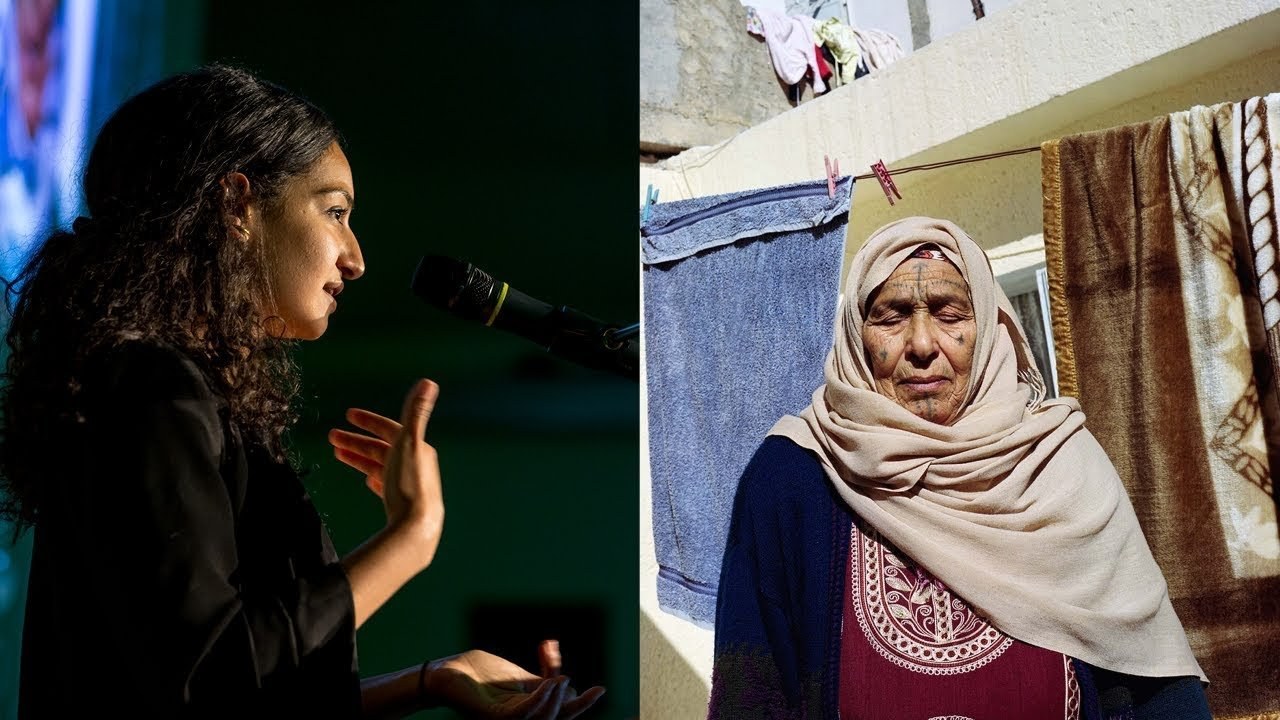
“Diversity becomes irrelevant if the framework for our institutions remain the same.”
I hope you had a nice break and our little tipsy I'm definitely not as funny as the last two speakers so please bear with me and please laugh at my jokes so yeah representation has been a really hot topic these days and I'm very aware of that it feels so inspiring and on the surface you feel like yeah we're a part of this we're doing something.
But I still question a lot of these ideas and I wonder if our are rallying for for representation is actually of substance or if it's actually creating more division in our spaces I still have made it this far as a working photographer though and I've even made history as a woman of color working in many of the spaces that I've odd but I still wonder if the processes by which we're seeing the world are changing for good or if we're simply filling the gaps into the same systems run by the same ideas that once excluded us diversity becomes irrelevant if the framework for our institutions remain the same let's be really real most of you in this audience can take a pretty decent photograph using whatever smartphone is in your pocket Apple made this really horrifyingly clear with those billboards that are all over town they're basically like a campaign that said don't try to be a professional photographer ever you'll never make any money the worth of the photographer and the photograph has become minuscule and yet our society feeds off of the image like hungry vampires the highest-grossing photographers in this industry are still white and male and they are always the 1% the numbers are horrifying and like many industries photography is through it for a reform these dark facts push me and many other photographers to question our approach we question how we can create powerful imagery which not only stands out but creates spaces for more people like us how do I represent myself my peers my ancestors my history how can I use photography my photography to inject my perspective into a narrative that has been so long dominated by a gaze which is satisfied with the one dimensional view of people like me I can't really make a pretty package of the work I make it's all over the place my work is relevant to anthropology to journalism environmentalism fine art commercials even fashion I can't really fit into a box but who can my work is a representation of me.
And I contain multitudes my work seeks to give humanity and history to the lazy stereotypes I find encountering myself encountering on a daily basis from the history of women's power in the Middle East and North Africa to using my body as a site of resistance and even creating powerful commercial work for people like me who do not fit the status quo I'm simply hoping that people will see past what has been forced into their ideas of the other I want more of the imagery we digest to push us to think to push me to think the worth of the photography could be so much more if we asked it to be there are many of you in the room who are gatekeepers to the spaces in which new powerful and important voices can not only benefit from but can also benefit you.
So we're stuck with capitalism for now some of the most effective and powerful work that happens in this world is at the hands of corporate entities I could sit here and cry about all the problems with that which is really not the reason why I was invited here.
But I could also just say let's just do something with what we have here.
And now I spend some time working in journalism and I found so many problems with the moral compass by which we often grant ourselves the right to photograph and report on others so often it is unjust and sensational the gaze is important and no matter what type of story we are digesting we need to have a critical eye oh and remember that the bodies that we so often see in the news deserve the same respect that we would give our own families I spent a lot of time making work about Muslim women in the Middle East as well as my own journey discovering the beauty of my ancestral homeland growing up in America we have this horrifying idea of what a woman from this region is like my work sought to take the women I knew looked up to and loved out of these typical scenarios we'd normally see them in I wanted to give these women contacts power most of the Muslim and Arab women we see in media are in really bad states no depth no context we assumed so much in our apathy towards them allows a stereotype to easily settle and from there we become complacent so this is a series of images I made in Yemen in 2013 I pitched it to everybody that I could blind emailed every editor on the face of this planet and nobody responded to me I think it was in 2016 that an editor from an art blog which was not it's nice that I don't think I even know it's nice that back then I don't even know it existed actually but you guys are really cool so yeah it was during the Olympics basically and there was this conversation about this hijab' volleyball player I don't know if you guys remember this but everyone was like can she play volleyball with a hijab on you know like just ridiculous like we I mean like women's bodies are just tossed around all of the time. And I mean this was just really silly this whole conversation that was happening because she was a fantastic volleyball player and I'm pretty sure she's still won the mattress that she was playing it.
Anyway I use this as an opportunity to push these images forward and I mean people were like why we don't understand why are we seeing veiled women in powerful positions why are we seeing them use their bodies to express themselves so I kind of rode this wave and this series of images worked as a way to challenge our ideas of Muslim women and women in general actually why must we only accept one version of a powerful woman why are we still policing women's bodies by refusing her ability to be great even if she's underneath a hijab why must we look at women a certain way why must we ask momen to look a certain way in order to be perceived as capable my images were a shock but some traction started to happen there I then looked for some grants to dive into this project which was super personal to me it was inspired by my great grandmother on Miami side she had these tattoos all over her face and I wanted to explore more of the history of these symbols and understand where they came from and what why they no longer exist and I got a few grants to document the last generation of them in North Africa basically all of the history books that I looked at when I was doing the research for this were written by white men colonialists mostly French and obviously with women like this in these regions in places where they can't even communicate on the same language level there's no information that can be transmitted that's honest and pure and being a woman to go out into these places and photograph these women and talk to them and gain their trust I learned so much more than any of the books that's so as for teaching yeah it was it was actually so beautiful to be able to see that.
There is so much more dynamic than this one version of a veiled woman that we are always seeing on the news and at that point in my career it had enough traction to be able to push this out I mean like then it's nice that published this.
But yeah I mean it was also a huge surprise to see mainstream media wanting to show this type of Muslim woman so yeah these are all indigenous women of North Africa they come from amazi tribes and obviously the Arabs were colonizers as well in these regions and Islam was a colonized religion.
So we also see the importance of understanding the history of a place that is really kind of so in I mean in Western media you see Islam as being this thing.
That's been there forever and these all are the bad guys and they've made their women oppressed forever but like actually these women we're getting these tattoos which represented their power and the matriarchy that existed only I mean this woman is old enough to be my grandmother. So it makes you question about I mean it makes you question the media and the ways in which Western media is using and women in women's bodies to push their political agendas ♪
so basically I formed my own theories on the loss of these tattoos and a lot of it had to do with the Islamization of the Middle East and North Africa and yeah I mean I can go into all of this.
But that would be another ten minutes so yeah III guess I often wonder if my journey of finding fair representation would have received the same attention twenty years ago my work blossoms in the West because I am digestible I'm American and no matter my tendencies towards atheism most headlines still refer to me and my work as the token Muslim very breaking barriers still in the media world.
That's how I generate clicks it's exhausting it's confusing most days feel like an existential crisis but on the days where the sun is shining a little and my person isn't tossed around for a battle or and for others to claim my identity I remember that I am lucky my story which is like so many others needs to be told when the weight of the word Muslim drags so many of us down reminder our religions don't define us so for many years I've been creating self portraiture as a means for expressing myself but also to take ownership of my body it really feels as though these labels tear me apart.
And it makes me feel as though my body is not my own there's this need for using my body as a tool for expression and using it as an act of defiance photography became my freedom in that sense I could define myself through all of my selves my decision to photograph myself was always my most political act I'm presenting how I would like to be seen to the world on my own terms and many women they do not have that privilege I'm protesting media's representation of people like me. And I am also protesting identity in itself the funny thing that I've learned about identity it does it is that it doesn't exist in one dimension it is evolving it is confused colorful nonsensical and weird it is definitely not a token I could never fully explain identity to you because it simply has no real weight the more I feed into the notion of it the less it makes sense and so I wonder why we always keep the question of identity at the forefront of our minds in the first place how can we fairly represent one one another without exploiting each other's mere humanity I so often carry these questions with me through every project of mine openly admitting that I do not have the answers but I want to remind us that.
This is what these questions are what's most important at the end of the day asking ourselves why why is it necessary for us to label one another so shortly after the election of Donald Trump the Muslim ban effectively barred my father and the rest of my M&E family super heartbreaking and I moved to Europe which is not that much better but it's better my anger with the media's representation of the Muslim was at an all-time high so shortly after the election I was approached by ASUS of all people and to create a new body of work I mean Asus is fantastic this is all because of Asus thank you.
But yeah they they basically asked me to just do whatever I wanted they told me I can express myself in any medium I want and that they would give me two shows in LA in New York and that I could also make an accompanying film which I was like what do like who what do I have to do like where and like nothing had like really like I didn't have to do anything except where some ASOS clothes just like that's fine I just moved to Europe like I don't even really have that many clothes right now.
So I'll take them. So basically.
This is how this project was born I'm pretty sure that they weren't expecting this. But it it went over really well.
So basically I created a body of work depicting the Arab woman and ahem this image of the Eastern woman in Hema month at we see a lot in history it is orientalist in nature these images are only the only depictions of North African and Middle Eastern women in museums and usually they're made by colonial men I played on these notions of Orientalism which is a term or originally coined by Edward Sade I won't go into the details of it it's fascinating and you should read about it but basically it is the image and depiction of basically everyone other than those who are the colonizers I knew that my work could lure people in if I could present them with familiar images and once I had them in those spaces in LA in New York and this is literally just a few months after Donald Trump was elected and there was this heightened sense of stress and fear in the air I had lured people into these spaces with these pretty much printed at this size and then led them into a room that was playing a film that still contained these images I would play it for you guys now.
But it's way too long anyway I spoke through the film. And it was a way of creating a barrier and I guess also a form of solidarity to other Arab American women I mean these spaces are really sacred for us.
And I grew up in these spaces these spaces mean the world to me. And I think that we've long felt that they were taken away from us and they were sexualized and no longer wholly in a way that we need them to be and it created a barrier in a sense that it was a space in which people who are viewing it who have that connection to a space like this could feel a relation to it and those who had no understanding of it past the images that they would see on a regular basis and museums or history books would learn something new and yeah you can look it up on Vimeo and find it there so circling back to the point about capitalism ASOS made this thing happen and there were literally no strings attached and I mean there are many problems with the way that we think about fast fashion or capitalism and all of these problems in the world.
But the reality of today is that for people like me who have a really hard time climbing the ladder of the photography world for instance and corporations really matter and commercial work really matters for people like us to create work and also to build on our work I mean I don't think I had ever created such a complicated set in my entire life nor made a film which was a dream so that's a still from the film so last year I was commissioned by nowness to make a film which was part of a series called rituals and they obviously asked me to do the one about us then I said yes because when I thought about it. Actually. There is no positive imagery out there made by a woman from a woman's perspective about the religion or at least not in the Western worlds so I took it as an opportunity to kind of use it as a way of creating a set of beautiful imagery in which I'd used all of this information that I'd gathered over the years to to show the beauty of Islam which I mean I mean I'm really not a practicing Muslim like I'm a normal human being who's just figuring it out.
And I don't think that any religion is just bad but I think we can all see the beauty in so many different religions and most have had the opportunity to have its space on the stage I mean we are really into Buddhism in London and really into Catholic art in Italy and you know where is the space for Islamic art where is the space for women's bodies in these these modern Western worlds so that's what I also on Vimeo you can watch it premiered at Tribeca Film Festival last year. And it's called the 99 names of Godin yeah. So you're probably just as confused as I am and that's great to be honest confusion and challenge provoke us to think and question the world around us. And that's really what we need in this world of imagery and this highly saturated fast-paced world of the things that we like every day so yeah thank you guys [Applause]
Latest Talks
-
Will Anderson and Ainslie Henderson
Bringing stop motion sorcery to BBC’s Small Prophets
Watch -
Amber Weaver
How does contemporary type design translate into the wider world?
Watch -
Murugiah
Why you should reject the formula and make art about things you love
Watch -
Marina Willer
Design thrives when you find poetry in the simple things
Watch -
Lizzy Stewart
The hundreds of drawings and writing-on-a-whim that goes into comic novels
Watch -
intra
The rewarding process of recognising the art in obscure everyday life
Watch