Tracy Ma is a visual editor at The New York Times, known for her insights on successful editorial packages and her unique role in enhancing reader experiences through design.
Tracy Ma
How empathy shapes the most meaningful editorial reader experiences
“Empathy isn't just a buzzword; it's the foundation of creating a meaningful reader experience.”
Transcript: May contain minor errors or formatting inconsistencies.
Visual editor at the new york times where she brings complex stories to life through visual wit and experimental interactions her impressive career to date spans five years as deputy creative director at bloomberg businessweek where she oversaw no fewer than 200 issues and teaching stints at parsons in new york now tonight she's joining us to share some insights into her own creative process and to explain how she and her team at the new york times deliver razor-sharp visuals day after day week after week so tracy please turn on your audio and video so we can actually say hello hi there hi everybody how's it going it's going well thanks so much for joining us.
So well so soon to the election as well I'm sure the mood at the new york times is pretty frenetic right yes yes for sure we're we're being kept busy absolutely well we really appreciate it. And so I'm going to kind of leave it to you now and you can start your presentation and share your screen and correct everyone else if you have any questions if any questions pop up as tracy's speaking please just pop it in the chat and we'll do our best to get around to them at the end over to you cool so yeah thanks so much for having me I'm really humbled and excited to be here to walk you through some of the work that I make at the times I joined the company about three years ago my home base is the styles desk my main area of focus is visual ideas presented on the web I publish a whole range of things sometimes they can be small and fluffy like writing dumb jquery for a dog you can pet with your cursor for example this published on the day of the american midterms elections in 2018 when we were all very tuned in online and maybe we all could have used a bit of emotional support or it can be not fluffy like this piece about protest mimetics we started seeing echoes of the hong kong protests a year later in the blm protests in america and we asked why and the answer was memes so for me part of my job is looking at how we as a society are using images and sharing them and what can that tell us about how we're living now and also part of my work on stats is developing our big story packages like this essay collection about how gen xers are middle age now when it published it created a big trending topic of conversation online and part of the reason why is that I think like it had a very striking visual language this took about two to three months to make of planning research and design but you know like other pieces take only two to three days to make and it's just as impactful I wrote and illustrated this piece in march using simple graphics we taught millions of people how to sew a fabric face mask it gave readers a sense that they could do something to help themselves to help others when you know guidelines and leadership was really unclear it remains among the top grades of the year for the new york times before publishing stuff online my work experience was in print production I had cut my teeth making a mag called bloomberg business week for about five years it was the early 20 teens biggest bull market ever startups everywhere we see money hadn't swallowed america whole yet we had a lot of fun with typographical and visual experimentation.
And sometimes taking tiny jabs at the rich the powerful and within publishing it was like the era of special issues like we made so many of them. And it was really making all these special issues that I learned what an editorial package was and that. There was like a scale of quality there's on the one hand a sort of editorial packaging that is what an old boss used to derive as embroidery a sort of decoration around incohesive things giving them a brand and shoving them together rather forcefully then there's a slightly better form where you're making people feel something at least right like feel emotions maybe experience humor even and then finally there's this kind of editorial packaging that's like held together through a cohesion of thought and tone and argument you know in my industry people are always going on about visual storytelling it's sort of lost meaning like a buzzword this top part is at least how I define it and for me a memorable experience I'm working on something like that was the 2012 business week election issue the whole issue posed a single question did obama do a good job or not in his first term and the whole magazine was structured to answer that one question and every page of the magazine answered to that one question that one thesis visually it was like a visual report card for incumbent obama and we used images and graphics to present facts to how people decode and understand the world around them that is totally different than making decorations for a long piece of text you know this whole thinking about editorial packages is very applicable to what I do now a lot of times when we make publish big packages of essays online I keep that little triangle in mind so at least know that I might be guilty of embroidering where I'm like graphic designing really hard around a lackluster thesis maybe you know I'm not going to knock on that too hard because like I think with some powerful looking graphics you're still bringing a lot of value to readers that value might not be like information.
But it's making a reader feel like they're part of something larger more powerful than themselves like a celebration of juneteenth emancipation day in america in an especially difficult year.
So I think it's good to know where that top benchmark is knowing that not everything you make every day will be groundbreaking visual storytelling because that's no way to live like sometimes you're putting a dang poster at the top of an article and I want to talk a little bit about this article toppers because though this is not groundbreaking visually led storytelling these like quick lower stakes online cover moments are highly visible surface with my creative output this is an illustration for of sober bros binging seltzer for an article we published in 2019 about sobriety as a trend now and judging from the metadata I made this illustration within three hours with lunch in between I made one option showed it to my boss corey and he was like well I love it.
And we shoved it online we topped it.
This is a complete departure from my experience in print production.
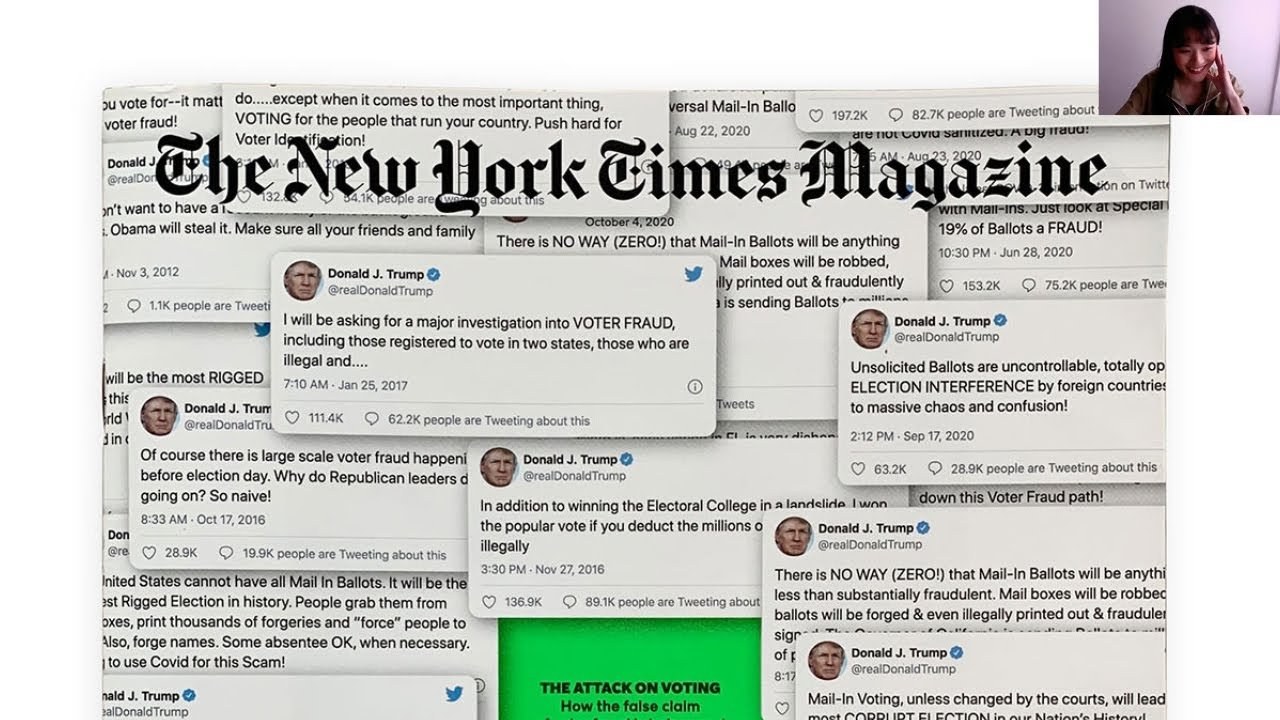
And I was reminded of this difference recently when creative director gail asked me to sketch for a potential mit mag cover story about how trump and republicans are peddling this false narrative around voter fraud I wanted to talk about the process of getting to here because I went through that through all the metadata and it looks like it took something like give or take 44 hours to make with a little over 100 iterations you know a million versioning or die is a workflow that I'm very familiar with having worked in print for so long and usually starts off with something like this you research you gather your raw material in this case it was trump's tweets and it's clear from doing just a tiny bit of research that he's been peddling this false narrative for years and you just sort of like quickly throw something visual together you're like okay yeah this is going to work but you set it down you go 180 you try something else maybe you do some other kind of research I did some photo research in that playground rule where that kid who accuses someone else of doing something wrong it's probably the kid who did it I was trying to see if there was a magical visual or layout I could get at that a bit and and then. I was in my head I was like a dirty card trick metaphor genius.
And then you try it out and you're like oh my god this is the dumbest thing I've ever seen and then you know like there's I was like is there a way to come by tweets with an image from client action like stuffing out is stuffing out like disenfranchised voters or their concept of democracy and then.
I was like is it not the tweets because it's mixing too many visual metaphors and something else another symbol that's sort of intervening gail suggested maybe a word or phrase could help convey that meaning better and then. I was like wait maybe we should try to focus on a specter of voter fraud or should we hone in on the fact that trump's basically got the entire federal government carrying this massive campaign of disenfranchisement or is it about the kind of like reality distortion field that trump is exerting gail also wanted to see some ideas involving the ballot meanwhile while all those other ideas are brewing back at your strongest idea you're having a party trying on different styles of hats and then the editor was like yo I'm like unsure are we giving too much real estate to trump's tweets on the cover should we try making the headline bigger so I'm like I'm begging the font and so finally we're like all right all right let's go back to something like this but put in the center I want to see it pop and then is the master getting too lost yay but wait you're not done yet we've decided to carry the feature opener can you like gather more tweets let's try some options yay oh my god you're not done yet like can we like turn this into an interactive so online this piece sort of like sits on top of an article you scroll and it triggers an animation like the trump's tweets are like assaulting you and like you try to like swat them away.
But they respond and in this way you can sort of also like read that some of these are kind of like just total lies and slightly deranged and like so a lot of readers experience this writing on the web right the way that they experience a lot of article toppers on the web you scroll and you see some text after the cover and I'm not here to pass a judgment like saying one way of doing things is right and the other crappy and wrong but one took 44 hours and the other took three just from like a pure math standpoint where does the other 41 and a half hour go well it goes to 13 other article covers this piece is about silicon valley bros being obsessed with stoicism and this is about how the california raisin industry is like very like mafioso very like full of death threats and very godfather I want to say that there's something very freeing and creating something.
That's a little less kind of like labor over for the most part that has been my experience in digital publishing you publish way more faster sometimes you get to have fun with it.
This is one of my faves apparently after talking to rat professors katie weber finds out that rats love making nests out of your car's engine because the wires remind them of tree roots their ancestral home it also leaves me time to make a painting of this iconic walmart worker who bravely stood up against an insane never master it leaves me time to make fan art of elon musk grimes and their baby ex elon musk refused to be photographed for his interview and I was like hey time for me to log on and of course it leaves me time for like ultra ambitious projects that you can only do online because it engage it engages viewers in like with literal interactivity like this taxonomy of the new celebrity where we've had and why times writers identify the new form of celebrity now like it's no longer hollywood a-list b-list c-listers but influencers twitch superstar tick-tock witches we then gave new york times readers seven days to vote on which category of fame they think is most relevant now by upvoting and down voting after seven days we revealed who the winners were I worked on this with a colleague rebecca lieberman who was amazing and like what was amazing about this project was that when it launched we just saw a torrent of people down voting on everything like this like I think like we had 1.7 votes 1.7 million votes in total of people either up voting and down voting and 1.2 million of them were down votes the people seem really depressed and want to hate on things.
And we provided valuable service by giving them a platform to do this other than twitter and now I will finally walk you through the new york times secret to coding a wonderful online interactive there's a magical google oh I I'm just informed that I'm just out of time seems like it's nice that has got to invite me back for another talk hey that's it thanks very much tracy we could have gone gone and seen that.
But that's no problem thanks so much for that that was that was absolutely amazing really really interesting I feel like gail bickler as well is going to come up a bit later in sophie's talk as well she's getting two two name checks there yes I'm sure before you go we've just had a couple of questions submitted by our audience and they're super interesting ones that you kind of touched on.
But it'd be great to go into a bit more depth so one is how is the shift from print to digital did you encounter any hurdles and a kind of second question on that one what's the most valuable skill that you were able to transfer from one to the other yeah.
I think for the first question I think I'm still going through all the hurdles of course there's like a huge technical gap between kind of like learning basic coding basic kind of like framework of kind of putting stuff on online and I think my team has been really helpful I mean the technological team at the times it's just like fast and like there's always someone who's an expert in something and like I'm really able to draw on that so like you know you still have to like learn new skills but there's always people who are patient enough to walk it through and I also took knife school and fronted development while I was still at bloomberg so I think I sort of like prepared myself for this shift and then the second question washers the second window washes right outside yeah could you remind me about that yeah I guess what's the most valuable skill that you've been able to kind of transfer from one to the other yeah.
I think it would be kind of just you know having a brain for you know what a story is I think like ultimately you're still presenting stories are still it's still a narrative form so you kind of like you're empathetic to like how a reader might come to this I think like you know empathy is something that I'm still developing and definitely is a skill and muscle that you learn so fantastic last question is what does your day to day look like are you usually working on those kind of quick breaking news stories or do you how often are you working on those longer term packages that you kind of mentioned I sort of always have a longer term packages on the background and maybe it's like one week before launch I'm only focused on that but you know some sometimes with masks with corona like we wanted to put out service that will help people so sometimes depending on the news I I'm able to switch over for some of those shorter term projects fantastic well listen thanks so much tracy we really appreciate you joining us this evening and also yeah talking through the window washes very very impressive you can now turn up your audio video and yeah thanks so much for that
Latest Talks
-
Will Anderson and Ainslie Henderson
Bringing stop motion sorcery to BBC’s Small Prophets
Watch -
Amber Weaver
How does contemporary type design translate into the wider world?
Watch -
Murugiah
Why you should reject the formula and make art about things you love
Watch -
Marina Willer
Design thrives when you find poetry in the simple things
Watch -
Lizzy Stewart
The hundreds of drawings and writing-on-a-whim that goes into comic novels
Watch -
intra
The rewarding process of recognising the art in obscure everyday life
Watch