Sophy Hollington is a Brighton-based illustrator and artist known for her complex linocuts and distinct visual style. She explores themes of folklore, mysticism, and the arcane, infusing her work with vibrant psychedelic colors.
Sophy Hollington
Complex linocuts from an illustrator who breaks rules to create
“Sometimes you have to break the rules to make the art you really want to create.”
Transcript: May contain minor errors or formatting inconsistencies.
Head now and meet our third speaker of the evening sophie hollington is an artist and illustrator whose unique work has been commissioned by everyone from the new yorker to the wall street journal to wired and penguin to name just a few her work mostly takes the form of relief prince a historic yet laborious process created using lino cutting sophie was recently asked by the new york times magazine to create a cover for an issue inspired by picachos de cameron that novella is was written in the aftermath of the black death in the 14th century and was a way for the author to process the fear and grief of the epidemic so no points for spotting the link there tonight sophie's gonna delve into this timely brief and how she approached that challenge so sophie please turn on your audio and video when you can hi there hello hi how's it going yeah I'm good thank you how are you fantastic yeah really good how how long did that take that that cameron project that must have been an epic it was rather yeah it was about three weeks start to finish and a lot to cram in amazing well really excited to hear a bit more about that.
So I'll let you kind of share your screen and present and everyone else again if you have any questions for sophie please pop them in the chat and yeah we'll do our best to get around to them afterwards apologies that's all right okay can you see amazing okay you can see the hello yeah I'll leave you too okay hello yeah my name is sophie hollington an artist and an illustrator so I've got a mouse going all over the place so yeah this is my work I I mainly use lino like matt said so all the black that you see in in this example is is a lino cut if you're not familiar with it.
This is what it is it's it's basically it's compressed cork dust and linseed oil which is put onto this kind of hessian back to form these sheets and get them in any size and you use these kind of carving tools to to carve away to create a relief print so this is an example of some of my work so what you're carving away is the the negative of the image which is the white of the paper and then you use the roller so to roll over what you've left behind and which is the positive you put a piece of paper stick that on top of the the block press it press it down you can use a press but I like to use a wooden spoon to touch every single part of that block where it's touching the paper and to correct print this is actually two blocks which I've stitched together because it's a little bit too sort of detailed for me to do just in one and then scan that in and I color it digitally and this is just a kind of for economy basically because of when I'm working commercially and I've got tight deadlines let's do loads of different blocks of different colors would just be be a bit too much for me to kind of take on.
But it also lets me kind of change your colors and do all those sorts of things.
So yeah this was a book cover that came out just last week I'm quite lucky and I get to apply my work to all different kinds of briefs I come from all over the place I do quite a lot of editorial stuff first of the new yorker new york times bloomberg business week lots of american publications finally but then.
I also do kind of commercial projects the sort of brands this was a skateboard design and then sort of more publishing stuff so book covers this was a really cool one because it was it was boil blocked so it's kind of like double doubling upper processes there and there was a kind of metallic foil and then.
I also get see lots of stuff for music kind of album covers and posters and these are some of my favorite beasts because they're often kind of the most open in terms of kind of themes what you can explore I'm really inspired by folklore and mysticism and kind of the arcane I guess which lends itself to the kind of the process that I'm using but then I try and combine this with a kind of more kind of eye-popping psychedelic or kind of modernist sensibilities so that I'm not just kind of retreading you know the past yeah and a really important project for me the last couple of years is this one it's a tarot deck that I did with a writer called david keenan and we created 30 tarot cards the kind of whole major arcana basically.
And then two each of us the sweet cards suit cards even and it was published by rothschild books we made a proper deck and that's basically I think what kind of sent me down this slightly sort of esoteric route kind of over the last few years I've sort of explored more with other things another really big part of my work is typography which I wasn't kind of initially drawn to like when I was at university or anything like that I didn't really go into that.
But it's something. That's happened just from doing posters and and kind of alvin comes and having to do type and the lino really lends itself to that the kind of the letter forms just seem to kind of appear and I don't have to to work very hard to sort of to make something that feels really kind of cohesive which leads me to this project which is of what I'm going to talk about the rest of the time.
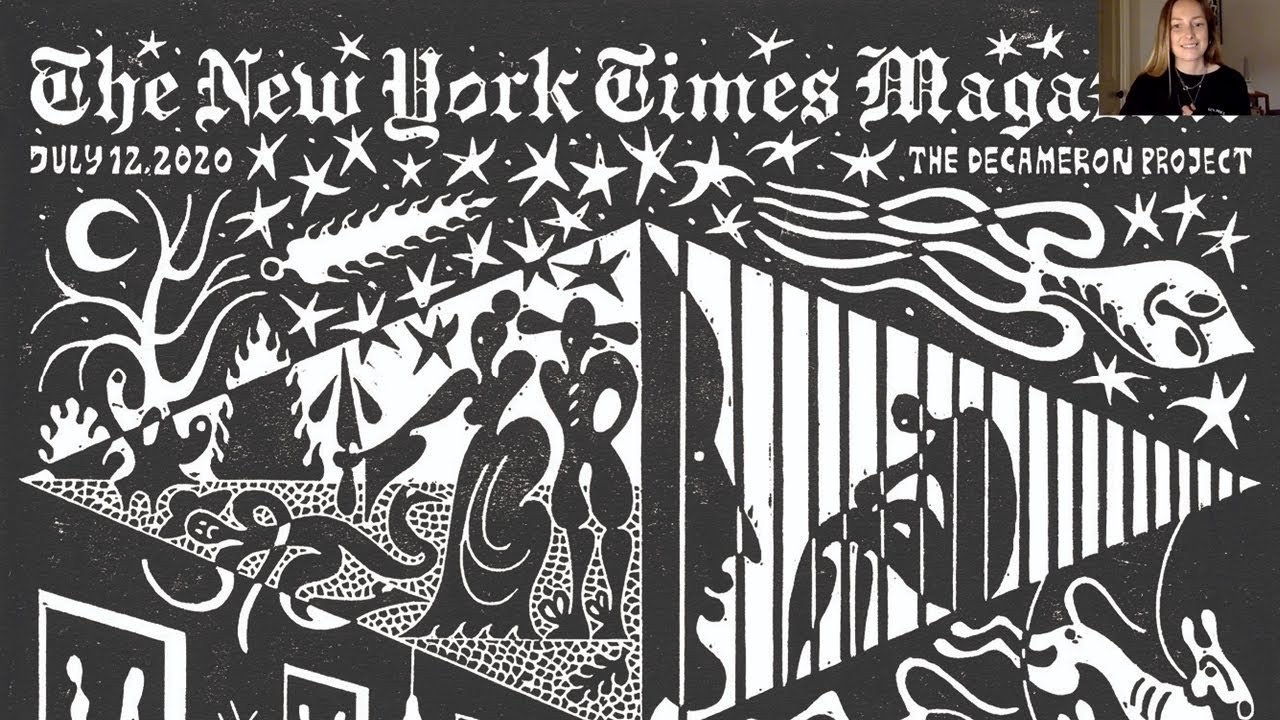
So this was the new york times magazines I did a special issue back in july called the cameron project which like matt said it was an ode to a a book which was written in the 1300s by this italian guy who escaped florence and the black death to the tuscan hills with a group of his sort of young friends I think they're all in their early 20s and they just told each other stories to pass the time that were all kind of you know about the themes of what they were dealing with at the time the pandemic and that's what this issue is it's 30 different writers very 30 different works of fiction that kind of dealt with kovis and the lockdown and what we were all kind of living through at that time in the whole world was it was kind of locked away and the magazine had never done anything like this before they'd never devoted a whole issue to something so completely so they asked me to come.
And sort of try and unify the whole project. Basically they kind of needed something that was gonna kind of umbrella it all.
So yeah this is my cover this is the introduction I've already explained what the camera is so I won't tell you again and yeah.
So this was a a couple of pages a couple of book plates from the original so yeah when I was first contacted I was sent this this pdf I thought maybe you'd like to see sort of the the whole kind of job from beginning to finish this is kind of a pacing kind of example so I can see exactly how much work that they were asking me to do which was a lot.
So I had three weeks to do I had to do a cover a table of contents an introduction all the titles all the kind of the text for each each story kind of these little ornaments and then all the spot illustrations as well and they put together these kind of mock-ups using work that I'd already done which is quite sweet so I could kind of see exactly what they had in mind so I had to get stuck straight in was kind of sketching my feet didn't really touch the ground and these are the little sketches from my spots I use an ipad for all my sketches it's the kind of one sort of like non large digital thing that I have and it's it's just a really good way for me to kind of show you know a client exactly what a lino cut is gonna is gonna look like instead of just doing pencil sketches where they can't see what's gonna be black and what's gonna be white and then.
This is the sketch for the cover I had to put five different stories on the cover and not like no one of them could take precedence so this kind of format with the diamonds kind of made sense to kind of to space it out and they could kind of bleed into each other a little bit.
And sort of kind of interact slightly like these little kind of parallel universes we messed around a bit with maybe doing color but then just decided to go with the straight up black and white print which was really cool actually because most of my clients like to use color but there's something very nice about just keeping the integrity of the original lino it's a bunch of my sketches for the the titles I have lots of kind of different things going on we have these little kind of glyphs like spaces and then.
That's the table of contents we had two of those and the sketch of the intro which you've seen so once I've signed off all of those sketches I have to make sure that everything is completely completely signed off before I start any carving I can I kind of got into this mammoth carving session which took a long time.
So this is the kind of whole process of me carving the cover I use this carbon paper to transfer the the sketch which I just print out on an inkjet printer onto the lino like this. And now you can see kind of the carving process takes about five or six hours to carve a sheet this big this is slightly bigger than a4 and with this much detail I get a lot of these little bits just all over my floor my whole hoover is full of them.
And then when it was done I can I can print it up. And then.
That's my print you've noticed that it's the wrong way around so I always carve the right way around which then makes the print that's the wrong way around which is like a big no-no in kind of print making but it's just easier for me. And I know that this isn't going to exist as a as a print you know I'm going to scan it in and just flip it. So it just makes sense for me to do it that way and that gap at the top was because I couldn't fit in the masthead so I had to carve that separately and when amazing that they let me attack their masthead like I did so I got to kind of change it a little bit put these little kind of wobbly edges on things to make it kind of sit with my work and there's the finished thing a couple more of the the blocks these are the the titles and I think there were more of those but I just quite liked how the how they printed like the actual prints how they're all kind of stacked like that I had to cut them all out.
But I just thought they look quite cool as images and then.
This is the finished mag bit of a flick through always kind of interesting to see what adverts your work is going to be printed next to I really liked as well this project how my work was kind of surrounding and and kind of next to kind of all these other artists work and a really kind of brave choice I thought of the art directors to choose an illustrator to do this job rather than you know just going with a sort of graphic design that approach which probably would have been easier another really cool thing about the project was that they made a kind of special website experience so if you didn't see the issue you could go online and when you hovered over these cards they would flip over like like tarot cards to reveal the illustrations and then when you clicked on them you would get these kind of pages and you could kind of read it like a book which I thought was a very tactile sort of sympathetic approach to the web experience and then finally and amazingly a few months ago.
I got another email saying a hardback book containing all of the stories was going to be published by simon and schuster and I got to do the cover for that as well but so this time it was a kind of just an all-encompassing illustration that kind of summed up the whole project as this sort of escape into fiction from the kind of virus apocalypse we were all experiencing and that's it thank you wow sophie what an amazing project that is that's incredible thank you had three weeks as well I know I know it was it was a lot fantastic well we listen we've got a few questions actually from the audience which is brilliant the first one is is something you touched on.
But yeah again like great to hear your thoughts again but what advantages are there to working with analog over digital illustration it's interesting that you then scan it in and flip it and things like that so what does it what's the kind of yeah the advantage of working with something analog in the start I would say interestingly that I actually often end up doing a lot less dilly dallying than a lot of other illustrators I share a studio with a bunch of other illustrators who all work sort of about a lot of them work digitally and I find it because I have to make these you know these commitments to what I'm doing and then that the client has also made the commitment to what I'm doing that that kind of the whole process ends up being quite seamless because everyone's sort of like you know they know they can't change their minds I suppose once it's done so I I really like that I'm not kind of one of those people that has to do loads of different versions of things I know some people struggle with very interesting yeah I guess that was what tracy was saying at the beginning as well yeah lots of different versions of 40 different versions of a cover I found that horrifying [Laughter]
exactly and someone else asks how do you deal with the slip of the hand and I guess that touches on something really interesting about your work which is that it is a kind of imprecise art I guess that. There are presumably little slips every now.
And then as perfect as you presumably want it to be but so how do you kind of deal with those little moments you know what it's never a huge problem if there's like a very small little nick or something I'll often keep it in because it's you know in this day and age and everyone's making work digitally it's like that's the stuff that's charming I've learned that now. Actually I used to kind of like you know cover up absolutely everything with a stencil and make sure that it was absolutely perfect but now I know that. That's actually what I have to offer you know.
And then. But if something's really like a nightmare then I can just scan it in and and fix it so because you know like I say the end result is so rarely the actual print itself it's it's actually a just a jpeg fantastic and finally there's a question I guess you know we looked at your your style there. And it is so unique and so characteristic I think everyone can recognize soapy hollington when they see it now but how did you discover that technique and decide that.
That's kind of the style that suits your work best oh god I mean I it was a friend of mine who I shared a flat with I just gave you my first sheet of lino and I made a lino comic it's part of my my kind of final degree project.
But it wasn't even like the big part of it it was like this little extra thing that I did but then. I got my first ever job after leaving uni was a cover for the new york times sunday review section which was just wild and they just said they were like we wanted to do a lino cut because they'd seen this this comic and so I guess it's just even though I didn't settle in online straight away I had another five years I was kind of trying my hand at other things because I found it so kind of tedious and difficult I was given that confidence from that first commission. And I kind of knew that.
There was something there. And then. I just kept falling back to it. And I just know that.
But the strongest work I was making was with dino so kept going fantastic maybe one final final question because it feeds on from that it's just I guess with that do you how do you kind of keep finding new angles to that style how do you keep re-inspiring yourself and reinventing that style because I guess there are some constrictions to it right yeah absolutely but then I guess the good thing about it is that I'm not I'm I'm not hindered by by themes you know I'm not that person that always draws cats or something like that you know.
I think the nice thing about it is that.
That's it's my voice and then what I'm able to do is explore tons and tons of different kinds of themes and I guess at the moment you know like I said I've gone down it's kind of slightly esoteric sort of route but I kind of I still feel that I could explore other things and that it would still be be me if I if I chose to kind of do something else awesome well listen sophie thanks so so much for that that was absolutely amazing and yeah amazing to see that project and all of its complexity yeah you can turn your audio and video off now but thanks appreciate you joining thanks so much
Latest Talks
-
Will Anderson and Ainslie Henderson
Bringing stop motion sorcery to BBC’s Small Prophets
Watch -
Amber Weaver
How does contemporary type design translate into the wider world?
Watch -
Murugiah
Why you should reject the formula and make art about things you love
Watch -
Marina Willer
Design thrives when you find poetry in the simple things
Watch -
Lizzy Stewart
The hundreds of drawings and writing-on-a-whim that goes into comic novels
Watch -
intra
The rewarding process of recognising the art in obscure everyday life
Watch