
Simon Landrein is a French illustrator and animator known for his cheeky comics filled with pop-inspired sauciness and innuendo. His work recently gained attention when he was commissioned to create a sequence for the children’s Cartoon Network show, The Amazing World of Gumball.
Simon Landrein
Animating a two-minute skateboarding sequence for Gumball in only six weeks
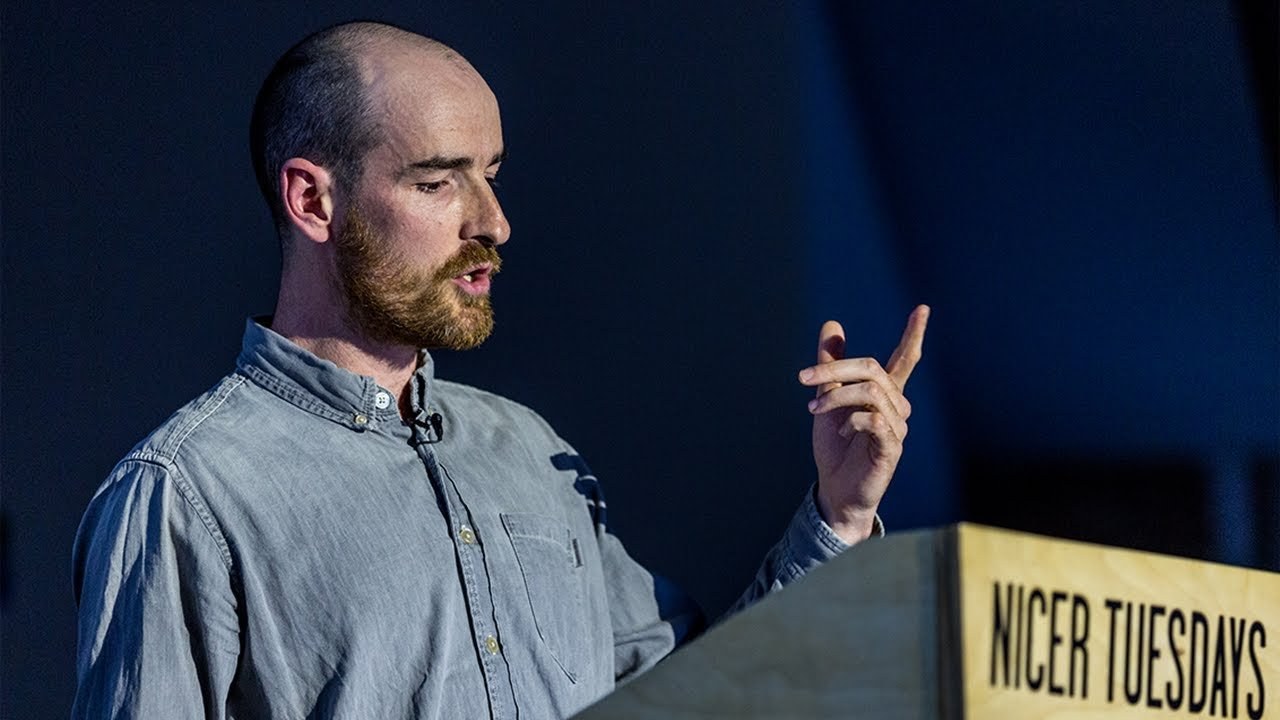
“Creating for kids means finding a balance between being cheeky and being appropriate. It’s like walking a tightrope without a net.”
Transcript: May contain minor errors or formatting inconsistencies.
Hello, good evening and thanks for having me tonight. So my name is Simon Landrin or Simon Landrin.
So this is me, I'm an administrator. And I'm an animator as well. I'm French.
But actually I come from Brittany, where basically we are known for a very strong tradition like having weird beard and not fit. We eat crepes, which is like very thin pancakes, and we drink cider.
But the weird thing is we are apparently known to wear like wooden shoes. So because of that, ten years ago I moved to London to work as a 3D artist.
But I was not very good. I mean I was not very in love with the technique.
So I slightly shifted towards illustration. So mostly 2D illustration. And mostly digital illustration. Thanks for the sponsor. And a few years ago, three to four years ago I started to use a very minimalist style.
So I could draw simple comics very quickly using closers, very reduced color palettes. And to be honest, the idea was to find a simple style to create very, very short stories and also to have fun, which I try to translate in those. I know the narrative is always a bit abstract, but everybody can find its own story in there, which I kind of like.
So basically nowadays I mostly work for newspaper, like editorial clients.
That's where you can find me right there. And so I'm just going to show you a few examples of the things I'm the most proud of. So I'm sorry it's a bit pretentious.
I did work for the New York Times, Didzeit in Germany, Le Monde in France, which are kind of mainstream editorial work. So once you get there, you are a bit proud. And you're like, yeah. So because of that, also I work for like a magazine, most of the time like cultural magazine. This is an example.
This is French. It's called Les Enrecupables. I mean, this is not French culture, but it's a cultural French magazine. That's all we call them. This particular image had a bit of success online. And I used to, I remember I posted online and then I realized that every time I will open my blog, I figure out like there are a lot of likes.
So I'll be happy. People seem to respond quite well to this image. And also I really noticed that I gained a lot of followers and likes from people with very exotic username. So it became a joke. Every morning I will open it and try to find the funniest one.
So I've got just the top three. I've got Jo Inus, Mina Jatouat, and your local homosexual. Which somehow, I don't know why it just reminds me like a local organic shop.
But I mean, it could be your local heterosexual. It doesn't matter. It's your local, besides your sexuality, I'm not sure.
So anyway, so that's my illustration work mostly. I do also a lot of animation because as you remember I come from 3D. I was actually like working into the animation business.
So this is me crying because animation is like, it's a long process. It's a bit harder to animate than just creating like single image. So yeah, it's very tedious actually.
So I'm going to show you. So because the style I was using at the time for like all those editorial work is fairly minimalist. I figured out that I could maybe like transpose that into animation myself. I'm not a very good animator, but because it was so simple, I thought I'd give it a good shot. I'm going to show you a very quick compilation of different personal projects I did over the last two or three years. So let's have a look. So, yeah. Thank you. Thank you very much. So strangely this animation work led me to work on a TV show called Gumball, which is a show for kids.
So yeah, so for me it's like a very strong stretch. You know, as you can see.
This is me. Yeah. I'm stretching a lot. So what really happened is actually the amazing world of Gumball is a Cartoon Network TV show. And I know because the animation world is fairly small in London, I know the creator of this show.
So we were at the pub talking and what they do like time to time is they ask for a different studio or a different animation artist to create a small sequence within one of the episodes.
So I'm drinking at the pub with Ben Beaucle, which is the creator. And he's like, dude, I'm writing an episode on Gumball about skateboarding and he knew I was like a big skateboard nerd.
So I'm like, okay, okay, I hear that. And he was like, would you be happy to just direct the animation sequence like the, you know, like the, the fit one in the episode like, yeah, dude, I'll do that straight away. Yeah, for sure. So good. Next thing I know, I was like, I was part of the, you know, writing process.
So basically I was there to give them as much detail. I mean, yeah, as much detail as I could about, you know, like all those skateboarding little thing that you can have in this episode.
So they will write like jokes and stuff like that. And I was also there to give ideas about the, you know, the sequence I will direct. So what happened is we were like throwing tons of ideas and everybody like, oh, yeah, that'd be nice. Like, let's do that.
This is crazy. Yeah. We should definitely do that.
This is a very good idea. What happened at the end of these, those meetings, like Ben just stand up, leave the room and just stop my back. And he was like, yeah, good luck, mate.
And then I realized like, I had to do like two minutes of 2D animation with the most hardest constraints we can get into animation. Everything is moving. A lot of perspective distortion. If you think about like skateboarding video, the tremendous amount of action to translate as well.
So I really start to stress out. So, you know, I started to work on the preproduction for a few weeks, you know, like designing, starting to think about the story, the storyboard and all that. And meanwhile, you know, like Cartoon Network had to do an animatic based on what I told them, you know, as those writing sessions. Because they have to time their episodes, you know, very neatly. It's a very tedious process for them as well.
So they come back with an amazing sequence. Storyboard, it does almost like a long single shot with camera turning all around the characters, a lot of details in the background and with crazy interaction.
So I really start to stress out. Like, you know, it was a lot for me. And so I figured out I have to come back and, you know, like, you know, paddling upstream, you know, to just maybe not do exactly, you know, what we were talking about in the session because it would be too much. And because the production time was like six weeks, which is very tiny if you are familiar with like production time in animation, like two minutes with all those constraints. It's a lot. And I only had like two animators and an intern. Luckily for me, I'm represented by passion pictures.
So they get like two very talented animators, but still it was like a bit of a stress for, especially for me.
So I'm going to show you just a few shots of the animatic that Cartoon Network did so you can have like rough ideas about what was in there before I start to take off a few things from that. Yeah.
So that's the shots I was looking at. And I was like very scared because obviously they are like full on. I'm not a very good animator, even though we had very good guys, it was only a team of two.
So I'm stressing out. And you might have recognized, by the way, like I give them like the reference for the music, I give them the divo as a reference. I thought it would be a perfect fit. So I'm coming back to it. So there you go.
So that's one of my first references I gave to the animator, which are like much simpler movements. And there's always a thing about skateboarding parts. Most of the time, it's mostly a compilation of their base footage. It's never seamless. It's never a time like an action scene. You will have fisheye shots, classic punch shots, traveling shots. It's more like a patchwork that you try to put together.
So I had much more of that in my mind than, you know, like I had much more like the skateboarding part than the action scene.
So I was working on a storyboard to adjust things.
So I gave those references because it's like iconic move, I think that I really like. And so while they were like starting to build those first scene, I started to work on the design. Oh, yeah.
So that's one of the first design I came with. I just had a look at the character and I didn't have them in front of my eyes. I just like, okay, just have a quick look at it and then you do them.
So that's why I, that was my first design for Gumball Darwin, another background character. So obviously, you know, I couldn't use the style I usually use, which are, you know, those are like designs are much thinner lines. The color palette is larger and there is a bit more detail. And it was, it wasn't purpose because obviously we have like perspective shots.
So the lines needs to be quite thin if you don't want, you know, like your character to be, to look like a potatoes in the background if they have like very thick line.
But anyway, like it's very bad actually because they look way too old. Basically they look like that.
So they're supposed to be like 10 years old or even younger actually. So what I did is like, I started to grow the head. So it feels like at some point he looks a bit more like 10 years old. Also what I did is that because it's a, it's a kid show that to wear helmet and pads, which is completely uncool. So, so to not lose the shape, you know, like I wanted to have like a simple shape, actually kind of a humanoid shape.
So I had it, the helmets and all the pads was just, just too line. You can see it's, it's within the design itself. It doesn't, it's, it's not outside. So that won't be, it would be easier for the animator to, to create at the end. Otherwise it's just a complicated, it will be too complicated for us.
So that's the head side we can over agree on. Then we move back to like the design much more faithful to the show. And we had this tail, obviously, obviously.
This is the model sheet I gave to the animator. And once I did Gumball, it was super easy to do Darwin because it's basically, it's just a, it's just a head with some limbs. So, you know, I was just translate that to the, to the orange guy.
I did also like a lot of background design, like for the background character design. Sorry.
So this is the roller blade guy. Well, I know it's very cool. And we had to change it anyway, because again, they didn't want to have that much element that relates to the reality because it's a kid show.
So there were always that things like you have to be careful and which is fine. I mean, but so we changed it for this guy, which is called Steve Small, who is like a EP working in the Gumball school.
This is a, I also tried to put some references that relate to skateboard itself and to be a bit geeky about it, but not too much obviously.
So this is a reference to the Santa Cruz screaming hand.
This is a character, you know, sleeping on the floor. You will see that a lot in skateboarding video.
This is like a reference to the video called mouse.
This is a skateboard video from the girl, which is like a skateboard company. It was directed by Spike Jones in the late nineties.
So I thought I would use cool reference to put in there.
This is the usual annoying scooter kid. So you probably have some of those guys around like a lot. I mean, there are some grown up still on those, but I also started to give to the emitter like just key frame, like the key element I wanted to really have into different shots. So those, those kind of things.
So they took that and they were make sure that at some point in the animation, you get to that key frame.
This is one of the other again, I have to remove the car because the car is too dangerous.
So we change it for a hot dog. No, that's the thing working in kids show is like, it's still dangerous, right? Like, yeah, but it's a hot dog. So. OK, fair enough. And same thing.
We had to change the giant bullet for a giant fist, which somehow is less. I'm full. And. And also, like I tried to have a bit of like the personality of, you know, things that will, you know, like little details that I will use in my adult illustration and animation into this one.
So this is like screenshots. So you can see, like, there is some similarities with things that you saw before and something here, actually. And but that's strangely that went fine. So it was OK. So and also, of course, because it was supposed to be these big action sequences, a sequence, sorry, we put it a lot of. I mean, lot we had a couple of good explosion in there.
So yeah, have a look. Oh. Oh. Help me. Oh. Oh. Oh. Whoa. Oh. Oh. Oh. Oh. Oh. Oh. Oh. Oh. Oh. Oh. Oh. Oh. Come on, job. I'll catch you. Yeah. Wow. Wow. Aha! Stop, and you need no loudly Yeah! Yeah! Yeah! Yeah! No! Come on! No, no, no, no! Yeah! Yeah! Yeah! Yeah! Yeah! Did you see that? Dude, I can scan!
Latest Talks
-
Will Anderson and Ainslie Henderson
Bringing stop motion sorcery to BBC’s Small Prophets
Watch -
Amber Weaver
How does contemporary type design translate into the wider world?
Watch -
Murugiah
Why you should reject the formula and make art about things you love
Watch -
Marina Willer
Design thrives when you find poetry in the simple things
Watch -
Lizzy Stewart
The hundreds of drawings and writing-on-a-whim that goes into comic novels
Watch -
intra
The rewarding process of recognising the art in obscure everyday life
Watch