
Sam Conniff
Why the golden age of pirates holds the blueprint for modern rebellion
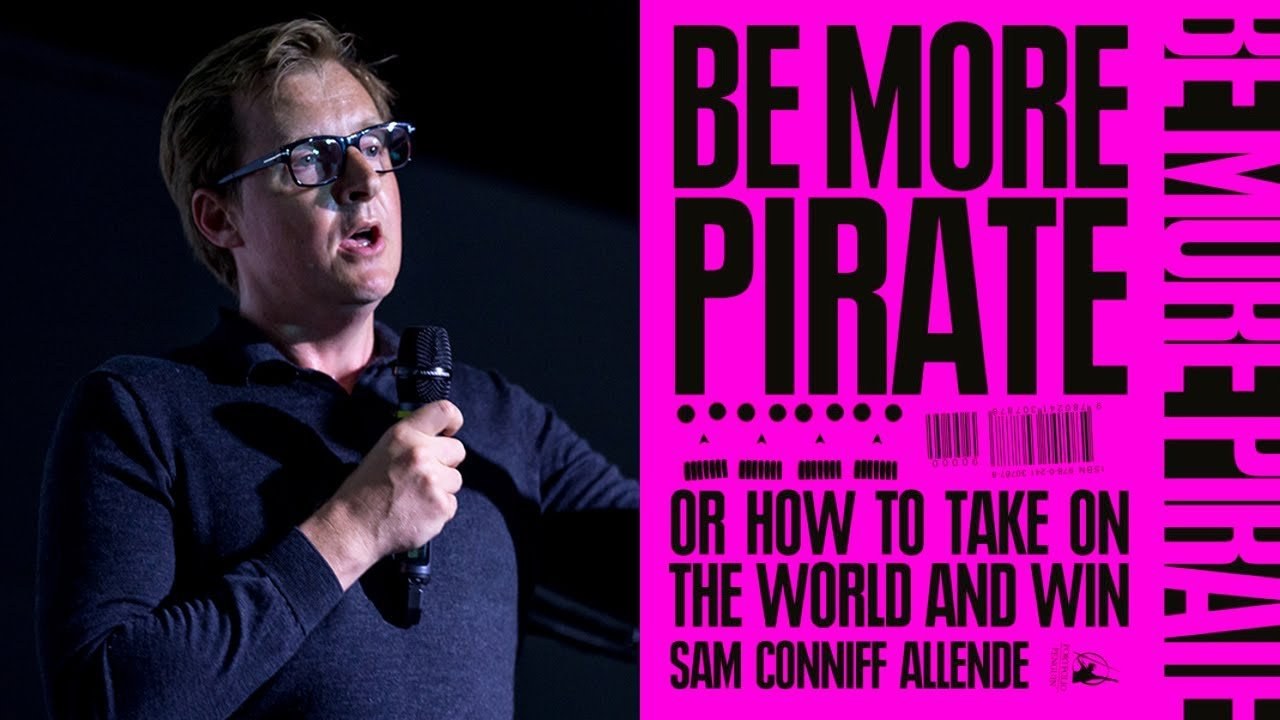
“The only real mistake that we can make is to believe that the way things are is the way things have to be.”
[Applause]
Wow I can't see anybody hello are you there how are you good good I've grown up with it's nice that most of my professional life but don't panic and all through Liberty and I just thought it's sweating quite profusely before I came on I realize it's out of respect not that you usually sweat out of respect but I think I am sweating out of respect because I've probably like you why the event sells out I rate it's nice that as a benchmark of good work. And that's probably why we're all here.
So I'm just really grateful to have the chance to talk to you. And so apologies I can talk quite fast and I'm gonna sweat a lot.
So it's gonna be ten solid minutes of sweating it's only or it could just be that we've had three fantastic and thoughtful exceptional I think speakers or it could just be that I badly chose to wear knitwear to a sauna either way we'll get down to business I would like to talk to of you about a lie I'd like to about the lie of the the business model of the late 20th century which has always been to some degree based on exploitation exploitation of individuals exploitation of creativity exploitation of the environment ultimately that was the business model that got us through the latter part of the 20th century and it's that time to call on it it's time to call on the notion of growth for growth's sake and all other clients organizations that are in which are pursuing the goal of scale for no other reason than scale and it's not I'm wholly down on the late 20th century of course it gave us lots of good things it gave us nano surgery and it gave us the Internet and it gave us the Spice Girls but history will judge us dimly I've you because we've left the great fridge door of history open and it starts to smell bad and at the beginning of the 21st century I don't think we can tolerate the business model that's got us into this mess and it is a mess and we know it's a mess it's a radical and disruptive mess and I'm sorry to get into this level but this is where all of our work goes and I think good work yes but our work will ultimately be judged on its impact and I think we have to absolutely ask yourself a series of questions because non-circular products as in non sustainable products built with Serpas supplies that we cannot replicate or reproduce any longer is tantamount to a war crime in a world that is 60 percent already over its biosphere if we're not asking that of our work then we're not asking the right questions we know that we're almost at war with ourselves and our ideas of design and how we integrate what we do what we make and how we exist together are also a breaking point it is growth for growth's sake in medical terms is cancer in our industry sometimes it's just another brief and we really need to question that I feel because getting us into a very dangerous place it is unacceptable to to have a brand essence of happiness yet use more water than you need for every bottle of coke cutter in the creation of it we have to ask the questions of our clients of the briefs and of the opportunities that we're working with we and our industry has to avoid being the suicide note on a signature on humanity's suicide note to itself and when we say with the choice I really believe it is a choice we absolutely have to make of whose side were on whether we're part of the problem or whether we're part of the solution and when we say we really I mean you I think this is this challenge of our times and I think the only only real mistake that we can make is to believe that way things are is the way things have to be I think that's wrong I think it is our power and all of us and the creative and good work that we do to go a bit further to challenge it a bit more and to ask more difficult questions and the truth is we have to you have to because there is nobody coming to save us. There is no higher plan there is no greater strategy there is no one with a big master idea that gets us out of this mess and if you don't believe me you need to and I love a Donald Trump meme as Nexus as much as the next person I love the idea of complaining a bitching about it because it is a mess but even more than that we need a plan when it's something that gets us out of this I think we need a rebellion.
Now I know rebellions a strong word and calls to mind ideas of burning cars and various other things and that is actually the power that I'm trying to drawn because I mean nothing less than actual rebellion really pushing back really breaking some rules really starting to make a mess but I mean that kind of sexy Star Wars rebellion cuz it has to be one that we enjoy and one that we own and one that we where we make great stuff the challenge is of course if we're talking about rebellion and rule breaking who do we look up to I think we're suffering a crisis of imagination at a leadership level in society today and certainly in business and I shall be god damned if I once again I'll give a young creative entrepreneur uber is the business model of anything that uber ization of anything is untested unproven and worse possibly toxic I think we have a short-sighted to narrow view too often and to highly regard Silicon Valley and don't understand all of the horseshit that sits behind so many of those unicorns so I think we need to look to history. And in history I think I found the appropriate role models for our age the Golden Age of pirates and so I spent the last two years what began as a metaphor looking into the history of this this radical moment of rule breaking when the kind of the Millennials of the 18th century pushed back on the broken rules and the broken system and the broken society of the day and lo and behold they did and the success they created was written out of history it's written out of the history by the establishment that they threatened so badly until now. And I know what you think I know what we all think we all have this precondition notion of pirates born of of Peter Pan and various other things.
And it's absolutely fine if not this then a kind of slightly sexier Johnny Depp version of pirates but I want to smash that because the truth of pirates is quite different I want to introduce you very quickly to my heroes of the pirating the golden age up here we have got black Sam Bellamy at 28 he was the first billionaire of pirates known amongst his crew as the prince of pirates who they called themselves Robin Hood's men up here we've got Edward Teach a KA Blackbeard he was the archetype of the pirate brand so dedicated was he to living the pirate values that he would set light to the ends of his beard just to strike fear into the hearts of his enemies up here we've got black Caesar one of the first but not the only black pirate captains and up here we've got Anne Bonny a female pirate captain a legend of her lifetime. And if you were to get a sense of what these guys were like and how they were guarded at the time you would absolutely be looking like this because they were front-page news they were the gossip they were the media darlings they were they were loved and they were hated they were they were hotly debated as to whether they were good things or bad things and they were the unicorns of their time they were the opportunity across the sea and the Far West that stood for something new and that stood for something different I would argue that the Golden Age of pirates rightful place in history is somewhere between the Levellers as working class heroes and social revolutionaries like those suffragettes I know. That's a tall claim so let me just quickly take you through a little bit of true pirate history right global branding lie by and large wheel think that was Coca Cola in the 1880 s well it wasn't it was the Pirates cuz of course the first global brand was the skull and crossbones deliberately intended to become a viral meme that took over the world secondly dual governance a system of checks and balances in every organization that the Pirates had this nail that captain was equal in power to the quartermaster once in charge of culture and the other one in charge of strategy not seen in business for another 25 years social insurance the idea if you lost a leg this is where the wooden legs came from you'd be awarded 800 Pieces of Eight if you lost an eye a hundred pieces of eight eventually an inalienable human right in the 1940s universal suffrage first seen on a pirate ship anywhere else we think it was a Greek Athens that came up with this idea.
But actually the first time that we see participative representative full suffrage on earth was on a pirate ship pay equality or actually we can't even compete this this one now.
So we still haven't managed to get there but on board a pirate ship true and transparent pay regardless of gender ethnicity or background diversity by design the Pirates without judge can't generate true diversity true equality the only place on earth where people of color women and men all shared equal opportunity equal say in matters at hand and I could go on many of the innovations and things that were chasing now in organizations the Pirates were there first again and again and even when it comes to issues like same-sex marriage they're seen on a pirate ship quote Mattie large so sophisticated was that even had an inheritance clause and if you're not convinced cocktails true fact invented by Sir Francis Drake a bit of rum and a bit of mint and some weird tree bark stuff and some sugar it's basically a mojito and the lead for this history lesson the need to bring this back now because exactly three hundred years ago. There was a surprising degree of similarity there was this backdrop of international interconnected conflict there was a the average age of a Golden Age pirate by the way was twenty eight there's an entire generation looking out a broken and unfair unjust system completely corrupt and self-interested establishment and once again this question this notion that we do things the way things are done because that's how they've always been and this generation said no you we're going to break these rules and rewrite them. And that's what distinguishes this age of piracy from anything else from any other it's not like you're Somali pirates or you're the Chinese pirates which are all great amazing and interesting stories this thirty-five years is one of the most pronounced periods of innovation everything we just seen in human history. And this I discovered midway through writing the book I thought it was a metaphor for change or a melian cuz I think that's what the world needs but actually by the time I got to the end of the book it was something more like a manifesto reason being pirates up.
And this is what I think we truly need to get our hands on this idea of have changed being actually each and all of our responsibilities this is where I began it's the quote that still sits on the cover of the book which frankly I can't believe I haven't gotten more trouble for but this idea that we all are up against the establishment and the organization this idea of rule baking a rebellion being something. That's easy to fall in love with actually comes from a very serious place if you look back across history each time that pirates come on to the horizon whether it's silent piracy music piracy online piracy or even the Pirates I'm talking about it's when there's abject market failure and that's what I think we're looking at that the broken business model of the 20th century based on a notion of exploitation each and every time it's time for pirates it's time for some ideas that have been existing innovating on the edges in the shadows to come forward and there are numerous examples of them. And I think exactly the way the Pirates ideas hundreds of years later became the norm by looking to the edges now by finding the rebels challenging the business models that we've got now challenging the educational establishment challenging their political institutions we've got now we will find clues to what comes next and I'll allow it. And invest in it to accelerate to the pace that we need in the book I've through looking although the the the decades of piracy that I found I found these kind of principles that sit across them all. And I think they might feel familiar to some of you you know fierce independence a notion of challenging the establishment being a good thing principles but also profit and highly talented but underappreciated generation.
This is what I think it means to be pirating and at the core of all of their success and everything they challenge set a thing called the pirate code and it's where those rules Sat the ideas of social insurance or or equal pay and it's incredible through 30 odd years that how how consistent these different articles within the pirate code remain and it's because they were based on something that we've we've lost a set of decision making principles based on principles based on values not the notions that are written on walls that are easily forgotten but ideals around which we can make decisions it's my suggestion when I arrived that in the book.
And I've been very lucky to travel the world meeting young entrepreneurs and social entrepreneurs and creative entrepreneurs whose ideas I think are as profound possibly as those the Pirates used I've begun to establish a pirate code 2.0 which I know begins to sound a tiny bit glib but that's how big some of the ideas I've been trying to find our how extraordinary it must have sounded 300 years ago to be planning an adventure and a mission taking on the Royal Navy where everyone be paid equally although we might have a black captain or a female captain ideas that were considered seditious at the time that have now found their place most of them what are the ideas now that we're looking at is it just the brief that we've got is it next quarters targets is it our business objectives are we at the right level are we using our creative ability and potential at the right level so the scale of the real challenges we face or do we need to dream a little bigger and that's what I've included in the pirate code 2.0 and I hope that it's just the very beginning and it certainly seems to be like I say it's not the notion of values that we might write on the wall and forget it's about something so much more I've only been a few weeks into this it's my first book I'm learning a lot I'm sure I'm getting a lot wrong but something that surprised me more than anything else three weeks in is this these emails that I've begun to receive of people who've been resigning from their jobs who've been stepping outside of the way things are who've been starting movements who've been demanding promotions and you know taking on the entire bread produced corporate site in the shops an incredible amount of rebellions of rules being broken but most importantly like the pirate's rules being rewritten and a couple of weeks back I received this one a young woman campaigning to help her friend be released she was taken into y'all's wood detention center amidst all the kind of storm there was over the over the wind rush news a young woman emailing would say that the campaign she's created to take on the might of the Home Office was based on the framework in the book the sense of responsibility this stage is huge luckily she's she's campaign successfully and has freed her but what's happened to me.
Now the books out and doing quite well is every single day I was even three four it's not more rebellions coming through and some that I love some tiny individuals and some huge ideas one I thought might appeal to use this Instagram tell it's amazing zero point zero defying the convention of have a kind of casual alcoholism that sits amongst so many of us and our friends but doing it in a beautiful and funny thoughtful way all of these ideas leading to what I'm beginning to call modern mutinies way beyond the expectations I had I was hoping that I might sell a couple of a thousand copies this was a it was a distraction project for me as I left Liberty but it's become something far more and I'm trying to work out now how I how I measure this how I manage this and how I make them most of it these daily rebellions these these modern mutinies the people who are truly defying conventions who are breaking rules and most importantly are rewriting them people who are collaborating together now taking on systems that around them breaking them and redesigning them.
So I leave that thought with you as it's been so powerful to so many the people who've engaged with the book.
And I'm inspired on a daily basis and I'm trying to work at how I fund the rest of my year at least to try and be the wind in the sails of some of these rebellions because I think the the hour is upon us my friends I think the day is upon us I think we live in historic times and I think history tells us time and again that those who break the rules go on to be our legends and our heroes and those who just follow the rules or just follow orders Adam ad viewed very dimly by history the people living in historic times I think the day is gonna be with us if not already when it is the right and responsible thing to do to break the rules and that's not easy I think we're hardwired to follow Convention and hand habits and norms and everything around us.
So I think it's time to start flexing that muscle I think breaking some rules becomes a skill a 21st century skill something's important to everyone so I urge you to think of a rule a one you know one that needs breaking a stupid one one that annoys you and think of what you're gonna replace it with and break it break it like you're mean it break it from the heart and break it tomorrow see how it feels the world won't stop no one will die and if you feel a little bit stronger if you feel a little bit bolder if you feel a lot braver then something good has happened and then starts making it a daily habit was that my friends is the rebellion I think that we need thank you very very much indeed [Applause]
Latest Talks
-
Will Anderson and Ainslie Henderson
Bringing stop motion sorcery to BBC’s Small Prophets
Watch -
Amber Weaver
How does contemporary type design translate into the wider world?
Watch -
Murugiah
Why you should reject the formula and make art about things you love
Watch -
Marina Willer
Design thrives when you find poetry in the simple things
Watch -
Lizzy Stewart
The hundreds of drawings and writing-on-a-whim that goes into comic novels
Watch -
intra
The rewarding process of recognising the art in obscure everyday life
Watch