
Rhea Dillon is a London-based visual artist known for her exploration of black culture, particularly through her video projects that address the nuances of black hair and identity. She emphasizes the importance of portraying blackness in everyday life while intertwining art with social commentary.
Rhea Dillon
Why the future of beauty might already be within reach today
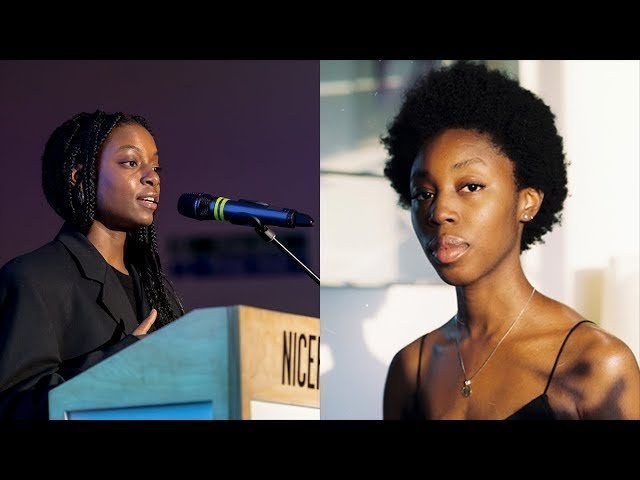
“What matters even more is the perspective of blackness on a day-to-day level and the humanisation of black body visuals.”
Transcript: May contain minor errors or formatting inconsistencies.
So I'm RIA nice to meet you all thank you for coming what I'm gonna talk about first is kind of my approach to my work. And I guess my artistry and I guess my research into that it's often what I find the most exciting part of my process they're going to hear process a lot throughout this whole talk so I kind of am really obsessed with what it means to be a master and the mastery of art where that has become and the origins of art and how that creates movements I quite often link the movement and those origins to the movement and the body of the African Diaspora and so how when thinking about the origins about other creators and masters of art how actually blackness has been emitted from that storytelling and that concrete history of this is a master for example Michelangelo whereas obviously we know that. There are black masters from Egypt too you know every corner of the world but just succinctly what is mastery and where and who I guess gets to talk and create their own mastery so I am really quite obsessed with the work of Kerry James Marshall and he also explores this in his work he talks about how blackness again was a mist from this. And I guess the modern day creations of these masters and this notable and this known worldwide mastery and that leads me into a topic that I like to call humane afrofuturism and I read about that for my dissertation. And I'm still a student I love again and for my dissertation and what he may not my future as it means to me is the kind of everyday of blackness in the respect and they're equalizing of the blackbody in society and so you may have heard of afrofuturism as a term by itself it's very much the advancement of black people through science technology more specifically but I feel like what is even more equally important right. Now is to look at how black masses experience on a day-to-day level and respected and so that becomes a humanization of the visuals and I guess the blackbody that we see for example Kerry James Marshall is undoubtedly one of the best artists that we've ever seen but when you.
Actually look at his work and the subjects or their compositions that he chooses they're very much a very basic visual just like this one here of a girl walking a dog down the street and when you're really taken aback by that you. Actually think about what visuals have we seen and what are we used to seeing and again it goes back to human after futurism when we're not used to seeing this basic mundane or normalized visual of blackness so I also have another love which is tacky hiko amaura he's one of the great video artists along the same vein of Nam June Paik and he has an approach to his work which is looking at like reflecting imagery he's got this piece for court TV for TV and what I really was excited about through his work and what inspires me is how how things are communicated and how things are expressed to another body and so I kind of in my work very much take what happens in society and reflect quite like actually the term in Japanese by the way for the moving picture doesn't actually translate to moving picture it translates the reflected image which is really quite interesting for me it's a ger e IG a and I very much feel that I take what's happening in society or in my research and I reflect Anna actually more succinctly refract so changing the channel and changing the storytelling of these masters into the modern day so I then got approached by an analyst to talk about what my vision of the future of beauty is and at the time I was kind of thinking very much I guess it's really quite almost obvious to go down this science fiction and afro-futurist lane of what they're a on scanned how will be traveling like Star Wars but then I realized that when it comes to you know the minorities and society and actually those who have been other other dasari oftentimes what we need in the future is actually something that can be very easily done right now. And so I thought back to times when I myself was quite depressed for example or really just quite low and it was very much in connection to my hair not being in its most beautiful state and most beautiful can be I guess a version of society's beauty of what I should look like and so I had done a project a year before. Actually again called process and it was really quite to empower and embody the afro hair movement and to talk about what afro hair is like during its process so I took these images of my friends and of myself and quite literally removing the body from this hair wash process and to appreciate and I guess take on to a new level the beauty of each stage of something I'm really interested in you know again processes so we're thinking on the future of black hair and again bringing it back to what we could just have today if everyone tuned in and was really listening is this respect for afro hair and a respect for the difference and the actual beautiful ways and meanderings of those curls so then after going off on that afro-futurist tangent and being like I want to make square spaceships that can blast a new-style on your head like that just wasn't me and never probably will be I actually I don't know concretely brought it down to again that respect and that beauty that can be shown and just stripping back the process of hair this is just me sharing a little bit I guess my key references when I was looking at black beauty and I guess afro Sheen I don't know if you know ever afro Sheen is a brand that is around it's probably started in the 50s that predominantly in the 60s and as a haircare product for afro hair and they had ads on TV but even then when I was trying to find visuals of black hair being washed I couldn't find any there was only one on one advert by Afro Sheen like I looked through archives of films to TV toussant like to you know art cinema or art house where whatever you'd like to call it. And I found this one reference which is that paused visual that you see and so that really upset me in terms of just I guess a respect and like a knowledge on what even afro hair looks like when it's wet so then that led me into making this whole visual story of breaking down the process quite literally as you'll see from the film at the end each scene as a kind of representation of the hair wash from undo to rinse to style I've kind of really in a sense tried to lift every version of that process one of my favorite scenes I like the more but I'm biased one of my favorite scenes is this one that quite succinctly references the unlawful and brutal killings of black people in society from Rodney King to today I can't even call it a recent occurrence and it's more I guess intrinsically linked to Trayvon Martin and the hoodie movement this scene actually represents the rinse process of your hair wash but in a very conceptual way I had the music I got to work with an amazing editor called Toby heard nowness the noise that's actually going on in this scene clippings from the police calls that were made his father talking to the public after you know coming out and knowing about his loss and they all kind of convolute and encroach on the mind when you're listening to this I often refer to the hair on our heads and that's the black bodies heads as a crown and this crown is very heavy and very laden with politics how I step outside with my hair in different ways and different patterns or in a different texture can determine what you perceive that I am trying to bring to society and what you could perceive the ayah I'm trying to say about myself and where I sit. And so this crown is very heavy and it's the heaviest on children so you'll see a lot of children in this film. And so with this the sounds sound pieces I guess that we used or kind of meant to embody all of that weight and that pressure that's put on children even just from running down the street and that movement of the black body is another thing that I'm really interested in but also the attire and the dress of the young black body is very much weighted and so the model quite literally dunks their head in the water and at that point you get a complete I guess zone out of noise that really sharp noise that funnily enough Ward's off young children from the corner shops that really sharp noise that is meant to then lift and almost in a baptismal sense release you from those fears and those worries and so I'm then gonna play the film and hopefully you'll enjoy beautiful people know true beauty is natural where the naturals proudly as a symbol of Pride and blackness our responsibility to promote love and unity among black brothers and sisters and help establish a new order of freedom and dignity for our people ♪
I was listening to my son's last cry for help I was listening to his life being taken and I was coming trying to come to grips and yells for help personally I was shocked ♪
beautiful people know true beauty is natural beautiful people know where the naturals proudly wear their Naturals proudly as a symbol of Pride and blackness as a symbol of responsibility to black people responsibilities to black people a responsibility to promote love and unity among black brothers and sisters responsibilities and help establish a new order of freedom and dignity for our people and help establish freedom ♪
thank you for listening [Applause]
Latest Talks
-
Will Anderson and Ainslie Henderson
Bringing stop motion sorcery to BBC’s Small Prophets
Watch -
Amber Weaver
How does contemporary type design translate into the wider world?
Watch -
Murugiah
Why you should reject the formula and make art about things you love
Watch -
Marina Willer
Design thrives when you find poetry in the simple things
Watch -
Lizzy Stewart
The hundreds of drawings and writing-on-a-whim that goes into comic novels
Watch -
intra
The rewarding process of recognising the art in obscure everyday life
Watch