
Oscar Hudson is a director known for his innovative storytelling and compelling visual narratives.
Oscar Hudson
Building 18 shrinking rooms to film a Bonobo music video in-camera
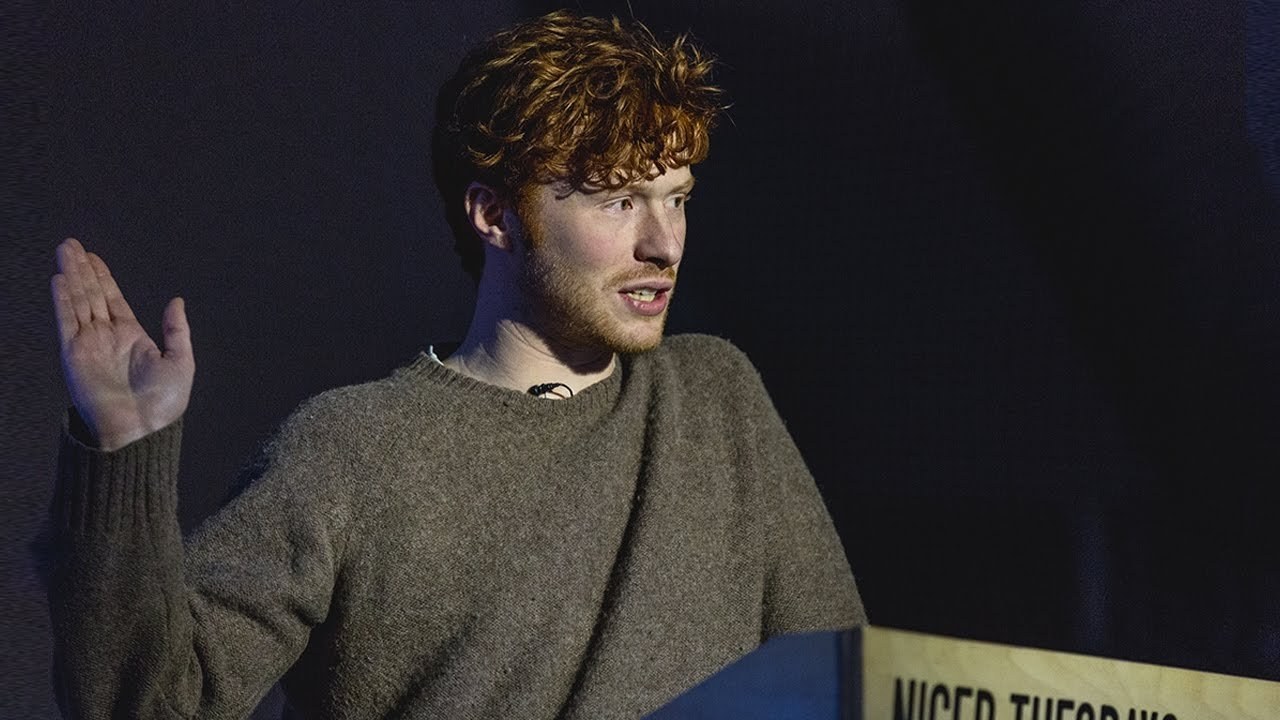
“We often believe that creativity is a solitary journey, but it's really a community effort.”
Transcript: May contain minor errors or formatting inconsistencies.
Hello. My name's Oscar Hudson. I'm a filmmaker, a director, and I do all sorts of films. I make short films, music videos and documentaries and I work with Pulse Film and I'm here today to talk mostly about my music video work particularly the Bonobo video which was just mentioned but before I get into that I'll show you a couple of the other things I've done. Most of my work has an emphasis on in camera effects and set design and that kind of thing. And I've done this one which was for radio head where we poured three tons of sand through the ceiling while a guy cleans up some dust. That was fun.
And we did this one for a bank a guy called Gilligan Moss where we got a bunch of identical twins to run around the set to create a kind of looping effect rather than doing it you know just by repeating the footage which would have been boring. We you know got twins. Look there they are. , and then this one is was for Darwin D's where we we got a load of banknotes and we use force perspective to put them in, you know, like that position in front of his face so that he looks like various monarchs and world leaders and things like that and presidents which was, you know, also fun. But basically, I guess the takeaway is I quite like doing things like hard the hard way and I don't really know how to do computer effects. So, you know, and yeah, I'm going to talk about this video I did for Bonobo. That's Bonobo up there.
Before I talk about it, I think it's better to watch it because I don't want to ruin the magic before we before, you know. So, here we go. It's beautiful. And even though I told you so, even though ♪
we play survival, we leave the lights on. The move will go somehow. Looking like soldiers waiting to drown when I'm not around no more. Looking at people that don't make a sound. Music's around. Stay warm. ♪
Oh no. ♪
Heat. Heat. ♪
the seasonal body knows. We make it all so loud. Just you and me. And we can see small machines in sunrise. ♪
I'm looking like soldiers waiting to drown and I'm not around no more. Pictures of people don't make a sound. Music around stay ♪
Heat. Heat. ♪
[Applause]
So, , so yeah, , I guess I guess now we start from the beginning. So, , when we when I first got the brief through from, , the label, it was it was pretty open except it came along with this little bit of information from, , Bonobo or Simon , about how he made the album and he talked a lot about how it was made while he was on the on the road touring the previous album. And a lot of it had to do with place and space and his relationship to the places he was passing through whilst away from home. And I guess I guess has a lot to do with alienation and a lot of feeling detached from you know our immediate setting. And so I I wanted to I wanted to to use that and I wanted to try and link that idea of physical and psychological space together somehow. And I had a little seed of an idea that did that.
A little bit and I thought I'd take that and kind of work it and make it make sense with the the track. , and that seed was this general idea of a room getting smaller around a person, a repeating setting shrinking physically around a person. And , and when I and so I had to, you know, convince them to let me do it. And so I had to write a treatment. And I do a lot of drawings when I do my treatments. And there's some of the drawings I did initially.
But I I don't know I didn't feel like it was enough to explain the idea properly. And usually when I when I have an idea I like I often don't want to do it on my desk.
I want to like go and do it physically and build something and make it make sense like that. And so I did that and I made a little I made out of cardboard in my living room like some rooms that got smaller out of plasterine and parsley leaves on the side there. , and , yeah, you know, it sort of explained something, but then I thought, okay, well, we're going to need to get some people in there.
So, I roped some friends in, got them to stick their legs and arms inside the room. And , you might you know, you remember at the end of the video, the guy's face shows up in this small room. Well, I I cast a a very special actor for that role there.
This is my dog. He's he's he works for Beef. So, there you go. , and as as you know, as high quality and professional as that video is, I was slightly concerned maybe the label wouldn't see it that way. So, I you know, I sent it to them. And actually, that was the lesson I learned was that, you know, you shouldn't be afraid of sending people stupid low-fi videos because they tend to react better than you think they will.
But I thought for this one, I really wanted to get it. So, I made I got asked a friend to make a proper video and we did a CGI version of it all. And you know, it did the trick. But, the one comment the label had after watching this was like, "Yeah, we love it. Great. Let's do it. But maybe can the main guy not be a middle-aged fat painter? I don't know." But but and I said, "Oh, okay." And so at the around the around the time of shooting, I'd just been in Japan for the first time ever on a different job and had this phenomenon of the Hiko Mori came up which is these guys who don't leave their bedrooms basically. They're overwhelmed by the pressures of life, of school, of work, whatever, and withdraw to their bedrooms and become these kind of hermit figures and live there for years at a time. And it's surprisingly common.
There's millions of them across Japan. , and I just felt like that was the perfect embodiment of this kind of link between psychological and physical space and someone's relationship with a room and increasing claustrophobia and it all just made too much sense to ignore. And so we went that way and and then we looked at the films of of Ozu who obviously just makes the most beautiful sets and uses color so elegantly. These little bursts of color around the image. And we I mean you probably noticed the kettles, we just stole that directly. That was just I I could not and the washing line even as well. And but the the Japanese aesthetic just lent so well to the project because obviously there's a lot more sitting on the floor in Japanese culture and so the furniture is lower to the ground which means that that worked really well with our low camera position because yeah well the the camera the camera rig we designed which I'll get on to later moves along the floor and so taller furniture we had been looking at the bottom of tables and things. It's not so good. , so that was really nice. And even even the kind of traditional diffused windows worked so well. It just solved the problem for us in terms of how we light our sets.
And then even down to the the flooring, we had to hide this the camera system and these tatami mats which have these black borders just offered this perfect solution of working that rail system into our set. And so it just it was it was too good to ignore. And and this is Roy Anderson, an image from a Roy Anderson film. And Roy Anderson. Roy Anderson is massive in everything I do. I love him.
He's he's the best. If you don't know him, watch his films. He just takes mundane sets, everything. He if you haven't seen it, all of his films are long wide shots. All of it's done in in sets and it's just beautiful and he makes mundane stuff just magic and I love it. And and so yeah, so it's all well and good talking about these design references and what you want it to look like and all of that, but this film obviously with 18 rooms that get smaller and smaller and smaller has this massive technical element that you have to figure out. And so I had to figure that out.
And then I had a flight and I went a bit mad on that flight and I spent four hours just going crazy and drawing this which is the Magna Carta or the Rosetta Stone behind the film. And if you look at the top right, you can see speed equals distance over time, which is GCSE physics and is the the answer behind the whole video because obviously, you know, it's all well and good in theory, but then you have to figure out someone's asking, so how big do you need the studio to be? And you go, okay, oh how long does it actually have to be? And you have to figure out exactly the ratio by which each room shrinks in order to know the total distance. And the total distance then affects the speed of the camera move to cover that ground.
And you think, okay, is that going to work with the song? Like how quickly should it move? How slowly should it move? Every small piece affects every other piece. And so I mean it was intense. It was a long it was a long and short flight at the same time.
And then we turned it into a kind of more a bit more of a technical thing to figure out what we were seeing from what camera angle, how it felt as you know actually with a camera moving and it looks like this kind of Tron thing.
And then we had to start thinking about actual physical props. Obviously everything we made and every every little element of it had to be scaled down times 18 at a different scale. So when you're going through that process, you have to think like very realistically about how you achieve that. , and so minimalism is great obviously. , and yeah, so here we go. Some props. , that's the back of a TV. That was a had a long phone call about the back of that TV. , it's a that's a games console being made there. Some pillows and some magazines.
We had about eight magazines for every room.
I think mostly made up of old copies of Private Eye. That is Oh, no. I'll come back to that. Oh. Oh, there's plants. Look how small that little plant is. That's about a centimeter high. There not all Yeah, not all the plants came out of it alive, I'll be honest. Coats all tailor made from scratch. I have that big one that fits me quite nicely actually. And I should have worn it today really. Some tables. And this is my pride and joy from the whole shoot. You don't see it one bit in the video. Completely unnoticeable, but look at the size of that tiny paper clip.
I made that personally and I'm very proud of it. Those are Oh, yeah. And so the video also contains a bunch of kind of references to the lyrics of the song itself and also just like little kind of in jokes about the concept of the video. So on the left you've got Daruma dolls which are sort of Japanese Russian dolls obviously is the shrinking thing and then that's the cover for Shakespeare's comedy of errors which is where the phrase no rhyme or reason originates from which is the refrain of the song.
And then nobody, by the way, that's the one thing nobody's picked up on on YouTube and it hurts me. , this is the cover.
We made a Japanese version of the cover, , which I actually think is rather nice. , in the set as well, we've got our main man, his graduation photo, his proudest day, and then as the video goes on, it gives way to probably what's more like the reality of his life, which is this guy with the games console and the vest.
And then which , actually, yeah. So, you know, we had all of these different rooms, and a lot of people wonder, they ask if if the character is the same person, and how we managed to achieve that, but it's not the same person, it's 10 people. , so that's that. And yeah, so there's the set. And I was quite pleased with how it all came out.
And it looked nice from there, but it looked even better from the side. And here's this sort of low res video to show you that. , obviously like the rooms are shrinking, but the lighting has to shrink in tandem with those rooms. Everything scales down. It's It was insane. It was kind of amazing looking at it from a side.
And then that brings us to the next question, which is how you move a camera down the middle of the whole thing and get it through gaps that are no more than 2 in wide at points, which is where this little camera comes into play. And this man, larger man comes into play. That's Ruben Wooden Desamp. He's regular Collaborate and DP. , and together we designed this thing and this system for moving this camera. I don't think anyone's ever done it before. You know, I don't want to like claim originality, but I think it is original.
, so it slides along on carpet like no wheels or track or anything. It just slides. We laid the the the floor of the set had to be super smooth. The rig has carpet facing down on it and there's a two nails that come out of the bottom that sit in a one millimeter wide groove that runs the entire length down the track. The set construct the set the construction manager was absolutely bricking it when it came to cutting that groove because that was like that basically he was being our our grip and the entire smoothness of the whole film depended on how smooth he could cut a line. But he did a very good job. And and yeah, and then we built this this tiny camera rig that's very small and narrow and and unusual and fun. And actually this we we received a piece of fan art on Twitter, which is this, which shows shows Reuben with the fire in his eyes and a halo and you know, just he's just inspired.
And then yeah, this is a video of us testing the rig. , beware.
This is where we realize that the the going through the legs near the bum thing is kind of funny. So, I should have warned you beforehand. , but anyway, yeah, that's us testing the rig and realizing it works.
This was a good moment as Ruben being like and then yeah, this is it kind of in action on the set from the side and it's all pulled along by a big motorized sort of crank system. And again, it's like a custom thing. It's a turntable for spinning product around that we rigged up with various nails and things and has a dimmer to make it move at different speeds. But but yeah, it was really cool.
It kind of worked, which was nice. And yeah, it was fun. It was it was a great atmosphere on set. It was a massive collaborative effort between everybody there. All the different department departments were chipping into the various other departments.
We had the gaffer building little miniature lighting props.
We had the DIT working on our rig system. Obviously, Luke, the art director, was basically doubling up as a grip on the day to figure out that camera move. It was really nice. And I think what was nice about it was that being there on the day, you could stand there and you could look down this corridor, this like infinity corridor, and you could kind of understand what the final product would be, which I think is sometimes not the case with film where you're or particularly the crew are sort of detached from what the final piece is going to be.
But yeah, it was it was an incredible effort and I'm you know I'm happy with what happened. So yeah, thanks [Applause]
Latest Talks
-
Will Anderson and Ainslie Henderson
Bringing stop motion sorcery to BBC’s Small Prophets
Watch -
Amber Weaver
How does contemporary type design translate into the wider world?
Watch -
Murugiah
Why you should reject the formula and make art about things you love
Watch -
Marina Willer
Design thrives when you find poetry in the simple things
Watch -
Lizzy Stewart
The hundreds of drawings and writing-on-a-whim that goes into comic novels
Watch -
intra
The rewarding process of recognising the art in obscure everyday life
Watch