
Nicolas Menard is an animation director and visual storyteller known for his unique blend of narrative and aesthetic in animated films. He often explores the interplay of emotions and story in his work.
Nicolas Ménard
Building an animated short around an anti-climax and a children’s book structure
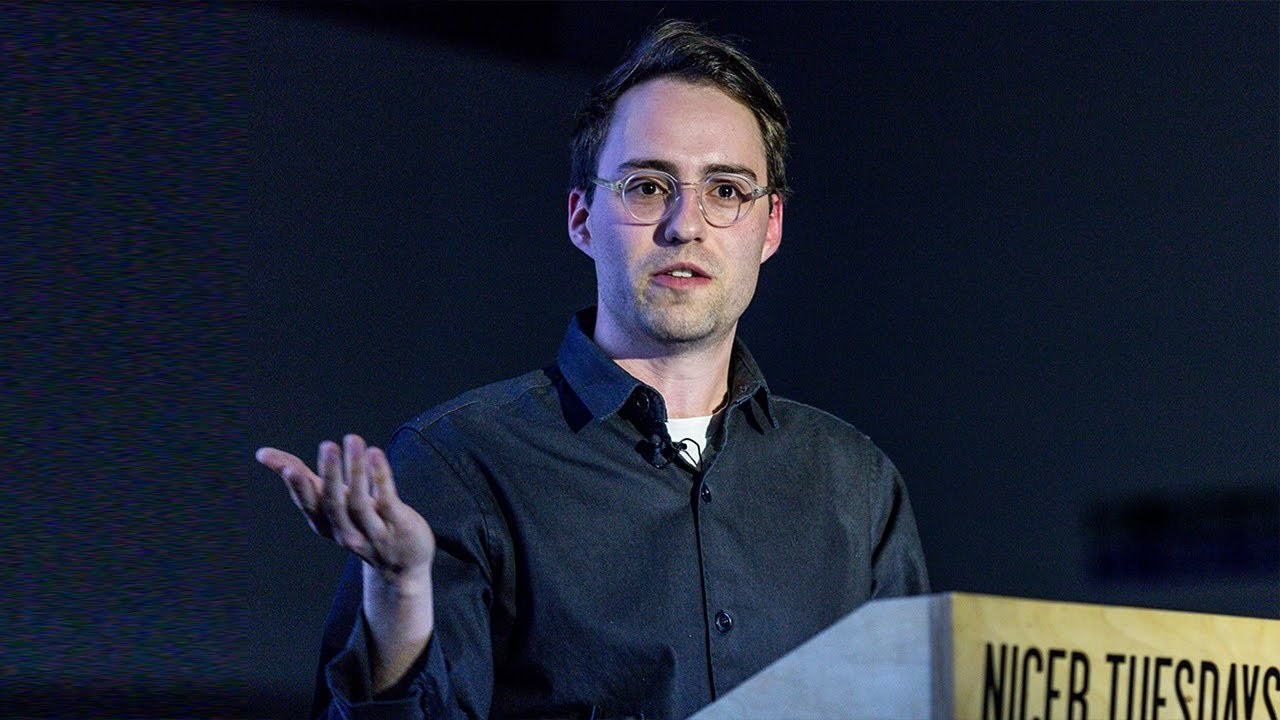
“Creativity is not a destination, but a continuous journey of discovery.”
Transcript: May contain minor errors or formatting inconsistencies.
Good evening. My name is Nicolas Menard. I'm a French-Canadian animation director and I work at Nexus Studios just here in Old Street. I feel the pressure of telling a joke to relax the atmosphere.
It's a joke about the weather. I've been living in London for almost five years and everybody knows that Montreal, in Montreal, it's minus 40 all year long and we only eat potatoes so I quite enjoy the tropical weather here. As well as the Indian cuisine, that's why I've been sticking around. Instead of describing to you what my work looks like, I thought I would just show you a couple of examples like this one or this one.
But that doesn't really matter. I'm here tonight to talk to you about a short film I did titled Wednesday with Goddard. It's a short film I did with my wife, Manchin Lowe, and she did the very complicated drawings, the one with the pencil.
I did the very easy characters that are colorful and blocky. I will be screening the film first and then I will come back on stage to talk to you about how we made it. Bon cinéma. Bon cinéma. Hello, I'm looking for God. Is this where he lives? I've wasted my afternoon. Every project I undertake fails miserably. Do not despair. I know where God lives.
Up in the clouds, you can find him at the top of the mountain. Tell me. We will camp here for the night to avoid being eaten alive by the Canadian grizzly bear. Evelyn, our journey brought me to a realization. Sleeping next to you in the intimacy of the camping tent made me fall in love with you. You are by far my favorite human being and I want to die by your side. From here you can see the entire world, the fire of the brightest lighthouse, the hues of the lashes gardens, the outlines of stars and broad daylight. In death one can reach all of these places. What should it be soon? I hope you enjoyed the film.
So I will talk through how we made the film. It all started back in March 2014, according to the email. I had this email from a guy called Charles Wettner, who is an animator. He is one of the leaders of the late network club. The late network club is a loose, rotating collective of animators who make animated short films and release them for free online as anthologies. Their first anthology is ghost stories. It appeared in September 2013 on Vimeo and included 11 independent short films. I received the invitation and jumped in. I was finishing the Royal College of Art at the time, so I was finishing my graduation film. It felt like a little bit soon to make a new short film just yet, so it took me a year and a half to come up with a script. Animation is quite a long and tedious process. Something I only started to realise is that I work better with a script or storyboards that I execute rather instinctively or spontaneously.
So although the script went through an iteration process, it was mostly written in a couple of days. It all started from the core of the structure. I kept thinking about wanting to make a film that starts like a children's book in a series of beats. That ends dramatically and badly. Like a big anti-climax that would almost leave the audience disappointed. A little bit like false expectations. Or the anti-climax that comes with completing an animated short film. Then after that, the theme of the search for God's own knowledge or love inserted themselves into the flow of writing. Just after I finished writing the script, my producer, Claire Cook, got an offer from Random Acts and they wanted me to make a short film for their show. They proposed to give me a small budget of £5,000 to help the production of the film, which was incredibly helpful because usually in short film making there's absolutely no money. At first, after writing the script, I thought it would be interesting to have a contrast between these pencil render drawings and simple line characters to reflect the cheesiness of spirituality sometimes that comes with shiny bright mountains and flowers and beautiful birds and stuff like that. I knew that my wife was an incredibly good drawer. At the time, we weren't married yet and she was having some visual issues, just graduating from the Royal College of Art.
We had to go back to China for a little while and we thought that a more meaningful way of staying in touch was to collaborate on this film together.
We started by bouncing a lot of ideas and exchanging emails with drawings. That's an early disperse picture of Eugene, our main character, in realistic photography. Then she came back with this incredible, very cinematic drawing. I tried inserting the characters in them, but it didn't seem to connect quite in the way that I wanted to. We tried different other mediums, like ink, and inserted them again with a character in it, so it looked a little bit more like a Belgium comic book. Here actually is a different character. She has just Super Mario in a stiletto.
Then finally she came back with this idea of making the drawings really smooth. She made this series of mountains, which I just added some topography next to it as a title to Hypos. We thought, well, that's great. It seems like it works a little bit more like a poster. Looking this other in mind, we kept with that workflow. I would design a layout like this one, and I would ask her, do you think you could render with pencil wood texture, for example? She would come back with these incredible drawings. After a lot of trial and error, we started coming up with that balance between my simple characters and their drawings.
This is her at her desk, making the fruits for the travelling scene. In terms of characters in animation, we had quite a limited amount of time to make the film, and a limited amount of people to help us. I thought it would be a good way to make animation faster, would be to hide the hands of the characters. When you do traditional animation, frame by frame, the hands take quite a long time to draw. I thought it would be useful to hide them like a Swiss army knife.
That's why you keep seeing hands popping out and hiding back again. The whole thing was animated in Photoshop. So it took a lot of layers. We used the timeline panel in Photoshop, where we aligned each layer, and each layer corresponds to two frames of animation. We animate at about 12 frames per second. I asked David Kemp, who is a German sound designer and musician, to collaborate with me on the sound. I sent him the script, and he was very keen to participate.
We did the whole sound part by email, basically. I would put up a queue sheet on Google Sheet, and he would follow it and come back with his own interpretation of what I was looking for. However, voice was quite a difficult thing to figure out. It was my first time working with voice actors, and it took me quite a while to figure out, actually. I have two slides here. I'm not sure if it's the right one.
So I started hiring this Welsh actor, and he couldn't really figure out the way I wanted to have a deadpan delivery. It seemed quite difficult for him to nail it, basically. I'm quite into stand-up comedians like Stuart Lee or Tignotaro or Andy Kaufman, and I was trying to get that kind of delivery for my characters.
I didn't work with him, but then I tried with the computer, and it didn't really work with the computer either. It didn't feel honest.
So I thought, oh, well, I'm just not going to have any voice acting at all.
But then in the end, we had a little bit of budget left for one more recording, and so I found this guy, Dennis Foley, who's Irish. As soon as he read the script, he nailed it. And another part that I want to talk about is how we actually design gods, because it can be quite daunting to design God.
But also, it feels quite repetitive, because it's been done so many times in history, and you just feel like there's no other way you can represent God at all. But my reference was Super Mario. Yeah, that's Super Mario Brothers 2, and the masks that follow you when you grab the key are quite... They represent God in some way.
So I thought I would take a little bit of inspiration from that. And bouncing at us with Manchin, something that we agreed on, that we wanted God to be as beautiful and repulsive as a flower.
So the God figure also felt like it needed to be a little bit separate from Manchin's pencil drawings and my simple drawing, so he was actually modeled in 3D by Mikhail Frikulski at Nexus. Here he is, happily modeling God. This is one of the first render that we got.
And then the fantastic Iris Aboles drew the outlines of the flower that we were looking for and animated each of the leaf and color-coded them, so then we could print all of the frames that we needed to then render on the page.
So these are 21 drawings of the flower opening up, which is two seconds of animation. That took three weeks to make, and a lot of coffee for Manchin.
This is the end result. That's it. I hope you enjoyed the film. And thanks for having me. Thanks for having me.
Latest Talks
-
Will Anderson and Ainslie Henderson
Bringing stop motion sorcery to BBC’s Small Prophets
Watch -
Amber Weaver
How does contemporary type design translate into the wider world?
Watch -
Murugiah
Why you should reject the formula and make art about things you love
Watch -
Marina Willer
Design thrives when you find poetry in the simple things
Watch -
Lizzy Stewart
The hundreds of drawings and writing-on-a-whim that goes into comic novels
Watch -
intra
The rewarding process of recognising the art in obscure everyday life
Watch