Mona Chalabi
Designing data journalism for clarity, and the hard truths of going freelance
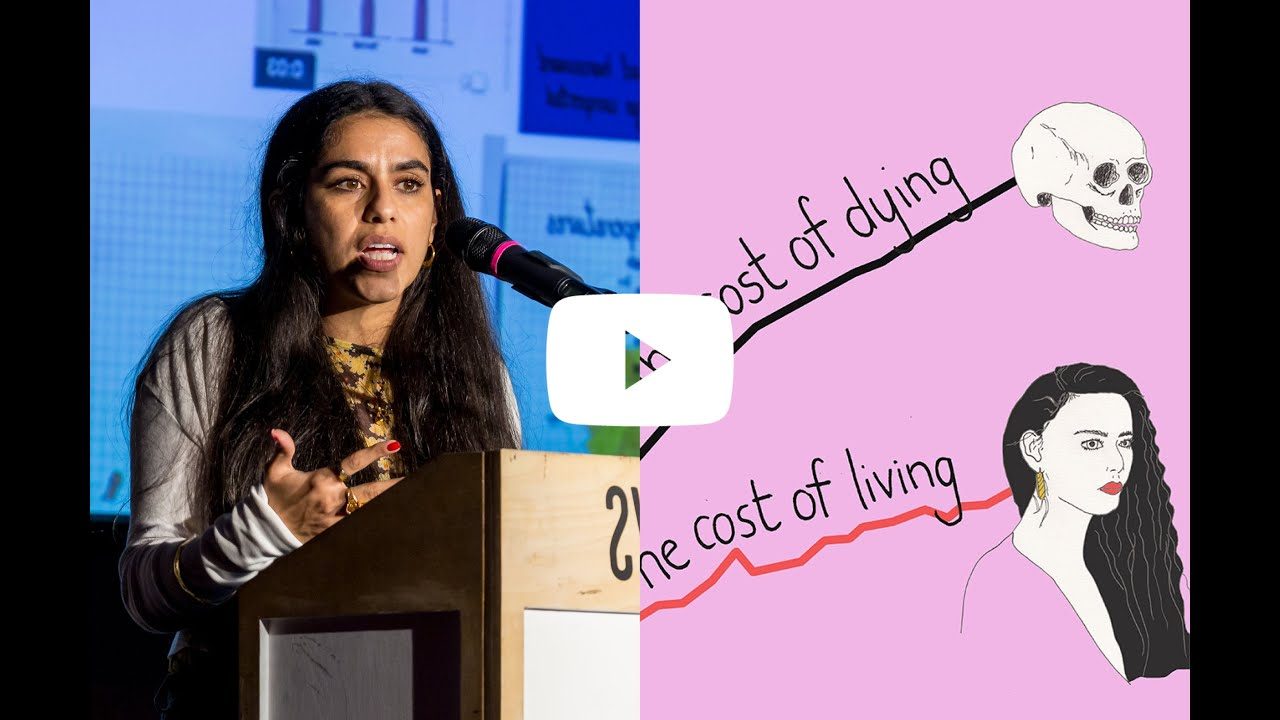
“I don't ever put decimal places on things because the truth is we don't know it's really two decimal places.”
I can't see anything can you hear me yeah okay I know I'm the only thing that stands between you and getting a drink or even better your bedtime.
So I'm gonna go really really fast and the talk is called it's not nice that because I'm going to very quickly describe the kinds of work that I do and then I'm gonna describe a couple of the issues that I've come against particularly now that I've started freelancing so as matt said I'm a data journalist that means I take numbers wherever I can find them and they end up being in all kinds of weird places home.
And I turn them inside the written words or illustrations and obviously for this particular room I'm gonna try and talk a little bit more about the illustrations today and when I'm designing these illustrations to put it like really really simply I'm often thinking of just kind of two criteria there's actually more criteria but this is just a simplification. And so clarity and beauty and like the worst chance I guess kind of fail at both on both of those scores weights they're ugly and confusing like this em and then you have the charts that are pretty and confusing which I think are almost worse because they kind of like bring you in so like this.
And then you have the charts that ugly and clear like this em and then you have what I'm like really really striving towards trying to create which are charts that are pretty unclear and not confusing and obviously with journalism that's absolutely critical right because I'm trying to inform people and make sure that they can and have the right information that they need to make decisions for their own lives so to do that I kind of take the classic chart sites that I'm sure most of you are quite familiar with and then I kind of turn them into these hand-drawn illustrations and it was so interesting to hear and a talk because one of the reasons why I create hand-drawn illustrations is because I really want to communicate to the audience the human component of data gathering right and the fact that a human was responsible for collecting these data sets and also to communicate how fallible this these data sets are right.
So when you look at one of my in astray shion's hopefully you walk away with like a sense of what the data is telling you.
But I don't ever put decimal places on things because the truth is we don't know it's really two decimal places so I'm going to talk you through like a specific example so those first three examples I gave of bad shots actually all came from this one study that I found and which was looking at inequity in consumption of goods and services ads to racial ethnic disparities in air pollution exposure which basically means that people of color in the US are more exposed to air pollution than white people.
So I tried to take those charts and create a handle and version of them right.
So this was my first version and whenever I'm designing these charts I have like a group text thread which unfortunately my sister who's in the audience today is on that group text thread and I had I send it so people who do nothing to do updates journalism and I say to them like do you get it I'm very often they're like I don't get it like this is a bad shot right.
This is a bad first draft what the hell is like micrograms per cubic meter mean who knows and this is the second version of it I did some arrows doesn't really do anything third version.
This is called a Sun key chart where it's like about the width of the thing.
But this isn't something that like how many of you really know how to read a Sun key chart not particularly useful and then. I just like really really simplified it and just had it as bars and like played around a little bit with the language as well.
So that's the final version of it. And I was it through a couple of other examples of my work.
So this one was in the wake of Hurricane Harvey I'm trying to show flood levels in the US. And I mean it's funny but it's also kind of not funny this is like a photograph of Trump after he was like distributing so it was so awful he like went to the community that was affected and was like throwing toilet rolls at them as if he was some kind of like Savior or something.
But the goal is that I feel like most people have a sense of like the president's height maybe like you know he's not necessarily a short man he's actually six foot two but the idea is to use him for scale poorly because if nothing else it reduces the number of numbers I have to show on the chart. So in every single time I'm designing one of these things I'm trying to eliminate the number of numbers on there and the words that are on there.
So this as simple as possible a slightly lighter topic Google searches for hangover cures which plummets throughout the week and then peak on like Sunday mornings and then very critical topic adults who have experienced rectal bleeding one of the very few examples where a pie chart is acceptable and then male circumcision rates and then back on to a more serious topics this was after a report was released in the u.s. Looking at crowding in immigrant detention centers and this one was actually really really interesting the methodology for creating it.
So I don't I don't know if it was really big news over here.
But these photographs were released in this PDF that showed how crowded those detention facilities were and I spoke to someone at I think it's called the school of forensic architecture in Kings and the way that they work is fascinating like one of the photographs showed a migrant holding up a letter so they could figure out the dimensions of the room knowing the dimensions of an envelope because they were actually holding up an envelope and then figured out how many people were in the room anyway I went to them to figure out the mass on it and came up with this illustration again like quite simple but I'm hopefully quite effective and I realized I put in too many samples in this I'm just gonna quickly go through the next month and this is for a piece that I did yes that was published yesterday on how dying in America has become very very expensive funerals are now very expensive people to pay for so I think it's that the cost of dying has gone up 223 percent over the past 30 years and the cost of living has brought 123 percent and as we thought people are doing GoFundMe is to pay for their loved ones to be buried in appropriate ways this horrific an occasion I also do like you know less charts II kind of more editorial stuff this was an animation I made to go with the piece okay.
So on.
So these three issues so how many freelancers are they in the room one one measly brie Lanza okay really not many freelancers here okay some okay great cuz no I think I'm gonna lose some of you at this point then okay.
So I started freelancing about a year ago and as I'm sure you know it is hard and so I just want to be quite transparent about some of the issues that I faced especially maybe some of you are thinking about going freelance if you haven't done it already issue number one he's getting paid so I I'm gonna make suggestions here that may or may not be useful take them if you like I have a very very inefficient system but it works me which is I have this like a mega spreadsheet of all the projects I'm working on I took like three different versions of this screenshot because some of them had like snarky comments about people. And I'm sure I still probably missed something in this but grey means I didn't do it orange means that it's a maybe green means I did do it.
And this is a way for me to track like have I followed up and actually asked for payment because they're kind of counting on you forgetting and when it's sometimes like a smaller job. That's like 100 quid it is sometimes if you're juggling loads of stuff easy to forget so I wanted to show you what first of all the importance of asking for money so this is now my go-to response I say to people I only do unpaid work for charities and nonprofits because it is quite extraordinary the number of for-profit companies that will ask you to work for free and I really want to let them know in as polite language as I can that what they're doing like isn't okay and this is the wording that I have landed on you can also choose to simply ignore them which I think is also quite effective mmm idea number two if you don't you want to get paid is maybe don't try and pursue the gallery route I mean some people are very very successful at it I tried to do an exhibition last year.
This is the behind the things of the breakdown of that.
And I ended up spending five thousand two hundred seventy eight dollars and fifty cents and this was me being like as constrained and as cautious as I possibly could about every single dime that I was spending and I didn't make any of that money back. And I wouldn't do it again so I think like you know it's really really hard because for so many of these things I guess you should be going out and asking for funding but that to me is also horrific because those funding applications can take weeks and weeks and weeks and it just feels like you're rolling the dice who knows so I'm coming back this idea of actually making sure that you get paid I wanted to just talk through what one of these examples might look like so I tried to do this quickly August I submit invoice for an illustration I do for a very very renowned company this is not his being film.
So I can't say who and then in September I follow up with lovely Henry and tell him hi could you please pay me in other words and then in September oh I hear from Lauren who lets me know that she's on it. And I'm gonna get paid and then I trace again in September and again in October cuz I still have them in paid and then this really really wonderful thing happens which is that the person who now represents me as a lawyer writes to Lauren and says well it hasn't been paid yet and within like hours the payment is issued to me.
And I honestly think I would have had to have traced this. And this was like about a half a year's worth of work like and I don't think they planned on paying me is the truth honestly like they are so renowned for not paying people. And I guess like I know it's difficult it's only now that I've been able to get a lawyer they take 5% of everything I own I know that I'm being filmed and I know.
This is a terrible thing Society have someone else pretend to be your lawyer it's an option right like she doesn't know who'd like Daniel Sirkin lawyers like have your mom create an email account or something and just follow up with people because it really seems to be the most effective way to ensure that the money does in fact hit your account okay problem number two is actually getting work.
So this is another like painful example that I guess I've learned is I received many emails that are like this that like honey we have this really really really exciting opportunity for you would you please sign this nd and we'll jump on the phone now I have become much much more careful at reading every single thing that I sign so this particular NDA said contracts are agrees that during the course of contractors business relationship with company for a period of one year after this business relationships emanates contracts are will not directly or indirectly alone or with any other person or entity solicits or do business in any capacity with any client of the company or with any potential client of the company with whom contracts are had contract contact during the course of contractors business wait for what the company and what this means is that I can't work with anyone in the same space for one year I don't even know what this project is yet they've just said they want to get on the phone with me to pick my brains and they want me to sign something promising I'm not gonna work with anyone in this industry I don't even know what the industry with is by the way.
This is a creative company brands it's like an agency they've got in touch with me about their partnership so it's just like no I don't want to sign this and what's really interesting is that like first of all like they really really pressurize me site and I was like I don't want to sign it.
And I said can you at least tell me like what the fee for these projects would be and after much much pushing they eventually told me that the fee was going to be $200 like why would I sign away the possibility of doing work for one year with anyone in this industry for $200 so basically Reed NDA's if possible do not sign them ever ever and try to get as much information as you can before you do sign okay third and final thing is getting your ideas stolen I often get emails like this as I'm sure many of you do which is like can you just send us all of your ideas for this particular project then we'll let you know whether or not we'll hire you to work on the project. And I think it's really really hard because I've often found myself in this stalemate where I like if I don't give over the ideas then it never progresses and I'm never gonna get that contract and I feel like now I hopefully I have enough of a portfolio to just be able to say like hopefully if you look at my work you kind of get it and should be able to trust I can come up with some ideas on this and but I would also say that I try as much as possible now to leave such a rigorous paper trail so if I do send over ideas I say explicitly in the email just so you know you don't have permission to use any of this in any capacity or any way.
And then hopefully it's harder for them to kind of wiggle out of it so finally so that you can go I wanted to suggest a criteria that I use when I'm trying to decide whether or not to say yes or no to a job.
So I try to check at least two things off of this kind of like mental checklist which are I want to either earn some money learn something.
That's going to help me professionally or help like I get so many project Commission's are from nonprofits and charities and like the truth is with all of these like do I know if the work that I'm doing is particularly helping like do I know that I'm actually doing good you really really don't but if you can foster a good community whether it's like your sister that you're texting to ask her her opinion on stuff or other people that you know in the creative space it's so helpful to understand whether or not you're checking those boxes that's everything thank you [Applause]
Latest Talks
-
Will Anderson and Ainslie Henderson
Bringing stop motion sorcery to BBC’s Small Prophets
Watch -
Amber Weaver
How does contemporary type design translate into the wider world?
Watch -
Murugiah
Why you should reject the formula and make art about things you love
Watch -
Marina Willer
Design thrives when you find poetry in the simple things
Watch -
Lizzy Stewart
The hundreds of drawings and writing-on-a-whim that goes into comic novels
Watch -
intra
The rewarding process of recognising the art in obscure everyday life
Watch