
Marina Willer
Designing the Stanley Kubrick exhibition through chess, symmetry and obsessive control
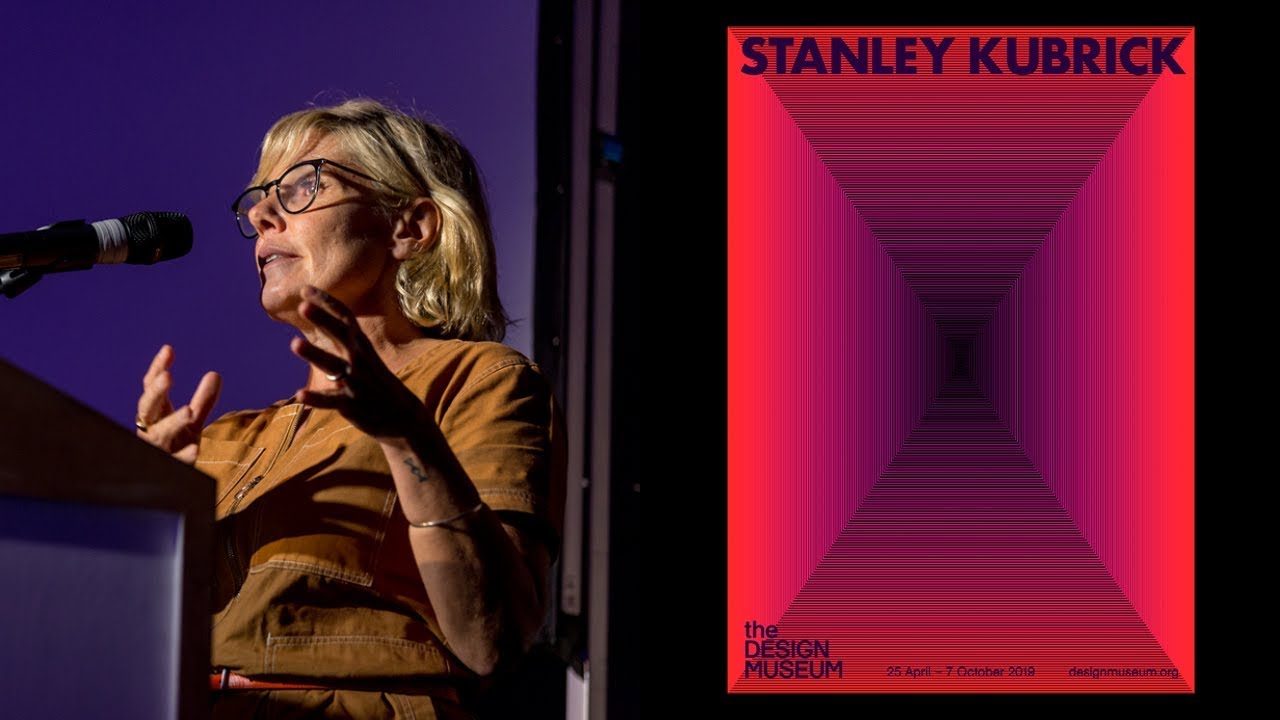
“We forget how much Kubrick was foreseeing the future — no one had ever seen the moon or the earth from space, and so he creates this image which you don't know if it's the moon or another planet or the earth, but it's dubious enough and he tries to imagine that.”
Thank you. Thank you. Thank you. Thank you for having us again. Hopefully I get this right. So, yes, I'm a partner company called the company is a company that's working with architects, product designers, graphic designers, digital, a bit of everything. And each of us work with a team. And that's why I start by saying this, because I think my work is very much teamwork and we couldn't do the kind of things that we do if it wasn't done really collectively. It's not solo at all.
I think I'll just show a very quick clip that shows some of the work that we do in branding and so on. Because in a way, my work has been very much about a mixture of things and branding and graphic design being at the center of it, but I've always been interested in film.
That's why, as mentioned, I made this feature film a couple of years ago called Red Trees, which is now on Netflix. And we do, as a team, and the team participated very much in that, but we do create films sometimes. And all of that kind of has been leading us to do more and more exhibition design as well, which is a combination of so many skills. So, first to show a brief slideshow of a few of the things we've been doing. Let's take a look at some of the things that we've been doing. So, this is a video of me making a film. I'm going to be doing a little bit of a bit of a video about the work that we do in branding and graphic design.
So, I'm going to be making a video about the work that we do in branding and graphic design. So, this is a video of me making a film, and I'm going to be doing a little bit of a video about the work that we do in branding and graphic design. So, that's super short and sweet, but I think it shows that the background of my work, and our work, is very much in creating systems and languages in a holistic way, and that manifests itself in every dimension, physical space, film, digital products, and everything. So, slowly we started to get invited to do exhibitions, and you see a little bit of the Ferrari exhibition, which was also at the Design Museum last year, wasn't it? And because of this kind of combination of skills, and the team is very much having to get involved in all these dimensions. So, with Kubrick, I think what a dream to be invited to design an exhibition for Kubrick. So, that's been wonderful, and I think partly it was because of the filmmaking as well, but the opportunity to really dive again into someone that you admire so much, and the work that you admire so much. So, I think for my entire team has been a real dream in getting to be so close to that subject, but the way we work is we work very closely with the curators, and sometimes the curator has a very clear point of view on the exhibition, sometimes not.
I think this evolved very much together. So, we try, like when we're doing a brand identity, for example, to really collate everything that we understand is interesting and relevant about that subject, and start to indicate an angle or a point of view, and obviously together with the curators. So, we started to look at some constant themes that are very present in his work. So, one of the things was chess, and I think very, very interesting for, you know, those who are more familiar with Kubrick will know that he was obsessed with playing chess, and also a very obsessive character in the way that he worked. He cared so much for every aspect of the production, and you start to see chess present in so many films, but not only that, we started to read that he was always, he was playing chess before he was a filmmaker, and he was living off that. He would play in a square in New York and get a coin for it, a few pennies for it, and he would never lose.
So, there was something amazing, but he talks about chess as a way to keep himself focused and be able to plan the film ahead, and also remember everything that happened behind, and orchestrate all these elements. And that method of working is very unique, and he would sometimes play with the actors in the middle of the game. It's famous that he was playing with Jack Nicholson in the middle of the shoot of Shining and so on. So, this is a common theme, and we actually started to explore whether that was something that we could use as a framework for the exhibition based on that. And as we were very lucky to be commissioned to do both the marketing, the films, the graphics, the space, the architecture, we started to think of all those elements at the same time. So, we started to explore and some of our team are very geeky, so they really got into this. How perhaps you could move in the space as you move the chess pieces.
We started to look at the typography to see if it could indicate that, and perhaps it could again create movements based on that, and you can read in many ways. So, we started to share some thoughts.
I think the design museum felt that we were getting a bit too carried away with the design, and we need to remember when we're doing something like this, we're really creating a framework and we're there to show Kubrick's work, not our work. So, sometimes we have to remind ourselves because we get carried away. Also, the other subject that started to come up very strongly, and I'm sure a lot of you have noticed this, is in his way of controlling things. You see also in the image, there is always this one-point perspective. There's a theme that keeps coming back in so many of his films.
So, one of our designs, Hamlet, made this grid with many films in it to demonstrate how this was really constant, and in a way a way of seeing his real desire to control every aspect of the production, because he would really do everything, if possible, from music to obviously get very involved in the script writing through to the graphic design of the marketing, through being obsessed with those things, the set, the directing of the actors, and every aspect of it. Then, obviously, the camera work as his background is as a photographer. So, we start to look at that, then, and I'm sure someone in my team might shout that I'm not clicking correctly, because I can't see the animations here, but these things are animated. Ah, it worked. So, we started to sketch, and again, I think the language was dominating a little bit, but I mean, we had so much fun re-watching all his films and reading everything about Kubrick again, and we were very keen on this route for both the space and the possibly for the posters and all the marketing materials that really used that perspective thing as a way of in a way representing the director's eyes in the way he saw things and controlled things and this absolute symmetry.
I think they didn't find that this was commercial enough, and everyone wants to see a picture of either Kubrick or the main actor in the film or something, so despite our love for this route, which also was and we don't have time here expressed in the space in many ways, we kept exploring things, but you see a bit of both in the exhibition if you have a chance to go, you will see that all these things have influenced the outcome and the final outcome. So as a result of that we edited a trailer of this theme of the one point perspective, which you see here.
And then I think that's why I say so much of a team work, because there's so many aspects that you have to put together to create the storytelling and it's not when you're like an architect designing a house, it's really creating a narrative and then how that narrative can work in a way that's not a narrative that's not a narrative that narrative can work in the space, how can you fit everything in the space, how can you express all the ideas in that.
So we receive lists and lists and our designers sit and spend hours and nights and I'm sure they nodding their heads now here just to make sure that we with the curators organize and make sense of all of this to create something that is coherent.
And using the themes as we have been talking about and all of that in mind, we have to come to some kind of sketch of how you navigate this space, how you perhaps can enter through the single point perspective, how you then create worlds which are the individual films and this was very much a requirement from the curators there. We could create and replicate the world of each film and then we start to form a language with these things, a graphic language, a color palette, how do we make captions work, how do we bring all these things together.
So there is a real complexity to it and we need the specialism of architects helping us and lighting companies that will support and the team really got involved in the whole making of it and being there to create the story and put it together. So after that we come to a design which then starts with the carpet of shining in the atrium which is really the teaser and then you enter the exhibition through this perspective of screens and here we showed a slightly longer version of that film which we show you here and that really drives you into the exhibition in the same way that I guess Kubrick was desiring to drive people into the screening away and invite them in.
Music Music And then of course it's such a delight to create the exhibition for Kubrick because the amount of this, he was so interested and obsessed with design so we get to talk about this in a moment but as you, after you cross the tunnel let's say you start to see the behind the scenes literally so you have all everything, all the work and the obsession that goes behind making those films. Every aspect of it you have his personal editing suite in the corner you have script, annotated scripts, you have everything and we really try to give as much attention to every detail as he would have done because there is something also special, this is the design museum so the design perspective was the one we wanted to highlight more than anything so making sure that everything was brought to life in that way so obviously for us graphic designers this in itself is such a wonderful moment but all of those things are there together and the way every caption is done our team went through lots of rounds of trying to propose ways that felt like coming from the film world and the way they were illuminated, the transparency and all of that.
I think there was a highlight moment when we were presenting the ideas today and into the design museum when we forgot to do the spell checking and when Stuart was presenting the slide came up and said, eyes wide shit, which was was a touch so we always remember that eyes wide shit moment. So as I said, after this central space in the process room all the details we get into all these spaces and the color palette of every film and the stories behind how that was made and with Kubrick he almost in every film led to a new invention in terms of technology and equipment so we for example used the lighting with candle lighting for Barry Linden which is the way that it was shot and many of these things are highlighted in the space.
So here our job is just really to do justice to all these wonderful things we have to display and put more attention to the design aspects because of where we are and I think we forget how much Kubrick was foreseeing the future and especially when you get to the space station which in the original plans was going to be the full space station. The way that he anticipated how branding was going to be used in our times even in space we don't remember or think about this but no one had ever seen the moon or the earth from the space and so he creates this image which you don't know if it's the moon or another planet or the earth but it's dubious enough and he tries to imagine that. So all of these details and he collaborated with so many brands to imagine what technology would be with IBM for example so when you look at the monolith how much that is what the tablets are today so all of that is just amazing material that we had to play with and as I said I think the team went really obsessive with looking at every proportion so the proportions of the numbers would correspond to the keyboard in the typewriter and the way this is lit is really in a way that relates to film and I think our job is then after we create the overall theme and the narrative is to make sure every single bit is given the attention that it needs and and that is more or less it I think as I said you couldn't do work like this without a wonderful team of people and it's completely collective so thank you to the guys and they're here and thank you for inviting us again.
Latest Talks
-
Will Anderson and Ainslie Henderson
Bringing stop motion sorcery to BBC’s Small Prophets
Watch -
Amber Weaver
How does contemporary type design translate into the wider world?
Watch -
Murugiah
Why you should reject the formula and make art about things you love
Watch -
Marina Willer
Design thrives when you find poetry in the simple things
Watch -
Lizzy Stewart
The hundreds of drawings and writing-on-a-whim that goes into comic novels
Watch -
intra
The rewarding process of recognising the art in obscure everyday life
Watch