
Lucy Hardcastle is a digital artist known for synthesizing craft and technology in her work. She creates visually engaging projects that explore the relationship between technology and human interaction.
Lucy Hardcastle
Licking the screen – why digital art should feel as tactile as glass
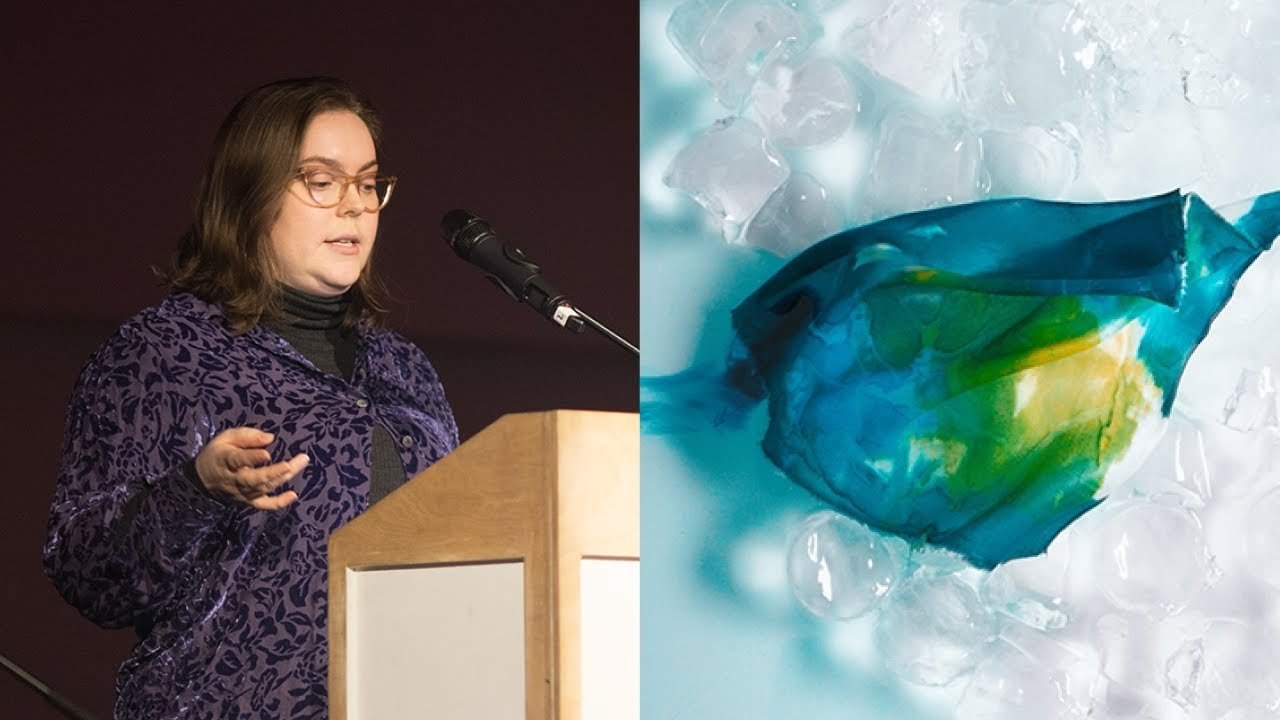
“Why do things to do with technology have to look a certain way?”
Transcript: May contain minor errors or formatting inconsistencies.
Hi everyone so you already know my name I'm a digital artist and a creative director at my own studio and a general interdisciplinary person.
So I'm best known for kind of creating visuals that feel and appear digitally native whether that means using rendering software or physical objects I kind of approach both in the same way.
And I really want to challenge the boundaries between the digital and the real and the physical and the virtual in order to understand what that means for us as we move forward into our future with technology so my work has a running theme of tactility ranging from things that are kind of shiny and liquid and mercurial to something that feels more densely textured both of these visual forms are kind of challenging how we feel when we encounter these textures so I use technology as a gateway for for innovation within my practice and I like to think of myself as a digital craftsman so the ultimate goal of my work is to really think about new ways of storytelling and part of that process often means creating new relationships with materials software techniques to find a new application.
That's really exciting to the user so the commercial side of my studio which has been developing since my postgraduate studies has included clients such as Levi's nowness and Alexander Wang one of the most recent projects that Alex just mentioned was the collaboration with Chanel ID for intangible matter where we created an interactive browser-based project that looked at the virtual and physical elements of fragrance the key members of my team include my consulting consulting partner Laura vent formerly from widening Kennedy and a lecture at you al and then my technical director Martin Robinson who is a previous producer at Jason bridge so I really want to kind of discuss these two really big themes the first one being material and the second one being technology that kind of encapsulate the practice of my work the ethos of my studio and where. I really want to go in the future so there's a general understanding that as humans we all experience the world through five senses however some people argue that.
There are up to 33 human senses and I really want to explore that through the idea of radicalizing those senses and using them as strongly and as interestingly as we can so one of my motivations for that is to create work that has an involuntary reaction from the user and often that means using a combination of them to create something that really feels immersive so this also accounts into the aesthetic decisions that I make such as this image and I think the aim is to challenge or create a reaction or inversion seeing something that you know and seeing it presented in a new way I actually have a background in textiles so that's something that has always informed my aesthetic and my material choice and I've always felt like it's important within my work to have a strong connection between what you're touching and what you're looking at whether that means creating a disconnect or creating something that feels hyper real to what you already know. So in that sense I really enjoy challenging the viewer on what they're seeing with their eyes do they think this is real do they think it's something that exists within the digital realm and I think the best way to kind of describe that is to be able to view something even if it's a flat image and know exactly what it would feel like on your skin without. Actually touching it in real life.
So that's a form of tacit knowledge which is kind of a theory that I've been researching throughout the whole of my masters and it's a process of learning through something that is immaterial it's all about intuition so kind of since the beginning of my career as a digital artist I've really wanted to question if it can be possible to gain that tacit knowledge through something that exists on a screen so my work always seems to have a sense of fluid reality to it. And I really want to try and Express that impossibility in things that are either real or not real and this is how I kind of develop the notion of licking the screen which was a piece of feedback I got from my project in townsville matter and I believe as humans we're obsessed with playing with forms that we can transform through our own hands for example the kind of slime craze that's going on on Instagram and YouTube at the moment and I really believe that that unlocks is kind of childlike playfulness that gives us a new understanding of how we use materials so the next huge topic technology I think there's a fundamental shift with the human relationship occurring between humans and technology currently and I think the development of the devices that we use in our homes and in our pockets shouldn't just be about providing efficiency it shouldn't just be about Oh making things faster so that we have more time that.
Actually doesn't even exist anyway I think it should really be based in our physicality and in the human condition. And including our senses that go beyond sight and beyond just looking at a screen so I really feel that the future technology will require us to refocus its pace and purpose in order to build on the fact that we are sensual emotive beings and I feel like this idea could be coined as slow tech allowing and including an expansion of physical and conscious senses as opposed to being led by the trajectory of technological development so I really want to synthesize the worlds of craft and technology together. And that's something I'm kind of constantly exploring on and off the computer so for example in the kind of glassblowing work that I do so right.
Now we're in the middle of a third Industrial Revolution with things like 3d printing being at our fingertips and I'm constantly questioning why does everything to do with technology have to look a certain way why does everything have to look like it's made of stainless steel for example and I think because of this that things like hardware software coders and makers should all be seen as the kind of new wave of craftspeople where we can weave some this theory and the new principles of craftsmanship into these fields this is also something that completely relates to the aesthetics for it that I think are also up for change so with that fusion we can kind of create a new narrative connection.
And I think my work is a way to access the new craftsmanship as I'm someone who works not just in things like glassblowing and making sculptures but finding new ways to create workflows between software's that doesn't currently exist yet so the way we think about software I think should be the same way we think about craft and we should really feel a trace of humanity within it we're currently experiencing the negative senses so we're currently experiencing this in a negative sense when you think about issues like for example a lot of hand dryers have racist algorithms to them where they only pick up white hands and that's the way that they've been built and issues like that that are surrounding technology at the moment I think that we need to really consider this technological revolution where everything is going to become immersive as some people fear that that will kind of disconnect us in a way. And I think there's a lot to explore there so having said all of that this fusion of thinking about those two expansive themes that are about materiality and technological development this all turned into a project called qualia which I developed while I was still at the RCA so essentially it's an interactive glass interface that really seeks to challenge the idea of one interface could be and I'm going to play a little video of how it works ♪
so the inspiration for this piece to really turn into a physical form started by observing the flatter displays that were used to touching I kind of became obsessed with this idea of a piece of glass that could organically be any shape yet still be interactive and act as an interface and kind of transform the way we consider glass as a portal I was really drawn to the glasses unique properties in both kind of the digital and the physical realms that we think of it in its really distinctive it refracts and bounces off light in a way.
That's completely recognizable to glass and as the material in our everyday lives it kind of swings between being luxury and being mundane which I think is really interesting so using primarily glass also came with its challenges it's one of the least conductive materials in the world.
But I was really convinced that we could you know as simple as it sounds extract an ingredient that already exists in touchscreens and have control over the object's response so through a multitude of processes using hardware and software we kind of achieved what I imagined where we had a responsive piece of glass that mimicked how you touched it kind of appearing like a magical vortex that looked really simple but actually it was a complete opposite of that.
So we were basically able to do this by using an earth metal that creates a clear conductive sheen over the glass and then once you've done that process you're able to link it up to an Arduino literally with some crocodile clips so what made this really innovative was the fact it was the first time that this technique of conduction had been used in a creative setting and on a curved surface prior to this it had only really been used by scientific and military application.
So this is one of the kind of base images are used for the graphics of what became the interactive piece and I really wanted to create responsive graphics that spoke to the magic intuitive nurse of something that you can just reach out and touch and it responds to you.
So we did this by building up base layers of a still image and then applying an outer layer that was almost this like reactive fluid motion.
And it was kind of like when you stick your finger in a running stream and it kind of cuts the water so it really created this physiological experience that linked that human curiosity to play with the craftsmanship of this organic piece of glass and that swiping gesture that even two-year-olds relate to swiping on iPads and touchscreens so it's really about the desire to reach out and touch something and that kind of moment between actually touching it and what you anticipate you're going to experience so I really see qualia as the beginning of an investigation with potential to develop into the future of how we see interfaces and the kind of interactive technology that's becoming more and more integrated into every tape everyday experiences qualia to me implies that our interactions with technology can be playful can be a motive and humanized I really don't see why things that feel like AI or Oh Interactive need to kind of have this feeling like a sense of dread to them that you always see in like sci-fi movies I don't see why it can't be something that feels beautiful and can exist side by side with you.
So the future the future of technology I think really needs to explore these principles of sensuous innovation and a kind of feminine language that I think I have through my work. And I think that could kind of create a lifelong companionship with what will be our digital future our current interaction with emerging technologies really need to be under constant scrutiny both through its conceptual and aesthetic values I think if we had qualia in our homes would we treat it differently to how we treat Alexa I really think that you know we need to ask the question is technology our servant or is it something.
That's almost a life enhancement what other design cues ought to be changed around AI and digital devices in order to have a more sensorial connected experience I'm really pushing my work to ask these sorts of questions as a way to build on qualia as a project and further explore new human connections based on technology with this kind of element of transparency and sensuality to them. And I really think that the element of transparency is vital because we shouldn't allow technology to be opaque in both its physical and conceptual manners manifestations we really need transparency with all aspects of our culture from the me to hash tag to our smartphones the negative presence of humans input into technology needs to be re-examined and I believe that the central innovation interpreted in my work is a means by which we can challenge this thank you very much [Applause]
Latest Talks
-
Will Anderson and Ainslie Henderson
Bringing stop motion sorcery to BBC’s Small Prophets
Watch -
Amber Weaver
How does contemporary type design translate into the wider world?
Watch -
Murugiah
Why you should reject the formula and make art about things you love
Watch -
Marina Willer
Design thrives when you find poetry in the simple things
Watch -
Lizzy Stewart
The hundreds of drawings and writing-on-a-whim that goes into comic novels
Watch -
intra
The rewarding process of recognising the art in obscure everyday life
Watch