
Karabo Poppy Moletsane is an artist and illustrator known for rebalancing African representation in the creative industry. She uses her platform to uplift other African artists and discusses the importance of accurate representation of African culture.
Karabo Poppy
Rebalancing African representation one bold illustration at a time
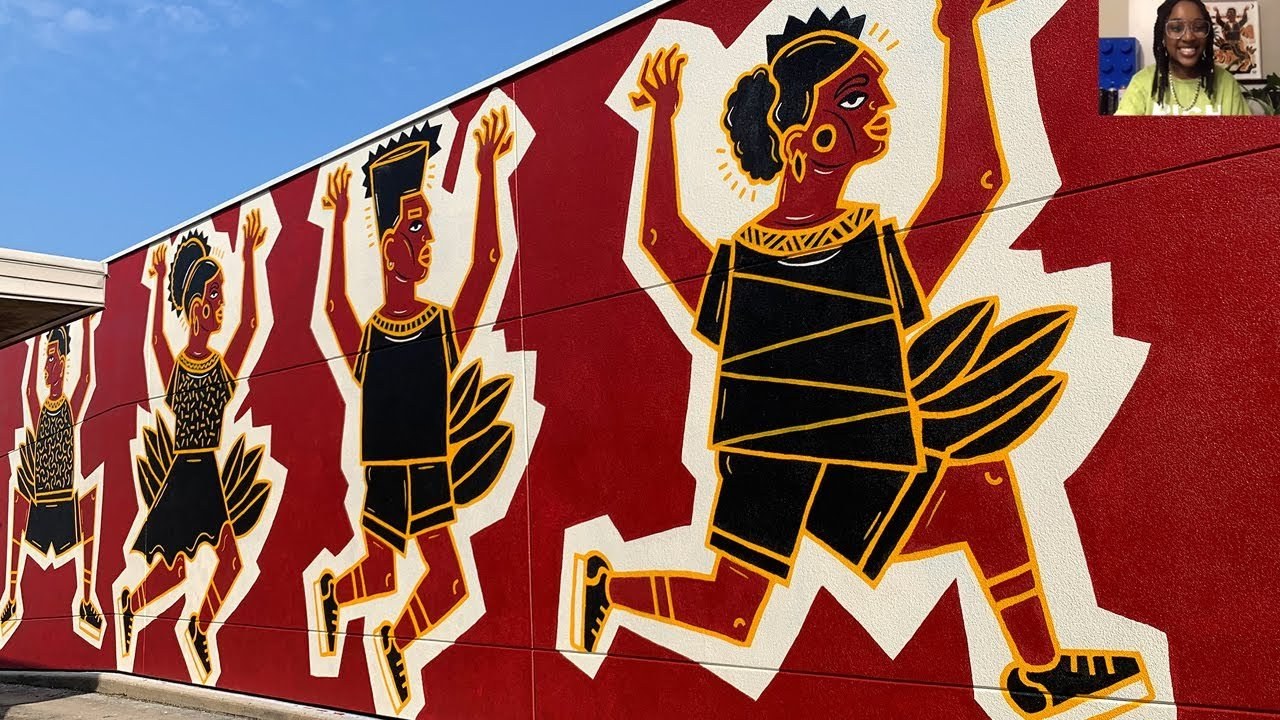
“When I started, I didn't see anyone who looked like me in the industry, and I realized how important it is to change that narrative.”
Transcript: May contain minor errors or formatting inconsistencies.
Traitor carabo poppy has worked for world-renowned brands including google netflix and nike anyone who's seen a photo of lebron james in recent months will likely have seen him sporting a pair of nikes adorned with one of her patterns her work aims to rebalance african representation in the media and the contemporary design sphere drawing inspiration from her everyday surroundings in south africa carabo's wonderfully energetic illustrations combine tradition with contemporary culture carabo please yeah turn on your audio video so we can say hi hey man how are you doing I'm all right thanks how are you I'm doing good thank you thanks for having me no not at all thank you very much for joining us I'm loving the the lego block in the background there the enormous lego block that's the future exactly I'm gonna hand straight over to you to share your screen and take it away.
But yeah everyone else thanks very much for your comments and your questions in the chat just keep them coming and I'll do my best to ask them after after this talk that looks great over to you amazing so hi everyone my name is karabo poppy moletzane I am an illustrator a street artist and a graphic designer based in johannesburg south africa I'm incredibly passionate about using my platforms and my disciplines to really try and both honor and show the world more accurate and contemporary representations and images of home so let's rewind 25 years ago.
So I grew up in a really small town called faryana thing it is in south africa and is mostly known for being a mining town and really for its factories and its rivers so I filled my time with a lot of media that I consumed being a child at the time it consisted a lot of media like this.
There wasn't much to do in the town so I spent my hours watching the simpsons watching mulan magic school bus beavers and back here to kind of name a few and I play games like mortal kombat like contra like super mario brothers and this is just to sum up I grew up in front of the tv this is pretty much where my love for all things visual kind of started although from a really young age I noticed that. There was a disproportionate amount of representation within this media that I loved and consumed so much I mean we had martin where I kind of had more of a connection.
But it's also still not enough because it's a different kind of connection it's experiencing blackness and black culture and like identity in a different way I appreciate the many many similarities that we see but I wasn't seeing images of home people that looked like me or narratives that were familiar that weren't a result of globalization.
So I longed to see home in the way that I experienced it.
And in the media that I consumed so I started growing really tired of images of desolate landscapes whenever people would talk about africa or south africa images of wild animals or starving people went home. And south africa kind of looked more like this I wanted to know where where our streets were where the subcultures were where our history of street art kind of comes from to kind of tell those stories and see those stories within media kind of seamlessly play out was something that I really longed to see so through the years in university I came to realize that I probably wasn't the only one that started feeling this way my design process always started with me going to areas that I felt were really great representations of our country and more broadly not just our country but our continent and as well we have so many different kinds of cultures living within south africa you kind of get to experience a little bit about another country without necessarily going all the way there.
So the bless the best places to kind of see this combination of culture and energy for me were markets and I think anyone that's had an opportunity to spend a significant amount of time within african markets knows that there's nothing quite like it people are able to experience a plethora of beauty of culture of energy of even hustling that is very minimally influenced by western culture and that is very iconic to not only our country south africa but our continent as well.
So I would spend hours taking photos while munching on street food and kind of buying my t material for my next projects and even like feeding pigeons along the way and each time I walk through the markets I would always hear people say to me and when you translate that that means could you take a photo of me. So it then clicked to me that I wasn't the only one that wished to see better representation.
But it was every day south africans that didn't have control over the media that also wanted to see this narrative being portrayed in a more accurate and more contemporary way and wanted to see themselves within media then works like this started to pop up as if it was as if many creators all across the continent kind of had this collective consciousness to preserve the african aesthetic I think a lot of african creators were being inspired by both the contemporary and the traditional within the visual aesthetics of our country I believe that our aesthetic has a really long rich heritage that's rooted in constant innovation and hybridity I know that from growing up a lot of the schools that I attended a lot of people didn't have a lot of access to many materials when it came to art. So innovation becomes extremely important because you have to make a lot out of a little you have to create something with a tool that possibly wasn't created to suit that art form so innovation was something that was at the forefront and since we have so many cultures within south africa hybridity became something super organic and became a form of honoring and almost meshing into a way of responding authentically to different cultures living in harmony so I believe that everyday south africans carry this with them daily I also believe that it is in the everyday seemingly mundane events where our aesthetic is at its most beautiful so I set out to preserve and celebrate that feel within my work and to represent a very underrepresented community and country at the time so being a sotun I was born in south africa but my culture comes from lesotho not many people know about lesotho but it's a very small landlocked country that's in south africa and that's where it's landlocked but having a voice for a very small community became something that was really important to me so an incredibly exciting phenomena carried on evolving and unraveling itself amongst african creators there was a welcoming of western influence yet a very strong presence of our narrative and heritage still remains at the forefront of everything that we do when it comes from ideation to execution as well it's difficult to separate ourselves as african creators from our heritage heritage is something.
That's put in us from a very young age and is seen in our everyday from how our parents who interact with each other to how as the siblings interact with each other to another phenomenon that a lot of africans can experience is that almost everyone becomes your cousin there's this familial connection that we have and it is really our heritage that really brings that connection. And it felt like a lot of african creators were putting this into their work because of how seamlessly it was taught within family as well so from ideation to execution we're seeing that heritage is something that needs to be at the forefront but we live in an age where globalization has had an impact on the entire world.
So we've become more familiar with western forms of storytelling western materials and tools and equipment western theories as well and mixing that in with our art has created really interesting imagery when it comes to either illustration photography or fashion we're seeing this welcoming of a western culture and a western ideology but we're seeing african ideologies and imagery and heritage staying and remaining at the forefront of everything that we do some of the artists that I really love is the group and collective I see a different view they kind of take the everyday johannesburg experience that isn't often seen within media and they pretty much show the beauty in it in a very raw and emotive kind of way.
And I feel that.
This is how a lot of african creators have kind of taken ownership of photography again and telling the stories they need to be told in a very authentic way we aren't having people outside of africa coming in authorizing our community and our environment and our stories as well.
But we are having african creators discuss and explore african ideologies ourselves and I think I see a different view as a great example of that we're also seeing that within fashion when it comes to regeneracy and matassa we see the the beautiful pattern pattern-making that is synonymous with our country I think not a lot of people would associate south africa with very mathematical or geometric ways of creating art I think a lot of people kind of associated with the more earlier forms that were found in south africa some of the oldest rock art that we had seen was extremely organic and I think not a lot of people associate the mathematics that goes into pattern making but that was something that was very iconic to the vendor culture in our country and the women were actually the ones that carried this older form of street art.
And now we're finding it kind of spill over not just in street art.
But we're seeing it in fashion as well. And I think richa nisi and makasa are really great beacons of what's to come and do it in a way.
That's still honoring this beautiful culture that we have we can also see that kind of influence within music and with how shoma josie is really taking ownership of boom and we are seeing a very western way of producing music yet it's telling of stories that are african and very synonymous with also a very small culture called the tsonga culture within our country and we're seeing that even though we are using maybe western advancements when it comes to technology we are telling our stories as authentic as possible whether it comes into fashion all the stories within songwriting we're seeing it here as well another great example is and he's an illustrator from zimbabwe and really telling of the texture and the energy that you can experience in everyday life living within zimbabwe and coming to south africa as well. There is a seamless approach to producing work from a place where we have learned our culture and our heritage from home it's almost organic in how we are able to put it into our work and really take from western influences what's necessary to tell the story better when it comes to my own process I remember growing up in a small town and my only iteration of media that really showed an authentic narrative that I was familiar with was looking at old style barbershop signage this was the first time I saw beautiful narratives that were very familiar to me I saw everyday people in these beautiful side profiles and really felt like this was how I could take my art and really pay homage to where I saw representation for the first time.
So I take that into every kind of work that I take on any kind of illustration my first thing is having that kind of representation and what am I doing as a black south african woman to really preserve the african aesthetic in as authentic of a way as possible so making sure that it's projects that really want to celebrate the underrepresented and to represent the underrepresented so I try and show as much diversity within my work while paying homage to the side profile images that I would see within barbershops and I really became passionate about making my work as accessible as possible when it comes to only having my work digitally we're really limiting the conversation around african traders taking ownership and that kind of appreciation staying within the continent and the country as well.
So I moved over into street art and looking at street art as a free way of experiencing art and a very large scale way of starting different kind of conversations so here were basketball courts that I customized along with another incredible creative called lucky lady luke to kind of tell these stories of the the relationship of basketball within the south african context so the kind of aggression and beauty yet finesse and skill that we experience so this takes me to one of my most favorite and most recent projects was a collaboration that I worked on with nike to release a collection of air force ones whenever I think back on the times 25 years ago growing up and watching martin there is a giant influence that I experienced from african-american culture and how african americans have found a beautiful way of taking their culture and putting it in to applied illustration or into music or into acting it's it's creating visuals out of something that you learn culturally and that was something that I wanted to do and anytime I saw a cultural leader when it came to african american culture I always saw people wearing air force ones and I associated the silhouette with doing incredible things.
And incredible creative things as well so when nike approached me to tell a unique south african story onto a sneaker collection it was pretty much my whole dream with wanting to tell a correct story and onto a canvas that's associated with culture and culture creation as well was something that was really an honor so I wanted to tell the stories of the stories of south africa that people don't necessarily see and the stories that also influence my creative practice as well so on each of these sneakers we decided that we would do something that nike had never done before.
So the air force one is actually made out of a different kind of leather we have custom dubrays I was able to customize the sole as well and work on embroidery and one of the very first things that nike's ever done is completely cover the swoosh with a patch that is speaking towards my really my love and my honor for the old style barbershop signage where I first saw representation within media and having that exist on such a monumental silhouette and shoe is just showing how the access to the access that we are having towards creating a new voice and a new identity is something that is seeming very reachable and possible and seems very timely as well.
So it's amazing that I get to discuss my own identity myself on something that I have followed and admired for so many years. And it's even gained as much traction as lebron james wearing it at very monumental times when he was wearing hats that were talking about the necessary arrests for the cops that killed brianna taylor on his feet I have my sneakers being featured there so everyone from lebron james to rhapsody to conceited and even offset have been seen wearing these as sneakers and it's almost affirmation for my work that it's not just work that is resonating with south africa but it's resonating with the continent and those that also associate themselves with roots within africa so to sum this up I would love to play a video of you to do a video for you to just give you more of a visual iteration of everything that I've just kind of said in this presentation as a kid the first place I really saw people that looked like me represented in art was on the walls of barber shops and salons that I visited with my family to get our hair done the beautifully stylized side profile faces of familiar people left such a strong impression on me that I referenced it to this day in my work my name is karabo bimolezane and I'm an illustrator street artist and designer I'm passionate about sharing my art with people that might not have access to it.
So I use unconventional canvases I turn everyday places and things basketball courts walls sneakers whatever I can find into art art that presents a sense of home I want my work to be the inspiration for future young artists so that the next kid from fidena thing knows that they can also do this ♪
thanks so much that was amazing grandma thanks thanks for showing us that and just an amazing amazing talk I guess all the way through really seeing the various inspirations that you brought into your work over the years is extraordinary a couple of questions from our audience from emily first off are there any particular techniques or signifiers that you say you would say are kind of indicative of the work of south african creatives today.
I think the techniques that there's so many techniques I think I'll just tell you my most favorite technique I think from going to study design we learned very western ways of designing and it seemed like there was a very strong science to how things should be done and we kind of learned that science and then apply that science in a very creative way.
But I think a really unique characteristic that I'm finding south african creators have is breaking the science so things don't need to fall within a grid for them to work it's almost like a feeling that it's working so the the colors that you use we learned that these two colors will complement but that isn't a very south african way of doing things you put colors together and you just feel as if they they compliment complement so we break a lot of those rules because we focus more on the feeling rather than the science behind it. And that's a really.
That's really one of my most favorite characteristics I think so there's a lot of rule breaking but if you look at the work somehow it makes sense when it shouldn't make sense on paper and I think that's the south african feeling that comes across yeah I love that. That's great and I guess you kind of touched on the inspiration and lots of the things that kind of fed into your work particularly the barbershop paintings how long did it take you to kind of develop your style because I guess you know we saw a few iterations there.
But that was kind of quite recent I guess what were the kind of steps between that to get to that style for you so people don't often love the answer that I give but it was almost immediate it's really difficult to kind of talk about it I think internally I was like developing the style by like developing a visual library so watching a lot of things looking at a lot of books and then whenever we go to the hair salon to do my hair is like a six hour day so I'm staring at these beautiful images for about six hours and I think subconsciously I'm building that library so when it comes to drawing it feels very natural and immediate so I started developing my style already when I was in high school it just seemed like the way my hand wanted to draw in the way I wanted things to look.
So I refined it a little bit throughout the years but already from high school when I started really taking art seriously I started drawing the very similar to how I'm drawing now okay interesting I mean sometimes it just happens that way right it just clicks and it's a natural thing yeah.
So I have tips for people to develop their own style but it wasn't really my experience okay fair enough all right well listen crap we're gonna have to leave it there but thank you so much for an amazing talk and yeah thanks for joining us all right I'll ask you too you
Latest Talks
-
Will Anderson and Ainslie Henderson
Bringing stop motion sorcery to BBC’s Small Prophets
Watch -
Amber Weaver
How does contemporary type design translate into the wider world?
Watch -
Murugiah
Why you should reject the formula and make art about things you love
Watch -
Marina Willer
Design thrives when you find poetry in the simple things
Watch -
Lizzy Stewart
The hundreds of drawings and writing-on-a-whim that goes into comic novels
Watch -
intra
The rewarding process of recognising the art in obscure everyday life
Watch