
Jack Sachs
How a hand injury led one illustrator to teach himself 3D animation
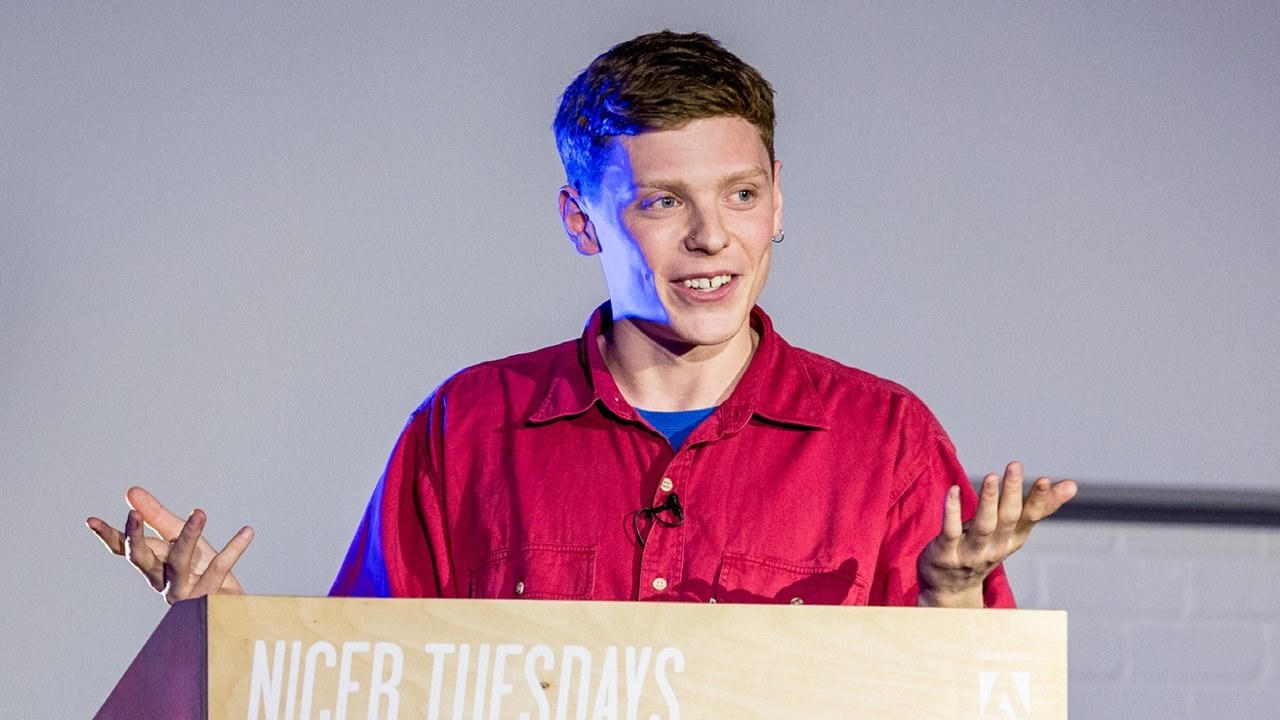
“Creativity is not a straight line; it’s more like a series of squiggly lines that sometimes connect and sometimes don’t.”
[Applause]
hello hi my name is Jack saxs I am a 3D animator illustrator I'm born and bred in London in Camden I studied at camell College of Arts and I graduated in 2013 and today I'm going to talk to you about sort of the main things that have happened between then. And now me being a freelancer here's some animation a little bit more sorry I've always really wanted to do that. So yeah this is I'll let you it turn it up ♪
so yeah that's a thing that I made for MTV last year and to give you an idea of the sort of still image work that I do there's an image for zeit magazine and for pickme up Festival so kind of I do everything sort of between still image and moving sort of like yeah gifts and shorter videos and longer videos and yeah that's not necessarily where.
I started out I started out I just studied illustration at camberwell. And sort of it's a very loose course you kind of get to do whatever you want but I was really just sort of doing lots of drawing so these are some Sketchbook Pages I never really get asked to draw professionally like sort of for money so these kind of very much for for me and they kind of are the backbone of all the stuff that I do in 3D yeah. So it's really sort of fun for me to have a separate practice but yeah these are just some Sketchbook Pages so basically I was getting along just doing my drawings but they weren't ever really sort of they wer I never really had a narrative element to my work they were just kind of still as you could see they were just sort of like very graphic and visual and then sort of out of the blue I had a massive injury I'll spare you the grizzly details but it.
Basically meant that couldn't hold a pen or pencil for about six months just as I was starting third year which is obviously ideal so I I started thinking about different ways that I could make images and I'd always had yeah an interest in 3D so just after I graduated like just thankfully I got picked up by these guys called Fox ADHD who made sort of topical news-based celebrity often gifts and that was really cool because it meant that I could just sort of like practice each week yeah each week just like yeah learning more and more 3D things here are some more so yeah but yeah no that was fantastic that went on for like the better part of a year. And it kind of got me through that weird stage of like having just graduated and like I got it. Basically meant I get to put out new 3D things every every week and then after a while I got picked up by by Blink Inc which was fantastic for me like it's a it's a production company that I've always really looked up to and I just sent them an email and I didn't realize that the person I was emailing was kind of like quite important I just said like hey how did you guys how did you get in with these guys and and eventually you know they asked me to come come in and I worked on a few things and eventually I got to work on Don't Hug Me I'm Scared number four which was like a dream come true because when I was at Uni these were just sort of starting to happen and yeah I don't know I'm not going to show it to you now because it's quite long but yeah if you haven't seen it I would definitely recommend so yeah like I've done so many great things with blink but this is one that I've done recently it's yeah it's a it's a commercial for for main bassets licorice all sorts and now a mixed up intermission from mayard ♪
bassets mixed up licorice all sorts so so yeah as you've seen like a lot a lot of the work that I've been doing lately involves 3d motion tracking which is like you film you go out and you film something or you film nothing essentially you sort of have to pretend there's something there with a camera I'm doing this because we have a shoulder rig so you go out and you sort of pretend that you're filming something.
But yeah you're just filming an empty space and then using sort of clever computer magic you can map in your 3D animations they look vaguely like they're in the space but I guess cuz my Approach is a bit more sort of I'm like I'm selftaught like which I yeah fail to mention I'll talk about that later but my Approach is a bit sort of DIY so kind of I kind of enjoy that sort of contrast between the 3D things and the real things here's another short film that I made is it going to work yeah it's it's just like sort of fun personal thing I just filmed it on my iPhone and yeah it's just it's fun just to get to like practice these things I suppose it's not really much [Applause]
so yeah's that yeah.
So I guess like I said this kind of become the backbone of what I've been doing in the last couple of years.
And I'm finding that people are sort of asking me to do more of it which is great and I've been I was kind of looking for a way to develop it into a sort of longer format thing because I was making these films that were sort of one shot and roughly like 30 to 40 seconds and I was contacted by Tate Britain who asked me to make something for an event called Tate loud where. Basically they have like live music and all sorts of workshops and things and they commissioned me to make an artwork which they eventually projected into a brightly lit room so great thanks and I'm going to show you a cut down version of it because we don't have very much time.
But yeah this is my film shh BR he wasn't just telling you to shh earlier is it. So it was really fun because we basically got access to take before and after opening hours which kind of creepy I'll let you watch it for a ♪
bit the idea of the film is that we're sort of vaguely following this pencil as a guide through the gallery while if it's supposed to be at just a sort of regular quiet afternoon but all these things are s of ♪
occurring so yeah they were pretty pleased about that shot yeah.
So we actually had a lot of problem s making this cuz we went along and we filmed everything. And we were working with somebody from the Tate and they were like yeah just go on film everything. And it turns out that you can only because of the copyright issues we could only use things that were made in the last 40 years no soor that weren't that were made yeah they haven't been made in the last 40 years.
So yeah that we're limited with our shots but like like I said it was really fun to be able to get in there and yeah film nothing.
So I'm going to show you a sort of I'm going to show you.
This is just so you can kind of get a bit more of an idea of how 3d motion tracking Works what's happened prior to this is that the computer has fig like this is how I made the first shot so in the hall where there's the guy with a sign and I've fed the film through this software which is Cinema 4D which I highly recommend to anyone who's like trying to get into it because like I said yeah I'm selftaught and it's the most except accessible one but yeah. So what I what I've done is I've put the film through Cinema 40 and those green dots are sort of they've mapped the space using Parallax data and Parallax data is sort of the way that two points I don't I don't really understand it. So it's yeah it figures it out.
Basically I was going to try and explain Parallax but I'm just not so yeah. So you can see that. Basically what it's also done using those dots is it's mapped the path of the camera and created a virtual camera in in the software so then my job is to then create these surfaces again in 3D that I can then use to sort of put my animations onto and around and yeah. So can I skip it forward a little bit nope okay yeah.
So I'm just you can see like I'm matching up these shapes to the space a lot of it sort of just like eyeballing it. There are sort of like some very Advanced ways of doing these where you can place trackers on the floor and then film it.
And then you measure the distance between the trackers in real life.
And then you know what you're doing but I don't so yeah like I'm I I learned all of this just from YouTube when I had my accident they just yeah. I just there's so many amazing resources out there and people put it all out for free and yeah I'd like to take this opport to thank them CU they're the backbone of what I do yeah.
So I'm starting to put in some 3D objects to sort of make sure that they will move in the correct way because obviously if they slide around and don't look like they don't move in the same way that the camera does then the whole thing's not going to work yeah.
So I guess from there on it's just more of this and that concludes my talk w
Latest Talks
-
Will Anderson and Ainslie Henderson
Bringing stop motion sorcery to BBC’s Small Prophets
Watch -

Amber Weaver
How does contemporary type design translate into the wider world?
Watch -
Murugiah
Why you should reject the formula and make art about things you love
Watch -
Marina Willer
Design thrives when you find poetry in the simple things
Watch -

Lizzy Stewart
The hundreds of drawings and writing-on-a-whim that goes into comic novels
Watch -
intra
The rewarding process of recognising the art in obscure everyday life
Watch