
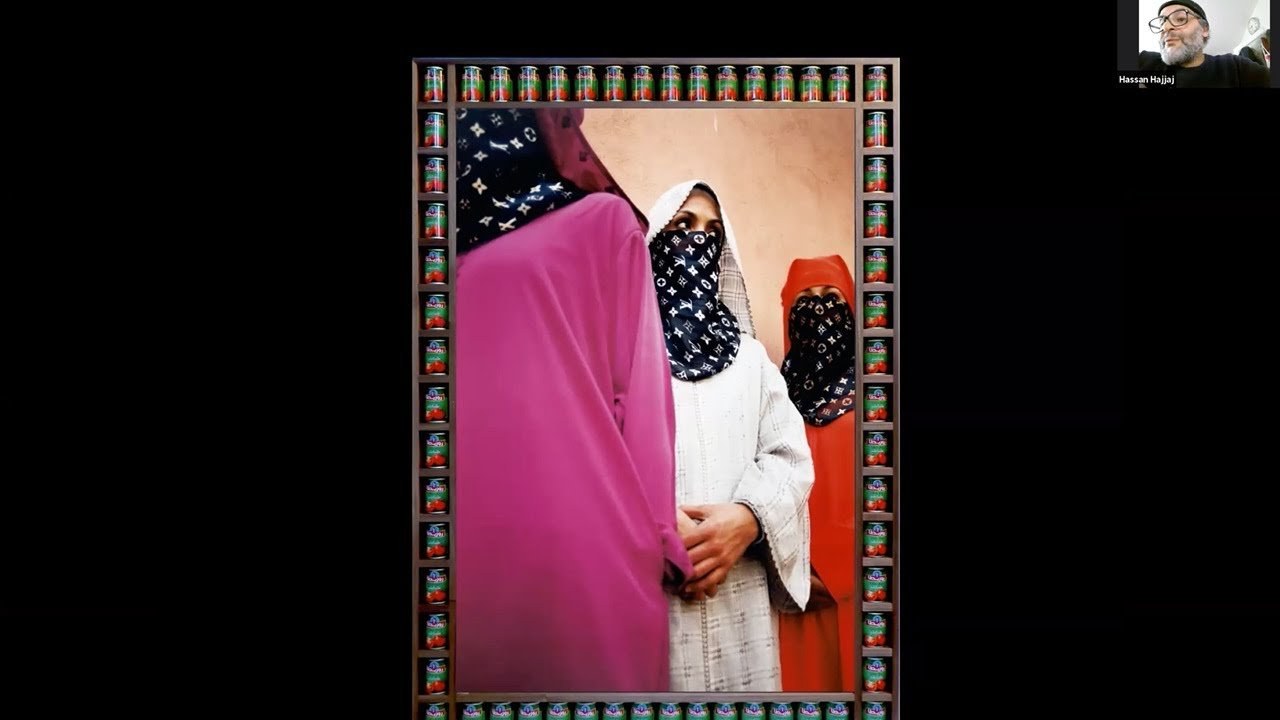
Hassan Hajjaj is a Morocco-born, London-based artist known for his unique blend of graphic design and photography. He is distinctive for his exploration of cultural identity through his vibrant and engaging works.
Hassan Hajjaj
Mixing Moroccan markets with London streets to build vibrant, product-framed portraits
“For a long time, I didn’t want to call myself an artist because I felt that term was reserved for those who fit in a certain box.”
Transcript: May contain minor errors or formatting inconsistencies.
It's time now for our fourth and final speaker of the evening originally from laresh in morocco not moscow the artist photographer and all-around creative polymath hassan hajjaj today splits his time between marrakech and london he's well known for his distinctive style depicting his subjects through ornately detailed imagery full of pattern and colour taking hues from pop art in his use of commercial products to build those frames he's joining us this evening for a q a but we'll also be sharing some images of his work on your screens as well so you can kind of have a look at some of his work while we're talking hassan if you're there could you turn on your audio and video there he is thanks how are you good nice to have everybody talking yeah it's a nice isn't it are you you're calling from east london is that right I'm in london I'm at home name I live in camden all right outside north london in my kitchen excellent fantastic and do you also by the way do you still have your your shop in shoreditch because I remember you yeah yeah is it is it I'm still based there I mean everything is closed you know just fighting with the rent with the council at the moment right.
But yeah you know I'm still trying to keep it again because it's a council property so yeah it's it's something that that was affordable but the neighborhood is changing now yeah of course of course yeah that's a big part of that. That's part of london isn't it again everyone I'm I'm going to be kind of keeping an eye on the q a box so if you do have any questions for hassan please put them in there. And I'll try and I'll try and get them to him.
But we're going to just yeah I'm going to start firing some questions and my colleagues will share some some of your work.
But I guess my first question was going to be have you kind of been during lockdown have you been able to kind of create anything I know you were in your studio maybe yesterday but yeah how's that been I think yeah well like everybody else it was a bit kind of a shock adjusting you know and everything else is happening around the world it's very difficult to be inspired but this is also inspiration comes out of this as well I've been really sort of being at home between the studio at home trying to edit some stuff working on some projects keep myself busy so it's been yeah I've been kind of busy but it's you know it's sort of not in the physical way in that kind of way yeah fair enough I think that's probably a lot of people's experience isn't it yes you you spoke to us I mean we did a big kind of interview and feature on you maybe a couple of years ago and one thing that really stood out was you said that when you started out as an artist you didn't really think of yourself as an artist even when you had your first solo show you still didn't kind of identify yourself as an artist I guess like why do you think you didn't think of yourself in that way.
And then when did that start to change well I think because you know when I started doing photography I was just doing it for myself I didn't have any sort of education in it I've had lots of artists around me that. Actually studied and learned the craft and history of art.
So I think feel I was worthy when I was shooting at the beginning and also trying to understand my craft and what I was doing and that was only happened along the way while I was shooting and you know started printing the work and showing it. So it kind of it was something more to do myself I suppose confidence and also to see if it was just a one-off thing or it's something that was long-term so I allowed myself to just keep trying and just see what was inside me and to see what's you know what I can you know what kind of work I need to put out there. So it took me a couple years you know.
I think it was about a year and a half and it was a bit of an uncomfortable word in at the beginning and do you remember was there like one specific time that you really thought okay yeah now I've kind of made it I'm allowed to use that word about myself yes I think well the one I've done my first show I think was in the 90s one of my first shows in marrakech and I remember after the opening we had like a dinner and you know with the gallery people and she was introducing me as a her artist and every man then I'll go to and whisper I'm saying I'm not an artist and then I keep saying this but she's kept saying this is my artists up for what if you want me to be artists that's fine I think my first time that I enjoyed I suppose saying or being an artist when I had to pull my phone from for my passport because occupation I never had an occupation prior that.
So I didn't know what I would put as occupation so writing an artist was a great moment for me that was a the moment I remember yeah it must be a great feeling that first time you put that in a box I guess like one thing I kind of mentioned in the introduction was that you split your time now between marrakech and london and yeah. I was just kind of wondering how that. Actually works on a kind of I guess yeah like a yearly basis or a monthly basis how often are you there how often are you here chaotic I'm going back and forwards normally a few weeks there a few weeks there it's quite chaotic because when I come to london I've gotta catch up.
And I'm busy and then when I get back to marriage the same thing. So it just doesn't stop but you know. I have a rhythm going I follow also my instincts and what's happening at the mo at the time.
But yeah I mean it was soft always seems it works itself out it's just to say it's just kind of you're always busy that's the problem you know you arrive there. And it's like you have to catch up and slip straight back into it I always say when I go on the plane going to market I'll take off my london hair I'm going to put my moroccan hat on when I come back I have to do the same yeah I can imagine you get different things from each city right like different inspirations from being in london.
But then like I'm sure going to morocco yeah you get different every day yeah I mean all my work is probably from between the two places you know without one I don't think I'll be doing what I'm doing so it's definitely all my influence is coming from growing up in london you know born in morocco growing up in morocco you know two different cultures languages and stuff like that. So that had really big part in my work you know that. That's for me when I see my work I see a journey you know like so you know because I'm working artisans like for example this picture here I bought the fabric I think in london because I wanted to look like sort of like football material then.
I had it made in marrakech by a you know a tailor and then set up the shoe the shoe is the same. So it has a journey of of my of you know of myself and the images I mean one thing that you kind of touched on. There is like I guess just how amazingly multimedia your work is and you you kind of don't just do photography or just do art you kind of genuinely do like I called you a polyglot but you know you do garments and furniture as well I mean how do you decide what medium you're going to work in I guess on any given day are you kind of waking up in the morning and saying it's going to be it's going to be fashion today what does it what does that work it took a while I mean you know you're looking at these pictures like these pictures from late 90s for example there's this picture the fabric I bought in brick lane had it made in math taking the picture and in marrakech I mean sometimes it could be a textile it could be you know the person it really depends and it sort of I suppose coming from a background not having studied art I didn't I suppose I had no barriers you know.
I think sometimes with some artists you know because they go and train us specific craft in the sense that you're a painter or photographer and they end up sticking to this I came from I suppose from a different route and I took the risks and I've really some time I've been on quite sort of you know I'm getting away with so much work and put furniture into the art world or a clothing item and stuff like that.
So I've been really getting away with a lot to add my work into the arts in the art world.
But it really doesn't as I say it really depends on on everything it could be that job it could be the person but you know the end of the day is the person. That's important to me in the image interesting we're kind of obviously looking at a lot of your work on screen right now. And it is just absolutely amazing I guess someone put a question in the q a it's since disappeared but I think it's it's worth asking is about the custom frames I mean you've obviously you've become known for them they're such an iconic part of your work when did you start playing around with frames and putting products in frames like that well you know my earlier work in early 90s it was a body of work I call graphics from the souq and basically I shot pictures of all arabic products like very local and very known products and I printed them up then photoshop was new had everything in photoshop I'm printing them on canvas so it looks a bit like a painting and that was an installation with the salon you know using all the street objects and really I didn't see it at that point it was more like just to show to my friends growing up in london you know morocco wasn't so cool in the 70s and 80s so I wanted to share some some of my stuff to my friends who into graphic designs or graffiti artists with designers and on and on.
So that was in the 90s so when I decided to show my photographs I instead of having the picture of the product in the you know in the picture I wanted to actually use the product and in the 90s it was very difficult for photography to be in the fine art well because it was still new it was still misunderstood it was still there's a bit snobbish to her. And I thought this would be great to to start with this I found you know sadly enough the the products communicate to people sometimes more than my photography they see something familiar and also they see different layers they find they find something new and also I'm using this kind of repeated you know mosaic things that we have in north africa so he's playing around with this as well and also sometimes I play with the pictures so you know like for example growing up in england they say look at that chick or he's looking beefy so sometime I would use the beef spam around the guy's pictures or you know the chicken spam around the girls pictures because of that sexism words so yeah. So really.
That's how it got kind of grown and as I just said people sort of known about that and sadly enough to say sometimes people come and mention the count before the picture that must be slightly annoying I guess yeah no no all no because it means you've got their attention you know you're not gonna please everybody so wherever they seen it it's and it's been good because even kids you know it's familiar to most people and stuff like that. So it's kind of worked for me in that kind of way yeah it makes sense any when you I guess are looking for these these objects I mean are you thinking is there a kind of you said there's a bit sometimes a link with you know the kind of the person the subject matter of the photo sometimes there's a link in terms of the product there there's obviously a clear link between the colors that you're using around in the frame as well how are you picking these things and putting them together with with images you know it's like that word you know does the egg come first of the chicken I mean be honest with you you know you know when when I came living in england I always remember wearing this very bright green jumper that friends took the made fun of me being in london because it almost felt like I came from a technicolor country to film noir country I mean the colors when I was doing the early work I had a moment in like in in in morocco I was shooting and then I realized it sucks to myself I was putting something together. And I said oh yeah I remember reading like the blue doesn't go with brown you know.
But in my heart it felt right. And then. I thought hold on forget that just go with the feeling of you know clashing things. So it really could start with the backdrop and then or the outfit.
And then I can work it back to front from there so sometimes you know african boy the athlete he had his own african flags that I bought made into a seuss and because I knew the color palette there.
So I chose something to to highlight him. So it doesn't get eaten up in the colors and then the frame to highlight still the person. And so I'm always trying to highlight the person.
And then kind of work it from there what the what kind of plot. That's going to go around the grand frame amazing I can imagine some of the graphic designers in the in the chat getting getting annoyed about the blue versus brown thing I think we'll have to leave them to the chat for that discussion well you know I don't know if people bring to morocco I'm from morocco and it's you know we're definitely not scared from color so it's definitely coming from that and also probably you know escapism for me you know when I'm shooting you know it's that moment I'm shooting I'm in that world as well you know so though I'm not in the in the picture I'm sort of creating that.
And I'm sort of really sort of in that kind of you know sort of a technical escaping yeah that makes sense I'm going to jump around a bit with the questions because so many good ones are kind of coming in on the q a as well but one thing I really wanted to ask you about is you've obviously you've been called quite a few times the andy warhol of marrakesh and I know that you know sometimes these names get foisted upon artists from the art press and people in the art world. And I kind of wanted to get your thoughts on it whether you you don't mind it or if you find it annoying being having that nickname you know what I don't really mind it it's a journalist that said it in the 80s especially when I was doing my only work with the arabic products totally understand you know I'm using the same palettes the same objects in some ways but then you know you can look at another way you know because it's coming from the west you know it's a journalist from the west is it something that somebody who you know from what so-called the third world country or another space trying to I suppose make their mark in the west has to be always you know sort of mentioned against somebody else so you could look at it that way.
But the most beautiful thing that happened from that I had a friend of mine god bless him rashid taha who's an incredible algerian singer passed away two years ago he saw my work in 2000 and he said the same thing you know andy warhol and I laughed I said russian everybody says this you know when they say and I understand and he looks at me and he said andy well means I have nothing.
So I took that word and I'm creating a clothing label and it's also bar in paris that I designed in 2002 so something kind of was born you know something. That's I suppose came out of it beautifully so you know.
So I have to thank that first journalist who mentioned that yeah actually that sounds like it's had quite a life since then as well since the 80s and there's a lot of questions coming through about your your kind of process your artistic process and one person asks like do you work in partnership with a set designer or a stylist or is this is this all you it's all me I have a small team that helped me like an assistant here and there sometimes I have students come and help me I've shot things so normally you know like for example this picture the outfit she's wearing I bought those in marrakech you know 50 diamonds it's about three dollars each so I knew I had to mix that and normally all my pictures you have to remember for everybody this is film with this picture I've been using ditch about all my pictures are done outdoors they're all done in the street the sun and I use daylight so I never shoot in the studio so every picture you're seeing there's been you know this out in the street so yeah thanks for that what was the question sorry I went on no that's all right it was whether you work with it with the team on these I mean a couple of people have asked yeah is there a big team kind of put together for these yeah I mean this one cardi b I flew the carpets from london to new york that was shot in new york I had my friend evan who assisted me you know to help me to hang the thing and his girlfriend is a you know photographer assistant these ones are done by myself you know the fabric that I bought in in bricklaying this one here had it made in my fashion shop my friend came out in in marrakech the same as this.
So yeah I said sometimes you know. I mean I don't have a set designer I have if you see my space I have lots of clothing lots of objects lots of outfits I'm always designing and making stuff so when I feel somebody you know something fits somebody correctly I will put that for that for that person yeah someone else has asked if you if you make all the clothes and design them.
And I think that's true isn't it most of it like this one with me. That's her shirt the chairs is mine the socks and wine the sunglasses are mine but the shoes are hers so it's not really you know you have to remember I'm shooting sometimes lots of artists if they have something I might just add on you know sunglasses or a pair of socks or something but most of the pictures I'm taking I'm sort of designing clothing like this is again this is all my design the accepted chairs and me. That's her trousers that's hank willis that's all my design for example this is all you know.
This is gillette because I bought old ones in my head I wanted the color palette and the fabric I bought america actually moved it on.
This is fabricable I wanted to have nike against eddie that's this was in I think early 2000 something like that so you know I shot that sort of you know created levers which are traditional clothing outfits in morocco and this is all my design for example this is all my design yes I'm wearing I have I have some people in morocco america who you know make all my this is all my design this is actually part of a body of work called autumn winter 2048 like the future so it's a fantasy such using all the fabrics and cheapest fabrics like all those are blankets that you have all over what so called third world countries and creating that this picture is called now riders these are musicians this is all his outfit I haven't touched him.
So this is a series on glamour which is a music for from morocco sorry because I jones that's my outfits this is again yeah. So lots of stuff I'm sort of buying fabric and that's where you asked me that question earlier on what inspires you it really sometimes a piece of fabric or a backdrop or something like that that happens and then I'll you know go from there fantastic we've only got time for a few more questions but one thing I kind of really wanted to ask is obviously you shoot a lot of celebrities as we've seen you know there's billy eilish and cardi b as well but you also shoot kind of you know inverted commas normal people as well is the process different when you're doing that I mean I guess are you are you approaching those in different way is it or is it fairly similar well let me correct you for that one first the people who said that normal they must not rock stars right the people got me noticed to them to the celebrities I've only been shooting celebrities maybe the last two three years you know I've been shooting for 30 years now just just over 30 years so you know.
I have thousands of images of all the different types of people that I've been showing and the last two three years I've had these you know let's say these situations to shoot these celebrities and I wanted to do it I wanted to taste what's the other side most of them because they like my pictures and I suppose they maybe want to be a part of that world where I've been creating my friends so when I do shoot I shot I shoot in the same way I try not to think of them as being a celebrity you know they they know what they're coming from they know I'm going to dress them up. And I use the same method or what I normally do so I don't get nervous but at the same time you know when you could do it like billy ellis or carly b that was for a magazine so you have to also work out to be professional that it's not just about use you know you want to make yourself happy but also the the person you're taking the picture off more importantly and the client so you have to be you know a little bit more professional what I'm shooting for myself have that freedom if a picture doesn't work I'm not happy with it I can come back to it or not use it. So that that would probably be the difference that's amazing so I keep having to remind myself that I've got to set up another question I keep getting distracted by the amazing infantry in front of me I guess one question I want to ask is like how music has affected your work because it's been a massive part of your life you've talked in the past about how even before you moved to london when you were living in laresh how yeah music was a huge part of your your life growing up.
But then in london as well as a teenager and beyond into into adulthood as well I guess yeah what role does music play in your life now and how does it affect your your work major I mean I'm you know music lover I have a lot you know lots of friends and musicians around me that I grew up with I've been very lucky to have you know to grow up and get turned on so many different types of music from indian music to african and on and on and on.
And it's really even in my work there's a big there's a big body of work with a lot of musicians I've showed over the years some of it I haven't put out there's some few of them are out there.
I also did you know like a piece of film with two volumes with each volume it has nine different musicians so it's been great you know it's almost like being I suppose a frustration for a frustrating musician and I'm using my palette as a you know as a music instrument to join them so so it's a major part normally when I'm shooting a lot of the time I would have a live musician playing during the shoot as well and stuff like that yeah.
So so I consider myself very lucky to be in that you know in that kind of situation wow a live musician as you shoot that that sounds amazing yeah I never thought that would happen and finally I guess like yeah what are you working on currently I mean have we what have you got coming up that we can really look forward to well you know I've had huge shows coming up like everybody everything stops I actually something totally different but I'm using my creative side into I'm doing a t brand that I'm working on at the moment I started working it from last year.
But I'm trying to with the tea brand I'm trying to promote music and other photographers so we'll have a gallery I'm going to start with moroccan photographers especially young ones and the tea I'm going have quite a few friends gonna use their music says basically have an app when you buy the tea you go and happily listen to to a track while you drink the tea so I'm working on that and at the moment you don't know what's gonna happen in the future with it but kind of enjoying doing that stepping aside and still have a creative side but working on the spreads on the product okay interesting wow and one final final question sorry I just really wanted to talk about.
This is there one I guess like you know you said you were maybe taking a step back but but is there one project in particular I guess that you you've always wanted to do but you've never quite managed to for some reason whatever reason like a dream idea that you've had for a long time but hasn't quite kind of come to fruition just yet I think I'm sure you if you ask any artists they probably say yes and probably more than one yeah.
I have there's a couple I mean one I've already done a major body of work which is on ganero musicians which is moroccan music and the whole story is like the you know I suppose the black moroccan so I want to try and tell the story that I've been showing that since the 90s all the masters for me it's also more than shooting it's documenting because by that they weren't getting pictures taken of them and also I also wanted to fuse it with capoeira and capoeira masters which is something I used to practice in the past and to show a journey of these two brotherhoods that one's under islam sufism and one I'm the catholic and to show these two beautiful things that are born like this gems that born in one in brazil one in morocco because I already did a show with them in 2001 like a live show. And it's something that I really want to go back to and and and do something so and again if I do this I don't want it to be just pictures it has to be more literature to be something you know a lot more like of a storytelling amazing I really hope that that happens that would be so so great thank you listen it's been an absolute pleasure and a treat talking to you and thank you so much for everything and there's a lot of questions that I've had to leave in the q a unfortunately yeah we haven't had time to get around to them.
But I'm sorry about that but thank you so much for joining us thank you thank you for inviting me as well you
Latest Talks
-
Will Anderson and Ainslie Henderson
Bringing stop motion sorcery to BBC’s Small Prophets
Watch -
Amber Weaver
How does contemporary type design translate into the wider world?
Watch -
Murugiah
Why you should reject the formula and make art about things you love
Watch -
Marina Willer
Design thrives when you find poetry in the simple things
Watch -
Lizzy Stewart
The hundreds of drawings and writing-on-a-whim that goes into comic novels
Watch -
intra
The rewarding process of recognising the art in obscure everyday life
Watch