
Frances Corner OBE is a leading figure in fashion activism and the head of the London College of Fashion since 2005. She explores the political dimensions of fashion and advocates for social justice within the industry.
Frances Corner
Inside the fight to end exploitation in the global clothing supply chain
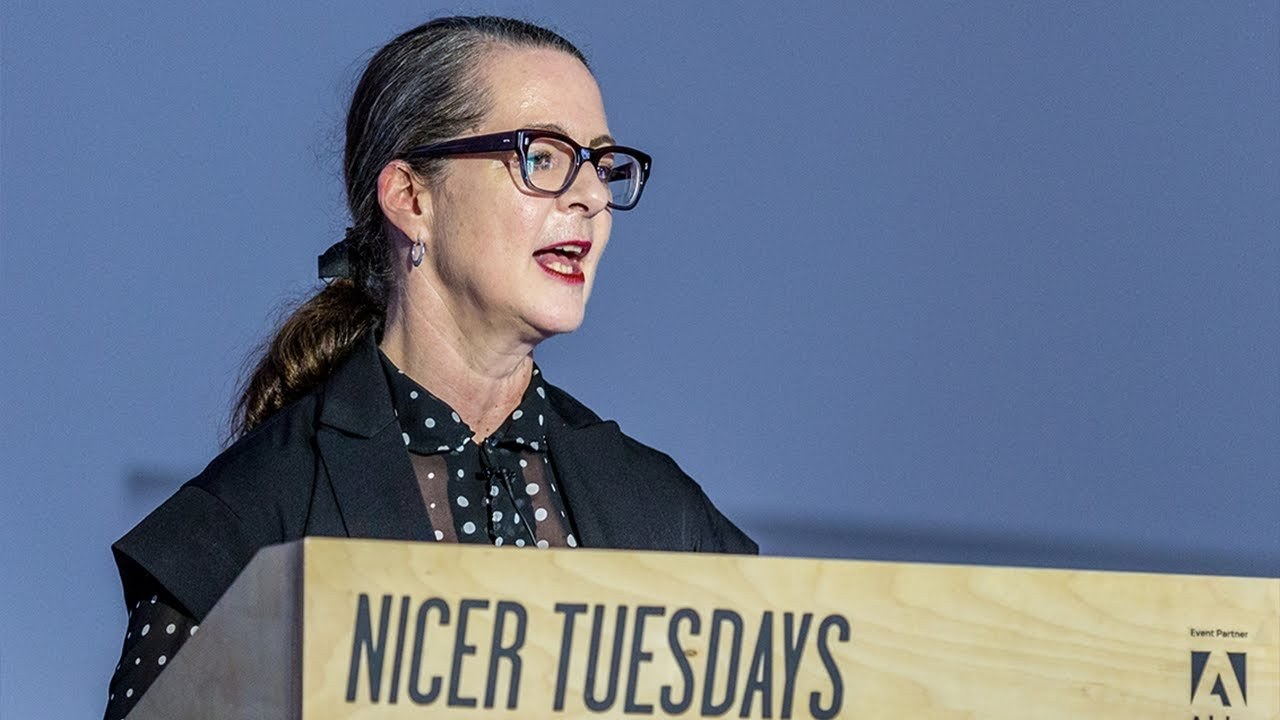
“There are more slaves in the world now than when slavery was abolished.”
Transcript: May contain minor errors or formatting inconsistencies.
Good evening everyone I think when I agreed to give this talk you weren't being faced with a general election.
And I promise not to talk about strong and stable leadership or breakfast or any of those awful things what I what I do I didn't want to talk about political and and I think because actually it's more important than it's ever been not in the big P sent but in the way that certainly we're noticing amongst our students and in a way of quite a lot of communities that we work with the sort of interest in the sort of activism and the need for actually doing something more than just a thought sitting as passive receptors to what is going on around us. And I think it's interesting people tend to think of fashion as being really ephemeral that you know it's something that doesn't really matter but I think one of my missions in life is being the sort of arty the case that that fashion really does and I think it's been really interesting to see how it's being increasingly adopted as a way of making a statement and so you've seen here ruth negga on the oscar catwalk and what she was doing you know you see this beautiful dress alan t know if you sort of follow fashion and know what that's about.
But actually the thing that really strikes with it is the fact there's a small blue ribbon that she's wearing and this is represents the American Civil Liberties Union and which is a nonpartisan not-for-profit organization you know which works for nearly a hundred years to defend and protect individuals rights and at a time when obviously the Trump has been elected and all of those sorts of factors the erosion of women's rights in particular were at the forefront and Ruth and and other actresses were adopting this ribbon to make the point and I think in a way that.
That's what I think for a lot of us we suddenly realize but all of the strives that have been moving a forward suddenly are being turned and we have in some way in our own ways needing to do something about that.
And I think that was the other thing that again you know saying fashions prefer the list you know potentially it's quite ephemeral but what is quite interesting is that sometimes is an object or an item of clothing that begins to capture people's imaginations and obviously what became as almost a joke the idea of wearing these pink hat actually was a way for lots of people to be able to express and challenge all of the things that were going on and that was for men as well as for women and for some people who couldn't actually stand up and articulate what they felt being able to knit to make these hats and to actually wear them was a way of making a political statement I think what's interesting as well is that the VNA has just adopted and bought one of these paths for their collection because it became and to signify such an important part during the campaign with Trump and these hats weren't the only item of clothing we tend to think that fashion doesn't necessarily strike a call.
But it does some of the things that people get most angry about our hoodies Hejaz we're cleaners if you think about the things that. Actually get not just a Daily Mail but all sorts of people really aggressive about items of clothing you think well you know surely we have a right to choose to wear whatever we wish I think one of the reasons again why sometimes fashion can be criticized is because it seems primarily as an industry for women and obviously it employs and majority of the workforce are women are all levels and I feel a little bit more about that later but it's also become the opportunity for a number of women to really challenge and adopt quite a little a political standpoint Vivienne Westwood I'm sure many of you will be aware of us and she takes about climate change and Stella McCartney who you're seeing here from the very outset through the influence power mother refused to in any way use any animal products and that was seen to be very curious when she first started out but now it's accepted that you can have you know really excellent clothes that look extraordinary and her shoes and her bags are known but it's not just the sort of nappa leather that she uses it's also viscose for example so she's planted a whole series of trees to develop a sustainable forest because this goes with one of the worst criterias that you can have in terms of destroying the environment so who she's actually worked with that to ensure that. There is a renewable source for all the Boyd's productions and her business is part of the caring group so caring is a bit like LVMH and this isn't necessarily so well known although they have some of the top brand you know Eve salmon raw Balenciaga you know Alexander McQueen they're all owned by caring and caring have adopted an environmental profit and loss account which means that over the next few years every single one of their businesses will become sustainable at all levels so the environmental profit and loss means you don't just know it manage the profit in terms of financial but what if its water impact what does it mean in terms of energy they even go right back into terms of looking at how the cattle are farmed you know how sheep are produced all of those elements and every single aspect of that supply chain are being challenged and this is really important because you know we are acutely aware in London College of Fashion is essentially a Women's College of the 57 million workers around the world 80% of those the women and we know acutely that modern slavery is a real issue I'm sure that you're all aware that we've with the terrible crisis that we've got whether.
That's to do with Syria or gannis fan and so on as soon as you get in migrating people's on one hand and demand for instant gratification on another you know that. There is going to be the exploitation of workers and that's something that we all in some way as consumers have to take account of and what was quite interesting a couple of weeks ago we had an event at the college on modern slavery asking really what fashion buyers not just those people who go out looking at the factory buying the buying and commissioning the work. But also us as consumers what can we do to help reduce the impact in terms of modern slavery because we know that for example within the UK there are between 10 and 13 thousand slaves and we know that what came out of the talk that we had the other week was that. There are more slaves worldwide now than there were when slavery was abolished there was a terrible article quite recently about people being openly sold in Libya but we need to think about these things when we're buying our clothes if we buy something.
That's really cheap you know that somebody really has been exploited in its production. And that's something that as consumers we have to really put a way up.
And sort of look at those consequences but one of the great things I get for all of this sort of things that are potentially quite negative not only is the fact that a lot of our students are really concerned about this and want to address all of these issues in the supply chain but we've also got activist groups like fashion revolution many of you all be aware of the Rana Plaza disaster that happened a few years ago. And this was set up by a couple of sort of activists eventually it started by saying well everybody on the 24th of 8 portions mark that day by wearing their clothes inside out to show where the label came from and the whole idea of who made my clothes became a sort of vantage point and now you have not just hashtag who made my clothes but who grew my clothes and that idea that if we all understand where our clothes come from who made them then again we can have it be much more sort of responsible and conscientious and conscious consumers and one of the other factors but as a college we've been concerned about is the idea that not just that we ought to be aware and get behind these movements and and in a way use our students were concerned about these things. But also to use the fact that we have all sorts of resources as being within the fashion industry so we work for example with women prisoners to set up a manufacturing unit because the majority of women who go into prison are usually there because of abuse of one form or another usually by men and not only that.
But they have to give up their children that so to come out without a job perhaps going back into abusive situation that you were before but given a job and manufacturing making clothes begins to link things up.
So if we know where our clothes have come from we know what they have been produced we're bringing manufacturing back to the UK essentially we're beginning to make things make a difference and to make to make change and that's one of the things that we work with in a very concerted manner and so in the end you know because I'm sort of coming up to thee for the last couple of words that I want to sort of say this evening is really but one of the things. That's becoming really interesting in all the reports that are coming through about the Millennials and what that means and Generation said community transparency authenticity these are the drivers and as consumers if we believe in these things then that is what is going to change the industry and that is something that I think whatever your creative discipline whatever part of the creative or cultural economy or organizations you come from we can actually be really active and to really give us some great messages and so I hope that maybe some of the things I've said this evening will to to to think about these issues and to encourage everybody to take a stand and to buy responsibly thank you [Applause]
[Applause]
Latest Talks
-
Will Anderson and Ainslie Henderson
Bringing stop motion sorcery to BBC’s Small Prophets
Watch -
Amber Weaver
How does contemporary type design translate into the wider world?
Watch -
Murugiah
Why you should reject the formula and make art about things you love
Watch -
Marina Willer
Design thrives when you find poetry in the simple things
Watch -
Lizzy Stewart
The hundreds of drawings and writing-on-a-whim that goes into comic novels
Watch -
intra
The rewarding process of recognising the art in obscure everyday life
Watch