
Rob Slater is a creative at the design studio Flat-e, known for developing cohesive visual interpretations of music, such as Daniel Avery’s record, Song for Alpha. His work emphasizes a collaborative and experimental approach to design.
Flat-e
Why the future of audio-visual shows never quite arrived, and chasing it anyway
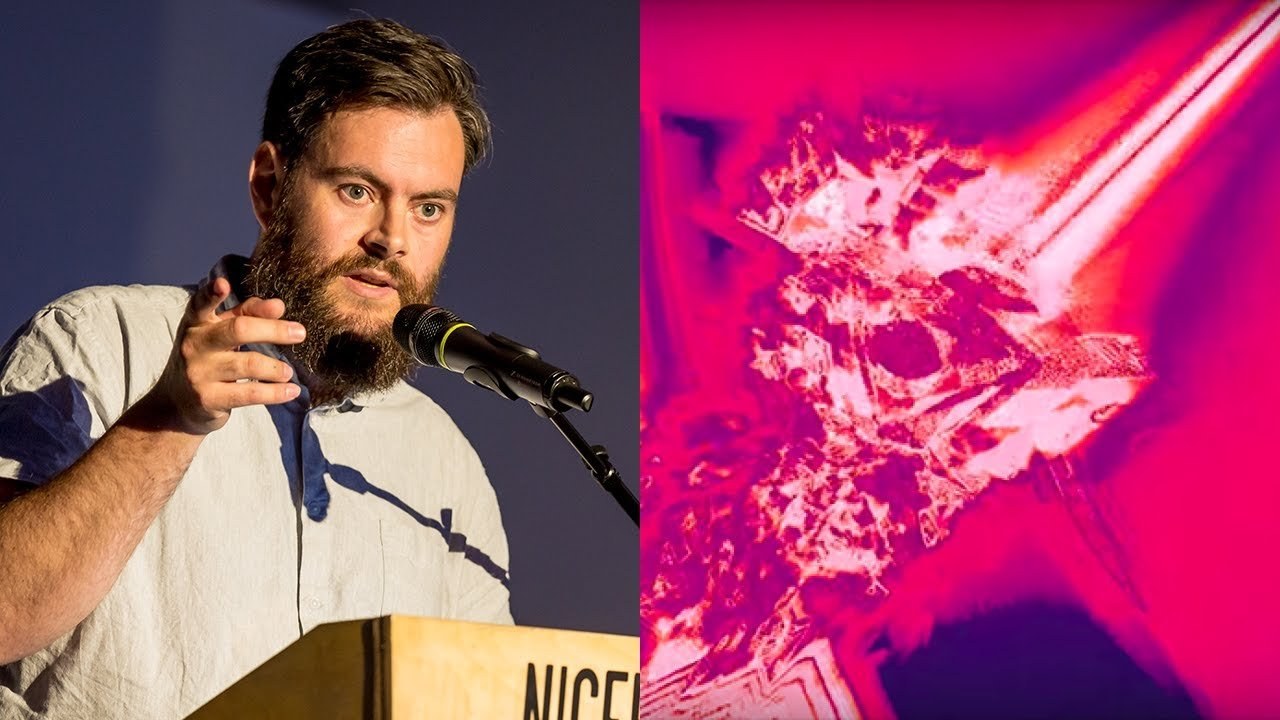
“We sit in a room together and mess around with things.”
Transcript: May contain minor errors or formatting inconsistencies.
My name is Rob I work with Matt Bateman and together we make work under the name flat II man I'm at college about 20 years ago we make stuff like visuals and light installations lots of the work is for musicians live shows but we also do music videos public installations and what people who seem to earn more money than make all experiences we started out doing visuals for people and what records artists like James Liddell LFO Clark and ain't fixed when we did some audio-visual shows called what works at the Royal Festival Hall.
And then started working for other acts and also doing work outside the music industry anyway there's a few clips of our work [Applause]
so basically the work mainly comes from sitting in a room together and messing around with things nothing complicated or futuristic just exploiting those interesting visual phenomena that happened sometimes and then refining them later after the initial messing around we just refine the process until something reveals itself and this example is basically just using a the surface of a TV to reflect light onto the inside of a glass open your head inside a giant cube covered in projections and filming it reflected in your eye ♪
most of our work starts with computers to generate really crude animations we then use the process of filming them projected onto are reflected in real world objects to create something new I'm really interested in software and hardware that do one thing really well.
But that let you easily connect one process to the next so you end with a daisy chain each adding another element to the overall effect but most importantly for me it's it's that there's an instant gratification so you can change one of those elements and see what you've manipulated reflected in the final process so for instance you can have a little program that all it does is make little animated lines nothing special really crude you can then use another program to play that out onto a TV and then you film the TV through a substance that distorts the image like a bubble in this example to create something interesting although the chain can get complicated each a process along the way is simple and understandable which is my preference so that you can your manipulations is what I'm seeing rather than any any delayed gratification in something like huge render times or something like that.
Anyway it's a little bit about our process I'm here to talk about some of the work we did for Dan Avery's album song for alpha he was really into the idea of creating visual work to accompany the album these would be used for music videos visuals for live shows printed work or to use for someone off shows with custom lighting setups interestingly also wanted to them to be able to be viewed together in one sitting either at the cinema or YouTube or Saturn or whatever.
And I totally love this idea because when I was a college and then after in the early 2000s I remember there being lots of things that seems to be pointing to a future where you'd go to the cinema and watch like an audio-visual show or there'll be TV channels that will be solely dedicated to audio-visual stuff for the launch of what visions DVD in around 2004 I think we did a tour in theatres it started with everyone watching music videos and visual experimentations on a big screen and then the screen rose up to reveal this massive rave and everyone jumped over seas and went and listened to people like Jem Liddell and Richard Devine watch the visuals on the screen and I remember thinking this is the future the future is gonna be ace and we're going to embrace like audio-visual stuff anyway fast forward to 2018 in it it's very clear that no one should ever listen to any predictions I make because in reality MTV does show stuff called Teen Mom to Facebook see in the Internet and the cinema mainly shows films about spaceships and fly men but but regardless of that I loved the idea of creating a cohesive set of visuals that could be viewed singularly or together or used in interesting ways we want to make visuals that explored the concepts of hope emerging from fear euphoria from dysphoria positivity from negativity or more broadly just light emerging from darkness the music is really hopeful and to me timeless so we we didn't want to make the visuals look modern or too threatening nor did we want them to look too clean this allowed us to create processes that would distort and degrade things for some of the other videos we had a daisy-chain of a camera recording an object playing back on a screen another camera recording the objects and so on. And so on until you'd basically duplicate the image six or seven times go straight in a really natural degradation creating a totally different final image from what we started with some of the early experiments involve revisiting old techniques and also looking at previous work to remember the things that came up on those previous projects that maybe we didn't have time to explore I think there's an obsession with the new at the moment that we've always tried to avoid we try to make work.
That's basically a continuation of our last project I really love the idea of trying to master something that you know you can't because every turn reveals something new to explore this is a really simple test using one of the prototype LED screens for a previous project it was to explore the idea of adding processes to convey a simple idea like light emerging from darkness the final visual could just have been a simple digital animation pulls him from Bright to dark but I think you'd lose the physical manifestation of the light so in the end we just recorded the animation on a physical object in this case an LED screen and it forcing light into a room which made that real ♪
this is another test to create a basically an autonomous machine that could create light and darkness using a VHS player so we ripped the back of a VHS player and then we got a cheap moving headlight the kind you see in clubs with even beams of light around and we gaffer tape to a metal ruler to the end we're then connected to a computer and programmed it.
So it would chop up and down and make contact with the metal magnetic contacts of the VHS players at this store in the image and what was really interesting about this technique was that you could program really complex and fast-paced edits but with a little physical robot so they're all tests that we did to sort of create the visuals and at the end of the show I'll show you a little edit of the final visuals we made for Dan but before I just wanted to talk about how else Dan's using the visuals for a few of his live shows we've created custom screens and lighting setups so the basic idea is we don't have to go back to the drawing board we're reusing this stuff that we lovingly created that we really like and done really likes but just giving it new life by letting it be shown in a different formation so you may go to add an Avery show where it's projected on a cube above him just on a screen or he's within a load of layers of screen but fundamentally you're seeing the same visuals the same idea and aesthetic so you're you just know you're a done Avery show.
Anyway thanks very much for listening to me going about that I'm just going to show you a little ♪
thanks very much [Applause]
Latest Talks
-

Will Anderson and Ainslie Henderson
Bringing stop motion sorcery to BBC’s Small Prophets
Watch -

Amber Weaver
How does contemporary type design translate into the wider world?
Watch -
Murugiah
Why you should reject the formula and make art about things you love
Watch -
Marina Willer
Design thrives when you find poetry in the simple things
Watch -
Lizzy Stewart
The hundreds of drawings and writing-on-a-whim that goes into comic novels
Watch -
intra
The rewarding process of recognising the art in obscure everyday life
Watch