David Shrigley is a British artist known for creating distinctive 2D work on paper, often characterized by a wry sense of humor. He has been isolating himself to produce art for over 30 years, finding inspiration even during challenging times like lockdown.
David Shrigley
Why a blank page is no excuse, and other lessons from lockdown drawing
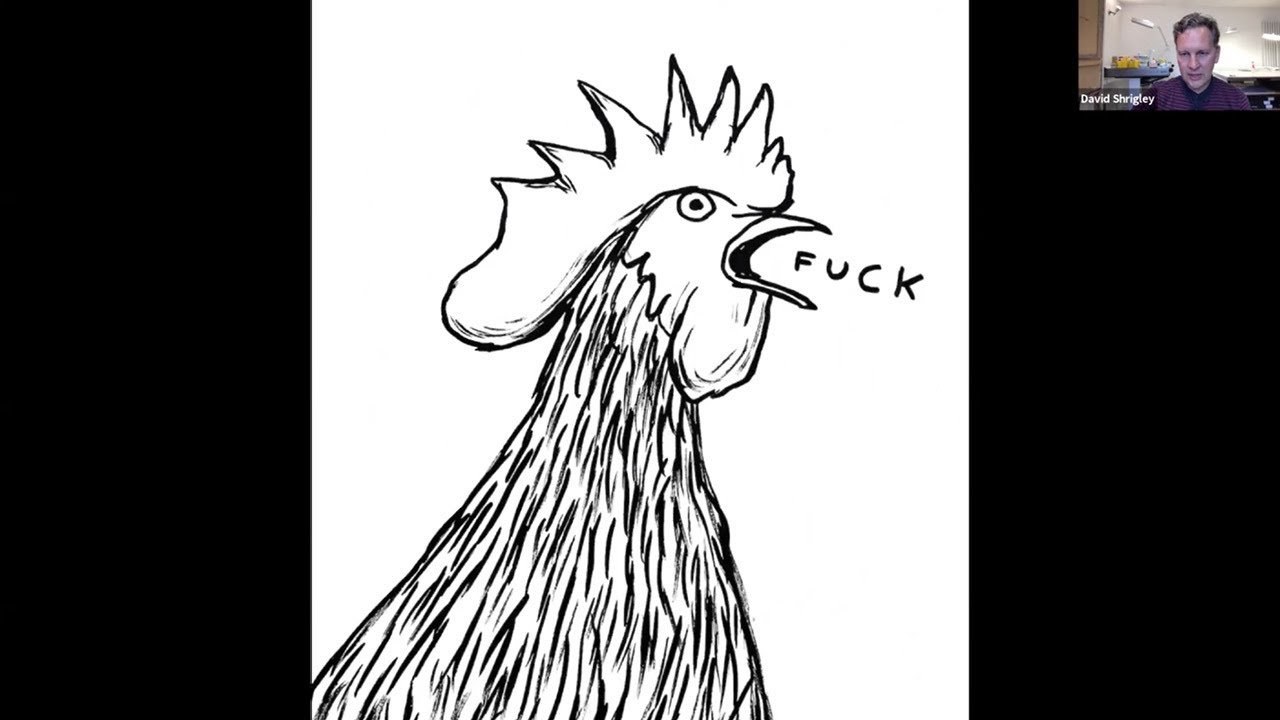
“I only ever make an artwork once. Except when they get lost in the mail.”
Transcript: May contain minor errors or formatting inconsistencies.
For okay it's time now for our fourth and final Speaker of the evening originally from Macclesfield British artist David Wrigley is well known and loved for his drawings that sardonically comment on everything from politics to modern life we're delighted that he's joining us this evening to talk through basically what's been keeping him busy during lockdown and David please turn on your audio and video when you have a second hi there how you doing I'm how are you well good thank you yeah no very I'm just an amazing amazing Freeza but I've been listening to you you're now in Brighton is that right how's everything down there alright yeah I've been I've been in Devon because I live in Devon most of the time and my Studios in Brighton.
But I just found out yesterday that I could have come here whenever I like because it's totally fine to travel hundreds of miles and basically do whatever you like doing lockdown so who knew convenient yes and well listen I'm gonna let you and take over the screens and do your presentation.
But yeah I'll call kind of catch up with you in 1012 minutes guys people with questions on the on the question group as always. And I'll try and get to them okay.
So I'm gonna share my screen and then I'm gonna play my presentation it's all good that looks perfect we're in alright good all right well I am basically maybe disappointingly just going to show you what I posted on Instagram Jerian lockdown I I guess it's the topic of the month isn't it lockdown what did you do during lockdown how're you coping with lockdown how are you gonna cope with lockdown.
And then there's the other questions that come along which are and will you make a small video of your studio on your iPhone and and let us see that which I've been us to do about about 12 times now and which I probably acquiesced about half the time but basically I work from home.
Anyway so my activities as a visual artist have always been pretty homespun because I'm so the best known for making 2d work on paper so just being isolated in in my house was is actually something I kind of embraced because it's sort of like what I do anyway. And I I've been making I guess I've been working on drawings at home for probably about 30 years like ever since I left art school when I first left art school I I started drawing as a central part of my practice which it kind of had always been I just didn't realize that you were allowed to just make drawings it turned out that you are so I made I made drawings and I published books and and then over the years I guess I've sort of become that become that guy that does that think and and Here.
I am so I had I don't know seven hundred sheets of paper I took with me to to the house in Devon. And I've kind of used about half of them now. And I just every day I make maybe 10 or 15 drawings and it's I guess the nice thing about lockdown just going to flip through them maybe not talk about them is that there's no you'd have to do anything anymore so there's no trips planned you're not going anywhere to do the exhibitions to visit art fairs to to do talks or this that and the other.
So I was supposed to go to so to go to Hong Kong and Tokyo in New York and the lien and Copenhagen and several other places I can't remember but and then the rest of you know that the rest of the year was pretty busy as well a lot of traveling and then.
And now I have to go anywhere in fact you know I thought I wasn't allowed to go anywhere but as I said before. And we were misunderstood we are allowed to do whatever we like during lockdown to hell with the consequences and for those of you who are not familiar with the current state of British politics anyway forget about it so drawing for me is quite a kind of meditative process in some ways it's very something I've done my whole life I don't really I don't know I feel like art school was a bit of a blip for me I I've just been making drawings since I can remember in drawings with text and and then I guess you learn how to draw formally and I went to gloves of school of art and that sort of changes things a little bit.
And then I I guess I found out about and Marcel Duchamp an Andy Warhol and I think it's that changed my thinking about our a little bit. But in terms of physically what I've done I've always made work in this way I'm in my 50s now so as he changed a lot over the years well I've changed a lot.
Anyway questions I get asked a lot are you make funny art don't you and how do you deal with being funny or whatever if it's supposed to be funny and I say I yeah and and they say you add the text first or the drawings later or other things you can you draw is another thing that they asked me I don't know the change the answers to those questions change depending on what mood I mean I've been come acutely aware of the importance of social media I think in this situation because I guess I've always been a bit of it was a bit of a late starter I was kind of forced to do social media maybe ten years ago by a publicist but more recently I started to embrace it and understand the possibilities of it that is Instagram this is this kind of like publishing I mean I I started I was forced to do social media by my publisher and and I kind of realized now ironically that social media is these are the form of publishing and it sort of has become almost more important than publishing making books there's only a lot easier than making books and as we as a previous speaker just said yeah books are fraught with the possibility of a disappointment when you get them back from the printer and they printed all wrong nice thing about Instagram is if you do it wrong you can just delete it put it back up again so that's good one of the interesting things about Instagram is that I guess more more recently in maybe the last four or five years I've started to allow other people to do the editorial process for me or to at least have the final edit of my work for exhibitions not for books I get to do that and for Instagram mostly but for exhibitions for commercial exhibitions which is how kind of how I make a living mostly selling original artwork and let other people decide I'll let the galleries decide because they've got to sell the work.
So I edit them a bit I probably make an exhibition is usually about 40 or 50 drawings and to to get that many I would do at least probably maybe between 150 and 200 black-and-white drawings and then I take away the ones that I really hate and then. I am left with the other ones and I I let them decide the ones that go in the exhibition and they never choose that the brilliant ones behind me in the studio I'm you can't see it right now but when I click off the screen well there's a there's a there's a sign that says really good drawings that nobody wants and I was telling my friend about this who's also an artist David Belling and we were out school together.
And I was saying yeah you know. I was get sent the inventory periodically I get sent inventory from the commercial galleries that showed me and they I'm always really surprised that they've got the really good drawings are left because nobody wants them.
And then the ones that they've won are usually the ones with cats and dogs in them. And in a way Instagram I guess you know you can sample the public enthusiasm for your work through the likes you get it for any individual drawing and I always find it I find it quite mystifying actually. And I think I posted this drawing today on the cat and I don't know it doesn't actually seem that popular and like all the other toys I've done cats and dogs but maybe maybe the numbers will come up soon.
So I'm gonna stop sharing stop sharing I won't stop sharing I would just stop sharing my screen I'm always willing to share and yeah.
I think I think that's it I try it in my mind there's a little clock that's counting down from 12 minutes and I feel it's probably I've got about 15 seconds left am I correct in that something like that.
That's it's all good don't worry we we can go to some questions from the audience and there were quite a few so and yeah I'll ask you a few questions if that's okay and I love the idea that there's a cat and dog ones go first through the calories can't think why and the first question is from Sarah and she says how many iterations do usually make of one idea is it like one and done or do you kind of redo an idea hundred times to get it perfect I do it once only once unless as happened recently parcel force lose the package with all your work in it in which case you have to do it twice but generally it is once and it would be nice for a representative and parcel force were watching this because I really would like that back that parcel I don't unfortunately think we have parcel force on our on our audience lists often but we'll try and let them know.
But yeah that is highly annoying so that's the only time you'd ever do something twice well you know there's coffee spare spills you know unless you know the dog will walk over things but even then I tried to you know make the foot prints into the artwork you know. So it really it is I really tried to do it once because it's hard doing it twice I think it's hard really hard yeah trying to fear someone is just realized in the chat that there's an entire package full of your work somewhere in the country that probably wasn't it out exactly and I think everyone wants to know this to be honest I'm sure you get asked it a lot. But is there a place where you get your best ideas I mean is there a specific time of day or something when you you know I guess like when you find you're at your most creative is there a time of day or a place that you go now right now. Actually when I had my dinner I'm on this special diet where.
I have to eat within a eight hour period and then. I was sixteen hours of not eating and and so yeah I'm eatin my dinner at about Hoppus five which means I can have my breakfast I was nine in the morning so yeah but Havas five the nutrition will start to wear off at about nine o'clock so that's when I stopped but yeah but between harpus five between 6:00 and 9:00 let's say so I'm giving you a very valuable time right now you're giving us the very best yeah the quality time you know where the you know the it's functioning well and not that you have to be grateful for that but you know what I'm also saying is it doesn't get any better than this so you know don't go to a conference don't go to a talk of mine but there will be any more talks and that's before before 6:00 in the evening otherwise it's not gonna be any good I'm very pleased that we've got the best of you thank you so much for giving up the most valuable part of your day and another question do you still get a blank page anxiety and someone's asked and if so how do you overcome it well you know the answer to that question obviously whoever asked that and you cover the page with stuff and then saya tidak spurious so David Lynch does isn't it anxiety disperses you cover the page and the anxiety disperses and yes that is it's not a flippant response that is that you know the the artwork doesn't make itself you have to make it get on with it and stop being anxious fair enough that's a harsh word for everyone out there and finally just one from from an art student I'm you kind of touched on art school as well. And this person asked was there any point in going to art school and would you recommend it I guess there she's just yeah just said she's an art school student and not sure it was worth it potentially well I think it's worth it if you've got 50 grand to chuck away I think that's the problem you know I I feel as if it is possible to have a a good education outside of school if you're studying fine art I think I feel like I could give somebody an education in my studio kind of thing that would be as valuable as you know in terms of tuition that would be as good as art school. And that's not being arrogant I'm some Oracle of wisdom it's the fact that you know art students in big classes they don't get any way to work they don't get access to tutors they don't get access to workshops very much. And I think that being a fine art student I couldn't speak for other subjects but being a student a fine art you can you just have to be in a studio with some other artists and have somebody who perhaps has more experience than you come to talk to you now and again to just to talk to you about what you're doing there you talk to them and that.
That's what fine art is and it's not worth 50 grand to be 50 grand in depth or that I don't think I think but it's a valuable experience because you get to spend time you know time doing your thing discovering what kind of artists you want to be what kind of art you want to make and I think that's really valuable education is very valuable but I left art school without any debt and the people who are my age in there you know this time of life now probably the majority of people who are watching this I've got a huge debt to do with their education.
And in the UK in the other parts of the world obviously they have to pay anyway.
But I feel very bad about that I feel like I want to you know it's a question that we've talked about with friends colleagues a lot about how can we change this and to wit I you know looking at universities saying they've got a massive black hole in their finances and I'm sort of like okay you know they give them their money back just drop out I don't know.
And it does very cynical and I you know but education is massively important I just feel like it's become a business and it's not about educating people it's not about you know with saddling young people with massive debt where we shouldn't be we should be letting them have a free education and encouraging them not just exploiting them yeah yeah and final question for you before I let you go there's obviously a great sense of humor and sarcasm in your work do you perceive art as a medium to spread messages about politics and society but in a kind of lighter way that I guess gets across a message in a in a different more nuanced way I've never intended to make any particular kind of hour but you know I guess my works about everything and anything.
But I think that you know the idea that there's political art non political art is it's a misconception I think any any artwork even if you're making abstract painting that can still be political because any artwork is about communication with other people what politics is is the relationships between people as soon as you bring another person into your world become it has a political dimension so with you whether you call it you know party politics or national politics or whatever you know we all make political decisions every day about every day of our lives and those people who say they aren't interested in politics just basically misunderstand what politics is you know what we call politics is just an extension of the interactions that we have every day with other human beings so yeah my work is political but so is yours fantastic David thanks so much and yeah it's been great talking to you and thank you for your presentation as well and
Latest Talks
-
Will Anderson and Ainslie Henderson
Bringing stop motion sorcery to BBC’s Small Prophets
Watch -
Amber Weaver
How does contemporary type design translate into the wider world?
Watch -
Murugiah
Why you should reject the formula and make art about things you love
Watch -
Marina Willer
Design thrives when you find poetry in the simple things
Watch -
Lizzy Stewart
The hundreds of drawings and writing-on-a-whim that goes into comic novels
Watch -
intra
The rewarding process of recognising the art in obscure everyday life
Watch