
Craig Oldham is a renowned British graphic designer and author known for his distinct work that spans film, television, art, and retail. His most recent book, inspired by John Carpenter's cult classic They Live, serves as both a case study and a celebration of the film's cultural significance.
Craig Oldham
The hidden art history and activism buried inside a cult 80s film
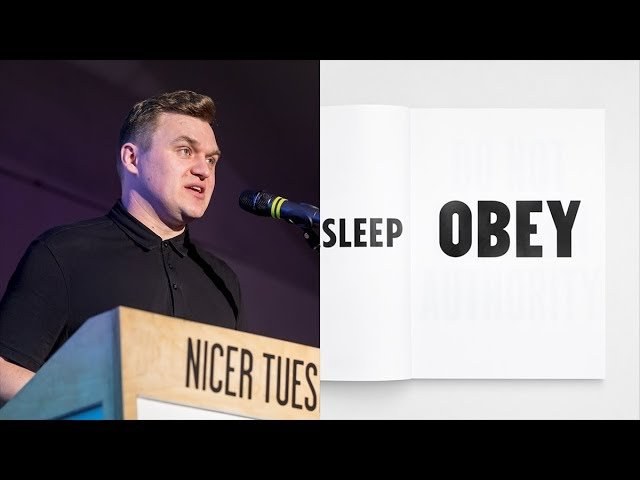
“I wanted to celebrate the fact that these films have a life of their own.”
Transcript: May contain minor errors or formatting inconsistencies.
The obligatory readjustments now here this I feel like I should sing you a song hmmm already swore but I'm just gonna solve breathe into the microphone so you can't hear anything and give you a couple of minutes to read this. That's blinding light I can't see a one of you I swear quite a lot it's my fault not yours you're on you're listening but I realized that some people don't really like swearing so this is probably not the talk for you you may as well just Dodger at the back there it's you know get an early night or something yeah.
So I'm gonna swear at you for a bit just cuz I Congress there's a big lie pointing at me.
But yeah I've sort of done one of these before. And I talked about a book I did on the - right. And it was it was good it was fun wasn't in a big room like this with big lights and lots of people.
But I'm gonna sort of rainbow rainbow I'm just winds here right let's go I'm really uncomfortable to hear this Pew thing it's like some sort of religious sermon. And if any of you read the news today you know it's not really good to be in this kind of position is it.
So I that is why I'm feeling very uncomfortable so I'm just gonna rattle on.
And then we can all hit the booze so I'm Craig I have a sort of schizophrenic existence I sort of run my own gig call the office of craig some of our creative I can't think of a better name and that which is my own name I'm hardly prince summer and I mean I generally just operated this kind of graphic designer doing all that kind of Monday the graphic designs have to do you know around and branding and like that you know it's work for sake let's not pretend it's anything it isn't he's work.
And I also sort of I mean we do grappling you know we do a lot of books would do a lot of exhibition design and stuff like that which is Terry's fault I've got to mention Terry it's shaking his head I mean obviously here's me because it's your fault that we do a lot of that Terry used to work for many wins and wins and wins that he wants to do exhibition design so I got some exhibition briefs and he did one then off somewhere else and now I'm just stuck doing all these designs for exhibitions I didn't want to do it first place but he's a lovely lad sorry and rough story books yeah is over there there's Nina my partner in crime behind a desk full of books really good books I see so you know get over there and yeah it's sort of been going about a year.
Now I think Nina told me today. And it is just trying to sort of do something different in the world of publishing so that's kind of our remit really through working with amazing people who haven't maybe they've got an idea and they want to do something.
But they can't find the right place for it or people keep saying that's great but I'm not going near it we are the people you should come to if you have those kind of thoughts but I mean this is one of them which is an idea I had which I sort of sat on for a long long time because I thought if I told anybody that they won't let me offer me pyjamas you know I'll be in the asylum for the rest of my life but Nina didn't laugh and that was you know that lots of people.
So I'll support me through it. And this is Epiphany edition.
So I am going to talk about one of these books which is the latest one but it's actually an idea for a series of books which I'll try and explain it in the best I can because it gets a bit matter but essentially the idea is to create a series of books that don't exist they are fictional books that appear in films as props as kind of super props where a character or a certain scene a book appears and then suddenly the film completely changes and we wanted to make those books real so I'm sure you've all sort of seen films where these things happen I mean the ones up.
There is sort of Beetlejuice on the far side then dark or The Shining and then Monday which came out last year and they're all kind of films where something happens when this soft printed artifact comes into the world of that film course. And we wanted to give them to you to the real world.
So the first one is actually on John Carpenter's they live now if I could see runs which I can't I'd ask who's seeing it. But I don't know.
So I'm just gonna pretend some of you have the least amount of you have and some of you probably haven't got a clue what I'm on about if you are one of those people I'm very envious of you because I love this film I mean it's as this poster looks and I'm just gonna sort of play your little clip where you sort of essentially the the epiphany moment in the film where this book appears just if you like sunglasses misses for you ♪
what's your problem I said what's your problem the lizards are among us.
So that's just a clip from the film where this where the protagonist who is a former pro wrestler called rowdy roddy piper he's 30 years old he wasn't he was released in 1988 so it's a xxx fun averse er II essentially and this is the sort clip the still from the movie and this is what the actual book looks like so the designed is essentially replica props from these films and the reason for that is I'm you know beyond sort of doing something that feels to me as a film nerd you know just something I really wanted to have like an artifact from that kind of world that can with it embodies that spirit but to celebrate the fact that these films have a sort of life of their own that they not only draw on culture on the time that they are made and you know they draw on their politics and the sort of the world around them.
And then they go out into the world. And it's completely unknown when film comes out who knows what it's going to do who knows what impact is gonna have on all of us or what things it's going to change or where it's going to sort of go on its journey and I love that because here a lot of films they have this of weird culture around them. And this was definitely one them.
So the initial saw book as I said it starts as a replica where we you know got as serious typographically in all going on trying to find these things or read dodges trace and we just cheated half the time I'll be honest with you but what I want to talk about essentially is I mean we even found the spread which if any of your printer production design the production design on this film he actually chopped up he must have been a lazy he just bought two separate magazines and glue them together. Basically.
So it's like Time magazine on the left and then something like Scientific American on the on the right if all that do but the reason I love this film it's not just because you know I wanted to do this. And I thought it was a nice idea there's a lot of rich stuff going on this film. And that's kind of what interests me about it so much yeah I love John Carpenter yeah.
I think he's really and 80s and kind of action b-movie sci-fi and I love that.
But there's a lot going on. And it's actually a really person and valuable kind of film that we have that we need right now.
And I'm just gonna sort of talk about a couple of the sort of threads that we've pulled out of this film to sort of show you the culture that drew on. But also the impact that it's had and the first one is obviously the commands are sort of a really striking visual sort of aesthetic that drives the whole film these subliminal commands that have been pumped out to us for all kinds of media by these aliens were called ghouls in the film well get to in a minute but these commands draw on sort of conceptual art from the fifties and sixties obviously Barbara Kruger you know her work very consumerist very sort of that you know a really sort of paired back aesthetic that's a drawn but there was there was other artists such as guerrilla girls of course that were operating before the film started in like 85 it was coming out in 88 but most of all jenny holzer and her work mainly because of where she used to put her work and the idea of conceptual art was always that it should just be an idea to get rid of the artifact and the object completely in line with what the film is started trying to say why are you buying all this we don't need that we don't want this sort of you know romanticism of the object and the artifact which is art essentially and they draw on that.
But I think is you know it's not a coincidence that all these artists were female and I want to get on that as well but when you see these sort of scenes in the film.
And then you see Jenny Holzer's work from the same time and before I think it's a really kind of obvious kind of distinction to make that those commands in the film are also commands in our real world really that sort of just plant seeds in his head that we think about only completely ends of the scale you know after the film of course it's had another kind of massive impact on Shepard Fairey Shepard Fairey contributed to the book he wrote an essay on how much he just loved the film and he was quite open about where he stall or here for him and he was just you know. Basically a student when it came out and he there's a lovely story in there about him essentially like cutting out all these Andrea the Giant has a posse stickers in his bedroom and he just used to say just put albums on or it watch scared videos already put they live on. And that's he sort of love the idea that commands and that's where that whole thing comes from the fact that he was just really interesting can you just trigger people. And sort of if obey you know obey the giant on the left there if that's his you know most negative piece then his most positive pieces hawk so just to throw that out there.
I found it really interesting these rendered him Obama in the same colors of the alien she's just you know just let that who knows that is not you know we have not stopped getting political so I warn you if you know if you're Tory leave the room this man was in power in America at the time and before the film Ronald Reagan who was America's Thatcher. Basically these this cowboy and I just like to draw attention essentially to the to badges and if you can read the statements underneath them one the one in the middle east from nineteen seventy nine eighty when he ran for the presidency for the first time which says let's make America great again and Keep America great was when he was reelected in 84 and in the eighties John Carpenter the director that's what he wanted to combat he hated the idea of Reaganism and everything he stood for Reaganomics which is his policy of trickle-down economics essentially all yell s let's give all the you know let's give the rich tax relief and they'll just share the money I've never met a person in my life who was expecting a fiver back we go to that bar game a tenner expecting a fiver back and Fergie turn a buck of your first force not I'm a five little pal sherry is it. That's ephod they'd do that they idiot and carpenter didn't like these kind of politics it was all about withdrawing government he was a big believer that government was too big it doesn't need to look after people people can look after themselves let's withdraw all that kind of stuff let's make it really lean and let's just make people rich so it's absolutely Norco instance but I mean every president since this film's been ours been rendered like this by the way and all of those things you know Trump is just resurrecting Reagan's policies now you've seen it you know he's shooting up shop everywhere is you know protection list in the United States all he wants to do is make people richer in most likely himself and that's well. That's just one of the ideas in this film that runs throughout on the surface of it why I think this film needs a sort of reappraisal and why this book exists and the reason that they look like that isn't just a sort of you know a nice little sci-fi kind of trope how can make a cool-looking alien with and silver eyes the the makeup arts you can see in the middle is called Frank and you know his idea was well it's all about greed let's make him look like rotting humans and I love that there's all these tiny little ideas that you don't even have to sort of think about within the film.
But that is an idea.
That's a creative sort of execution that. Actually lets embody these Europe is everything we're here which with a with a very serious danger that could become us that if we accept the greed because all they're doing in this film of the very least scary thing of ice film is not that they're gonna the laws into a sleep so they can eat us or anything like that they just want us to give them money that's all they want and that's probably the most terrifying that we and we sign up to it and he just recruit Inhumans so that very notion I think is really interested in really political he also does a lot to kind of subvert a lot of the popular ideas in Hollywood and popular ideas in film about like the origins of where the hero should come from this is a scene when the hero who wanders into town the wrestler were showed you with the glasses and the only place you can find any shelters on a sort of the shanty town essentially and it's a tiny tiny tiny little scene in the film where his he sort of body on the left there the two backpacks wandering away in the middle on the Left Frank he just says come to justice film you can get you know food and not showers and it's just this sea of homeless people and working poor and you know that you could again you could just let this thing go but justice bill was a real place in LA and it was caught together by a bunch of homeless people who tried to sort of get together a collective to share their money to pull their resources and their knowledge and to educate people and get people off drugs to try and read to get them into a society that was essentially turning the back on them Reagan's policy and they managed to get this this site which was an old kids playground for a dollar a month and they created this community and the Elliott Police were were literally ordered to bulldoze it once a month which they did and that happens again in the film piece that this eye is cleared I'm just spoiling the film for you by the way.
But it was set up by this guy called Ted Hughes who was a sort of preacher but he was also an activist campaign and he did lots and lots of stuff he's a really interesting block I find it really weird he's got some sunglasses on his chest but he got rewarded by this character in the film who's the preacher who was a kind of classic archetype sort of you know blind preacher who can see this you know the 80s folks and that idea of homelessness you know it's it's everywhere working poor people who you know I work in three four jobs just to try me just to triumph and shelter we're living in you know temporary accommodation it's it's with us now for lots of reasons and I think you know the film is really interesting because of that and what it.
Actually how it portrays women John Carpenter is more you know he's been operating since the sort of you know mid sixties and you can check through his sort of back catalogue every single film if a woman isn't the lead character they have strong female characters within it. And it's really bizarre I mean he's most known for Halloween Jamie Lee Curtis or you know the fog which is a dream Bob or you know.
But there's strong characters in all of his films throughout perhaps only the one isn't the thing.
But I don't who knows maybe the dogs for you male but this is meg Foster and meg has a quite a small sort of role in the film.
But it's really really important and it's actually really subversive because in the film like and in in eighties like all you saw and all you see now really is if you watch any kind of action film we're people on horseback or caroling in a car chase it's always men always men and John capita didn't like that but and worse more so like they were always invincible you've watched any our Schwarzenegger film one punch they never get all sit.
And it was like the vanished and he just didn't like that. And I think that's part of what the character the eve does with this and and she she serves the purpose in the film she just completely undermines the main character the whole way through it tells him he's stupid you know he makes up these half-assed plans that she just parks all the holes in him and there's a great line in it where he sort of Chinese trying to get to put the sunglasses on saying you know have a look have a look you'll see don't you understand that she's like no I understand you tell him here you find the forces of evil that nobody can see we are some sunglasses and then she throws him out of a window it's a great film but you know he there's so many subliminal ideas in there about unpicking all that kind of hyper masculinity that kind of toxic stuff I mean one of the best lines ever I'm sorry I will do this like those was talking about like Alice Watts know Sylvester Stallone jean-claude Van Damme these were the only blocks that were allowed in action films in the 80s one writer once said that artists were saying a lot like a condom filled with hazelnuts but that was not you know that was the sort of toxic thing that they were pumping out to us through film.
This is what men should be like this is what men should look like lo and behold in the 80s is a massive gym careers and everybody's pumping iron in you know giving it that one foot in the trunks and it was this film just completely on pix it and shows you how stupid and vain it all is mainly through this it is the longest fight in film history if you've seen the film you'll know what I mean I mean it's it's only about it's around six minutes which don't sound that long but feels like six hours honestly and that's because again because there's an idea in it there's a subliminal idea it's like this is the same thing that makes this fight good is the same thing that makes that fight at the end of Bridget Jones good that's how blocks fight they don't not Jackie Chan do you know.
I mean two blocks outside pub it's not one kick and they're gone roundhouse floor nah it's not real and the same with ease these two really big guys going at it.
But they stop they get out of breath they laugh at each other they start talking and then they just cut keep carrying on it's just the most bumbling action you've ever seen in an action film.
But there's a point to it there's laws of ways you can read this film this this fire within the film lots of people say it's about sort of you know it's about gender which it could be but there's also like in American politics in American history you know it's a white man tried to tell a black man who's oppressing him and there's a lot of ideas in that as well which is you know obviously in America quite a hot subject but it just serves to undermine the action hero because he he strolls in there and gets his ass kicked and he bleeds and he's bruised and he limps and he hasn't got a plan and he comes from a different background to any other action hero you ever see so as I said the book is a replica John Carpenter the director wrote the foreword for it and he talked about why he wanted to make this film about why he loved sort of B movies from the 50s and how they could actually tell a story.
And I think that's what I really love about what he says in the vial of film in general particularly kind of genre filmmaking is we need a filter to sort of look through to see the world as it is it's really hard to talk about a lot of these subjects it's really hard to talk about for in homelessness and sort of why people are dying and film gives us a sort of an entertaining filter to sort of look at those things through so you can see this film as a action sci-fi film from the eighties and it is and you can enjoy for 90 minutes of that but you can also dig a little bit deeper and you can you can see what it says of our society that we're all part of still 30 years on. And I think that's really interesting and a lot of the contributors that had something - they all saw picked up on that as I said that mentioned Shepard Fairey before he he did a piece in there John Grant as well the musician he wrote about john carpenter's music and about how that's as much a character in the film as anything else even though he hates it which is quite funny actually.
But I mean if you've ever listened to John captures music I mean it's probably more famous now for these music than his films but I mean a lot of used to where we call it dooms in if you have a like if you like electronic music that gives you the impression that someone's about to come behind you let you throw up you'll love his work we also involved brand ilysm who are a sort of odd hacking collective a bunch of street artists will go around and they change advertising in the public realm and pour their own stuff and they talked essentially about how this film was inspired like thousands of street artists to sort of go out there there's also a piece from the philosopher Slav rzz who is if you don't know him he's just keep bonkers and he just just just talks about the fight that's it.
That's all he's interested in why are they scrapping and his life's about ideology freedom is painful heavy solid as Terry would say yes Terry Hugh and so I'm just gonna sort of just show you a few spreads from it really.
And then I'll off it's our book supposed to talk about the designer sorry but I'll get back to you we we designed is a replica prop but obviously you want to see four pages in the thing so what the hell are we going to do so it's about trying to sort of capture an aesthetic of what it was you know the intention. And sort of give the film's presence over in a kind of printed form that might do it justice so there's a lot of I mean it's a magazine technically so I'm trying to design a book that behaves like a magazine but still a book and using a lot of sort of high gloss material and then all the contributors are on sort of a really high white gloss and then when I get into a piece talking about those sort of bigger issues like feminism or about sort of the politics and the time he switches to black which is again that playing with the film's ascetic when you put the glasses on everything's black and white off everything's cool it's a bit like a reverse Wizard of Oz and all these things and there's a lot of sort of political kind of material in there in the sections there's a lot of research and film kind of artifacts mabini from how they sort of built those kind of aliens in their kind of world there's also a massive section on media and how we're controlled by that I mean this as I said and keep sane to you it was med 30 years ago nor internet nor snow nor Twitter none of that bollocks the only sort TV gets it in the neck in this film but you know it.
Basically predicts binge watching and you know we're all guilty a lot aren't we sat there in a state of undress generally if you me. And we also released a saw a special edition then again it was just about every single thing in the design of this book has to have a reason I just can't work any other way because I hate those moments where someone goes oh that's me last what did you do that for and your own answers what it kind of looks nice I hate that it kind of drives me madman Anna used to grill me for like that but so every kind of choice we made a creative choice comes from that world.
So we did a special edition of the film.
This is a scene where he finds this in a church and in all these cardboard boxes are all the sunglasses which he'd Nix and runs off we want so a special edition comes in a cardboard rap mmm which comes out it also has I didn't show you they spy on the film but you know the vendor was at the the news stand he although all the money says this is your God on it.
So there's a sauce certificate with the number on there and a lenticular bookmark essentially the same dimensions so that does the odd thing and again like every idea as simple as we can to just sort of plant you in that world it's you can't really see it.
But that's the point it's got subliminal messages written all the way throughout it which are printed in a kind of gloss UV so you have to really kind of strain your busted eyes to see the thing but you know there's another level there for you to actually engage with the book and try and find out what it's talking about we also had a stupid idea when they get towards the end of the film when they break into the aliens and they you know go in for them all all the sort of commands start to go bilingual and they sort of say things like this. And it's just they saw we had glyph so being a nobbut we I work with the designer called Tim Donaldson who took essentially artistic leap from that we created a typhus.
And in the book there's an essay which is written completely in this alien typeface including all the page numbers all the navigation all the captions they're all in the goulds language and we've got some before tonight we we just sort of let people try and work that out which if you have the patience and a lot of paper you can start to sort of d-chord this if you see the patterns but we've got some special prints and I hear we got the big pimp where there's a link where if you buy the print you can download the font with the thing and you can decode it all yourself but again that just comes from the film and the last thing is it smells like bubblegum we printed with us a scented ink throughout the book oh you laughs does get your nostrils over there. And ice for this reason I have come here to chew bubblegum and kick ass and I'm all out of I'll just leave you with that [Applause]
Latest Talks
-
Will Anderson and Ainslie Henderson
Bringing stop motion sorcery to BBC’s Small Prophets
Watch -

Amber Weaver
How does contemporary type design translate into the wider world?
Watch -
Murugiah
Why you should reject the formula and make art about things you love
Watch -

Marina Willer
Design thrives when you find poetry in the simple things
Watch -

Lizzy Stewart
The hundreds of drawings and writing-on-a-whim that goes into comic novels
Watch -

intra
The rewarding process of recognising the art in obscure everyday life
Watch