
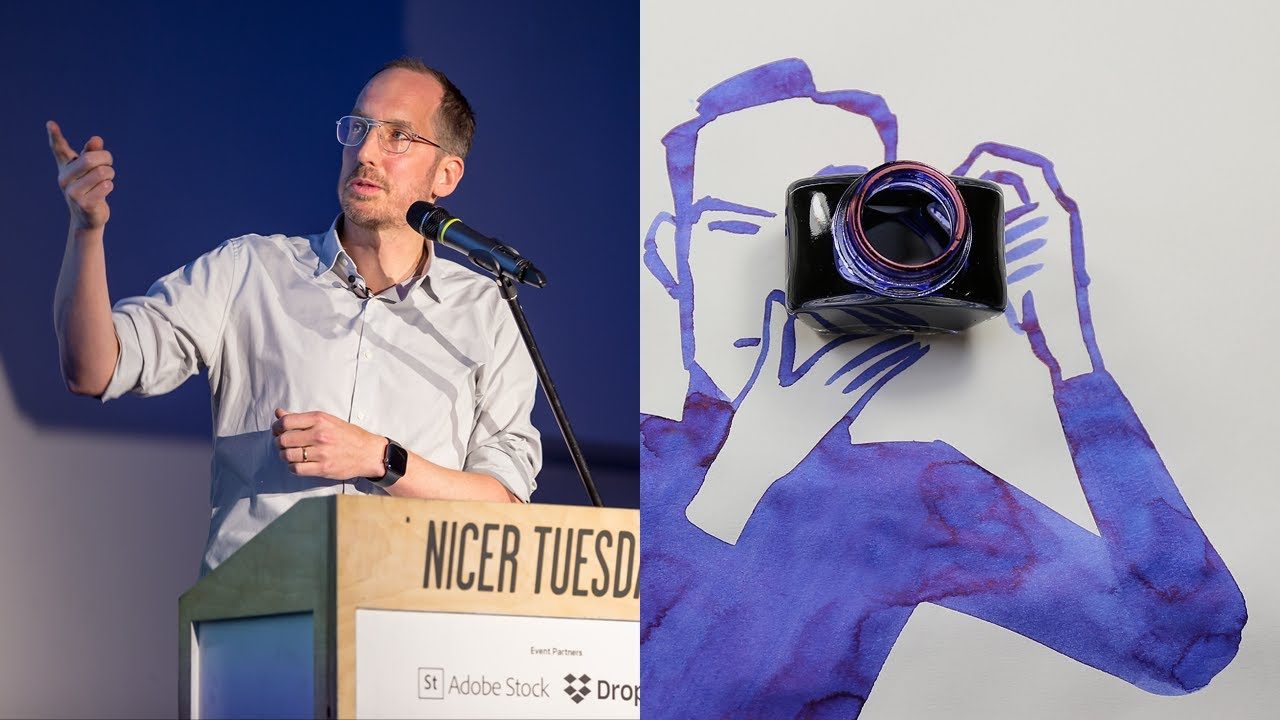
Christoph Niemann
Designing a 20,000-tile mural for Wannsee station that honours Berlin’s dual history
[Applause]
it's great to be back and yeah.
So as mat said today I want to talk about really one project this uh Tile Design I made for that train station in Van and the project started early this year when I got an email from a curator called Ruth she's originally from I think Israel lived in London worked for the British Council and is in Berlin now and she said Kristoff I have a great project for you. And that's the moment where I always cringe because it's nice when people come to us with great projects but usually my experience has been a great project in the mind of curators is often something where they have their own ideas and then they want you to kind of execute it but my biggest fear always with projects that also go out of my usual work which is more print or or or web related is that it ends up being 10% design and 90% emails phone calls you know easing people's clients of course there's a lot of money involved so people have very valid concerns I just don't want to spend my life like that but my wife had worked with Ruth on a on a board of a museum she said she's amazing just keep talking to her.
And then Ruth said what it's all about and as met said it was about redesigning that. And I felt okay the bar is not that that high I might be able to manage it. And so coming up with new images for these walls of this pedestrian tunnel in in vanzi and I I said I would love to do this but only under one condition I want to do the art.
And I'm going to give it my best shot and then you have to deal with the client and dealing with the client means you tell them. That's it if you love it we'll do it if you if you don't love it no problem no money involved but then then. That's it. And I thought that she would give me some push back and say oh but I need you to kind come to the meetings but she said this in my opinion is the only way you can ever make a real kind of artistic project done if you go to clients and say look we want your enthusiasm we bring our enthusiasm and if you know if it meets especially for for a real kind like artistic project you can't discuss that you can't crowdsource it you can't have all these meetings to make it happen so I said yes and the one thing I knew after 5 minutes when I started my design work was that I was going to use tiles because tiles are of course in that Subway station but ties are in every subway station in the world they're relatively cheap they're durable but for me most importantly they were the only material that I had any experience with when it comes to architecture because the one kind like architecture project I had done before was I had redesigned one of the bathrooms in in our house when we moved from New York to Berlin I was afraid that my kids would not like it and they love the New York City subway.
So I I I thought okay I'm going to give you the New York City subway map folded into the bathroom as a tile drawing so I knew that it was possible to work with these and that it was really like making a three-dimensional pixel drawing and I work in a lot of different styles but a pixel drawing is something that. Actually keeps coming back because I love the the ultimate abstraction of it my first book that I published right after school was actually a series of really 32x 32 pixel icons these portraits so that.
That's the art spread here with you know jati malich chisto and so forth so the of course you have to have the the knowledge but it's really about making something as simple as possible and then having the user or having the reader project their own experience and knowledge into an image and this is something where pixelation abstraction I think is is terrific so I I knew pixels and tiles that was the one thing that was said now the project was really it's the tunnel that connects the train station through the lak site in in Van van is the is on the southwest side of Berlin you get here by train or you can take the bike through the woods and then it's defined by up there you see the beach this is really like the the Berlin City Beach and then there's a lot of fancy mansions and and and Yak clubs around the lake it's really known simultaneously for two separate things the one is the beach this is by a famous Berlin illustrator hinr Sila from 1902 a drawing where like this is where berliners go in the summer you hang out a lot of people hang out at the beach and just like have a jolly good time and yell at each other because that's what they do and another thing that you have is you have probably Berlin fanciest Mansions there from the 18th and 19th century and this is one of the most important ones and like so many places in Berlin of course it has an incredibly dark history because this is the place where the infamous van conference took place so that was on January 20th in 1942 when like the Nazi bureaucrats gathered there to really make a cold bureaucratic plan for like the industrial killing of all the Jews in in Europe for me really like the in Century with a lot of low points really the moral low point something.
That's just cold and brutal and this really happened here people gathering for a meeting with with this in unfathomable outcome and on the other side of the L you have the beach this is where people kind of enjoy themselves and these things are sitting side by side and I thought I I can't like have them cancel each other out because the the idea is that Berlin consists of both it consists of this dark history that has not only the Nazi part of course but like even the earlier stuff than the uh the wall the Communist party there are so many chapters of that history. That's in Berlin and of course it's a vibrant International fantastic City and something I really appreciate about Berlin is how it deals with a lot of that past by not hiding it away in kind of far away Memorial where you take the the kids once a year.
But it's really inside the city so these are called Stepping Stones these are little copper Stones they're placed all across the city so we have a few in front of our house so it's a private initiative where people researched to find out who died in that house so you kind you come home with your groceries or you up you're going to a birthday party for your kids and you step over a name of somebody and says like this is the person who lived here.
This is where they died and that's what really keeps them alive and it's it's part of your everyday life. And I think this is a this is a great way to kind of keep the history as part of everyday life another example that I think is incredible is like the wall you know is only still visible in very few places but wherever the wall was where you now have like the city being one you have this scar of cobblestones that runs through the city and it's so abs ract but I think in that abstraction is a huge power because it really weaves it together with contemporary life and with everything.
That's happening so I thought I really wanted to show both of these sides of Vante the historic part and the kind of Carefree beautiful summer day and I started really with the house Dean conference because for me that was the the key part like I wanted to solve that one because for me was the most difficult one to kind is there a way to do justice to that kind of evil with with with an image and the first approach was to kind of use more of a conceptual illustration here with the with that conference table and then the train tracks referring to the trains going going to aitz but it ended up being feeling for me too much like an editorial illustration. And I wanted something that really refers more to the to the actual landscape there.
So I used this image of like two people visiting the lake and then seeing the The Villa and just having this one red window and then the red reflection in the in the lake as a reference to what happened there and for me it was also clear like you know if they like it I I was happy with this I felt if the if the the German Railway would would accept that then I know we were on the on the same page and and they did and from there. And it was It was kind of easy and and to kind of bring the whole thing together.
So the other side was was much more fun and easy so that's really the big beach scene you have all these people and like there's there's the woman slowly submerging people in in the rowo of course the weather is not always that as great as advertised and then in the in the back you have the the skyline of Berlin in the distance max liberman the probably most important German expression impressionist had a house there at Villa vanzi and I turned basically like that painting in the villa into this liberman is also famous for a quote which comes up a lot these days is like he he died in the mid-30s but he saw the rise of the Nazis and it said I cannot even eat as much as I want to puke and yeah I keep thinking that a lot these days and so this is what I love about the abstraction of these tiles is that on the one hand it's abstract it's it's detailed enough that you can tell story you can like show diverse people but on the other hand I think it's so abstract that it allows to viewer to project their own stories and their own identities into the drawing and I think this balance is something that worked that worked nicely and so I did the pixel drawings there were like basically two 1K files the smallest project I've ever done and the Big Challenge was of course now how can I turn these pixel drawings into a real kind of architectural thing.
So I just said okay great we like it now let's go for it we have to order the tiles and so they needed a proper tally of each color and so I really started to uh count tiles and since I kept doing changes to the thing it was it was a disaster because I spent every day I spent three hours like okay I added three red ones and three light green ones but then wait a minute what did it was and then thankfully I I kept discovering a new feature of of Photoshop thank you Adobe which I've never used before it's the histogram you know I used it sometimes of course when you have a photograph and you want to see where like the light areas are but it allows you to count pixels which it was really made for tile designers because whenever I made changes I just had to kind like use the eye dropper and then it gave me a perfect a perfect tally of the U of the pixel size so I gave the drawings to the to the construction people said like go and they started and I think they spent a day or two and they said like look when we leave the job said we're we can't even get in a into a car because we're dizzy by staring at these whole squares all day and they kept making mistakes they kept kind like not really adding them up properly so they said we need a proper a proper system so I built a grid we here with letters and numbers that gave them a better way to define where each each T goes and I have to say I love doing that stuff that's where I felt like sir Norman Foster at the the illustration table and so they had these little they had these little sketches and then they went out there and and and put them put them together and what was uh I didn't have time to go there.
I was traveling a lot.
So they would always send me the the drawings and I had to they would send me photographs and I would always have to check whether it would make sense and then I realized that something was slightly off.
And then called them back and they had to rip out the tiles But ultimately it was actually an incredibly smooth project and what I still can't believe you know especially with you Berlin and the whole I don't know if you know the history with the airport which I think now has been taking 15 years the the first call coming in January and the whole thing was finished completely done in in October and then.
And then considering that a huge Federal Institution was kind of had to give its okay and it's 20,000 tiles that had to be ordered and installed in into the right way yeah and that was that was quite incredible and once I at the opening day it was the first day I could really see the entire thing in real life for the first time and what was strange is that when we work as designers usually the print out or the screen gives gives you a pretty good impression of what the final will be like and when I walked into the space and saw the saw the mural for the first time it looked exactly like on the screen but on the other hand it was so different because it really for the first time felt I was walking in that in that illustration and there was a completely surreal feeling but it it worked and also of course there's no way you can see the entire mural at once because it's so long that you have to kind of keep walking by there.
But I thought like very nice side effect of that was that the that you kept discovering new things and when people kept U kept wandering through it at the opening ceremony they would like stop at things.
And then kind like run back and forth because they had discovered other things but probably my very favorite part was that when you when we look at a screen usually things are at a certain si at a certain distance but with this with these tiles when you got very close it was totally abstract you could not really make sense of what it is it's just color tiles in in kind like beautiful colors and then kind as you zoom out the image reveals itself and you can have this effect by kind of going further away and closer to the wall and have basically the image kind of coming in and out of focus without anything technical happening and yeah.
So this is the the final the final mural I'm very excited that it. Actually came to life. And I'm just going to show you a quick video now that I took just with a gimbal walking along ♪
[Applause]
[Applause]
Latest Talks
-
Will Anderson and Ainslie Henderson
Bringing stop motion sorcery to BBC’s Small Prophets
Watch -
Amber Weaver
How does contemporary type design translate into the wider world?
Watch -
Murugiah
Why you should reject the formula and make art about things you love
Watch -
Marina Willer
Design thrives when you find poetry in the simple things
Watch -
Lizzy Stewart
The hundreds of drawings and writing-on-a-whim that goes into comic novels
Watch -
intra
The rewarding process of recognising the art in obscure everyday life
Watch