
Charlie Engman is a New York-based photographer known for his long-term project photographing his mother, Kathleen, which culminates in a publication titled 'Mom'. His work explores the relationship between familial connections and the complexities of identity through intimate imagery.
Charlie Engman
Photographing his mother until she became something entirely new
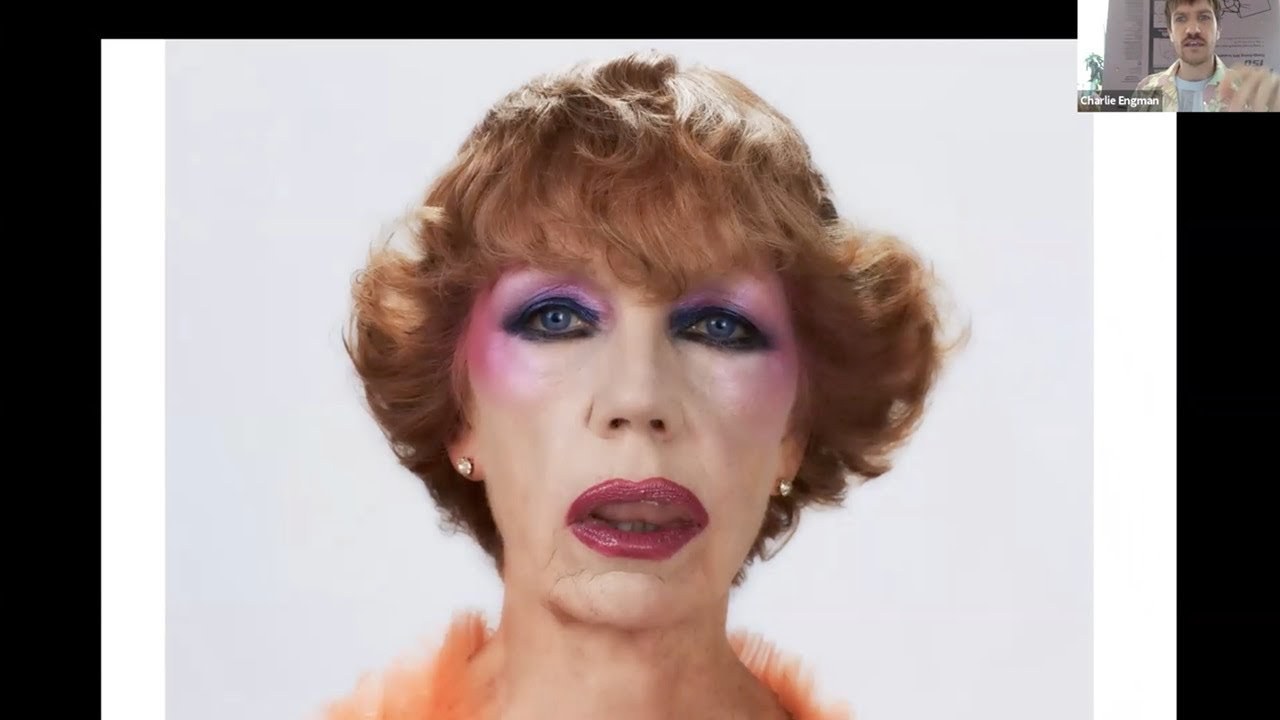
“The more developed that work became, I realised that actually this person is a person.”
Transcript: May contain minor errors or formatting inconsistencies.
Our third speaker tonight is the wonderful charlie Eggman the new york-based photographer recently released a book chronicling his long-term collaboration with his mom Kathleen while the project began organically it's evolved into a fascinating collaboration that questions familial relationships and the power dynamics of photography and Charlie we're very pleased to have you here and please turn on your audio and video so we can say hello there is I yeah we can hear you how I it's I'm still basking in Paula's universe right now. So it might take me a while to like come back to my world.
But I'm gonna try you're talking today about a book. And I think you've got a copy that you want to just hold up and show people and about the book.
And then yeah I'll leave you to do your presentation yeah.
I just released this book. Basically it coincided with the Global Hawk tone and I just wanted to show it as a kind of physical object cuz that's what a book is before I switch over to screams I think you know Paulie gave me a good transition there you know we can have a bit of a push and pull between the screen and the in the real also I think you know I love I it's important to get a physicality and I love one aspect of it is I was in I produced this book in Italy right before lockdown I was in Italy the day literally the day before that whole country went into lockdown and one thing I wanted to do you know a book process at some point becomes quite mechanized and dehumanized certain in Stern aspects and one thing I kind of loved an idea of ecstatic failure so I wanted to sort of even in those mechanized processes inject something where there could be something outside of myself I could sort of abdicate my responsibility as a maker and sort of give choice to someone else so one thing I wanted to do in that sense is I wanted to have this sticker which I don't know if you can tell here.
But it's actually top applied to the book. And I I told the book binders you know you can put it anywhere on the cover so that each cover is a unique discreet object so everyone's own copy of the book kind of is its own book.
And then of course I got the cut and then coronavirus happened and the lock did happen and then. I got the book back and they're all in the same spot so that was a anesthetic failure of an attempt to ecstatically fail which I kind of loved so I just wanted to sort of show that and also like one thing which I'll talk more about that maybe but you know I switch paper types in the book which is something you can't tell on the PDF and just wanted you get a sense of the size anyway.
So this is the book it's called mom and it is about my mom there's somewhere in the audience eagerly taking notes I'm sure like a good supportive mom switch over to my screens and this is just gonna roll through basically the the book from start to finish isn't it yes exactly so it's working yeah.
I think this is working preview you slideshow let's do this okay. So yes so you can see this sticker is not in the same place as it was on my physical book. But that's fine yeah.
So I'm just gonna let this roll and I'm just gonna talk because I'm much more interested in the relationship kind of between images and what goes on through that kind of process rather than talking about specific ideas this is a funny format for me because I I prefer to be sort of reactive and collaborative you know like I was saying it's kind of normally been doing these talks about this work with my mom with my mom because she's a huge an integral part of the work but she's in the audience so that's that's close enough so do please ask a lot of questions and I'm gonna try to make as much time for questions because I think that's that kind of reactive experience is much more a generative that's kind of why I do photography anyways because it's so it's okay.
So this is a book about my mom and with my mom so some basic facts about this book is I've been making this work for over ten years so maybe about eleven years now. And so I started making this work when I graduated from university I went to the University of Oxford in the UK I'm from Chicago originally and I went to school in the UK to actually study Japanese in Korea and while I was doing those studies I kind of picked up photography because I'd always had a sort of creative impulse and wanted to explore creativity but I also had a lot of very different and diverse interests so I figured I should go to university to sort of work through other things. And if I still have this creative impulse I could come and revisit that and and I found while I was studying that I really wanted to still kind of scratch that creative itch and I found photography to be a very expedient device for that it was it was a good way for me to sort of make notes but I didn't really know what this thing photography was so I graduated University my visa in the UK expired and I suddenly found myself back at home in Chicago living on my parents couch thinking oh what should I do and so naturally I was just playing I had this I had a sort of burgeoning relationship with photography and I was taking pictures of everything and anything I was taking pictures of plants I was taking pictures of garbage I was taking pictures of my dog I was taking pictures of myself a lot I have kind of a creative background previously in in dance and theatre and performance so there was a lot of this sort of gesture ideas towards gesture or performativity and I was living at home so naturally my mom was one of the many many things that I was also trying to involve in this sort of a cumulative playful inquisitive process so that's kind of the the basic why and when of how this work started and and I want to make it very clear that you know.
There wasn't an idea of a project about my mom at the beginning it was really an impulse and something that I I wanted to sort of play around with and she and the reason I sort of started to hone in on her is first I kind of started to realize that in the act of actually photographing her. There was something that was very destabilizing and a very kind of exciting and generative and in her energizing way for me you know my mom is someone who I've obviously known my entire life and she's someone I'm very familiar with or at least I thought I was familiar with her. And I kind of couldn't locate her in Scituate her very specifically in my life and all still in kind of general society you know she was my mom and I had ideas of what moms are supposed to be or at least what suburban Chicago white American white moms are supposed to be but while I was photographing her you know that kind of destabilized and unfamiliar eyes that kind of familiarity I sort of see aspects of not only her herself but also our dynamic in our relationship that kind of made me step back. And in question a bit maybe I don't know exactly what's going on here.
So I kind of by having that sort of external action or kind of mediated action of photography I started to realize that. There were certain gaps in my understanding of things.
And so I started photographing her very casually and in fits and starts with no real kind of clear purpose and alongside that as I started playing with other forms of photography and other subjects I I started a career as a professional photographer and my work because it was really at one point very heavily centered on the body and ideas of form and shape and gesture I sort of found myself being led into an idea of fashion photography and into that kind of world. But also other kinds of commercial and another kinds of photography and as I was doing that I started to really kind of hone in on or sort of become familiar or be confronted let's say with the idea of the mechanics of representation that were going on photography you know as a commercial photographer I was sort of given a certain kind of authority to describe value to describe desire that's the job of the commercial photographers to sort of represent something as valuable or as desirable and as I started to do that. And I I you know had all my fingers and all these different kinds of image making and different interests I started to realize how important this idea of context was so how different types of making or different scenarios or contexts of making had different values at different rules for and rules for desires so for example the idea of making a fashion picture is crucially very different from making an art picture or at least we feel that those things are different and I and with this idea of context that also led me to this idea of category or convention so like there's a category for example of fashion photography and I like to think of this metaphor of a box like okay we imagine that fashion photography is a box and you're supposed to put certain things in that box and what can you put in that box where what does that box hold and what can you put in that if you put something in that box does the box kind of give and it expands a little bit like you pushing on the boundaries of the box but the box can hold it or if you put something in just the bottom of the box drop out can the Box not hold that.
So I started to think of all these kind of boxes like fashion photography the box of fashion photography what can you put it into it and maybe if you put this into it it stops being a fashion photograph the box kind of falls out. And it become it has to be held by the sort of art box for example and as I started to kind of rub up against these ideas of categories or sometimes I like to call them conventions and I started to again think about what those mechanisms were and also I started to see these boxes everywhere you know not only are there boxes like certain categories of image making like fashion and art there's also ideas of mom or family or woman or American white middle-aged etc and so I started to sort of pick up catch lifts of these ideas and these mechanisms behind image making in general I mean while I was constantly making casual work with my mom here and there and working with a lot of other people and working in a lot of other contexts I started to realize how special and unique the kind of trust that we were sharing was you know my mom being my mom was really giving herself to me in a incredibly full way and a very unconditional way. There was an extreme amount of trust that I kind of had taken for granted because that's just that was the context in which I grew up and working with other people. And sort of thinking about all these different sort of forms image-making I sort of realized wow there's actually like a huge core here that is very stable and that's a huge opportunity not only for me.
But also for for her and let's see what we can do so I started to sort of think about these ideas of categories and contexts and conventions by using this kind of pillar of trust and as pillar of this individual I have some sort of idea of an unconditional relationship with as a kind of control and an experiment of of category so I you know we have this phrase visual language and I love this I love this phrase because you kind of think language okay. So like what kind of voice does various do various visual these have so for example like what kind of lighting does hard flash have a different light than soft have a different voice sorry than soft kind of shadowy light or is there certain kind of styling techniques or what kind of voice two locations have so yeah my mom kind of acted as this sort of control in these category experiences and I started to try to sort of throw as many sort of contexts and categories and conventions at her as possible so I've cast her in runway shows that I've been involved with she's she's been in TV commercials sometimes I have nothing to do with me you know I photographed her on every kind of angle every kind of photographic technique I can think of you know we've we've really challenged different modes of kind of relationship and the more I did that and the more I was kind of using her as a sort of material or this sort of sounding board or kind of control as I was talking about it I started to kind of realize you know. Actually and and the more developed that work became. Actually this person is is a person this person isn't an inert kind of control or some kind of mute stand-in for various categories such as mom or woman of a certain age or or subject of a photograph or whatever she is a flesh-and-blood human with all sorts of contradictions and complex and complexities which you know beg to me the question of ethics but what doesn't even mean to photograph someone and and also crucially who are these photographs for you know it's one thing for me to photograph my mom and we can have a sort of interaction. That's that's catapulted by that in by that between us too.
But then if I create a book for it of it.
And then submit it to everybody what does that mean and who are these photographs for like what is it what is that dynamic of turning a personal outwards for example so yeah.
I started to question this idea of Authority and the sort of power power dynamics of photography so you know when we have this idea that the photographer is sort of bestowed a certain kind of authority over the represent representation of things that they're photographing so if that's true what are the ethics of that Authority and is it possible then for me to use that authority of an image as an image maker just sort of create more domains of authority so for example can I give my mom a certain kind of authority by by kind of enacting my authority as an image maker like so if I'm putting her in a runway show or if I'm putting her in a commercial or making a video with her or just giving her a wig - where can she sort of react to that in a way that sort of complicates those dynamics and that seem kind of transactional or one-to-one and again what are the ethics then of sort of bestowing that Authority or sort of abdicating responsibility or authority and that I think goes extra there's an extra layer of that once the book.
Now is published is now that there's a book out there. And it's been externalized outside of a personal relationship does that create then extra responsibilities to bear you know now she is this become this sort of stand-in for a kind of general mute mom you know she's not just this individual I understand very intimately and now that the book just came out like I said and obviously it's come out in a context where I'm not able to sort of chase its tail except by online reactions to it.
So I'm very curious to see sort of what the voice and life of the book is afterwards and how that affects not only me. But also my mom and then our dynamics going forward but anyway there's all of these questions about contexts and cathegory and authority that had been swirling around and you know the more I think about it and the more I work the more clear becomes me that. There aren't answers to those questions of you know what does it mean to take a photograph or whatever and at best my work and specifically this work with my mom the best that it can do is sort of create a thing that can hold those complexities and those contradictions and just give a space for those things that kind of happen simultaneously and I like to use you know I love metaphors so I have this metaphor the box but I think there's also a great metaphor of the triangle so you have sort of let's say very easy way of putting it you have me and you have my mom and then you have the point the third point for let's say of this work or photography or I guess this work is better catch-all.
And I like this kind of idea that. There are these sort of died economies or dyads that are going on that sort of seemingly describe fixed end of the spectrum and by adding this Third Point this sort of triangulation you're able to sort of zoom out and look at the entire spectrum and I think there's a lot of different kind of dichotomies going on in the work obviously there's the sort of idea of a parent and a child or an adult and a child and like I've talked about ideas and their authors and subjects or gender so male versus female or the idea of personal versus public abstract versus specific which also like academic versus vernacular institutional versus marginal violence and care you know some of the pictures I did with my mom are very kind of mean pictures and some of them are very caring pictures and that kind of spans the whole spectrum of a relationship so I kind of like that. There are these constant sort of duality is going on and the work is that sort of external position where an observer yeah it's kind of I mean to use sort of highly academic language it's sort of like a tertiary position that absolves the observer or the the person engaging with the work from having to sort of ascribe to either end of the spectrum it can kind of hold the entire spectrum at once I can hold the contradictions that exist there that was a real rambling of a lot of sort of swirling very abstract and sort of also specific ideas going on but my aspiration for the work is that yeah at the very least I can hold a space that can sort of talk about all those juicy squishy questions in a way that can generate conversation generate feeling and yeah and kind of generate more work going forward so I don't know maybe hopefully I left some time for questions I'm much more invested in the questions it was actually amazing Kelly thank you so much I mean just amazing to see you know amazing to see your thought process in that way.
So yeah thank you so much for that. And we do have some questions I mean one was about where we can buy your shirts which I think it's probably very important but let's move on to some other ones and firstly from from Juliette this is one and do you get a feeling of what you want for a final image before you shoot or do you improvise and play until something feels exciting and feels right yeah well yeah that's an interesting question because for me I think I hope what I sort of intimated in my talk is that I'm really trying to sort of do everything at once I don't like to choose you know.
I think it's pretty important for me to try every sort of technique of image making so sometimes that that involves being highly described highly specific and planned and really kind of script out and and kind of moodboard out an idea.
And sometimes like I said that means literally having as open of a an ideas okay mom here we are like I have a camera you're in front of me let's just start and see what happens and be really reacted in that way. And I think for me it's important to sort of constantly kind of live in that spectrum and sort of try to do both as simultaneous as I can which I think is why it's important for me that this became a book is that the book kind of like I was saying at the end of my talk it kind of conveniently holds all those different ways of making and I think yeah for me personally at least it's very important and to do both of those things because obviously you know like paula was saying you know she has this game where how close to the mood board can she get the actual actual fact and as I said in the beginning I love what I like to call it kind of an ecstatic failure I love when the picture doesn't look like the mood board and what is that gap between the mood board in the picture and why doesn't it look like it what are all the reasons that are swirling around the image that mean that it failed and yeah.
So I hope that kind of answers the question yeah definitely absolutely I mean I think you know we there's so many questions in the Q&A bar at the bottom of the zoom and I'm really sorry we're gonna have to really go try it time for kind of one more question and berate I mean Charlie if you do have time you can type in there and answer some of these questions as well I'll do that.
But this the second one comes from that. And I guess your mom is also in the in the chat and there's a lot of love for her at the moment but the question is was your mum did she find it difficult to be completely open to the process I mean wish she always kind of open to the whole thing were there ever moments where that wasn't the case yeah well I I try to make a point of not speaking for her.
But I've spoken to her a lot about this very specific question. And I feel confident and answering categorically know part of the reason that the work happened in the first place is that I just knew that.
There were very little boundaries between us you know we I could ask of her things that I couldn't ask of other people and that was very kind of crucial to the making of the work. And is kind of foundational in the work so no she's a she's I think very uniquely game. And is really willing to sort of give herself to a process and that is a that is a gift and it's something that I think I'm very I don't know I feel very blessed to have that fantastic yeah I mean that who kind of answered the question just put in the chest as well but she thinks it comes across in the photos that.
That's the case yeah well.
This is Charlie thank you so much for everything after that amazing presentation great to see you all your thought process and live like that. And if I could ask you to please stop sharing your screen and then yeah and say mutant stop your video but thank you so much again thank you Matt thank you guys
Latest Talks
-
Will Anderson and Ainslie Henderson
Bringing stop motion sorcery to BBC’s Small Prophets
Watch -
Amber Weaver
How does contemporary type design translate into the wider world?
Watch -
Murugiah
Why you should reject the formula and make art about things you love
Watch -
Marina Willer
Design thrives when you find poetry in the simple things
Watch -
Lizzy Stewart
The hundreds of drawings and writing-on-a-whim that goes into comic novels
Watch -
intra
The rewarding process of recognising the art in obscure everyday life
Watch