
Ben Cullen Williams
If a computer could dance, how would it move?
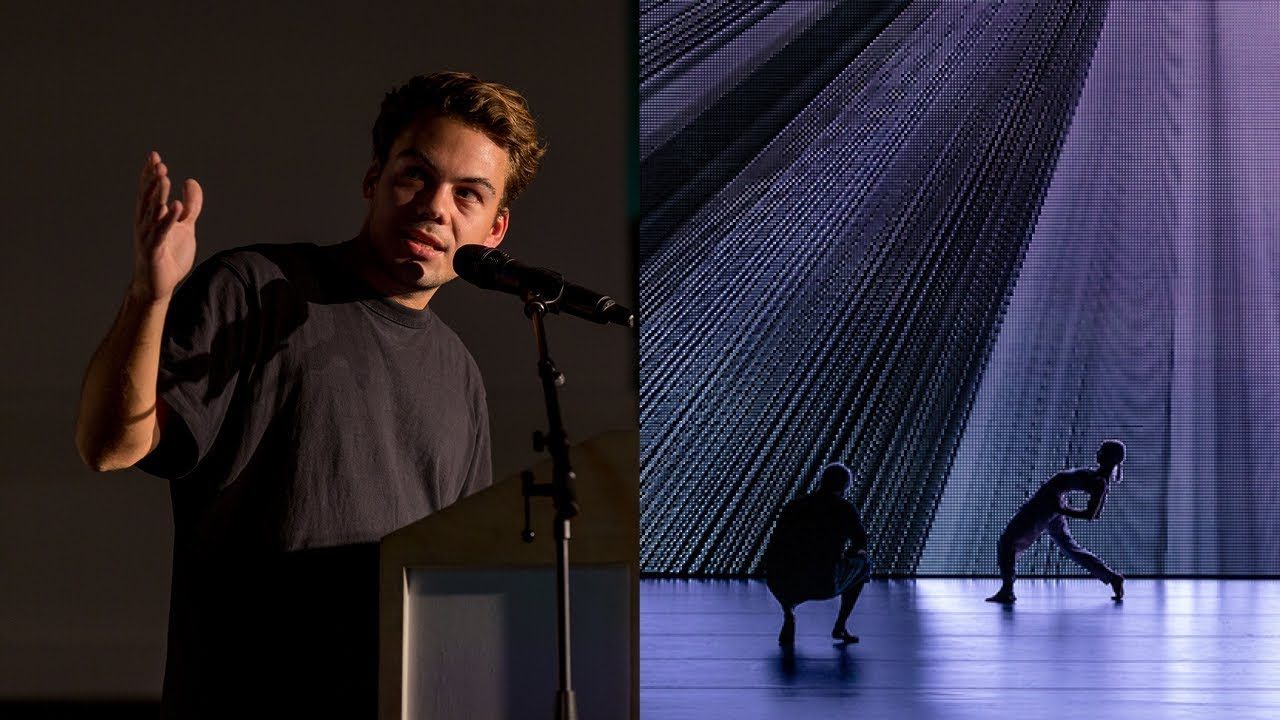
“If a computer was to dance, how would it dance? And this question formed the basis of our entire exploration.”
I was just told by an clicks Studios that patent you can put your notes on keno so I'm holding them in a quite old-school way which is strange so I'm going to talk about AI so you have to bear with me if there's been a rustling for my notes on the on the desk Thank You ventra duction I don't really need to I guess introduce myself but that is that's me and tonight I'm going to talk about a project called the living archive and AI performance experiment which took place in LA this summer the project was a collaboration between Wayne McGregor Google arts and culture and myself I collaborated with them on the video installation which was to be part of the la project is a quick trailer of the work but before I talk about that project I could give you a quick overview about myself and some of my creative practice my work is rooted in the practice of sculpture however I believe that sculpture is the interrogation of our physical world rather than the need for a physical sculpture physical object and so it can kind of manifest in a whole host of ways through my work I aim to create an engagement with the phenomenological elements of the world around us like lights bass form and materials and I'd like to draw on a range of fabrication processes from physical to the digital to help us to help us understand this changing world we live in in this increasingly digitized environment along with my physical work I use photography and film to help interrogate and understand the world I move around in and I travel in this is a project I did a few years ago which was on a expedition to Antarctica with the Explorer Robert Swan which hopefully is going to have another manifestation this year then on a much larger scale I build physical worlds themselves and through my large-scale installations I I aim to create affecting experiences for the viewer that can alter and change their psychological state this is actually an image of my first collaboration with Wayne McGregor and it was a kinetic light sculpture for his piece autobiography there premiered in 2017 at Sadler's Wells and I'm very pleased to say that it's still going strong and flying around the world I think it goes to Asia for a couple of dates and I think it goes to Australia early next year so back to the project at hand what is the living archive this the AI experiment it's a it started off well it is an experiment between studio Wayne McGregor and Google arts and culture it's a tool for choreography that's powered by machine learning which generates original movement inspired by Wayne's 25-year archive as part of the tool it captures the dancers movement it analyzes it then it extends it in real time with original material Wayne's work that was to be shown in LA was created by him and his dancers in collaboration with the in collaboration with the tool and the video installation I was the create was also to use at all. But interrogate and use at all in different and unknown expected ways in order to do this I had to collaborate very closely with the Google arts and culture lab in Paris and this is a real privilege because when I went over there. I was confronted by some most amazing genius coders you know in the world and you know then we sat down.
And we start talking together about what we're gonna do together at the start of the project the tool was outputting movement as stick figures and some images that resembled lifelike forms and along with these there were the start of some abstract representations and as these abstract representations I thought that I felt we really needed to push further and my first question for the Google team was simple if a computer was to dance how would it dance and this question form the basis of our entire exploration my next question was do you think you could make me a 15-minute piece of AI generated choreography you know to anyone else they'd be like what are you talking about of course luckily for me the answer was yes because my plan while working with the lab was to hijack that code and visually output that code in a whole myriad of different ways you see as humans and I'm sure you're well aware of this we have a body and a physical structure that allows us to move and express ourselves you know in only a certain set of ways will always be confined to our human form it's why on this project where we didn't need to why would we confine ourselves to something that resembled a human form we could show movement in a whole spectrum of ways initially we started looking at the aesthetic of the AI Movement code itself this is the code straight from the curve straight from the Python script when we started making the code like environments we started making these environments that the code could react to each part of the body had a different representational node you can see here LH for left hand and L F for left fer and the axis is for the center of the head and also you can see here because the the technology and the AI was perfect the movement of the note moves around the screen and around the space in sometimes a slightly unpredictable way here's a short clip of this of these mood of these nodes moving around the moving around the environment we then went on to investigate the visualizations of the code in a whole series of different ways from dots moving around a screen to animated lines and as you can see here a static type energy that reacted to the intensity of the code depending on depending on a particular time in the movement we then started exploring visualizations I had more of a lifelike quality from soul like structures to forms that had a kind of angelic feeling and this the nodes of the body interacting with the dot matrix you can see here that the it's already have it starting to have a physical organic quality to itself in this clip you can see the generative movement interacting with the dot matrix it's almost an entity being born code made physical our next step was to kind of go back to the original stick images and see what we could do with these and extrapolate new meaning from such a simple simple form and we want to rework these in a variety of ways this image here looks to me like a scrolling typography or a moving landscape just using the simple stick figure you can see on the right that the that the movement of the dancer is being undone by the previous that the one on the left finally we started exploring images that were closer to the human form and here you can almost see the body overlaid the skeletal structure below that was forming the forming the movement of the dancer here's a clip of some of the AI generated dance and what was wonderful about it was some was beautiful that some was actually quite ugly and strange and it was the ugly and strange parts of fascinated me you know as humans we're socially conditioned to understand beauty in a certain way but AI doesn't have this bias and I felt was integral not to edit out any of the ugliness so as not to privilege our own human lens so all of this was moved in all of this was left in all the strangeness all the ugliness all the jerkiness was intensely left as part of the project. So it felt it was a authentic and real for the performance and installation in LA the videos sewn on a large semi-transparent LED screen I felt was important to have a strong presence of technology on the stage almost as if part of a computer had been ripped out of place there it needed to be simultaneously roar and visceral was having a fragility to it much like our own bodies you know that we we have the screen also had a strong presence and lifelike energy of its own sometimes it completely transformed the stage becoming at one with the dancers and on other times the code and the dancers were seen in unison the screen acting is a digital insight into part of the process of the choreography like an x-ray between the two and here in one of the visuals the code can almost be seen raining down on the dancers in other parts of the show we highlighted the seemingly fragile screen exposing the skeletal structure of the screen itself stripping away the light almost like stripping away the skin bring the technology to the fraud to bringing the technology to the form and here finally towards the end of the show one of the dancers standing back and reflecting looking at the AI dancer on the screen as the work drew to a close you know I can't tell you how much I learned through the process of creating this work it was the biggest learning curve of anything I've ever done and as a result it's changed my way that I look at the world. And I believe that it's only through interrogating new technology that we can truly find the right place within society and this couldn't be any more relevant when it comes to AI and the development of AI in our in our day to day lives so I'm gonna leave you wood once it's on the last speaker I'm and leave you one question to think about maybe on your way home we will allow the new aesthetics that AI presents to us to challenge the way we look at the world or will we simply reject them as being ugly and strange thank you [Applause]
Latest Talks
-
Will Anderson and Ainslie Henderson
Bringing stop motion sorcery to BBC’s Small Prophets
Watch -
Amber Weaver
How does contemporary type design translate into the wider world?
Watch -
Murugiah
Why you should reject the formula and make art about things you love
Watch -
Marina Willer
Design thrives when you find poetry in the simple things
Watch -
Lizzy Stewart
The hundreds of drawings and writing-on-a-whim that goes into comic novels
Watch -
intra
The rewarding process of recognising the art in obscure everyday life
Watch